Most of us have a question we would like to put to a group of people. A product manager wants to know why trial users drift away in their first week. A teacher wants to know which parts of a course landed. An HR lead wants to hear what a reorganisation feels like from the inside. A club chair wants ideas for next year. A form gives each of them a score, and an interview programme takes weeks they do not have.
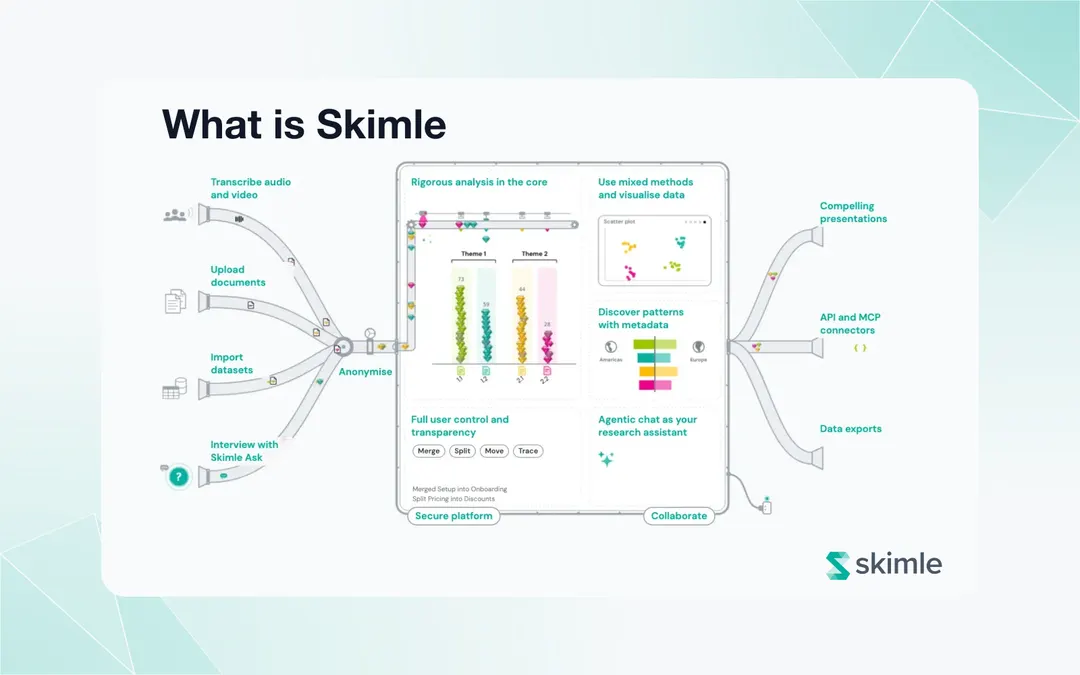
Skimle Ask sits between the two. It is an AI interviewer: you set out what you want to know, share a link, and every respondent has a short conversation in which the interviewer asks your questions and follows up where an answer needs it. The answers arrive in Skimle as themes, numbers and quotes. This post is for anyone wondering whether Ask fits what they need: who uses it and for what, how it works, and where it is not the right tool.
The 90-second film below shows what Ask is and how to use it.
What is Skimle Ask?
Skimle Ask turns a survey into a conversation. Respondents answer in their own words, by typing, speaking or recording a video, and the interviewer reads each answer before deciding whether to ask a follow-up question. You can mix in closed questions such as star ratings, multiple choice or a net promoter score wherever you need numbers, and an open "why" after a low score is usually where the useful answer comes from.
It works in three steps:
- Create. Describe in one sentence what you want to find out and Skimle drafts the interview guide, or start from a ready-made one. You edit it until it asks what you need.
- Share. Send a link, print a QR code, email personal links to a list, or embed the interview on a website or in a newsletter. Respondents need no account and nothing to install.
- Understand. Answers flow into a Skimle project, where the analysis builds a set of themes from what people said, counts who said what and links every finding to the quotes behind it.
Creating and running an Ask is included in every Skimle plan, including the free one. Only the analysis of the answers uses credits.
Who is Skimle Ask for?
Anyone who wants reasons as well as numbers from more people than they could interview by hand. The table below is a quick way to find yourself, and the sections after it show what an Ask looks like for each group.
| If you are... | You might ask... | What you get that a form does not give you |
|---|---|---|
| An individual: teacher, event organiser, coach, club or community lead | What worked in a course, what to change at next year's event, what members want | Answers you can act on, without reading 80 free-text boxes one by one |
| A consultant or strategy team | Expert views on a market, stakeholder input before a workshop, why a deal was lost | Many interviews in the time a few calls take, with every quote traceable |
| An HR or people team | How a change is landing, why people leave, how hybrid work is going | Candid, anonymous answers with the reasons behind the scores |
| A product, marketing or customer experience team | Why trial users stop, first reactions to a prototype or advert, what customers want next | The score and the reason in one place, from the people who matter |
| A researcher | Open questions at survey scale, in several languages | Rich qualitative data that flows straight into rigorous analysis |
| A public body or campaign | What residents want from a new park, views on a proposal | A light consultation people can answer from a poster or a newsletter |
| A developer or product builder | Onboarding questions, an in-app feedback prompt, reader feedback on every page | A conversation where you have a form today, with structured data coming back |
Individuals: teachers, organisers and community leads
A teacher sends a link at the end of a course: "What was the most valuable thing you learned?" and "Which parts worked less well for you?", each with a follow-up when an answer is vague. An event organiser asks attendees for the highlight and what to change next time, with a quick grid for venue, content and food. A club chair asks members what they enjoyed this year and what to try next. Setting one up takes a few minutes, and reading the result takes less time than reading the free-text box of a form. A teacher describes doing this in how a teacher used Skimle Ask to shape a course.
The same goes for the lighter side of life: ideas for a party, wishes for a team trip, or memories collected for a retirement book. This is the use the first version of this post called "Doodle for interviews". Doodle made it easy to find a date without an email chain, and Ask does the same for a question with more than one right answer.
Consultants and strategy teams
Consultants live on interviews, and most projects have more people worth hearing from than there is time to call. Ask lets you interview the long tail while you keep the live calls for the people who matter most. Typical uses:
- Expert input for a market study: trends, the competitive landscape and who is winning, from twenty experts at once instead of four.
- Workshop expectations: send it before a workshop and arrive knowing what success looks like for each participant and what might get in the way.
- Lost deal debriefs: ask a client why they chose another provider and how you compared, a conversation that is often awkward in person.
- Stakeholder and integration views: how a company is seen by partners and clients, or what worries staff in a merger.
Every answer comes back as a document you can analyse with the rest of the project's interviews. See how Skimle supports consultants and primary research in consulting projects.
HR and people teams
People will tell an anonymous interviewer things they will not say to a manager, and a follow-up question turns "communication could be better" into something you can fix. HR teams use Ask for employee pulses (a quick feeling for the week, an agreement grid, then what is going well and what is in the way), exit interviews, hybrid work check-ins, town hall follow-ups and readings of how a transformation is landing. Our guide to HR surveys with AI interviewers covers this in detail, and Skimle for HR and people teams shows the rest of the workflow.
Product, marketing and customer experience teams
Ask is at its best right after a moment that matters: a purchase, a support ticket, the first week of a trial or a cancellation. An app team asks how likely people are to recommend the app, then what they enjoyed and what frustrated them, and the follow-up gets to the screen and the moment. A churn interview asks for the main reason someone stopped, what could have kept them, and what they use instead, which tells you who you are losing to. A prototype or an advert can be shown as a video, so respondents react to the real thing. For running these continuously from inside a product, read always-on customer research with embedded AI interviews, and for a full worked example see the Skimle Ask walkthrough, which follows a garden centre's customer study. More on this group: product managers and customer and market researchers.
Researchers
For academic and market researchers, Ask is a way to collect open-ended data at a scale interviews cannot reach, in up to 29 languages, with answers landing in the same project as the analysis. It does not replace in-depth interviews, but it widens what you can ask of a survey sample. AI interviewing vs human interviewing sets out where each fits.
Public sector and campaigns
A city planning a park can put a QR code on a poster and ask residents how they would use it and what would make it feel safe. A ministry can run a light consultation on a proposal, asking how familiar people are with it, how it would affect them and what they would change. A campaign can ask voters what matters to them. For analysing responses at scale, see public comment analysis for government consultations and Skimle for the public sector.
How do you set one up?
On the Skimle Ask page, there are three ways to start:
- Describe it in one sentence, such as "Why do new customers stop using our app in their first month?", and Skimle drafts a guide with the right question types.
- Answer three questions: who you are asking, what prompted this, and what you will decide with the answers.
- Start from a ready-made guide. There is one for most of the situations above, from App feedback to Lost deal debrief. Pick one to see its questions, its AI follow-ups and roughly how long it takes, and Preview as a respondent to try it.
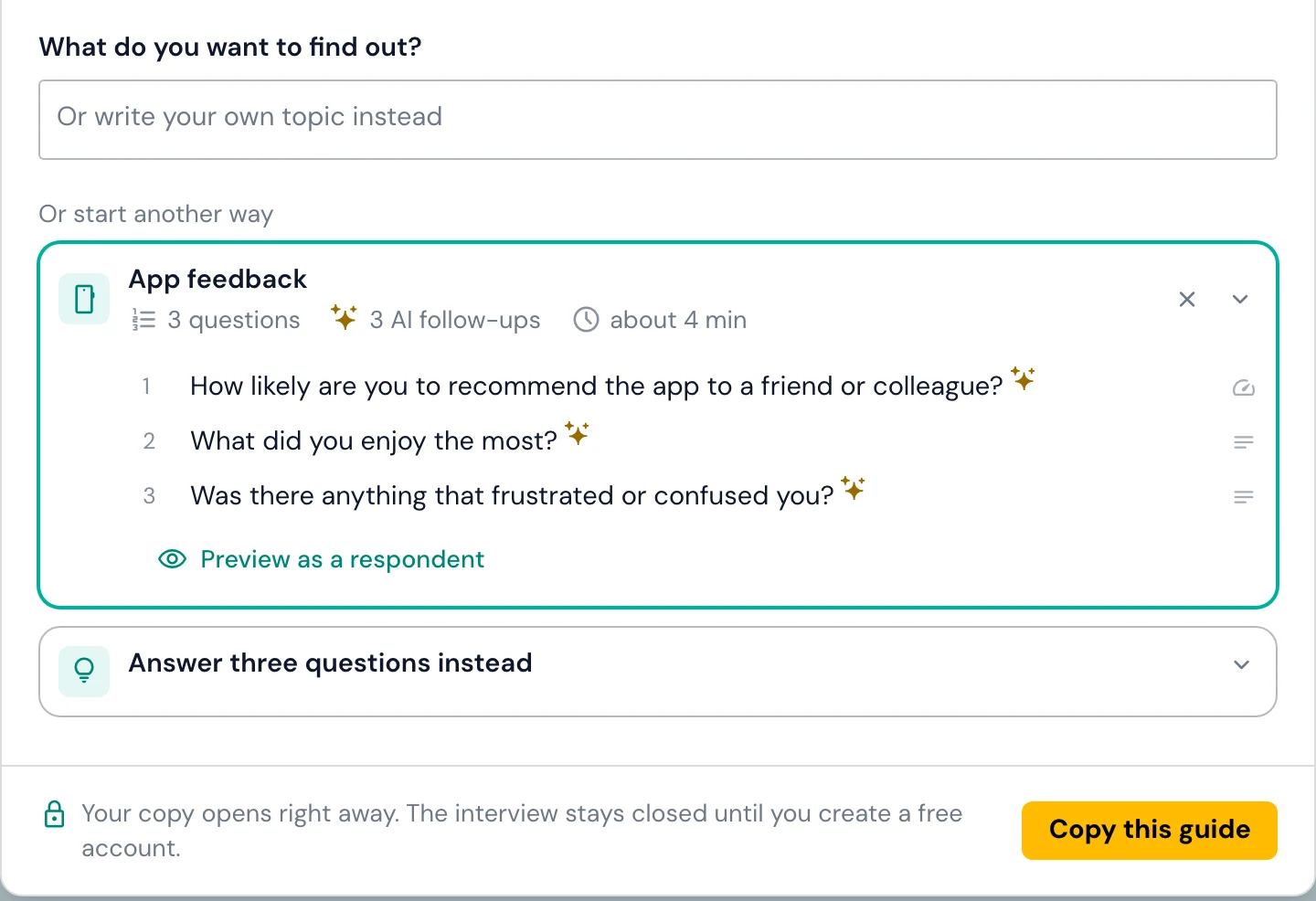
Whichever way you start, you get a guide you can edit freely: change any question, add your own and remove what you do not need. You can do all of this before you sign up; the interview stays closed until you create a free account. For advice on the questions themselves, read how to write a good interview guide.
What will your respondents experience?
Respondents open the link and see a short welcome message, with your name, role and photo if you add them. Then the questions arrive one at a time, in the style of a messaging app. The phone screens below are from a shopping feedback interview.
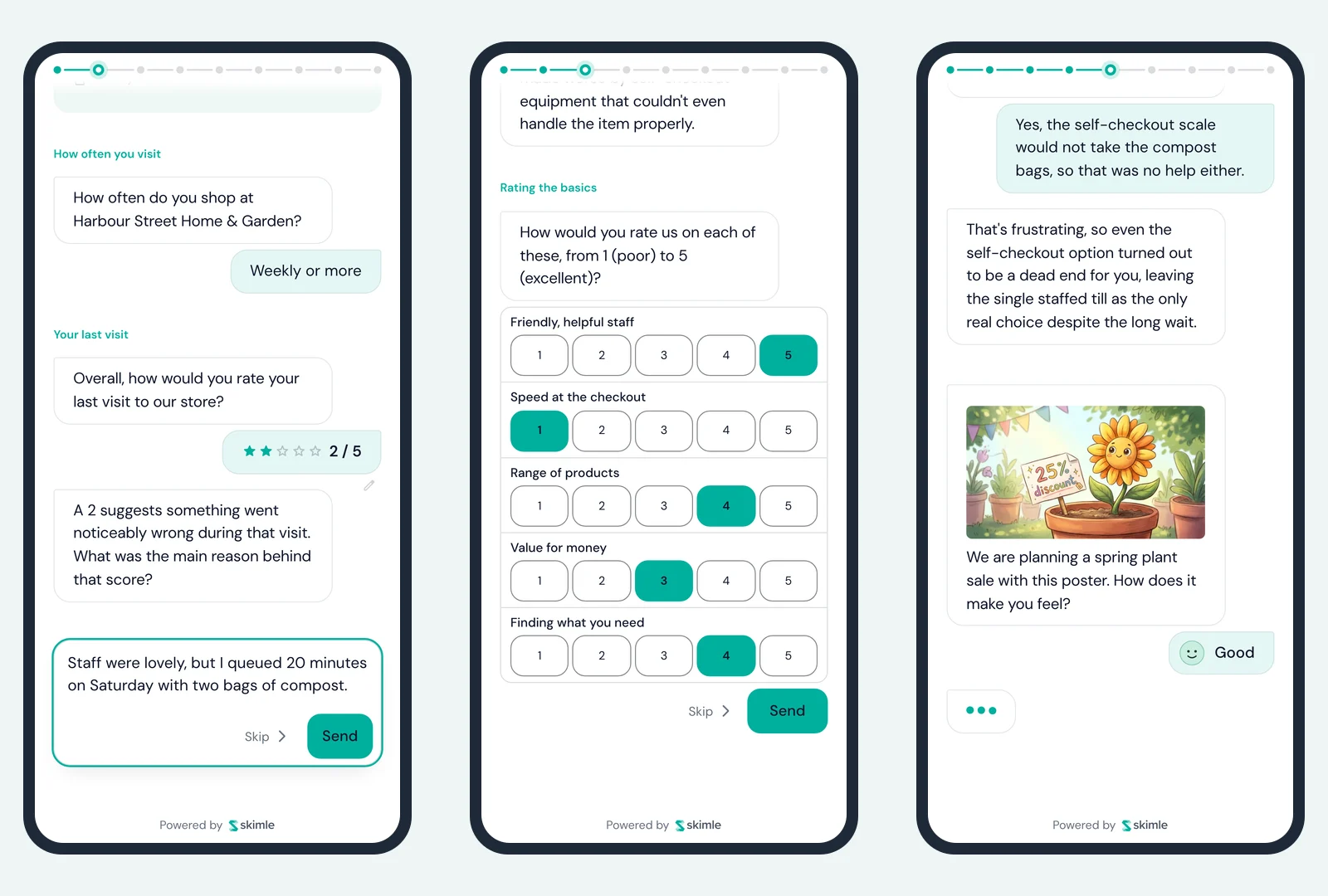
A few design choices shape how it feels:
- Follow-ups are earned. The interviewer asks a follow-up when an answer is vague, surprising or missing a detail, not after every answer. You set how many it may ask for each question.
- 13 answer types. Open answers can be typed, dictated, recorded as voice or video, or uploaded as a photo. Closed questions include multiple choice, checkboxes, dropdowns, rankings, best and worst, star and face ratings, sliders, net promoter scores and rating grids. Any question can show an image, audio clip or video to react to.
- Branching. A rule can send people to a different question depending on their answer, so someone who rated the checkout 1 out of 5 is asked what happened there and everyone else is not.
- 29 languages. You write the guide once and tick the languages to offer. Respondents see their browser's language when it is offered, and answers in different languages are analysed together.
- It respects time. Respondents can skip any question, and the interviewer trims follow-ups to finish within the length you set.
The interviewer was tested with the most demanding respondents we know of, which is teenagers. The Skimle Ask page has a live demo interview you can answer yourself in a couple of minutes.
How do you reach the people you want to hear from?
Ask gives you several ways to put the interview in front of people, and you can use more than one at a time:
- A link and QR code. Paste the link into email, Slack, Teams or WhatsApp, or print the QR code on a poster or receipt. A separate named link per channel marks each answer with where it came from.
- Personal links for a list. Upload a spreadsheet of people and each gets a personal link, sent from your own Gmail, Outlook or Mailchimp with a ready mail merge. Extra columns such as customer tier come through as data you can compare by. Skimle does not send the emails itself.
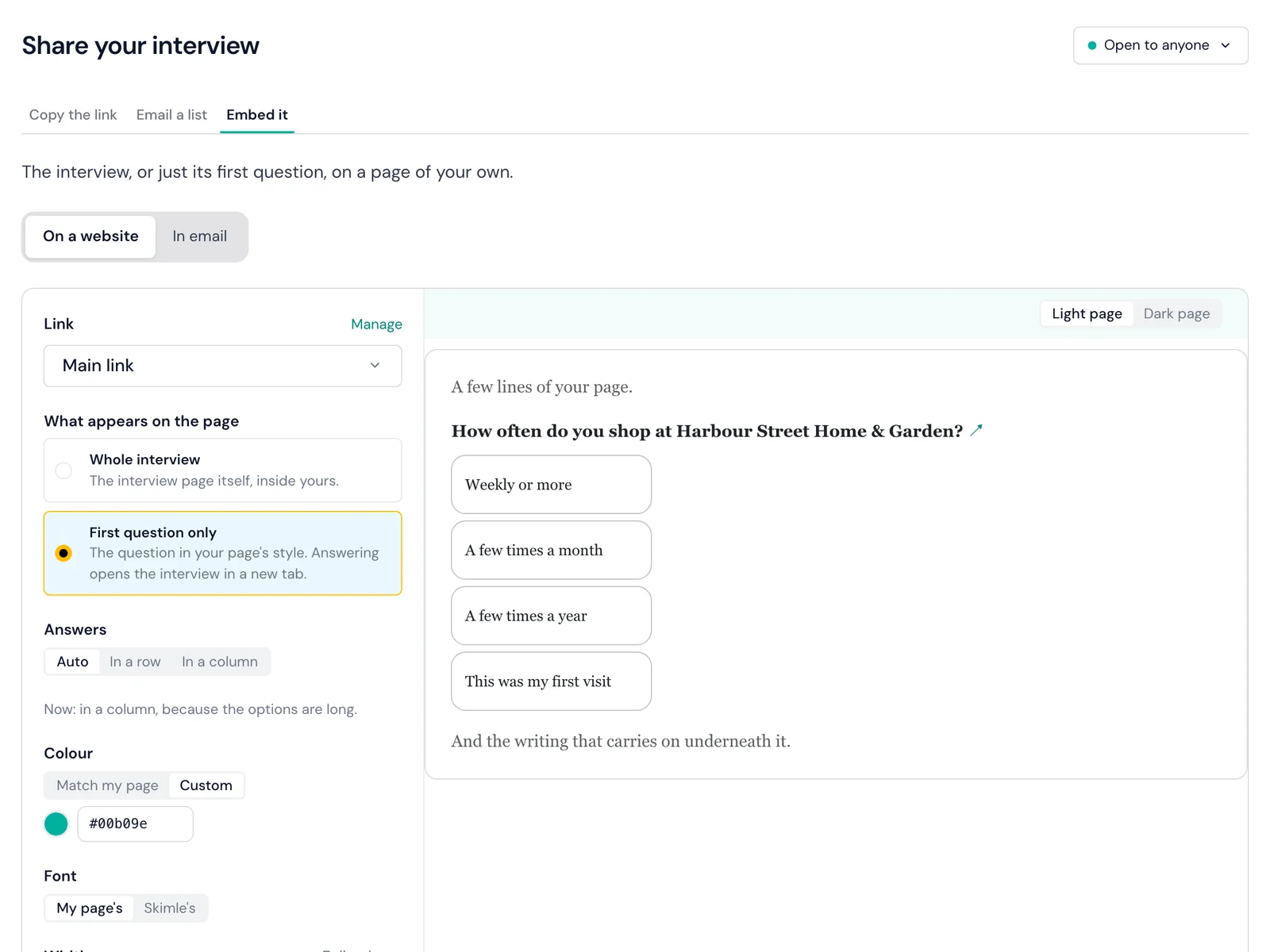
- Embedded on a website. Embed the whole interview, or only its first question styled to match your page, so readers start answering without leaving it.
- Inside a newsletter. Paste the first question into an email, and readers answer it with one click.
You decide who can answer: anyone with the link, only the people on your list, or nobody once you have closed the interview.
What happens to the answers?
Each completed conversation lands in your Skimle project as a document. When you run the analysis, Skimle reads every answer in full, builds a set of themes from what people said, counts how many mentioned each one and links every finding to the exact words behind it. Closed answers such as ratings and choices become columns you can filter and chart, so you can see, for example, whether people who gave a low score mention different things from those who gave a high one. From there you can ask questions of the data in the agentic chat and turn the findings into a slide deck in Presentations.
The Skimle Ask walkthrough follows one study through every step, and how many AI-moderated interviews you need helps you decide when you have enough answers.
When is Skimle Ask not the right tool?
Ask is not the best fit for everything, and it is better to know before you start.
- A two-option poll. If all you need is a count of yes and no, a simple poll or form is quicker. Ask earns its place when you want to know why.
- Finding respondents. Ask does not recruit participants or supply a panel. You need a way to reach the people you want to hear from, such as your customers, staff, members or a panel you already use.
- Live, in-depth conversations. For a 60-minute exploratory interview where rapport and a human reading the room matter, a person is still the better interviewer. Many teams use Ask for breadth and keep a few human interviews for depth; see AI interviewing vs human interviewing for the trade-offs.
- Research needing specific approvals. Academic and clinical studies may need ethics approval that names the tool. Ask stores data in the EU and never uses answers to train AI models, but check your own requirements first.
What does Skimle Ask cost?
Creating, sharing and running Skimle Ask interviews is included in every plan, including the free trial, which needs no credit card. Analysing the answers uses credits, and the free trial includes 200 credits to try it. Paid plans start at €20 a month, and organisations can arrange custom volumes. See pricing for details.
The quickest way to find out whether Ask is for you is to open the Skimle Ask page, pick the guide closest to your situation and preview it as a respondent. It takes about a minute.
About the authors
Henri Schildt is a Professor of Strategy at Aalto University School of Business and co-founder of Skimle. He has published over a dozen peer-reviewed articles using qualitative methods, including work in Academy of Management Journal, Organisation Science, and Strategic Management Journal. His research focuses on organisational strategy, innovation, and qualitative methodology. Google Scholar profile
Olli Salo is a co-founder at Skimle and former Partner at McKinsey & Company where he spent 18 years helping clients understand the markets and themselves, develop winning strategies and improve their operating models. He has done over 1000 client interviews and published over 10 articles on McKinsey.com and beyond. LinkedIn profile
Frequently asked questions about Skimle Ask
How is Skimle Ask different from a survey tool like Typeform or Google Forms? A survey tool asks everyone the same fixed questions and stops at the answer. Skimle Ask reads each answer and asks a follow-up when it needs one, so you learn the reasons behind a score. You can still use closed questions such as ratings and multiple choice wherever you need numbers. Our comparison of Typeform, SurveyMonkey and Skimle goes into the differences.
Do I have to write the questions myself? No. You can describe your topic in one sentence and let Skimle draft the guide, start from a ready-made guide, or answer three short questions about who you are asking and what you will decide. You can edit any question afterwards.
Do respondents need an account or an app? No. Respondents open a link, scan a QR code or answer on your website or in an email. There is nothing to install or sign up for.
How long does a Skimle Ask interview take? You set a target length and the interviewer paces itself to finish within it. The ready-made guides take between three and seven minutes.
Can responses be anonymous? Yes. You can collect answers without names or email addresses. If you send personal links to a list, answers are linked to the person on the list, which you can use to compare groups.
Can I embed Skimle Ask on my website or in a newsletter? Yes. You can embed the whole interview, or only its first question in your page's own style, and paste the first question into an email newsletter so readers answer with one click.
Which languages does Skimle Ask support? Interviews run in 29 languages. You write the guide once and the questions are translated automatically. Answers in different languages are analysed together, with quotes kept in the original.
Is my data secure? All data is stored and processed in the EU, encrypted and GDPR compliant. Answers are never used to train AI models, and data processing agreements are available for organisations.