Signal & Noise
Skimle's resource centre dedicated to high quality analysis using modern methods
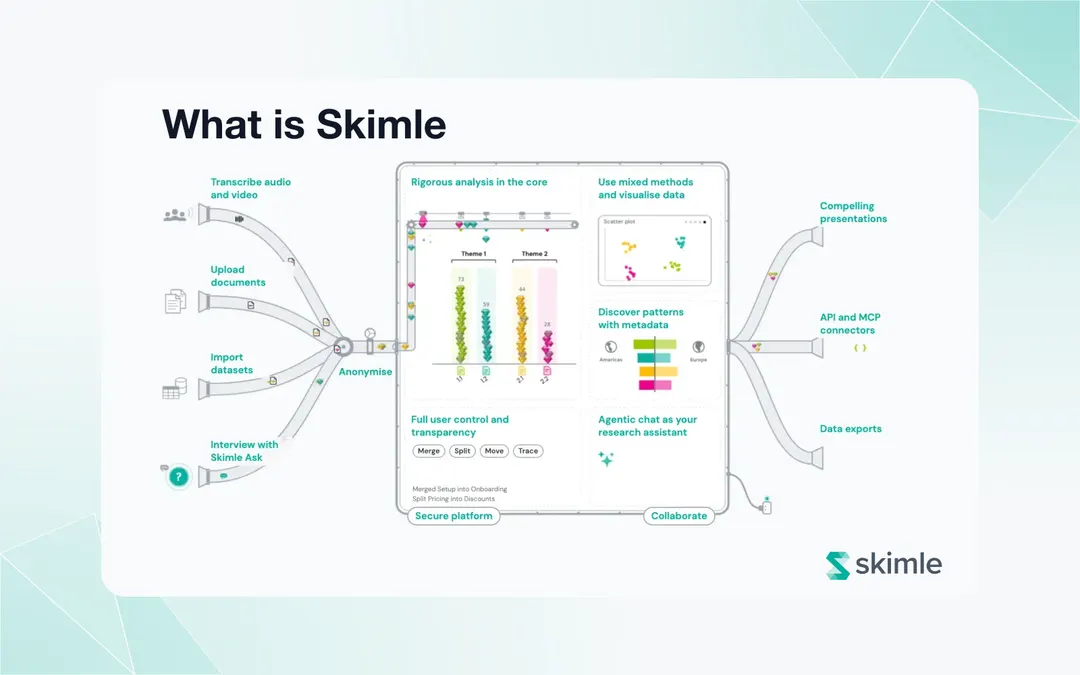
What is Skimle
What is Skimle? An AI qualitative data analysis platform for interviews, surveys and documents. Watch the new product film and explore all 15 features.
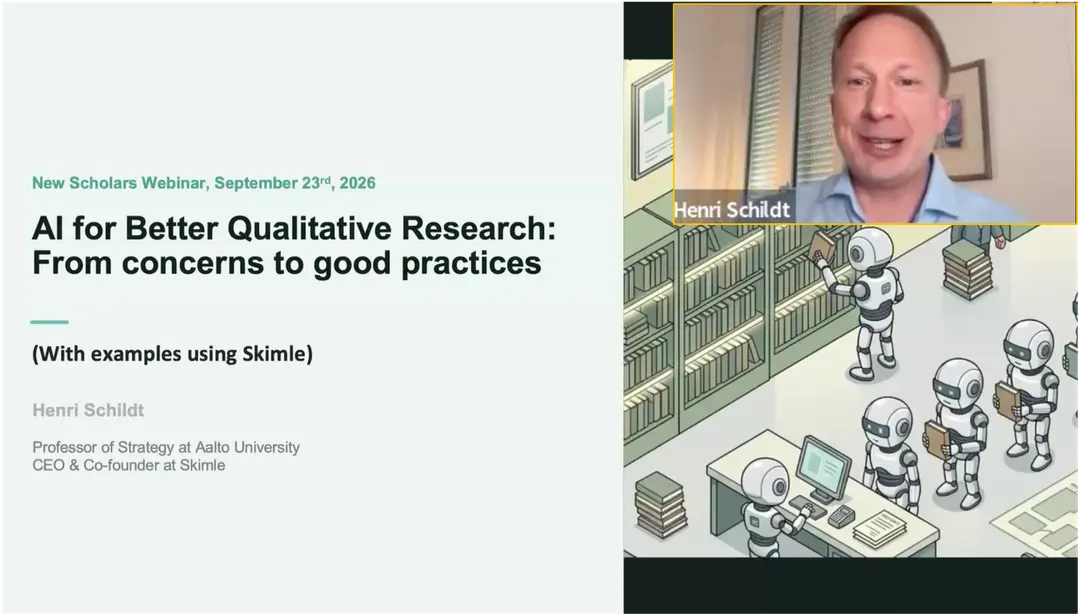
AI for better qualitative research - Henri's presentation in New Scholars Webinar Sept 23rd, 2026
Watch Henri Schildt's New Scholars webinar on using AI in qualitative research responsibly: hallucinations, transparency, counter-evidence and agentic AI.

Perspective on responsible use of AI for analysing large document datasets
Our working perspective on how AI helps across the research lifecycle in large-scale qualitative analysis, especially as the field shifts from episodic to continuous research.

Skimle is the Excel for text
Would you trust a calculator's number for a €1 billion decision with no visible workings... or use real tools? We think qualitative analysis deserves the same rigour as a quantitative.

Human in the loop is not a checkbox
Every AI research tool claims a human stays in control. Most of what that means in practice is an accept button. Here's what real control actually requires.

9 design criteria for AI-assisted qualitative analysis tools
The critiques of AI in qualitative research are serious and worth noting. Here are is our synthesis of 9 design criteria a tool must meet to deserve a place in rigorous research.
Skimlecast Season 2, episode 4: who's afraid of Claude, GPT and Fable?
Skimlecast episode 4 is live. Why we are not afraid of frontier AI models, the engine-and-car analogy, and why transparency and control matter in analysis.

Designing AI that augments qualitative researchers instead of replacing them
If we want AI to augment expert researchers instead of automating them out of the loop, we need shared design principles. This post lays out three core criteria — predictability, two-way transparency,...

What AI sycophancy & hallucinations look like in practice... and why boring is better
I fed 650 randomly labelled customer comments to a basic AI tool. It confidently found cultural differences that did not exist. The risks of using AI tools wrong are real.

The renaissance of qualitative research
LLMs can now process meaning, not just count words. This changes qualitative research fundamentally — not by making experts redundant, but by making expertise matter more.
Skimlecast Season 2, episodes 1–3: origin story, AI in academic research, and the future of knowledge work
Season 2 of Skimlecast is live. Three new episodes cover the origin of Skimle, using AI in academic research, and where knowledge work is heading.

Hallucinations, limited context and black boxes? Not with Skimle
The three biggest problems with using AI for qualitative analysis — hallucinations, context window limits, and black-box outputs — and how Skimle's architecture solves each.

Behind the scenes: how Skimle orders and evaluates your insights
How Skimle's three-phase insight assessment combines embedding similarity, LLM quality checks, and source verification to surface the most relevant findings.

Introducing Skimle MCP: connect your qualitative research to AI tools
Skimle now supports the Model Context Protocol, letting Claude, Cursor, Windsurf and other AI tools read and write your structured qualitative project data.

Introducing Skimle Anonymise: rigorous pseudonymisation for qualitative data
Skimle Anonymise lets you pseudonymise, anonymise, and de-identify qualitative transcripts with AI-powered detection, audit trails, and GDPR/HIPAA compliance.
Skimlecast episodes 11 and 12: customer insights with metadata variables, and the rise of agentic AI
Episode 11 shows how Skimle handles customer research and feedback. Episode 12 explores agentic AI and Skimle's new AI chat that can access and edit your data.
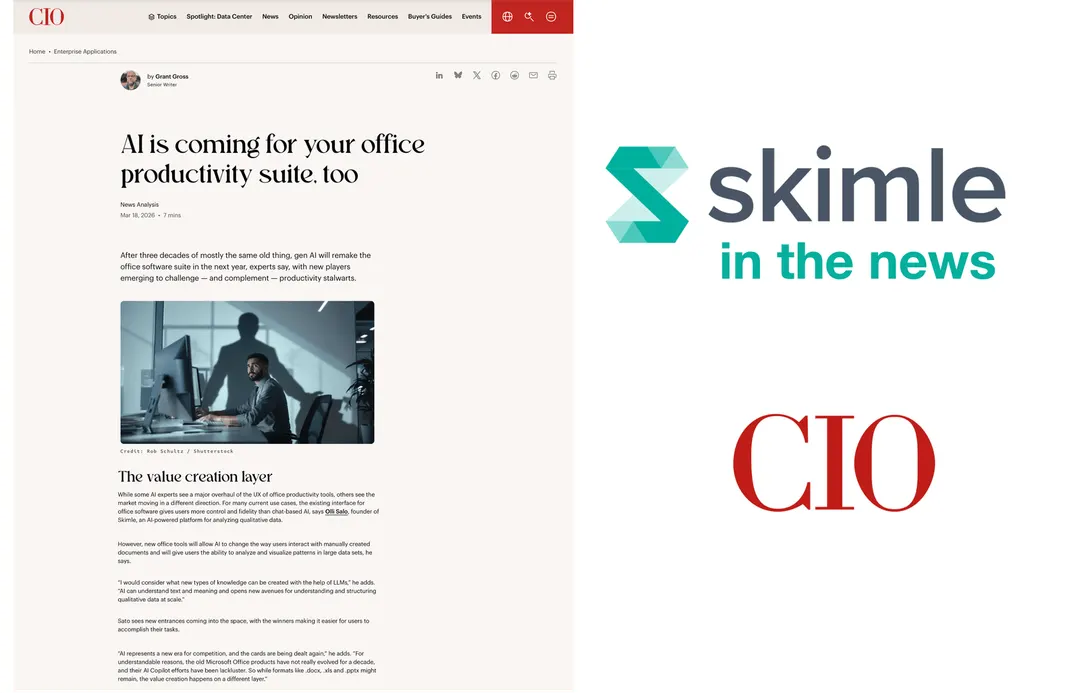
Skimle featured in CIO.com: AI is coming for the office productivity suite
CIO.com argues that AI will end three decades of stagnation in office software. Skimle co-founder Olli Salo is quoted on what that means for knowledge work.
Skimlecast returns: episodes 9 and 10
Episode 9 digs into manual coding and REFI-QDA export for academic researchers. Episode 10 introduces Skimle Ask, our AI interviewing tool for HR and beyond.

Gathering rich data with AI-interviews - Introducing Skimle Ask
Skimle Ask is an AI interviewer that lets anyone collect rich qualitative insights at survey scale. Set up in minutes, share a link, get real answers — not just scores.

Death of SaaS... or the renaissance of better software?
SaaS valuations are crashing and commentators are calling it the 'SaaSpocalypse'. We think the story is more nuanced - and for well-designed software built on genuine domain knowledge, this moment is ...
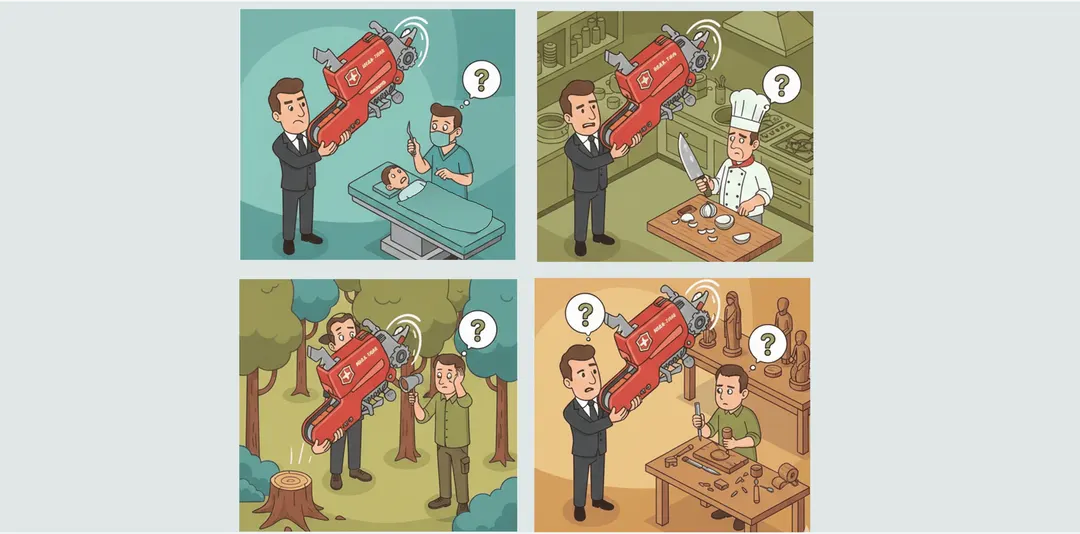
AI text analysis - Don't use 'motorised Swiss knives' for serious qualitative analysis
AI can help in analysis, but the rush to replace rigorous methods with wrong tools risks more harm than good. One head of AI remarked 'big AI' is trying to sell the same tool for all use cases.

How does ChatGPT actually work? And how do LLMs analyse data?
Most people have serious misconceptions about how ChatGPT and other AI systems work. Understanding what's actually happening under the hood helps you use these tools better and avoid their biggest pit...
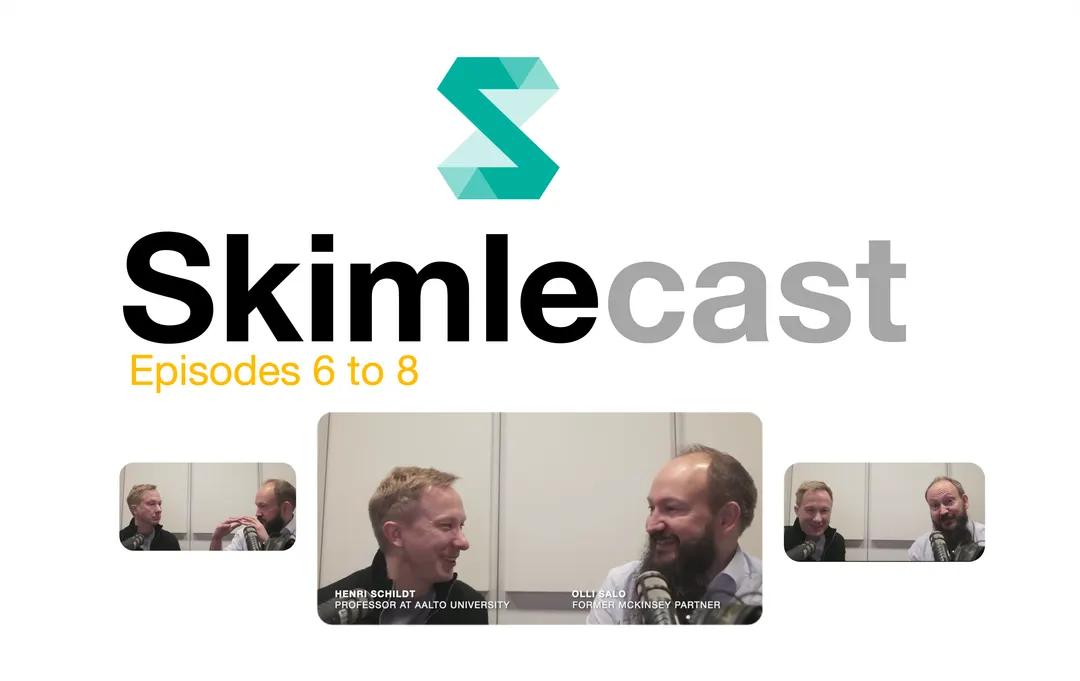
Skimlecast is back: Episodes 6 to 8
This time we went into a professional podcast studio and spent some quality time discussing how Skimle works, our learnings from start-up life, and the big 'Is AI good or bad?'-debate

Is AI destroying our ability to think? Using technology to augment, not replace expertise in qualitative research
Copy a question and paste it to a chat bot, press enter and mindlessly copy the answer back... Will poor use of AI reduce rigour of qualitative analysis and make us dumber?