Updated 16 November 2026: This article now covers the research published in the autumn of 2026, including a 74-country study in Nature Human Behaviour, Pew Research Center's test of AI "digital twins" against its own panel, a 19-study mega-study of digital twins and a second-year industry replication by Strat7. It also explains how to read the accuracy figures vendors quote.
Synthetic respondents, AI personas that answer surveys and interviews as if they were real people, do not yet work as a substitute for asking people. The 2026 evidence is consistent: they can land near a population's average answer on familiar questions, but they miss individuals, exaggerate differences between groups, inflate positive and knowledgeable answers, and cannot tell you what has changed. Across 19 pre-registered studies, twins built from 500 answers per person were only modestly more accurate than a plain language model with no persona at all.
Market researchers and customer insight teams have been offered the idea under many names: digital twins, people models, synthetic panels, synthetic respondents, "human AI". Under the branding, most of these products work the same way. A general large language model is given a persona, assembled from demographic data or from a person's earlier survey answers, and asked to answer as that person would. This article looks at why the idea is so appealing, what the newest research shows when it is tested, how to read the accuracy claims vendors make, and where synthetic respondents still have a sensible role.
The 90-second film below explains what synthetic respondents are, why they are so tempting, and what the 2026 studies found when they were tested against real people.
What are synthetic respondents?
Synthetic respondents are AI-generated stand-ins for survey or interview participants. You describe a person (age, gender, income, region, perhaps their answers to an earlier questionnaire) and a large language model answers your questions in that person's voice. Ask a synthetic 35-year-old mother of two in Manchester about a new grocery delivery service, and the model produces a fluent answer drawn from patterns in the text it was trained on.
Vendors differ in how much data they put into the persona and in how they collect the answers, but the core mechanism is the same. The model has never met your customers. It predicts what a person described like this would plausibly say, based on everything it has read.
That distinction matters for everything that follows. A synthetic respondent is a prediction about a person, generated from a description of them. Its quality depends on whether the description carries the information that drives the answer, and on whether the model's general knowledge of people like that is right.
Why are synthetic respondents so appealing?
The appeal is easy to understand, and most of it is economic.
- Cost per respondent. Buyers of research know a real survey complete or interview costs anywhere from 10 euros to several hundred, depending on the sample. A synthetic respondent priced at a euro or two feels like a bargain, even though the model call behind it costs the vendor a fraction of a cent.
- Speed. Hundreds of synthetic interviews can be generated in minutes. Recruiting, scheduling and fielding a real study takes days or weeks.
- No fieldwork friction. Synthetic respondents never miss an appointment, never drop out halfway, never need an incentive and never fall outside quota.
- Unlimited sample. You can ask for 10,000 respondents in a niche segment that would take months to recruit in reality.
Investors have noticed. Synthetic research start-ups have raised large venture rounds, and synthetic respondents were named one of the trends market researchers should watch in 2026. At industry conferences this autumn, vendor sessions came with polished demos and animated "digital twins" answering surveys on stage.
What those sessions rarely showed was evidence that the answers were right. That is the question the 2026 research set out to test, and it is the question a research buyer should ask before paying for a synthetic sample.
What does the 2026 research show?
Until 2025, most of the case against synthetic respondents rested on methodological unease and anecdotes. In 2026 several independent teams tested the claims at scale, with different data, different countries and different model families. The table below summarises the main studies.
| Study | What was tested | Key result |
|---|---|---|
| Chen, Wang, Wang and Bhatia, Nature Human Behaviour (October 2026) | Twins of 67,201 people in 74 countries answering the Global Preference Survey, 12 model set-ups | Synthetic answers explained about 1.3% of the variation between individuals and 4.2% between countries |
| Pew Research Center (September 2026) | Claude Opus 4.6 twins of real panellists, nearly 300 questions | Average gap of 12 percentage points; over 15 points on 28% of questions |
| Peng, Toubia and 21 co-authors, "Digital Twins as Funhouse Mirrors" (2025, revised April 2026) | 19 pre-registered studies, 164 outcomes, twins built from 500+ answers per person | Average correlation with the real person of r = 0.20; only modestly better than a base model with no persona |
| Strat7, "Synthetic data: Is this as good as it gets?" (July 2026) | 3,000 real respondents against two synthetic providers | Headlines within 2 to 3 points, but tracking change over time was right only 47% of the time |
| Chen, Zhu and Zheng, "When Synthetic Users Fail" (July 2026) | Four models against the General Social Survey and World Values Survey | No model beat a simple demographic lookup at predicting individuals |
| Kaiser et al., NIM Marketing Intelligence Review (2026) | Brand choice and attitude ratings | 79% match on brand choice; ratings skewed positive and less varied |
Synthetic answers carry very little information about real people
The broadest test so far appeared in Nature Human Behaviour in October 2026. Fadong Chen, Qijun Wang, Lei Wang and Sudeep Bhatia rebuilt the Global Preference Survey with twins of 67,201 real respondents in 74 countries, covering six economic preferences: risk-taking, patience, altruism, trust and positive and negative reciprocity. Across twelve model configurations from the GPT, Gemini and DeepSeek families, the synthetic answers pointed in the right direction more often than not, but the alignment was weak. They explained about 1.3% of the variation between individuals and, even after averaging to country level, about 4.2% of the variation between countries.
The detail is instructive. The models reproduced most demographic gradients, for example how risk-taking differs by gender or age, but their consistency with 15 known cultural patterns was close to chance. Errors were larger in lower-income countries with weaker digital infrastructure, where less of the training data comes from. Newer and larger models did no better than older ones, and the models agreed with each other more than with the humans they were meant to represent.
Twins built from rich personal data barely beat a plain model
The strongest argument from vendors is that their twins are built from real data about real people, not from demographics alone. The "Funhouse Mirrors" mega-study, led by researchers at Columbia Business School, tested exactly that. Each twin was built from the person's answers to more than 500 questions in the Twin-2K-500 dataset, and the twins were then tested across 19 pre-registered studies with 164 outcomes. The average correlation between a twin's answers and the real person's answers was r = 0.20, and the twins were only modestly more accurate than a homogeneous base model given no persona at all.
On individual-level accuracy, twins given the full 500-question history scored 0.748 and twins given only 14 demographic variables scored 0.746, a difference that was not statistically significant. The richer data did help the twins capture some differences between people, but it did not make individual answers more accurate. The authors name five distortions: insufficient individuation, stereotyping, representation bias, ideological bias and hyper-rationality. Twins also showed less variability than the humans they copied in 93.9% of comparisons.
A separate July 2026 benchmark by Chen, Zhu and Zheng reached the same place from another direction. Against the U.S. General Social Survey and the 63-country World Values Survey, no model beat the strongest non-AI baseline, a lookup table built from demographic data. The models over-weighted demographic identity: political affiliation explains about 1.5% of the real variation in confidence in banks, but up to 67% of the variation the models produced. In segment-targeting tasks they inflated the gap between segments two- to fourfold and would have pointed a team to the wrong segment in around half of U.S. cases.
Put together, these studies suggest that most of what a synthetic respondent "knows" comes from the base model and the demographic label. The personal data that vendors emphasise adds little to the accuracy of each answer.
The errors follow a pattern: flattened, stereotyped and too positive
Pew Research Center's September 2026 study is the most transparent test of a commercial-grade set-up. Pew gave Claude Opus 4.6 each real panellist's demographics and their answers to Pew's own political typology survey, then had the twin answer nearly 300 questions from three later waves, in the same order and with the same programming as the humans. Pew picked Opus 4.6 because it performed best of the models it tried.
The synthetic estimates differed from the real ones by an average of 12 percentage points, and by more than 15 points on 28% of questions. The chart below shows the shape of the misses.
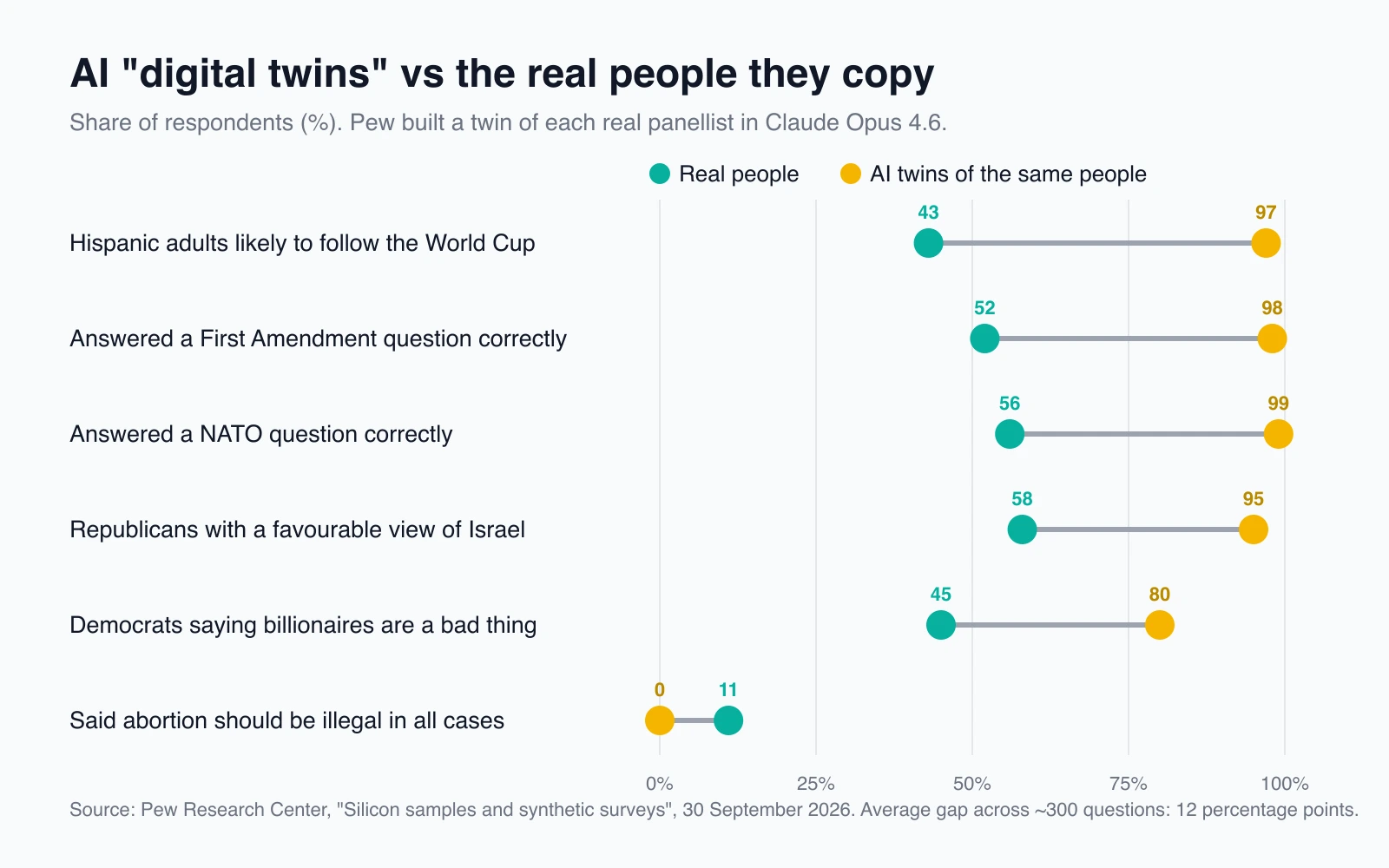
Three patterns run through Pew's results and the other studies:
- Flattened variety. Nearly half of Pew's questions had at least one answer option that not a single synthetic respondent chose. Real people were about four times as likely to answer "not sure". The Funhouse Mirrors twins were less varied than their humans in 93.9% of cases, and the Nature Human Behaviour twins were more homogeneous than the people they copied.
- Stereotyped differences. Views held by many people in a group became near-universal in the synthetic data. 97% of synthetic Hispanic adults said they were likely to follow the World Cup, against 43% of real ones. This is the same over-weighting of demographics that Chen, Zhu and Zheng measured, and it is exactly the error that misleads segmentation work.
- Inflated knowledge and positivity. Synthetic respondents knew far more than real people: 98% answered a First Amendment question correctly, against 52% of adults. Kaiser and colleagues found synthetic brand ratings skewed positive, with the largest upward bias for well-known brands, and Strat7 found synthetic willingness to pay 16% above what real people said.
Pew's conclusion was blunt: AI models "are not an adequate replacement for traditional polling on topics of broad public importance." It also found results were highly sensitive to the model chosen. GPT-5.1 overstated how extreme opinions were, while Opus understated it.
Synthetic panels cannot see change
Much commercial research exists to detect change: a brand tracker, a pricing study after a competitor's move, reactions to a new category. Strat7 repeated its 2025 comparison in 2026 with 3,000 nationally representative respondents and two synthetic providers. Headline numbers came out within 2 to 3 points of the real ones on average, which is the figure vendors tend to quote. But the synthetic surveys tracked the direction of change between 2025 and 2026 correctly only 47% of the time, which Strat7 described as no better than a coin toss. In a pricing exercise, purely synthetic respondents broke the logical price order 68% of the time.
Strat7 recommends avoiding synthetic data for tracking, market-mix modelling, new segmentations, subgroup analysis, situational questions and new or low-penetration brands. Its group AI lead put it simply: "Don't replace people."
Better models and more data do not close the gap
A common response to these findings is that the next model will fix them. The evidence so far does not support that. In the Nature Human Behaviour study newer models did not outperform older ones. A September 2026 paper by Wang, Hunt, Tang and Joseph asked a more practical question: can twins reduce the number of real respondents you need? Newer models and richer respondent data improved some fidelity measures, but did "not reliably translate into human-data savings", and twins said little about which individuals deviate from the average.
Earlier findings point the same way. A 2025 study in Political Analysis found 48% of coefficients estimated from synthetic responses differed significantly from the human ones, and the sign flipped in 32% of those. Kinzinger and Hartmann at TU Munich gave models each person's full response history and still found the best correlation with the real person's answers topped out at r = 0.59.
Is there any evidence in favour?
There is, in a narrow setting. Maier and colleagues (2025) tested synthetic consumers on 57 personal-care concept surveys from a large consumer goods company, with 9,300 human responses for comparison. Asking the model directly for a 1 to 5 rating produced unrealistic distributions. Letting it answer in free text and mapping that text onto the scale reached about 90% of human test-retest reliability when comparing how products ranked against each other on average purchase intent.
That is a useful result for one job: screening many concept variants in a familiar category before testing the best ones with people. It is an aggregate ranking across products, not a prediction of what any segment or individual will do, and it is the kind of headline that gets shortened to "90% accuracy" in a sales deck.
How should you read a vendor's accuracy claim?
Accuracy figures such as "93% correlation with real respondents" appear in many synthetic research pitches, often without an explanation of what was correlated. The number can be true and still say very little about whether the product will help your decision. Most survey questions have a typical answer pattern that any language model knows: people prefer lower prices, rate familiar brands higher and agree with mild statements. Correlate synthetic and real averages across a set of such questions and you will get a high figure even from a model that knows nothing about your customers.
The same goes for "our twins produce more realistic variance than a standard model". More spread is not more accuracy. A random number generator also produces variance. What matters is whether the variation lands on the right people and the right segments.
Before buying, ask for answers to these questions:
| Ask the vendor | Why it matters |
|---|---|
| Correlation of what? Question averages, segment differences or individual answers? | Question-level averages are easy to match; individual and segment answers are where twins fail |
| Compared with which baseline? | A claim means little unless it beats a base model with no persona and a demographic lookup table |
| How does it compare with human test-retest reliability? | Real people answering twice set the ceiling; a figure without it has no scale |
| Was it tested on data the model could not have seen, after its training cut-off? | Published surveys may be in the training data, which flatters the result |
| Did it detect change between two waves? | Tracking and reaction to new things are where Strat7 found coin-toss accuracy |
| How do segment gaps compare with the real gaps? | Inflated segment differences lead to the wrong targeting decision |
The buyer-side practice that holds up best is the one a research lead at a large brand described at a recent conference: use synthetic respondents only for low- and medium-risk decisions, because they inflate positive answers and flatten real differences. That is consistent with every study above.
Why do synthetic respondents fail?
The research explains what goes wrong. Our own experiments at Skimle suggest why. We have used synthetic respondents internally, for example to generate realistic dummy data for testing analysis (consultation responses to a planned shopping centre, a fictional due diligence on a toymaker) and to have an AI critique our website. Three limitations come up every time.
They are trained on the past
A language model knows how people have reacted to existing products, events and ideas. That makes synthetic respondents reasonable at telling you whether something matches an established pattern: does a landing page include the elements successful SaaS pages usually have, does a guide cover the topics readers expect?
It makes them poor judges of anything new. A feature that changes how people think about a task, a category that did not exist two years ago or a reaction to this month's news cannot be in the training data. The Nature Human Behaviour results show the same limit geographically: where less text exists, the models know less, and errors were largest in lower-income countries. Research that sets out to discover something you do not already know needs people who have actually had the experience.
They produce plausible answers without lived experience
When we asked synthetic respondents about analysing open-ended survey responses, they gave articulate answers that named real pain points such as slow manual coding. They missed the experiences that only come from doing the work: being 200 responses in and realising the coding frame is wrong, or a quote that fits two categories equally well.
Merrill Research described the same gap with synthetic design engineers who gave textbook answers about sustainability in vendor selection. Real engineers said sustainability matters, but not when they cannot get parts for months. That is the insight a study exists to find, and it was invisible to the model. Pew's finding that real people say "not sure" four times as often points the same way. Hesitation, contradiction and digression are information, and synthetic respondents remove them.
Their positivity is a setting, not a measurement
Language models tend to be agreeable. Vendors can tune a persona to be more critical, but then the negativity reflects a configuration choice rather than what customers feel. Either way you are choosing a level of enthusiasm instead of measuring it. That is why the inflated ratings in the Kaiser study and the 16% higher willingness to pay in Strat7's study matter so much for concept tests, pricing and purchase intent, the very questions synthetic panels are most often sold for.
When can synthetic respondents be useful?
Used openly and for the right jobs, synthetic respondents can still save time:
- Piloting research instruments. Run a draft questionnaire or interview guide past synthetic respondents to catch confusing wording, missing answer options and broken routing before real people see it.
- Checking against known standards. Ask whether a checkout flow, onboarding sequence or article covers what similar ones usually cover. The right answer is established, so the model's knowledge of the past is an asset.
- Screening many variants in a familiar category. Following the Maier et al. approach, rank a long list of concept or message variants, then test the shortlist with real people.
- Generating realistic dummy data. Build test datasets for analysis pipelines, training or demos where no real participant data should be used.
In all four cases the output feeds a decision about the research, not a decision about the market. Before any finding reaches a business decision, real people should have been asked.
When should you not use synthetic respondents?
The evidence closes off most of the high-value uses vendors pitch:
- Segmentation and targeting, where twins inflate segment differences.
- Tracking change over time, where they performed at coin-toss level.
- Pricing and willingness to pay, where they overstate what people will pay.
- New categories, new brands and reactions to recent events, which are absent from training data.
- Minority groups and markets outside wealthy, English-speaking countries, where errors are largest.
- Any study where hesitation, emotion or lived experience is the point.
For these, the faster route is not to simulate people but to make real research quicker. If you work in insights, see how Skimle supports customer and market researchers.
What is the faster alternative to synthetic respondents?
The case for synthetic respondents rests on two real pains: fieldwork is slow and expensive, and analysis takes weeks. Both can now be shortened without replacing the people.
AI-moderated interviews such as Skimle Ask reach real respondents through a link, ask open and rating questions, follow up on interesting answers and collect hundreds of responses in days. We compare the approach with traditional interviewing in AI interviewing vs human interviewing and review the market in the best AI interview tools of 2026. Real respondents bring their own risks, so it is worth knowing the warning signs of fake respondents as well.
On the analysis side, AI can compress weeks of coding into hours while keeping every finding traceable to what people said. That is where AI-assisted thematic analysis earns its place, and it is a better answer to the price pressure behind the commoditisation trap facing research agencies than selling simulated respondents.
The bottom line
Synthetic respondents are cheap, fast and convenient, and in 2026 they still do not tell you what real people think. The best evidence available, from Pew, from a 74-country study in Nature Human Behaviour and from a 19-study mega-study, shows the same pattern. The answers are flattened, stereotyped and more positive than reality, and most of their accuracy comes from the base model and the demographic label rather than from the personal data vendors emphasise.
Use them to test your research, not to replace it. When a vendor quotes an accuracy figure, ask what was correlated, against which baseline and on what data. And when the decision matters, ask people.
Frequently asked questions
What are synthetic respondents?
Synthetic respondents are AI-generated personas that answer survey or interview questions as if they were real people. A large language model is given a description of a person, such as demographics or earlier survey answers, and predicts how that person would respond. They are also sold as digital twins, people models or synthetic panels.
Do synthetic respondents work?
Not as a replacement for real respondents. In 2026 Pew Research Center found AI twins of its panellists missed real results by 12 percentage points on average, and a 74-country study in Nature Human Behaviour found synthetic answers explained about 1% of the variation between individuals. They can come close to population averages on familiar questions, but miss individuals, segments and change over time.
Are digital twins better than basic synthetic personas?
Only slightly. In the 19-study "Funhouse Mirrors" mega-study, twins built from each person's answers to more than 500 questions were only modestly more accurate than a base model with no persona, and twins built from 14 demographic variables were as accurate on individual answers as the full twins.
What does a "93% correlation" claim from a vendor mean?
Usually it means the average answers across a set of questions correlated with real averages. That is easy to achieve, because most questions have a typical answer pattern any language model knows. Ask whether the figure covers individual or segment answers, which baseline it beats, how it compares with human test-retest reliability and whether it was tested on data after the model's training cut-off.
When should you use synthetic respondents?
For low-risk research tasks: piloting questionnaires and interview guides, checking work against known standards, screening many variants in a familiar category before testing with people, and generating dummy data. Avoid them for segmentation, tracking, pricing, new categories and anything that drives a significant decision.
Can synthetic respondents replace focus groups or interviews?
No. Interviews and focus groups exist to surface unexpected reasons, emotions and contradictions, which are precisely what synthetic respondents flatten out. AI-moderated interviews with real people are a faster way to get qualitative depth at scale without simulating the participants.
Sources
- Simulated responses from large language models are weak proxies for human economic preferences across 74 countries - Chen, Wang, Wang and Bhatia, Nature Human Behaviour (2026)
- Silicon samples and synthetic surveys: Can AI stand in for human respondents? - Pew Research Center (2026)
- AI survey samples poorly replicate human public opinion - Pew Research Center (2026)
- Digital Twins as Funhouse Mirrors: Five Key Distortions - Peng, Toubia et al., arXiv (2025, revised 2026)
- Twin-2K-500: A dataset for building digital twins of over 2,000 people - Toubia et al., arXiv (2025)
- Synthetic data survey responses "significantly different" to humans, finds study - Research Live on Strat7 (2026)
- When Synthetic Users Fail: A Cross-Domain Benchmark of LLM-Simulated Human Survey Responses - Chen, Zhu and Zheng, arXiv (2026)
- When Can LLM Digital Twins Reduce Human Measurement? - Wang, Hunt, Tang and Joseph, arXiv (2026)
- Leaving Insight to Digital Twins? Promise, Progress and Limits of Synthetic Respondents - Kaiser et al., NIM Marketing Intelligence Review (2026)
- Synthetic Personalities: How Well Can LLMs Mimic Individual Respondents Using Socio-Economic Microdata? - Kinzinger and Hartmann, arXiv (2026)
- LLMs Reproduce Human Purchase Intent via Semantic Similarity Elicitation of Likert Ratings - Maier et al., arXiv (2025)
- Synthetic Replacements for Human Survey Data? The Perils of Large Language Models - Political Analysis (2025)
- Synthetic Respondents: The Promise, The Pitfalls, and The Reality Check - Merrill Research
- Rival Group's 2026 Market Research Trends Report
About the author
Olli Salo is a former Partner at McKinsey & Company where he spent 18 years helping clients understand their markets and themselves, develop winning strategies and improve their operating models. He has done over 1,000 client interviews and published over 10 articles on McKinsey.com and beyond. He is co-founder of Skimle. LinkedIn profile