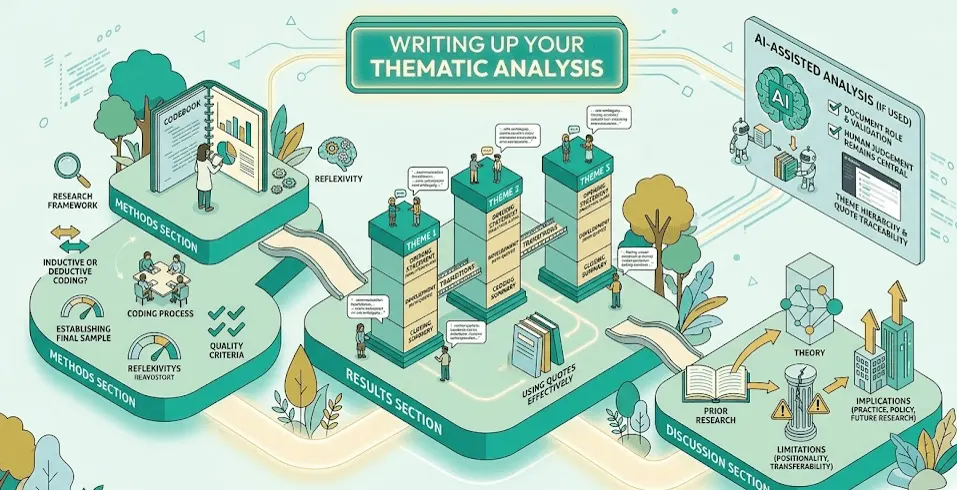
A thematic analysis report has three core components: a methods section documenting how you conducted the analysis, a results section presenting the themes you found with supporting quotes, and a discussion section interpreting what those themes mean. Getting the structure right is what separates a write-up that survives peer review from one that comes back with requests for major revisions. The results section typically runs 2,000–4,000 words for a journal article, organised around your themes with each one opening with an analytical claim — not a topic label — and developed with quotes from multiple participants.
For most academic thematic analysis reports, the results section runs between 2,000 and 4,000 words, organised around your themes with subthemes as needed. Each theme gets an introduction, illustrative quotes, and interpretive commentary that explains what the theme means and why it matters for your research question. The methods section, written separately, documents your analytical procedure with enough detail to satisfy peer reviewers — which methodology you used, how many coders were involved, whether you used inductive or deductive coding, and how you reached saturation or defined your final sample.
What goes where: structure of a thematic analysis write-up
A complete thematic analysis write-up has three main components that serve different functions:
Methods section: how you did the analysis — your epistemological stance, sampling decisions, coding procedure, and quality checks. This is where reviewers evaluate your rigour.
Results section: what you found — your themes, subthemes, and the evidence supporting each. This is where you present the substance of your analysis.
Discussion section: what it means — how your findings relate to existing theory and prior research, limitations, and implications. This is where you build the argument that your findings matter.
The common mistake is collapsing these together: writing a results section that is really a discussion, or a methods section that is vague enough to raise doubt about whether the analysis was systematic. Keep them distinct.
Writing the methods section
A methods section for thematic analysis needs to answer five questions that experienced reviewers will ask:
Which version of thematic analysis did you use? Braun and Clarke's reflexive thematic analysis is by far the most-cited framework, but there are others. Name it explicitly. Reviewers will notice if your methods section describes an approach that does not match your citations. See the complete thematic analysis guide, the demystifying thematic analysis post, and the step-by-step walkthrough of all six phases for a full account of the available frameworks and how each phase works in practice.
Was your coding inductive or deductive? Inductive coding means themes emerged from the data without a predetermined framework. Deductive coding means you applied an existing theoretical framework. Abductive approaches start from the data but refine analysis in dialogue with theory. State which you used and why.
How was coding conducted? Was coding done by one researcher or multiple? If multiple, how were disagreements resolved? Did you use a codebook? If you used software or AI tools, name them and explain the role they played. See below for how to handle AI-assisted analysis.
How did you establish your final sample? If you recruited until saturation, state which saturation standard you applied. Reviewers increasingly expect explicit reference to the empirical saturation literature, not just the generic phrase "saturation was reached."
What were your quality criteria? Reliability and validity mean different things in qualitative research than in quantitative work. Use the appropriate terms: trustworthiness, credibility, transferability, reflexivity. If you conducted member checking or negative case analysis, say so.
A methods section that answers all five questions honestly and specifically will survive most peer review scrutiny. One that is vague on any of these will invite revision requests that slow publication by months.
Writing the results section
This is where most write-up problems actually occur. The most common failure modes are:
- Listing themes with minimal interpretation (essentially producing a table of contents with quotes attached)
- Over-interpreting without enough evidence (asserting what themes mean without showing the quotes that support that interpretation)
- Quote-dumping without commentary (three quotes in a row with no analytical thread running through them)
- Themes that are actually topics rather than interpretive claims (labelling a theme "Communication" when the finding is "Participants experienced communication breakdowns as a symptom of role ambiguity, not frequency")
Well-written results sections treat each theme as an argument, not a label. The structure for each theme should follow a consistent pattern.
Structure for each theme
Opening statement: what the theme is and what it claims. Not "Communication problems" but "Participants identified a consistent pattern in which breakdowns in communication were attributed to ambiguity about who held decision-making authority, not to the volume or frequency of communication attempts." This is the analytical claim you are making.
Development: two to four paragraphs building out the theme, each grounded in quotes but driven by your interpretation. The quotes are evidence for the analytical point; they should not substitute for it.
Transitions: brief signposting that shows how the themes relate to each other. Do they build sequentially? Do they represent competing perspectives? Do they describe different stages of the same process?
Closing summary: one or two sentences that consolidate what the theme showed before you move to the next.
Using quotes effectively
Quotes should be:
- Representative: chosen because they illustrate the theme clearly, not because they are the most striking thing anyone said
- Contextualised: always attributed (Participant 7, female, mid-career) and with enough frame to understand the context
- Edited minimally: use ellipsis (...) for omissions and brackets for clarifications, but do not edit out complexity that is actually part of the meaning
- Varied: draw from multiple participants, not repeatedly from the same two or three voices. A theme supported by 12 participants should quote at least four or five of them
Length varies by purpose. Shorter inline quotes (one or two sentences) embedded in your analytical commentary work well for illustrative purposes. Longer block quotes (three to five sentences) are appropriate when the full texture of what someone said is analytically relevant — but use them sparingly. A results section that is mostly block quotes is a results section where the analysis has not been done.
Formatting themes
Most thematic analysis results sections follow one of two formatting patterns:
Narrative with embedded headers: each theme gets an ## or ### subheading followed by prose. This is the more common format in social science journals and makes the document readable.
Numbered themes with subthemes: useful when the thematic structure is complex and you want readers to track the hierarchy explicitly. Theme 1 has subthemes 1.1, 1.2, 1.3, and so on.
Both work. Use the format that fits your journal's norms and your structure's complexity. If your themes are relatively independent of each other, numbered hierarchies help readers navigate. If your themes build into an argument, flowing prose with headers reads more naturally.
How many themes, and how detailed?
Most thematic analysis studies report three to seven main themes. Fewer than three suggests the analysis was not fine-grained enough. More than seven often means the themes are actually subthemes that should be nested under broader categories, or that the research question was too broad.
For subthemes: use them when a main theme has genuine internal structure that matters for the research question. A theme about "participant responses to uncertainty" might have subthemes for "cognitive responses", "emotional responses", and "behavioural responses" if that distinction is analytically important. Do not create subthemes just to add apparent depth; it inflates word count without adding insight.
For deciding how detailed to go within each theme: the test is whether the additional detail changes your reader's understanding. If your fourth illustrative quote about a theme adds nothing that the first three did not already establish, it can be cut. Analytical thoroughness is not the same as exhaustive quotation.
Writing the discussion section
The discussion interprets what the results mean in relation to:
Prior research: where do your findings confirm, extend, or contradict existing literature? Be specific. "Consistent with Smith et al. (2019)" is not enough; explain the nature of the alignment.
Theory: if you were working with a theoretical framework, how do your findings relate to it? Do they support it, refine it, or challenge it?
Limitations: qualitative limitations are different from quantitative ones. The relevant issues are: the positionality of the researcher (how might your background have shaped your interpretation?), the transferability of findings (what is and is not likely to generalise?), and the completeness of your analysis (were there aspects of the data you did not analyse?).
Implications: for practice, policy, or future research. Be realistic; overstating implications is a fast way to get rejected.
How to document AI-assisted analysis
AI tools have changed qualitative data analysis workflows significantly. If you used AI tools to assist with coding or theme identification, you need to document this — and the expectations are still developing across different journals.
The minimal requirements are:
- Name the tool and describe exactly what role it played (e.g., "initial theme generation", "quote retrieval", "pattern identification across the corpus")
- Describe how you validated and refined the AI's output through your own interpretive work
- Be clear that the analytical judgements were made by the human researcher, with AI providing computational support
More journals are accepting AI assistance when it is documented transparently and when the researcher demonstrates critical engagement with the AI's output rather than presenting it as the analysis itself. See the guide on using AI in qualitative research for academics for a full account of how to write up AI-assisted analysis in ways that satisfy peer reviewers at top journals.
Tools like Skimle generate a structured theme hierarchy with all supporting quotes traceable to source, which means the AI's contribution is auditable. You can review and revise the theme structure before finalising, and the quote-to-theme links provide the evidence chain reviewers need to evaluate your interpretation. See how Skimle handles thematic analysis for detail on the workflow.
Common peer reviewer concerns — and how to address them
"The analysis is not systematic enough." Usually means the methods section did not describe the coding procedure in enough detail. Fix: add a paragraph describing your specific coding process step by step.
"The themes seem arbitrary." Usually means the themes are labelled as topics rather than claims, or the results section shows quotes without sufficient interpretation. Fix: rewrite each theme opening as an analytical claim and add a sentence after each quote explaining what it illustrates.
"The sample is too small." If you followed the saturation literature and your sample is in the 15-25 range for a focused research question, this is defensible. The response is to explicitly reference Guest et al. (2006) or Hennink et al. (2017) in your methods section and state which saturation standard you applied.
"Member checking was not conducted." Not all qualitative traditions require member checking, and there are legitimate arguments against it. If you did not do it, state why (e.g., Braun and Clarke's reflexive TA explicitly questions the value of member checking as a validity criterion) and cite the methodological literature that supports your approach.
"The researcher's positionality is not addressed." Reflexivity is a genuine requirement in most qualitative traditions. A reflexivity statement does not need to be long, but it does need to be substantive: who you are in relation to the topic, how that might have shaped your interpretive choices, and what you did to attend to those potential biases.
A note on word count and proportion
For a typical journal article of 7,000-9,000 words, a rough allocation for thematic analysis write-ups:
- Methods: 700-1,200 words
- Results: 2,500-4,000 words
- Discussion: 1,200-2,000 words
The results section carries the most weight. It is where you earn the argument you are making. Methods and discussion support it from either side.
For thesis or dissertation chapters, these proportions scale up rather than change: a doctoral thesis methods chapter might run to 4,000 words and a results chapter to 10,000, but the proportional relationship is similar.
Putting it together: a structural checklist
Before submitting a thematic analysis write-up, run through this:
Methods section:
- [ ] Framework named and cited (e.g., Braun & Clarke's reflexive TA)
- [ ] Inductive vs deductive stance stated
- [ ] Coding procedure described (who coded, how disagreements were handled)
- [ ] Saturation or sample completion criteria stated with empirical reference
- [ ] Software or AI tools documented if used
- [ ] Quality criteria addressed (trustworthiness, credibility, reflexivity)
Results section:
- [ ] Each theme opens with an analytical claim (not a topic label)
- [ ] Every claim is supported by quotes from multiple participants
- [ ] Each quote is contextualised and attributed
- [ ] Interpretive commentary runs through the section (quotes never stand alone)
- [ ] Theme count is in the 3-7 range (or clearly justified if outside it)
- [ ] Transitions between themes are explicit
Discussion section:
- [ ] Findings related to prior research specifically
- [ ] Theoretical implications addressed
- [ ] Limitations stated (positionality, transferability, analytical completeness)
- [ ] Implications realistic and specific
If you have followed the thematic analysis methodology guide during your analysis, the write-up should follow naturally from your analysis notes and codebook. The write-up is not where you do the analysis; it is where you report what you already found.
Frequently asked questions
How do you write up a thematic analysis?
A thematic analysis write-up follows a standard academic structure: an introduction framing the research question, a methods section describing your coding process and reflexive stance, a results section presenting each theme with supporting quotes, and a discussion connecting findings to the literature. The results section is the most distinctive part — each theme gets its own subsection with a descriptive heading, 2–4 verbatim quotes, and interpretive commentary that goes beyond paraphrase.
How long should a thematic analysis results section be?
For a journal article, the results section typically runs 2,500–4,000 words covering 3–6 themes. For a dissertation chapter, 4,000–6,000 words is common. The length depends on the number of themes and the depth of evidence presented for each one.
How many quotes should you include in thematic analysis?
Most published thematic analyses include 2–4 verbatim quotes per theme to demonstrate the pattern across multiple participants. Using quotes from only one participant weakens the claim that you have identified a genuine theme rather than an individual perspective.
What is the difference between a theme and a finding in thematic analysis?
A theme is a pattern of shared meaning identified across data. A finding is the interpretive claim you make about what that pattern means in relation to your research question. The theme label ("uncertainty about career transitions") describes the pattern; the finding statement ("participants' career uncertainty was amplified by a lack of institutional support") is the analytical contribution.
How do you reference Braun and Clarke in thematic analysis?
The standard citation is: Braun, V., & Clarke, V. (2006). Using thematic analysis in psychology. Qualitative Research in Psychology, 3(2), 77–101. For reflexive thematic analysis, also cite: Braun, V., & Clarke, V. (2019). Reflecting on reflexive thematic analysis. Qualitative Research in Sport, Exercise and Health, 11(4), 589–597.
Ready to structure your thematic analysis before writing it up? Try Skimle for free and see how AI-assisted theme identification produces a traceable, quote-linked structure you can write directly from.
Related reading:
- The complete thematic analysis guide
- How many interviews is enough for qualitative research?
- How to use AI in qualitative research: a guide for academic researchers
About the author
Olli Salo is a former Partner at McKinsey & Company where he spent 18 years helping clients understand the markets and themselves, develop winning strategies and improve their operating models. He has done over 1000 client interviews and published over 10 articles on McKinsey.com and beyond. LinkedIn profile
Sources
- Using thematic analysis in psychology — Braun & Clarke (2006), Qualitative Research in Psychology
- Thematic Analysis: A Practical Guide — Braun & Clarke (2022), SAGE Publications
- How Many Interviews Are Enough? — Guest, Bunce & Johnson (2006), Field Methods
- Code Saturation versus Meaning Saturation — Hennink, Kaiser & Marconi (2017), Qualitative Health Research
- Establishing trustworthiness in qualitative research — Lincoln & Guba (1985), Naturalistic Inquiry, SAGE Publications