Skimle feature overview
Skimle is AI qualitative data analysis software that turns interviews, reports, and documents into structured insights, combining professional rigour with the speed of AI. Our customers report 3× faster end-to-end analysis, spending more time on insights and less on manual transcriptions.
Basic LLM tools like ChatGPT or Claude work as black boxes and are prone for hallucations. Legacy tools like Nvivo, MAXQDA or Atlas.ti force you to spend the majority of time manually coding, not actually analysing. Skimle is built different: you get a rigorous automated AI workflow for analysis with full two-way transparency and user control.
Every document is systematically analysed and every insight links to a verified verbatim quote. Edit categories, trace findings to source, and discover patterns automatically — allowing you to spend time understanding your data not managing files and codebooks.
Start where your data lives: audio, transcripts, documents, or open-text answers. Transcribe, anonymise, categorise, and code every excerpt. Find patterns with mixed-method tools, collaborate with AI agents, and export findings into reports and presentations.
Skimle has over 1,000 happy users across 30+ universities, research agencies, and consulting firms. We're constantly improving Skimle together with our customers.
The team behind SkimleQuick walkthrough and key features
Step 1
Upload and collect data
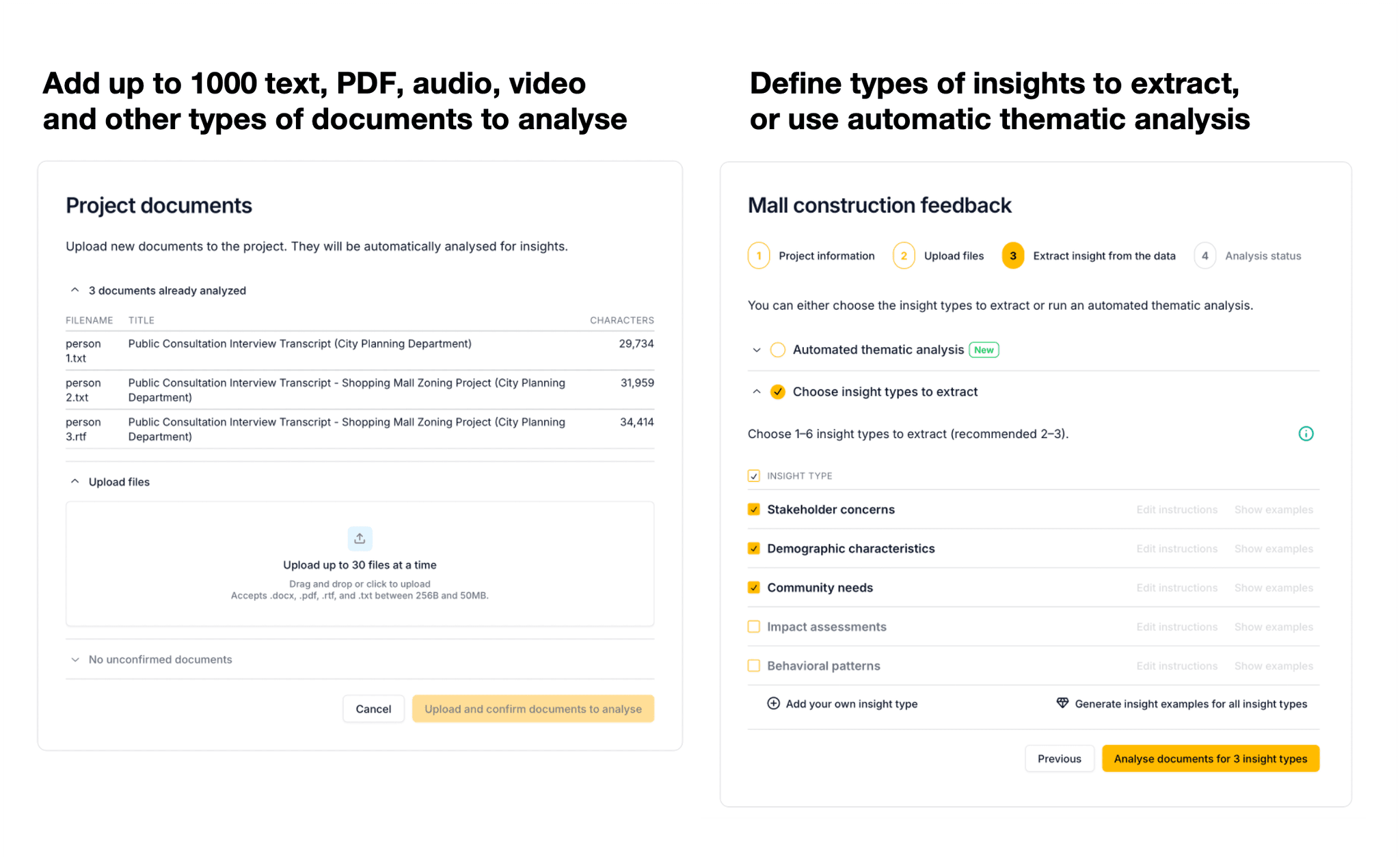
Upload documents in any format, transcribe audio and video, anonymise transcripts, or collect new data with AI-assisted interviews.
Safely upload text and audio data
Read more
Analysing interviews and other documents in multiple languages with Skimle

Read more
How to write the perfect interview guide — 10 practical tips for preparing your questions

Read more
Effective business interviews — tips and tricks from a former McKinsey Partner
Skimle accepts qualitative data in virtually any format, making it easy to start your analysis regardless of how your data was originally collected or stored. Upload interview transcripts as Word documents or PDFs, open-text survey responses as CSV files, consultation feedback as text files, data room documents, call logs, meeting notes, and more.
Audio and video files are automatically transcribed within Skimle's secure environment — multi-speaker identification included, no external transcription service required. Audio files are securely deleted after transcription. With support for over 100 languages and GDPR-compliant EU storage, Skimle handles the most demanding data protection requirements.
- PDF, Word (.docx), RTF, plain text, CSV
- Audio and video with automatic AI transcription and multi-speaker support
- Open-text survey responses and form exports
- 100+ languages supported
- Up to 1,000 documents per project
- GDPR-compliant EU storage with Data Processing Agreement
- Single-tenancy cloud option available
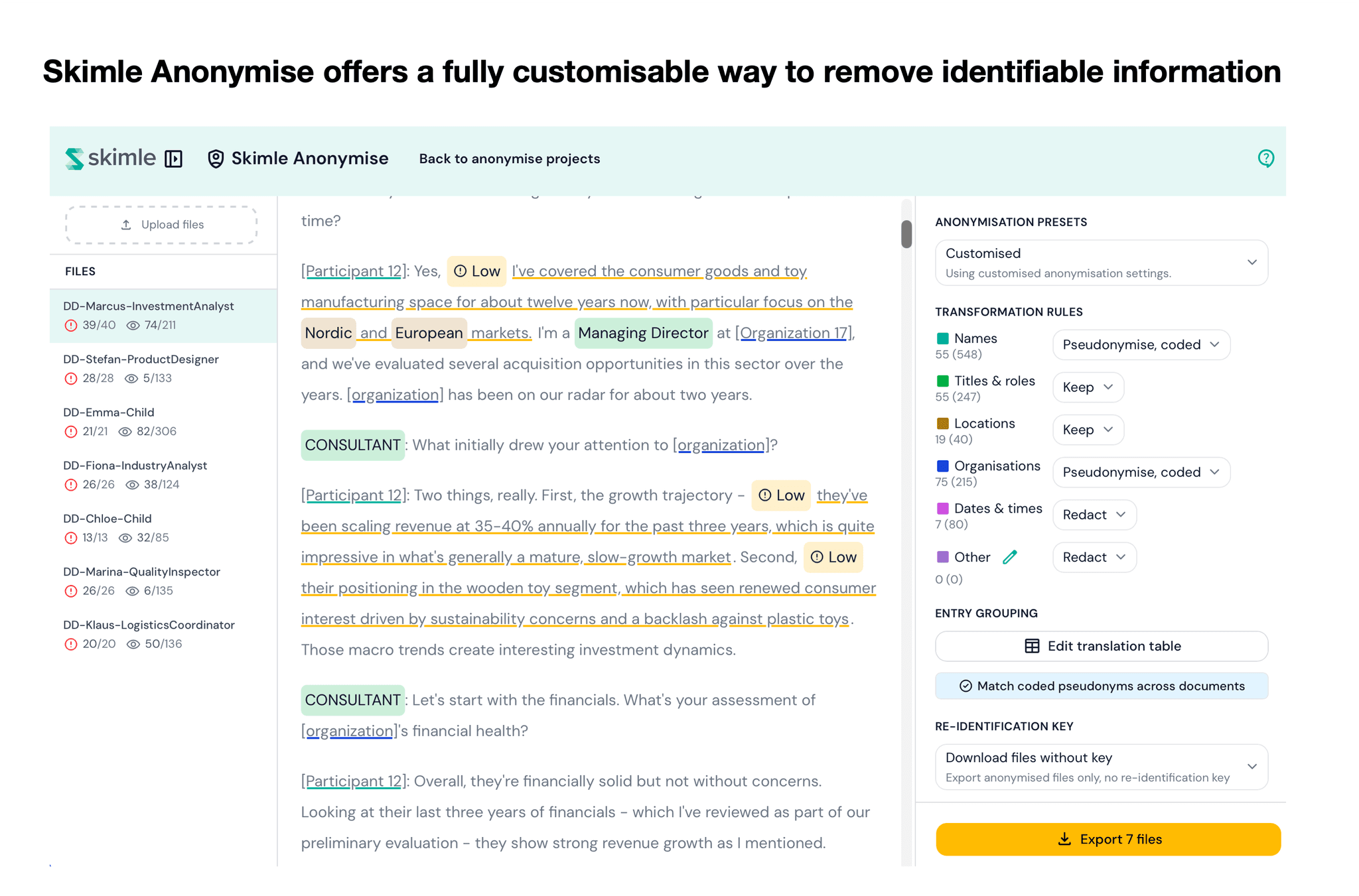
Anonymise your documents
Skimle Anonymise detects personal identifiers across six categories — names, titles and roles, locations, organisations, dates, and other — and lets you apply per-category transformation rules before sharing, archiving, or publishing your data.
Three preset compliance levels handle the main scenarios, from light pseudonymisation with a re-identification key retained, to HIPAA-grade strong anonymisation where the key is destroyed. The export includes anonymised files, a PDF audit report, and an Excel translation table.
- Six identifier categories: names, titles and roles, locations, organisations, dates, and other
- Three compliance levels — light pseudonymisation, strong pseudonymisation, HIPAA-grade anonymisation
- Cross-file consistency: same pseudonym for the same person across all documents
- Custom redaction rules in plain language
- Date shifting preserving temporal relationships
- PDF audit report and Excel translation table for ethics boards



Create "Skimle Ask" AI interviews

Read more
Gathering rich data with AI interviews — introducing Skimle Ask

Read more
HR surveys — moving from meaningless numbers to deep insights using AI interviewers
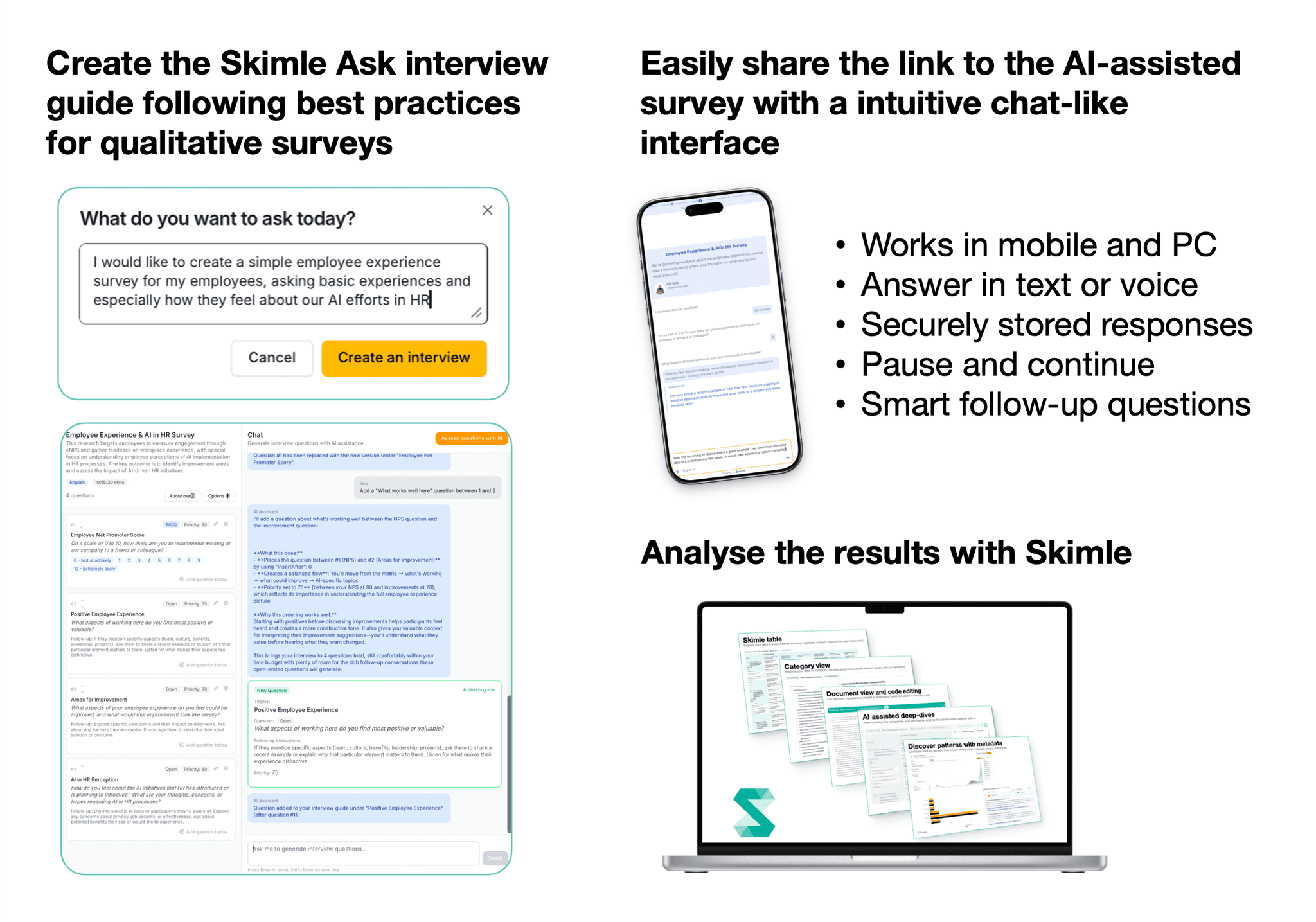
Go beyond traditional survey tools with Skimle Ask — our intelligent interview platform that conducts conversational interviews with respondents. Instead of rigid multiple-choice questions, Skimle Ask uses AI to engage respondents in natural dialogue, asking follow-up questions based on their responses, just like a skilled human interviewer would.
Skimle Ask automatically feeds responses directly into your analysis project, where they're processed alongside your other qualitative data — combining interview transcripts, survey responses, and AI-collected insights in a single analysis.
Example uses: Employee engagement surveys, gathering feedback on a transformation project, collecting ideas for new features, course feedback, user research, public consultations.
Test answering a Skimle Ask interviewStep 2
Analyse and explore your data
A structured, transparent workspace to find insights, discover patterns and verify every finding back to verbatim source quotes.
Analyse and structure data to find themes


Read more
Complete guide to thematic analysis — from raw data to actionable insights

Read more
How to use AI in qualitative research — a guide for academic researchers 2026

Read more
Using ChatGPT and other LLMs to analyse qualitative data — what works and what doesn't
At the heart of Skimle is a sophisticated AI workflow that systematically identifies insights and organises them into coherent themes and categories. Skimle reads each document carefully, understanding context and meaning to extract genuine insights — not just surface-level observations.
The approach is grounded in academic qualitative research methodology. Skimle breaks down each document into meaningful segments, identifies patterns across multiple documents, and builds a hierarchical category structure. The methodology has been validated through academic research and a patent application has been filed for the core process.
- Reads each document systematically, section by section
- Uses hundreds of atomic LLM calls per document to understand meaning
- Identifies insights and codes them iteratively to categories
- Builds hierarchical category structure across all documents
- Handles 10 transcripts to 1,000+ open-text responses consistently
Full control and two-way transparency
Skimle pioneered the concept of two-way transparency in AI analysis. Unlike chatbots that provide answers without clear sourcing, Skimle shows you exactly where every insight comes from — and critically, what the AI didn't pick up.
Click any insight to see the exact quotes supporting it. Click any quote to jump to its context in the original document. Open any document and see which text was coded — and more importantly, which text wasn't, so you can verify nothing important was missed.
You maintain full editorial control throughout. Manually edit categories, move insights between themes, merge or split categories, and adjust the entire structure to match your analytical framework.


Discover patterns across documents
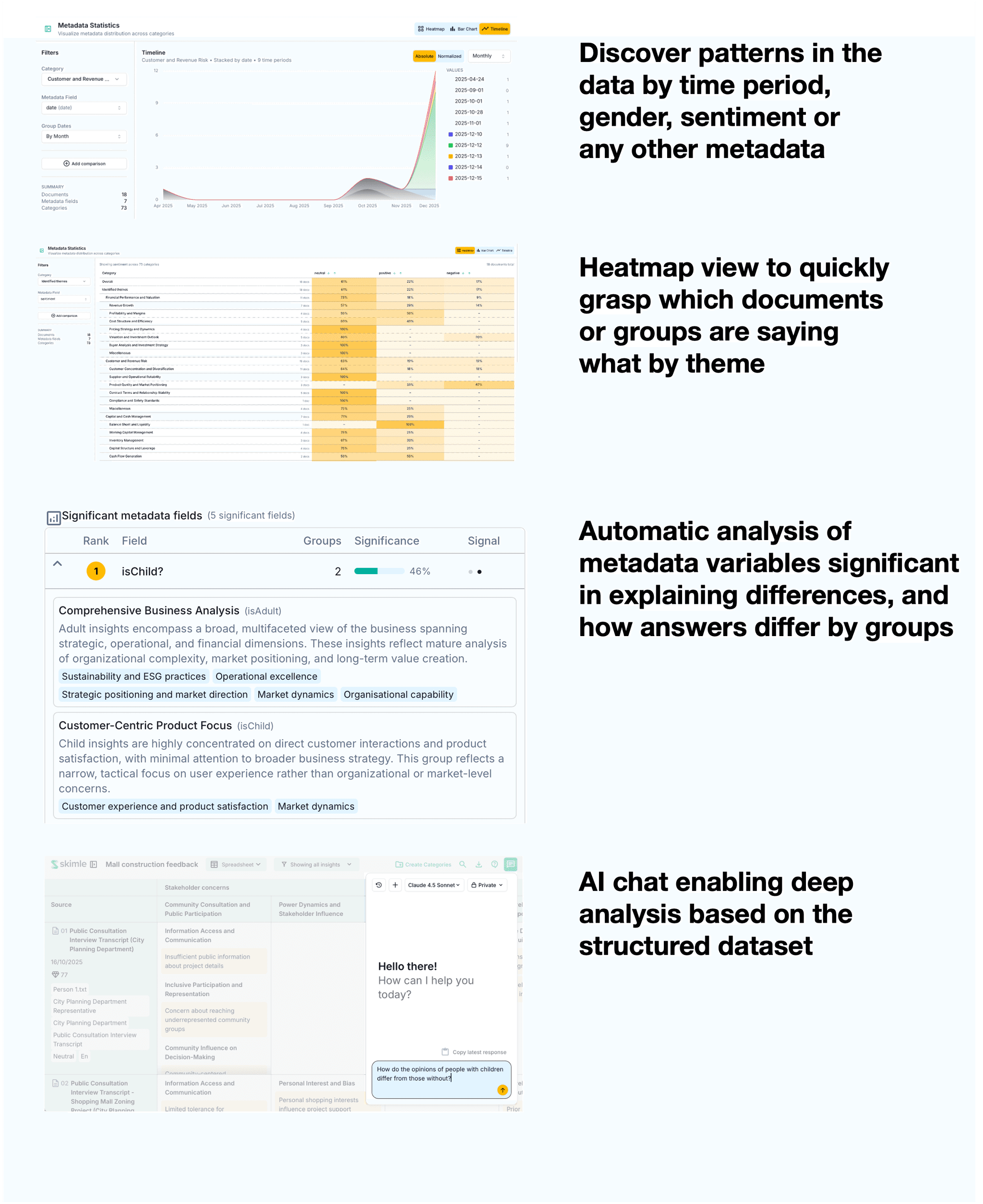

Metadata Statistics lets you explore patterns in the data. Skimle automatically assigns metadata based on document contents (e.g., sentiment and time period), allows you create metadata with AI (e.g., instructing to mark each document based on "Is this a contract, yes/no") and you can also manually add your own fields when importing on .csv files or after the data has been uploaded.
Metadata variables can be used in different ways, for example to visualise a heatmap of which topics feature in which types of documents or how the data looks different for different time periods. Skimle also automatically identifies which metadata variables best explain differences in data and summarises the differences. For example, how do the answers between women and men differ, or does the sentiment of the answer influence what features they bring up.
The AI Chat function takes this further — ask questions and receive structured, data-grounded answers. Unlike vanilla chatbot "analyse the documents" features, answers in Skimle are stable and based on your pre-structured data rather than ad-hoc retrieval.
Step 3
Export and integrate
Export to the formats you already use, evaluate documents against criteria, and connect Skimle to your systems via API and MCP.
Exports matching your workflow

Read more
End-to-end workflows — importing and exporting data with Skimle

Read more
Self-serving qualitative data — how AI enables democratisation of insights

Read more
Manual coding and REFI-QDA export — combining Skimle AI analysis with manual workflows
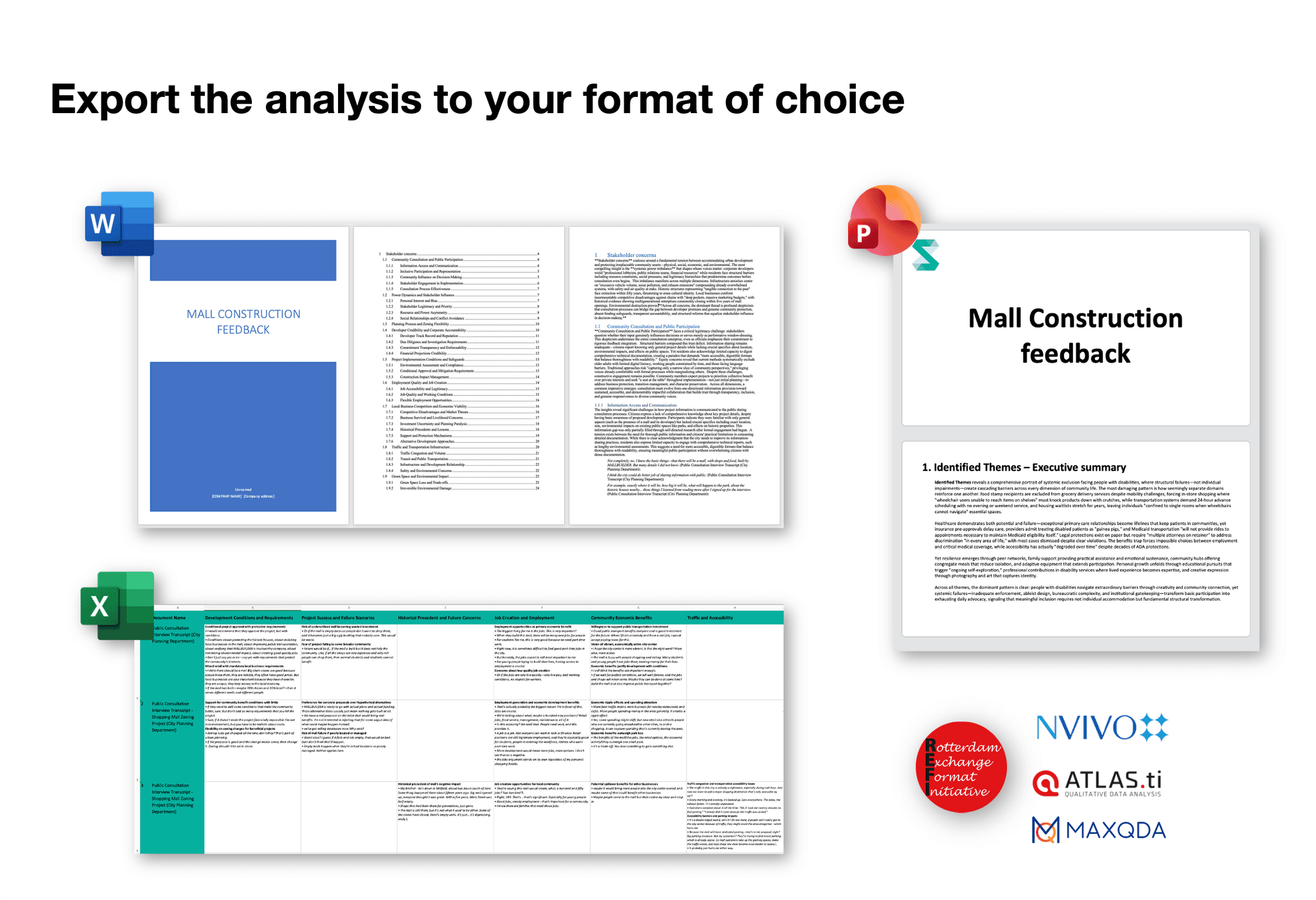
Generate comprehensive Word reports with organised sections, executive summaries, and supporting evidence. PowerPoint decks with key themes and verbatim quotes formatted for stakeholder communication. Excel for further quantitative analysis, REFI-QDA (.qdpx) for interoperability with NVivo, MAXQDA and ATLAS.ti, or integrated with AI tools via MCP connections.
- Word report with executive summary, category hierarchy and verbatim quotes
- PowerPoint deck with key themes and evidence per slide
- Excel export of the full Skimle table
- Open source REFI-QDA (.qdpx) format for NVivo, MAXQDA, ATLAS.ti and other legacy coding tools
- Simple word document export with coding shown as comments in each document
- Bespoke export formats being developed together with customers
Agentic Chat and MCP

Read more
Introducing Skimle MCP: connect your qualitative research to AI tools

Read more
Step-by-step guide to agentic analysis workflows with Agentic Chat and MCP
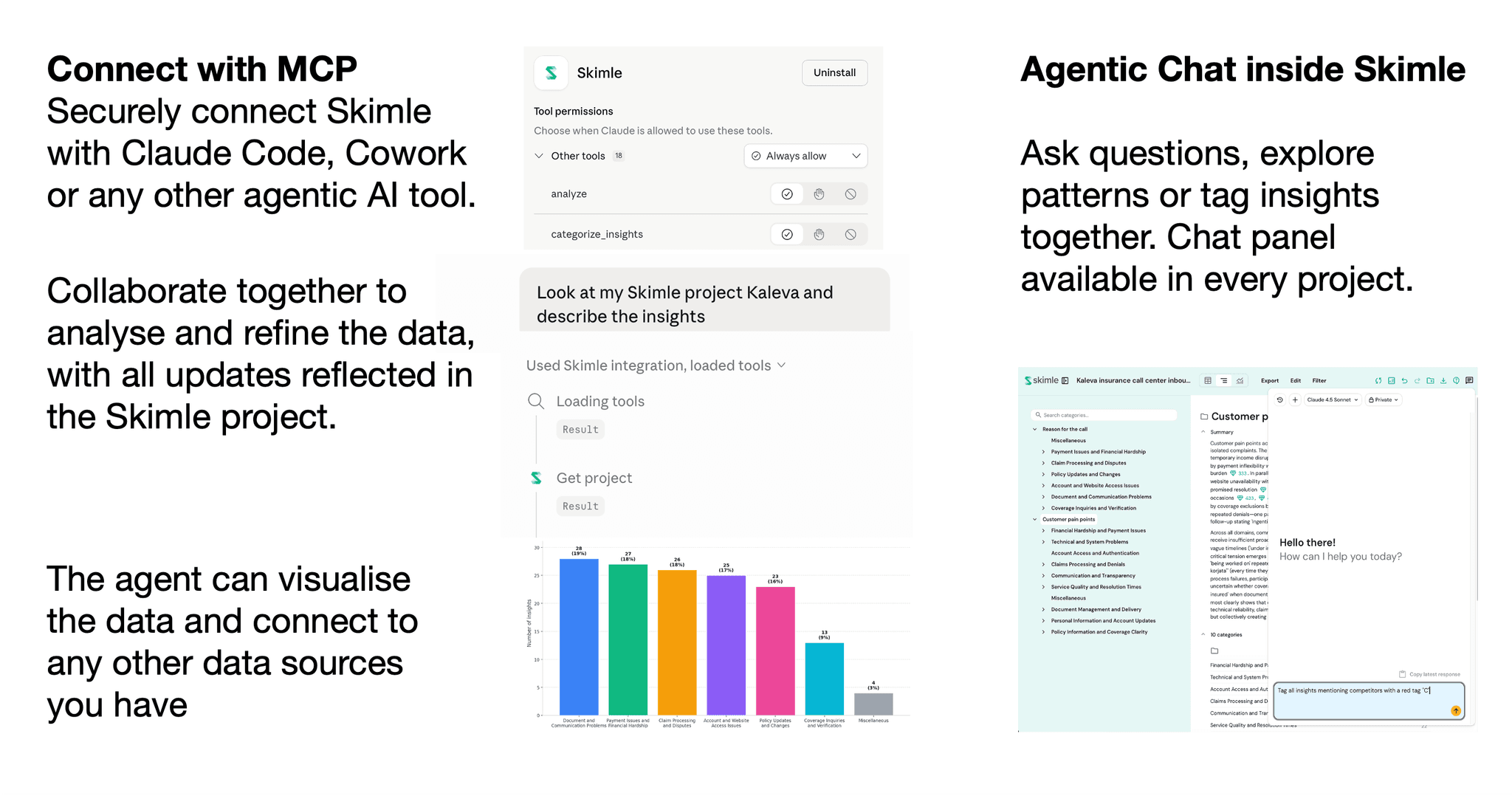
Skimle is fully agentic. Every project includes a Chat tab with a structured AI agent that knows your data model — categories, insights, metadata, documents — and can search, compare, reorganise, and annotate, all with citations back to source quotes. This is not a chat wrapper over documents; it is a purpose-built research agent operating on structured data.
The same agent is available externally via Model Context Protocol. Connect Claude Code, Cursor, Windsurf, or any MCP-compatible tool to your Skimle project and access 13 read tools and 5 write tools — from semantic search and metadata filtering to creating insights and reorganising categories.
Collaborate with your team
A Skimle project is a shared workspace. Invite colleagues into the same project and everyone works on the same documents, categories and insights, so coding decisions, tags and notes stay in one place instead of scattered across separate copies. You set the level of access for each person you invite: Editors can upload documents, run analyses and edit the results, while Viewers can read and explore everything in the project without changing it.
In enterprise accounts, an administrator has full control over the organisation. They decide who can access which projects, what each member is permitted to do, which features are switched on, and how credits are allocated and spent across teams. That makes it straightforward to bring a research assistant, client or external reviewer into a single project while keeping oversight of the whole account.
How does Skimle compare?
Skimle vs. other qualitative analysis approaches
There are four ways to approach qualitative data analysis. Only Skimle combines rigour, speed and full transparency.
| Ad Hoc | Rigorous NVivo, MAXQDA… | Ad Hoc + AI ChatGPT, RAG… | Skimle | |
|---|---|---|---|---|
| Rigorous | — | — | ||
| Transparent | — | — | ||
| Fast | — | |||
| Versatile | — | — | ||
| Price | Free / ad-hoc | $100–1,840/year | $0–25/month | Free trial · Starting at €20/month |
| Learning curve | Low | High (weeks) | Low | Low (no training needed) |
| Scale (1,000+ docs) | Limited | Limited by manual effort | Unverifiable coverage | Up to 1,000 docs per project |
| GDPR / EU AI Act | Limited | Limited | Limited | Built-in · EU servers · DPA available |
| Verdict | Fast but cursory — glancing through materials, brief summaries, no systematic coverage. | Publication-quality rigour, but months of manual coding per project. | Fast in demos, but answers vary by query, coverage is unverifiable, and outputs can't be defended. | Academic-grade rigour at AI speed — every document systematically analysed, fully transparent. |

Read more
Why 'RAGs to riches' doesn't work — structuring data instead of dumping embeddings

Read more
Qualitative data analysis software — a 2026 comparison of tools

Read more
How does ChatGPT actually work? And how do LLMs analyse data?
What Skimle isn't
Skimle is not a tool for producing quick AI summaries or outsourcing thinking to a machine. It is a power tool for human experts — designed to let you do 200% quality work, not 50% effort work. Skimle handles the systematic, labour-intensive parts of qualitative analysis so that you can spend more time on judgement, interpretation, and insight — the things only a domain expert can do well.
FAQ
Frequently asked questions
- What is Skimle?
- Skimle is an AI-powered qualitative data analysis platform that systematically structures unstructured documents — interviews, reports, consultations, customer feedback — into organised, analysable datasets with full traceability. Unlike chatbots, Skimle processes your entire document set upfront, extracting insights and organising them into hierarchical themes where every finding links to a verified verbatim quote.
- How is Skimle different from ChatGPT or RAG-based tools?
- RAG tools retrieve relevant passages at query time — so you get different answers each time you ask the same question. Skimle analyses your entire dataset systematically upfront, creating a stable structure where every theme links to verified quotes. You get comprehensive coverage, consistent results, and full traceability instead of black-box answers.
- How is Skimle different from NVivo, MAXQDA, or ATLAS.ti?
- Traditional tools require manual coding of every passage — systematic but time-intensive, taking weeks to months. Skimle automates the coding process with AI while maintaining the same systematic, transparent methodology. You get NVivo-quality rigour at a fraction of the time, with a more intuitive cloud-native interface that requires no weeks of training.
- Can I use Skimle for academic research?
- Yes. Skimle is built by academics and inspired by established methodologies: thematic analysis (Braun & Clarke), grounded theory (Glaser & Strauss; Strauss & Corbin), and the Gioia method (Gioia, Corley & Hamilton). Skimle's full audit trail lets you document exactly how themes were derived, which satisfies peer review requirements. Researchers at 30+ universities currently use Skimle, and we provide suggested citation language upon request.
- What languages and file formats does Skimle support?
- Skimle supports 100+ languages and accepts PDF, Word (.docx), RTF, TXT, CSV, audio (MP3, M4A, WAV) and video (MP4, MOV) files. You can mix formats and languages in a single project — upload English interviews, German reports, and Spanish survey responses together. Audio and video are transcribed automatically.
- Is Skimle GDPR compliant and secure?
- Yes. All data is stored in the European Union and never leaves EU servers. Skimle is fully GDPR compliant and provides Data Processing Agreements for institutional customers. Your documents are never used to train AI models. Single-tenant cloud deployments are available for enterprise clients with stricter data sovereignty requirements.
- How do you prevent AI hallucinations?
- Every insight Skimle generates is verified against source documents — if the AI produces text that does not exist verbatim in your data, the system flags it and re-processes. Two-way transparency lets you click any theme to see the exact supporting quotes, and open any document to see which text was coded and which was not, so nothing can be invented or missed.
- How quickly can I get my first results?
- Most projects are ready within 1–3 hours of uploading your documents, depending on volume. A typical set of 10–20 interview transcripts is usually processed in under an hour. You can upload, start an analysis, and have structured themes with supporting quotes ready to explore the same day — no setup or training required.
- Do I need technical skills to use Skimle?
- No. Skimle is designed for qualitative researchers, analysts and consultants — not engineers. You upload your documents, describe your research question, and Skimle handles the rest. Editing categories, exploring themes, and exporting reports all work through a point-and-click interface. No coding, scripting, or AI expertise required.
- How does pricing work? Is there really a free trial?
- Yes — Skimle offers a free trial with 200 credits (enough for approximately 200–300 pages of documents) and no credit card required. Paid plans start at €20/month for individuals on annual billing (€25 month-to-month), with larger plans for heavy users. Organisational and enterprise plans with custom volumes, SSO, and single-tenant deployments are available on request.
- What's the maximum number of documents I can analyse?
- Skimle supports up to 1,000 documents per project. This is well beyond what any manual approach could handle and covers most professional use cases — from 10 in-depth interviews to 1,000+ open-text survey responses. If you have a particularly large dataset or ongoing analysis needs, contact us to discuss options.
Built for professionals, by professionals
Skimle is based in Finland and developed "by researchers for researchers" and "by business people for business people". Our team combines decades of high-quality manual thematic analysis from academia and consulting, with expert software engineers and designers.
We are trusted by Finnish government ministries, over 30 universities, dozens of consulting and market research firms and large companies. All data is stored within the EU and processed according to our strict GDPR policy and terms of service.
Want to learn more? Explore our Signal & Noise blog, our FAQ, and use cases by sector. We're also happy to demo the product or explore how Skimle could fit your needs. Read more about Skimle