In a strategy consulting project, primary research typically means 20-30 stakeholder interviews conducted over 2-4 weeks to inform a recommendation that the client is paying (often significantly...) for. The interviews may be with customers, prospects, competitors, distribution partners, or industry experts. The findings need to be reliable enough to anchor a recommendation, fast enough to fit a project timeline, and structured enough to survive a presentation to a sceptical executive committee. These experts could come from the client, wider industry, internal experts, analysts or other sources, and sometimes the interview-based research is complemented with surveys, observations (e.g., mystery shopping) or external datasets.
Having run well over a thousand interviews across McKinsey engagements and observed a great many more, the most common failure mode is not bad interviewing. It is failing to design the research properly before the first meeting is booked. Teams rush to fieldwork before they have been honest with themselves about what the interviews need to establish.
This guide covers the full consulting research workflow: how to scope the research design, how to build an interview guide that actually works, how to run the fieldwork efficiently, and how to synthesise findings across 20+ interviews quickly enough to be useful.
Phase 1: scoping — work backwards from the deliverable
Before you book a single interview, answer three questions:
What decision will this research inform? Consulting primary research should be hypothesis-driven. You are not exploring to see what you find or building a grand theory... you are testing specific propositions that will confirm, refute, or refine the strategic recommendation. List the 3-5 hypotheses that the research needs to address. If you cannot name them, the research will wander.
What would change the recommendation? This is the inverse of the above, and a more demanding question. If the interviews revealed X, would you recommend differently? If the answer is "no, we'd find a way to accommodate it," then you don't actually need the primary research — you're doing it for proof rather than learning. That is fine to acknowledge; it shapes the research design differently.
Who has the information? Map the universe of people who could answer your hypotheses: customers (current, lapsed, prospective), market participants (distributors, intermediaries, suppliers), competitors (reachable via expert networks), and independent experts (academics, former executives, industry analysts). For each research question, identify the ideal respondent type. You rarely get to interview everyone, so prioritise by information value.
The worst research I have seen is when question 2 above is not considered and everything is done just to support a decision. For example, there was a large museum considering opening a new branch, and the primary research conducted was simply trying to justify how lots of new people would visit the city because of the museum. People on the street were asked how much longer and more likely they would visit the city... and of course most politely gave estimates that when analysed led to significant opportunities. A proper research design would have been less bullish and tried also to disprove the whole idea of additional visits.
Phase 2: designing the interview guide
A consulting interview guide is not a questionnaire. It is a structured conversation framework that the interviewer can adapt in real time while covering the essential ground.
Structure it as a funnel: Start with broad context (who is this person, what is their situation, what is their relationship to the topic), then move to the specific areas your hypotheses address, then close with forward-looking questions that reveal priorities. 45-60 minutes allows for 4-5 topic areas at roughly 8-10 minutes each.
Write fewer questions than you think you need. A guide with 40 questions produces a rushed, shallow interview. A guide with 12-15 carefully chosen questions, each with 2-3 follow-up probes, produces rich material. The best consulting interviews feel like a conversation that went somewhere useful, not a form being completed.
Hypotheses should drive the topics, not appear as questions. If your hypothesis is "customers value delivery speed more than price in this segment," your guide topic might be "trade-offs in supplier selection" with probes like: "Tell me about the last time you switched suppliers — what drove that?" and "If you had to give something up, what would you give up first?" The hypothesis is tested through the story, not by asking "is delivery speed more important than price?"
Put the context-setting topics first, the most sensitive topics last. Respect the relationship-building dynamic of the interview. Asking someone to compare you to competitors 3 minutes in, before trust is established, produces defensive or diplomatic answers.
For a deep dive on interview technique, see how to conduct effective business interviews and how to write a perfect interview guide.
Phase 3: sample design and sourcing
How many interviews? For a consulting project, 15-25 interviews across your key respondent types typically produces reliable findings. Fewer than 10 and you risk being misled by outliers. More than 30 and you are usually experiencing diminishing returns — the same themes keep appearing.
The key is heterogeneity within purpose. If you are testing a hypothesis about customer preferences, you want customers who vary on the dimensions that matter (industry, size, tenure, relationship depth) — not a convenience sample of customers who are easy to reach.
Sourcing: Four main channels for consulting interviews:
- Client relationships: The client can often open doors to customers and partners. Useful, but creates social desirability effects — respondents know they are talking to the client's advisors and may moderate their views. Acknowledge this in your interpretation.
- Expert networks: GLG, AlphaSights, Guidepoint, Third Bridge. The expert network industry reached approximately $3 billion in revenue in 2025, growing at 12% annually, which reflects how central these platforms have become to consulting primary research. Expert calls are typically 30 to 60 minutes, compliance-screened, and can be arranged quickly. They are excellent for industry expertise and competitor perspective but less useful for current customer experience. And they cost a lot...
- Direct outreach: For specific individuals (former executives, known industry figures, academics), direct LinkedIn or email outreach often works better than going through a network. It takes more time but produces more candid conversations.
- Internal experts: Consultants working in a larger consultancy have the benefit of being able to call to people within the company. I can't count how many great calls I had with my peers at McKinsey - it seemed there was an expert for almost all topics. And in turn I would take the late evening calls when people wanted to understand operating models, digital and AI topics :)
For a detailed guide on maximising expert network calls, see expert network calls: how to get more from primary research.
Phase 4: fieldwork
Note-taking or recording? Both, where possible. A summary memo written within 30-60 minutes of each interview — while memory is fresh — is more useful than a full transcript for most consulting purposes. But having the recording as a backstop is valuable. If you are not recording, have a note-taker so the interviewer can focus on the conversation.
The post-call memo: Write it immediately. Format: respondent profile (who, what role, context), 3-5 key points from the call, any evidence that strongly confirmed or challenged a hypothesis, anything surprising or unexpected. Keep these to one page. After 20 calls, you will have a corpus of structured summaries that dramatically simplifies synthesis.
Confidentiality: For expert network interviews, the expert's employer and identity is typically confidential. Attribute findings in your deliverable to "industry expert interviews" or "customer interviews" rather than to named individuals. For direct outreach interviews, agree confidentiality terms upfront.
Managing the clock during calls: A 30-minute expert call feels long until you realise you have 5 topics and 20 minutes left. Prioritise ruthlessly. The 2-3 topics that most directly test your hypotheses get the most time. Be willing to cut a topic if the conversation is producing valuable material on something else.
Phase 5: synthesis — turning 20 interviews into a finding
This is where many consulting primary research projects try to cut corners. The team completes fieldwork, the memos are written, and then faces the challenge of converting 20+ individual accounts into 4-5 clean findings that can anchor slides.
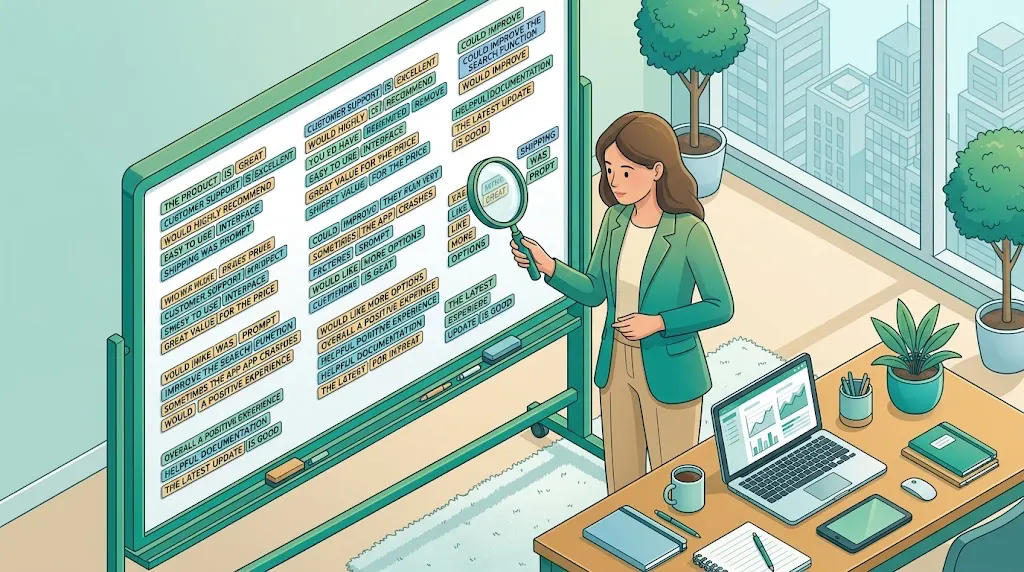
The manual way: spread the memos across a wall or table, find the recurring patterns, note the quotes that capture them, write the finding. This works, and skilled consultants do it well. It takes days for a full dataset.
With AI support: loading all interview transcripts or post-call memos into a structured analysis tool dramatically accelerates synthesis. Skimle can identify recurring themes across tens or even hundreds of documents, code them by topic area (matching and expanding on your research hypotheses), and surface the supporting quotes for each pattern. You still do the interpretive work — you decide whether a pattern is a genuine finding or noise — but the mechanical assembly is compressed from days to hours. Using metadata analysis, you can also compare patterns across respondent types (customer vs expert vs competitor) and segments (SMB vs enterprise, different geographies).
How to present findings that hold up to scrutiny
Consulting clients are smart and sceptical. Research findings presented as percentages from 15 interviews will be challenged — correctly. The right framing acknowledges the qualitative nature of the evidence while building confidence in the pattern:
- "Consistently across customer interviews, the dominant concern was X" — stronger than "8 of 15 customers said X" (which invites the question of what the other 7 said)
- "In several independent expert conversations, unprompted, Y came up as a risk" — the unprompted and independent qualifications matter
- Quote the most vivid example verbatim — one well-chosen direct quote is often more persuasive than a frequency count
For a full treatment of this challenge, see presenting qualitative research findings to executives.
Frequently asked questions
How many interviews do you need for a consulting project?
15-25 interviews across relevant respondent types is a reasonable target for most strategy consulting projects. For a narrow, specific hypothesis (e.g. testing one aspect of a market), 8-10 well-targeted interviews can be sufficient. For a broad market assessment, 25-35 may be needed across multiple segments. Quality matters more than quantity — 12 rich, well-sourced conversations are more valuable than 25 superficial ones.
How do you handle a respondent who is not candid?
Diplomatic or guarded responses are common when: the respondent knows they are being recorded, they have a relationship with the client, or they are worried about competitive sensitivity. Techniques to open candid conversation: establish early that the findings will be aggregated and anonymised; ask about the industry or "what you see others doing" before asking about their specific experience; acknowledge the sensitivity directly ("this is a delicate area — I appreciate you being candid").
Should you share the interview guide with respondents in advance?
Not always. For expert network calls, sharing a brief agenda (3-4 topic bullets) is appropriate and expected. Sharing the full guide can produce over-prepared, less candid responses. For customer interviews where you want genuine reaction rather than rehearsed answers, share only the general topic areas.
How do you code and synthesise qualitative interview data quickly?
The fastest reliable approach: structured post-call memos (written immediately after each call), followed by pattern analysis across the memo set. For transcripts, AI-assisted analysis reduces the time to identify recurring themes across a corpus by orders of magnitude — what used to take 2 days of manual work can be accomplished in hours. The interpretation still requires human judgement. See how to analyse interview transcripts for the step-by-step process.
Can primary research findings be cited in published reports?
Only with explicit consent. For expert network interviews, the expert's employer is always confidential by the network's terms. For customer interviews, agree citation terms upfront. "According to our primary research interviews with 20 market participants" is typically safe; "According to [company name]'s customer X" requires consent.
Ready to synthesise 20+ consulting interviews quickly without losing any of the nuance? Try Skimle for free — load your post-call memos or transcripts, identify the patterns that hold across respondents, and export a structured findings brief.
Related reading:
- Expert network calls: how to get more from primary research
- Commercial due diligence: how AI changes the primary research workflow
- Win-loss analysis: how to systematically learn from deals
About the author
Olli Salo is a former Partner at McKinsey & Company where he spent 18 years helping clients understand the markets and themselves, develop winning strategies and improve their operating models. He has done over 1000 client interviews and published over 10 articles on McKinsey.com and beyond. LinkedIn profile