AI-assisted qualitative analysis means using large language models to support parts of qualitative analysis, such as summarising interviews, coding passages, grouping codes into categories and searching for counter-evidence, while the researcher keeps control of interpretation and theory. Used well, it lets you work with all of your data rather than a sample. Used badly, it produces confident, unverifiable findings.
I am a professor of strategy at Aalto University and have published qualitative, interview-based studies in journals including Academy of Management Journal, Organization Science and Strategic Management Journal. In 2026 I set out the case for artificial intelligence in qualitative research in Organization Studies. I am also a co-founder of Skimle, an AI tool for qualitative analysis, so read my recommendations with that interest in mind. This guide is written for PhD students and academic researchers doing theory-building, interview-based work, particularly in management, organisation studies and neighbouring fields.
The guide covers what AI-assisted analysis is, where the academic debate stands, what the empirical studies show, how AI can help at each stage of a study, the main risks and safeguards, and how to report AI use in your methods section.
The two-minute video below summarises the guide: the academic debate, how well AI fits different methods, AI at each stage of a study, the main risks and how to disclose AI use.
What is AI-assisted qualitative analysis?
AI-assisted qualitative analysis is any analytic workflow in which an AI model performs part of the work and a researcher directs, checks and interprets it. The term covers very different tools, and the differences matter more for academic work than the models inside them.
| General chatbots (ChatGPT, Claude, Copilot, Gemini) | AI add-ons in traditional QDA software (NVivo, ATLAS.ti, MAXQDA) | AI-native analysis tools (for example Skimle) | |
|---|---|---|---|
| What AI does | Answers prompts about uploaded text | Suggests codes, summaries or chat answers inside a manual coding project | Runs a structured workflow: extracts passages, codes, categorises and summarises across the whole dataset |
| Coverage | Uneven: long uploads are searched, not read in full | Depends on the feature; often one document or a selection at a time | Every document processed, with uncoded passages visible |
| Traceability | Quotes may be paraphrased or invented | Codes are linked to passages | Every finding linked to verified source passages, and every passage to what it was coded as |
| Researcher control | Re-prompting | Full manual editing of codes | Editing, merging, splitting and restructuring of the AI's draft |
| Data protection | Varies by plan and provider | Varies; often cloud AI features in a desktop tool | Varies; check data location and model training terms |
| Best academic use | Brainstorming, reading support, single documents | Researchers committed to manual coding who want light assistance | Systematic analysis of larger datasets with an audit trail |
For a broader look at the tool landscape, see our comparison of AI tools for qualitative research released in 2026, and for why chat interfaces struggle with whole datasets, how ChatGPT actually works.
Where does the academic debate stand in 2026?
AI-assisted analysis is contested, and you should know the arguments before you choose a position in your own methods section.
In 2025, Tanisha Jowsey, Virginia Braun, Victoria Clarke, Deborah Lupton and Michelle Fine published an open letter in Qualitative Inquiry, co-signed by 419 qualitative researchers from 32 countries, rejecting generative AI for reflexive qualitative research (Jowsey et al., 2025). Their core argument is that approaches such as reflexive thematic analysis depend on a subjective, positioned researcher, so handing analysis to AI is not methodologically congruent. They also raise social and environmental justice concerns. In 2026, Susanne Friese, Kien Nguyen-Trung, Steve Powell and David Morgan replied in the same journal, arguing against a binary pro-AI versus anti-AI framing and for critical, reflexive integration (Friese et al., 2026).
My own position, which I develop in Organization Studies, is that the right question is not whether to use AI but whether it augments the researcher or automates them out of the analysis. AI has real strengths for qualitative work: practically unlimited attention, the same granularity of coding across every document, and no sunk cost when you want to recode a corpus for the third time. Those strengths are only useful if the researcher still reads, interprets and decides.
Methodological fit is the practical test. AI's role should differ by approach:
| Approach | How well AI fits | Sensible use of AI |
|---|---|---|
| Reflexive thematic analysis | Contested; its authors argue against it | Transcription, reading support and retrieval at most; keep coding and theme generation human |
| Codebook and framework approaches | Good | Apply an agreed codebook consistently across all data, with human checks on a sample |
| Grounded theory | Good for open coding and constant comparison; theorising stays human | Code every new interview as it arrives, compare categories, search for negative cases |
| Theory-building case studies (the Gioia tradition and similar) | Good for organising evidence | Map data to emerging dimensions, check how much evidence supports each claim |
| Content analysis | Very good | Systematic categorisation and counting, with reliability checks |
| Interpretative phenomenological analysis | Limited | Close, idiographic reading is the method; use AI only for administration |
What does the research say about AI and human coding?
The empirical evidence is still thin but consistent. AI is good at finding descriptive themes and organising evidence, weaker at interpretation, and prone to confident errors that a researcher must catch.
| Study | What was compared | Main finding |
|---|---|---|
| Wachinger et al. (2024), Qualitative Health Research | ChatGPT against an experienced human analyst on the same interview data | Substantial overlap in themes, but ChatGPT stayed descriptive rather than interpretive and fitted data to theoretical frameworks that did not apply |
| Cevik and Abu-Zidan (2025), Cureus | A custom GPT following Braun and Clarke's six steps against manual analysis of three datasets | 15-25 minutes instead of 492-705 minutes, but variable outputs between runs and little explanation of decisions |
| Our sycophancy experiment (2026) | A general AI assistant asked about cultural differences in 650 comments with randomly assigned country labels | The assistant confidently reported stereotyped cultural differences, with supporting quotes, in data where none existed |
| Our reanalysis of an Organization Science study (2026) | Skimle's automatic analysis of 53 interviews against our published analysis | The AI surfaced most of our themes and often the same quotes, but flattened a longitudinal story that only became visible by comparing informants over time |
The last two are ours, so treat them as illustrations rather than independent evidence. They point to the same lesson as the independent studies: AI is a strong retriever and organiser of evidence and a weak judge of what the evidence means.
How can AI help at each stage of a qualitative study?
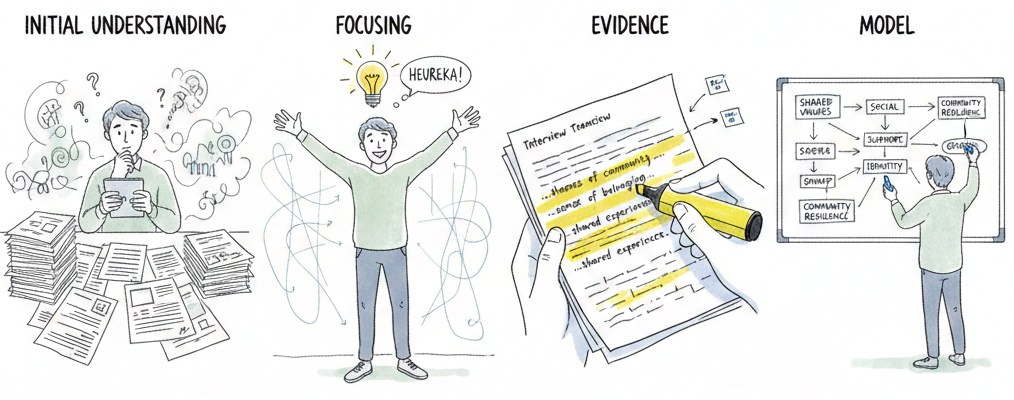
After collecting interviews and secondary data, theory-building studies typically move through four interconnected stages: developing an initial understanding, defining and refining the research question, marshalling evidence, and building a theoretical model. AI can help at each stage, but in different ways.
| Stage | Use AI for | Keep for yourself | Risk to watch |
|---|---|---|---|
| 1. Initial understanding | Interview summaries, overview of topics across the dataset | Reading the data, especially the most informative interviews | Mistaking summaries for understanding |
| 2. Research focus | Checking how much data speaks to candidate questions and concepts | Deciding what the data is a case of | Asking leading questions and getting agreeable answers |
| 3. Evidence | Systematic coding, categorisation, comparisons across informant groups and time | Judging what passages mean and which ones matter | Over-interpretation and flattened context |
| 4. Theoretical model | Alternative readings, counter-evidence, checking claims against the data | The creative leap to an explanatory model | Cognitive surrender to plausible but obvious output |
1. Initial understanding: summaries and an overview of the dataset
It is useful to start by "taking control" of the dataset: writing summary memos, highlighting interesting passages and noting the weaknesses of the data. AI is good at this. A chatbot can summarise an interview from the perspective of your research interest, and an automatic thematic analysis can summarise answers to each interview question across all interviews.
Summaries are not understanding, though. If your goal is theory, you still have to read your data. Conducting interviews is intensive work, and you probably remember less of what your informants said than you think.
2. Defining the focus: "what is this a case of?"
Good qualitative studies often change their research question several times. In our own Organization Science study, we spent years framing the data around organisational identity before realising it was a study of social purpose. AI can speed up this search by showing how much of your data speaks to each candidate concept, and how varied that evidence is.
Do not ask the AI what is surprising in your data: it will tend to give you the obvious. Use it to test your own observations instead. Ask how many informants discuss an idea, who they are, and what the counter-examples look like.
3. Marshalling evidence: AI-assisted coding and categorisation
Developing theory involves coding empirical passages, grouping codes into categories and linking categories into an explanatory model. This is where AI saves the most time, because it can code every passage in every document at the same level of detail. See our guides to qualitative coding and to inductive, deductive and abductive coding for the choices involved.
Two capabilities matter for academic work. First, comparison across metadata: splitting categories by informant type, site, country or interview date. Our reanalysis showed why: without it, the AI merged views from 2017 and 2023 that contradicted each other. Second, recoding through a different lens: re-categorising the same coded passages through an alternative theoretical frame. In my New Scholars webinar I re-categorised one dataset through transaction cost economics in minutes, and most quotes landed in "miscellaneous", a quick signal that the lens did not fit.
4. The theoretical model: where AI cannot replace you
Building an explanatory model is the most creative part of qualitative research, and there are no real shortcuts. AI can still help by playing an adversarial role. An agentic analysis can generate the obvious explanations and null hypotheses in a dataset, which you can then treat as the alternatives your theory has to beat, and it can search for counter-evidence to each emerging claim.
The biggest risk at this stage is what I call cognitive surrender: accepting output that looks compelling and is often technically correct, but is too obvious to build a contribution around.
Iterate during fieldwork, not only after it
The most radical change AI allows is to the shape of the research process. Instead of the waterfall model of design, collect, analyse and write, you can code every new interview into the same scheme as it arrives, so your sampling and interview guide can adapt during fieldwork rather than months later. Qualitative research has always been iterative in principle; AI makes it practical.
What are the risks, and how do you manage them?
In every stage, the greatest risk is that the researcher stops attending to the data and outsources the thinking. The table summarises the specific risks and the safeguards I recommend.
| Risk | What it looks like | Safeguard |
|---|---|---|
| Hallucinated quotes | A quotation that is paraphrased or does not exist in the transcript | Use tools that verify every quote verbatim against the source, and spot-check before citing |
| Sycophancy | The AI finds whatever you ask about, such as "conflict" in neutral disagreements | Ask neutral questions, then ask for disconfirming evidence; read passages yourself |
| Incomplete coverage | A summary of 50 interviews built from a handful of retrieved passages | Use workflows that process every document and show what was not coded |
| Flattened context | Views from different times or informant groups merged into one theme | Compare categories by metadata such as date, role or site |
| Cognitive surrender | Accepting a plausible but obvious analysis | Treat AI output as a draft and a set of alternatives to beat |
| Bias | Coding errors that correlate with who is speaking | Check results across groups; see bias in AI-assisted qualitative analysis |
| Privacy breaches | Identifiable interview data processed outside the agreed jurisdiction | Check data location, processing agreements and training terms; pseudonymise first |
| Irreproducibility | Different results each time, with no record of what was done | Prefer predictable workflows and keep an analysis log |
The sycophancy problem deserves a concrete example. Prompt a chatbot to "find examples of organisational conflict in these interviews" and it will label statements such as "we debated the strategy extensively before reaching consensus" as conflict, because it is trying to satisfy your request. A better approach is to collect every passage about disagreement or decision-making, and then decide for yourself which are healthy debate and which are dysfunctional conflict. The AI organises; you interpret.
In Olli Salo's experiment with randomly labelled comments, a general AI assistant invented cultural differences between Finnish and US customers. When the labels were flipped, it found the same stereotypes again.
What should you look for in an AI tool for academic research?
Most of these risks are design problems, not model problems, which is why the choice of tool matters. We have set out 9 design criteria for AI-assisted qualitative analysis tools, based on the critiques in the literature. The four that matter most for academic work:
- Non-fabrication. No quote or claim that is not present in the source, checked by software rather than trusted to the model.
- Two-way transparency. You can move from any finding to its sources, and from any source to how it was coded. See two-way transparency and why a citation is not an analysis.
- Substantive control. Editing the AI's draft must be easy, or researchers quietly stop doing it. Human in the loop is not a checkbox.
- Method-agnosticism. The tool should support inductive, theory-driven and abductive work, rather than nudging everyone towards one approach. I discuss this in designing AI that augments qualitative researchers.
For tool-by-tool comparisons, see the best tools for PhD students doing qualitative research and our NVivo alternatives for academic researchers.
How do you stay reflexive when using AI?
Reflexivity now needs to cover the role of AI in your analysis, whether you use it or not. I suggest a two-sided check. Staying in form asks whether you are still the one doing the analysis: did you read, verify, challenge and overrule the tool? Raising the bar asks whether AI made the analysis better than it would otherwise have been: did you test alternative framings, search for counter-evidence and use the time saved to go deeper?
A study that only does the first is safe but no better than one done in 2019. A study that only does the second risks findings no one can trace back to the data. My longer piece on reflexivity about AI: staying in form and raising the bar includes questions for each stage and an example journal entry.
How do you report AI use in your methods section?
Disclosure is now expected. The Committee on Publication Ethics states that AI tools cannot be listed as authors, and that authors who use AI to collect or analyse data must disclose how and which tool in the methods section, remaining fully responsible for the content (COPE, 2023). Check your target journal's own policy too.
A useful disclosure covers five elements, following the University of Göttingen's guidance on AI disclosure for qualitative research:
| Element | What to state |
|---|---|
| Tool | The tool, the model where known, and the version or date of use |
| Task | What the AI was asked to do, and at which stage |
| Data exposure | What data was uploaded, in what form (for example pseudonymised) and where it was processed |
| Human oversight | What you reviewed, changed or rejected, and how disagreements were resolved |
| Impact on findings | Whether any AI-generated text or categories appear in your findings, and how they were verified |
Example wording: "Pseudonymised transcripts were analysed with Skimle (October 2026), an AI-assisted qualitative analysis tool processing data within the EU. The tool proposed an initial coding of all 48 interviews; every quotation was automatically verified against the source transcripts. The first author reviewed all categories, merged or renamed 23 of 61 and reassigned passages where the coding was inaccurate. Categories were then compared by informant role and interview year. The theoretical model was developed by the authors without AI assistance."
For more example wordings, separated by whether you kept AI steps apart from your theorising or developed ideas with the AI, see our methods note on reporting the use of AI in qualitative research.
Checklist: before you upload interview data to an AI tool
| Check | Question to answer |
|---|---|
| Ethics approval | Does your ethics approval or consent form cover AI processing of interview data? |
| Pseudonymisation | Can you remove or replace participant identifiers before upload? |
| Data location and privacy law | Is the data processed and stored in a region acceptable to your institution and the privacy laws that apply, for example in the EU for European studies? |
| Training terms | Does the provider guarantee your data is not used to train models? |
| University policy | Does your institution restrict or approve specific AI tools? |
| Journal policy | What does your target journal require you to disclose? |
| Methodological fit | Is AI assistance congruent with your analytic approach? |
| Audit trail | Will you be able to show what the AI did and what you changed? |
If you answer "no" or "unsure" to any of these, talk to your supervisor and ethics committee before you start.
Watch: talks and webinars on AI in qualitative research
- Embracing AI in qualitative research, thoughtfully and responsibly: my 46-minute webinar on augmenting rather than replacing the researcher, with three concrete workflows.
- AI for better qualitative research: my New Scholars webinar on hallucinations, transparency, counter-evidence and agentic AI.
- Using Skimle to analyse interviews: a practical walkthrough of an interview study from upload to findings.
- Skimlecast Episode 5, on the four key steps in academic qualitative research:
Further reading on AI-assisted qualitative analysis
- Reflexivity about AI: staying in form and raising the bar: a two-sided reflexive check for AI-assisted studies.
- Perspective on responsible use of AI for large document datasets: how AI fits across the research lifecycle.
- Is AI destroying our ability to think?: on augmenting rather than replacing expertise.
- Quality as the differentiator in the era of AI: why your own sense of quality matters more now.
- Can ChatGPT analyse qualitative data?: what general chatbots can and cannot do.
- Writing a thematic analysis results section: turning coded data into findings.
If you work in academia, see how Skimle supports academic researchers.
Frequently asked questions
Is AI-assisted qualitative analysis accepted by academic journals?
Increasingly yes, with disclosure. COPE requires authors to state how and which AI tools were used in data analysis, and many journals now have their own AI policies. Reviewers will expect you to explain what the AI did, what you checked and how you kept interpretive control, so keep an audit trail from the start.
Can I use ChatGPT for qualitative data analysis?
For reading support, summaries of single interviews and brainstorming, yes. For systematic analysis of a whole dataset it is weak: long uploads are searched rather than read in full, quotes can be paraphrased, results vary between runs and there is no audit trail. Purpose-built tools address these problems with structured workflows and verified quotes.
Is AI compatible with reflexive thematic analysis?
The authors of reflexive thematic analysis argue it is not, because the method depends on a positioned, reflexive researcher generating themes. If you use reflexive thematic analysis, limit AI to support tasks such as transcription and retrieval, or choose a codebook or framework approach where AI assistance is methodologically congruent.
Does AI replace manual coding?
It can replace much of the mechanical first-pass coding, but not the judgement. Expect to review, rename, merge and reassign codes, and to read the most informative interviews in full. The time saved is best spent on comparison, counter-evidence and theorising.
How do I avoid hallucinated quotes?
Use a tool that checks every quote verbatim against the source document, and spot-check quotations before you cite them. Never copy a quotation from a chatbot answer into a manuscript without finding it in the transcript yourself.
Is AI-assisted analysis GDPR compliant?
It depends on the tool. For identifiable interview data, check that processing and storage happen in the EU or under an approved agreement, that a data processing agreement is in place, and that your data is not used to train models. Pseudonymising transcripts before upload reduces the risk further.
How many interviews can AI help analyse?
Hundreds. Many top management journals now publish studies with 50 to 100 interviews, beyond what most researchers can code consistently by hand. AI-assisted tools can code every passage of every interview at the same level of detail, which makes larger and longitudinal datasets practical.
Ready to try AI-assisted qualitative analysis with a full audit trail? Start a free Skimle trial and see every category linked back to verified quotes from your own data.
About the author
Henri Schildt is Professor of Strategy at Aalto University School of Business and co-founder of Skimle. He has published more than a dozen peer-reviewed articles using qualitative methods, including work in Academy of Management Journal, Organization Science, Organization Studies and Strategic Management Journal. His research focuses on organisational strategy, innovation, artificial intelligence and qualitative methodology. Google Scholar profile
References
- Schildt, H. (2026). The case for artificial intelligence in qualitative research. Organization Studies, 47(9), 1501-1505.
- Schildt, H. (2026). Designing AI for qualitative research: predictability, transparency, and control in AI tool Skimle.com. SSRN.
- Jowsey, T., Braun, V., Clarke, V., Lupton, D. and Fine, M. (2025). We reject the use of generative artificial intelligence for reflexive qualitative research. Qualitative Inquiry.
- Friese, S., Nguyen-Trung, K., Powell, S. and Morgan, D. (2026). Beyond binary positions: making space for critical and reflexive GenAI integration in qualitative research. Qualitative Inquiry.
- Wachinger, J., Bärnighausen, K., Schäfer, L. N., Scott, K. and McMahon, S. A. (2024). Prompts, pearls, imperfections: comparing ChatGPT and a human researcher in qualitative data analysis. Qualitative Health Research.
- Cevik, A. A. and Abu-Zidan, F. M. (2025). Utilizing AI-powered thematic analysis: methodology, implementation, and lessons learned. Cureus.
- Committee on Publication Ethics (2023). Authorship and AI tools.
- University of Göttingen (2026). AI disclosure for qualitative research.