A client reads your findings deck and asks the question every researcher eventually gets asked in one form or another: "where did this come from?" You pull up the quote. Interview 14, 08:32. The client nods. The moment feels like proof.
It isn't, not fully. A citation proves one thing: that this particular sentence exists somewhere in your data. It proves nothing about the other 39 interviews you didn't quote, the passages your process skipped, or whether the theme you're presenting is the strongest pattern in the corpus or just the one that happened to surface first. A citation is evidence for a claim. It is not evidence that the analysis behind the claim was thorough.
Why does this distinction matter more now than it used to?
Manual qualitative analysis had a natural, if imperfect, check built in: a researcher who spent three weeks reading every transcript by hand had, almost by necessity, actually read every transcript. The rigour was slow, but the coverage was rarely in question.
AI-assisted analysis breaks that link. A tool can now produce a plausible-looking theme, complete with a supporting quote, in seconds, without any guarantee that it looked at the rest of the corpus at all. The citation is real. The quote genuinely exists in the transcript. What's missing is any signal about what the tool didn't surface, and whether that omission changes the story.
This is not a hypothetical risk. According to KPMG's 2025 global study on trust in AI, 66% of people rely on AI output without evaluating its accuracy, and 56% report having made a mistake in their work because of it. Separately, Ipsos survey data cited by G2 found 70% of people report difficulty trusting online information because they can no longer reliably distinguish authentic content from AI-generated content, while only 47% feel confident in their own ability to tell the difference. Professionals presenting AI-assisted findings to a client are asking that client to trust output from exactly the category of tool the same client's own instincts are increasingly sceptical of.
A citation, on its own, does nothing to close that gap. It answers "is this quote real" while leaving "is this the whole picture" completely unaddressed.
What would actually make an analysis defensible?
Not a longer citation. A different kind of visibility, in two directions.
Direction 1: From finding back to source
This is the direction many tools already provide, and the direction most people mean when they say "AI shows its sources." Click a theme, see the supporting quote. Click the quote, see it in context in the original document. This matters, and it is table stakes, not the differentiator: Skimle systematically traces every insight back to the exact source passage, verified against the original text so a quote can't drift from what was actually said.
But this direction only ever answers questions about what the analysis did find. It cannot answer the harder question a sceptical client actually needs answered.
Direction 2: From source back to coverage
The second direction is rarer, and it's the one that actually earns trust rather than just displaying it: opening a source document and seeing, at a glance, what got coded and what didn't. Every passage the analysis picked up highlighted. Everything else on a plain background, visibly un-coded.
This is the direction that catches what an analysis missed rather than what it found. If a highlighted passage looks wrong, that's a correctable error. If an entire section of a transcript sits un-highlighted and turns out to contain something relevant, that's the failure mode a single citation can never reveal, because the citation only ever points at what was already found.
Skimle calls this two-way transparency: outputs trace to source, and source traces back to what was and wasn't used. The second half is the one most tools skip, because it's harder to build and less impressive in a demo. It's also the half that turns "trust me, I read it all" into something a client can verify themselves in thirty seconds, by opening any document and looking.
What "show me where this came from" should feel like
There's a version of this conversation that goes badly: a client asks for the source, and the researcher has to search through folders, re-open a transcript, scroll to find the relevant section, and hope they remember which document it was in. That delay, however brief, reads as uncertainty even when the underlying finding is solid.
There's a version that goes well: the client asks, and the answer takes thirty seconds. Click the insight, see the quote, see it in the document, see what else that document contained. The speed of the answer becomes part of the evidence. A researcher who can produce full traceability instantly is visibly working from a systematic process, not reconstructing one under pressure.
For market researchers and consultants, that thirty-second answer is worth building the workflow around deliberately, not treating it as a nice-to-have. See our guide on how Skimle fits customer and market research work for what that workflow looks like end to end, and how Skimle handles hallucination, context window limits, and black-box outputs for the mechanics behind it.
This is a control question, not just a trust question
There's a version of this argument that's purely about client-facing reassurance, and that version undersells the point. Two-way traceability is not only about proving something to a client after the fact. It is what lets the researcher themselves catch an error before it reaches the client at all.
A researcher who can scan a document and instantly see what was and wasn't coded can catch the case where an important passage was missed, and fix it, before it ever becomes a client-facing gap. A researcher working only from a list of AI-generated themes and supporting quotes has no equivalent check available. The absence of transparency doesn't just create risk when a client asks a hard question. It creates risk that nobody asks the hard question at all, including the researcher.
This is also why manual override matters alongside visibility. Seeing a gap is only useful if you can act on it: editing categories and coding decisions directly keeps the researcher's judgement as the final word, with AI doing the mechanical first pass rather than the interpretation. Our 9 design criteria for AI qualitative analysis tools covers this in more depth, synthesised from published academic critiques of AI in qualitative research.
What to ask before you trust an AI-assisted finding
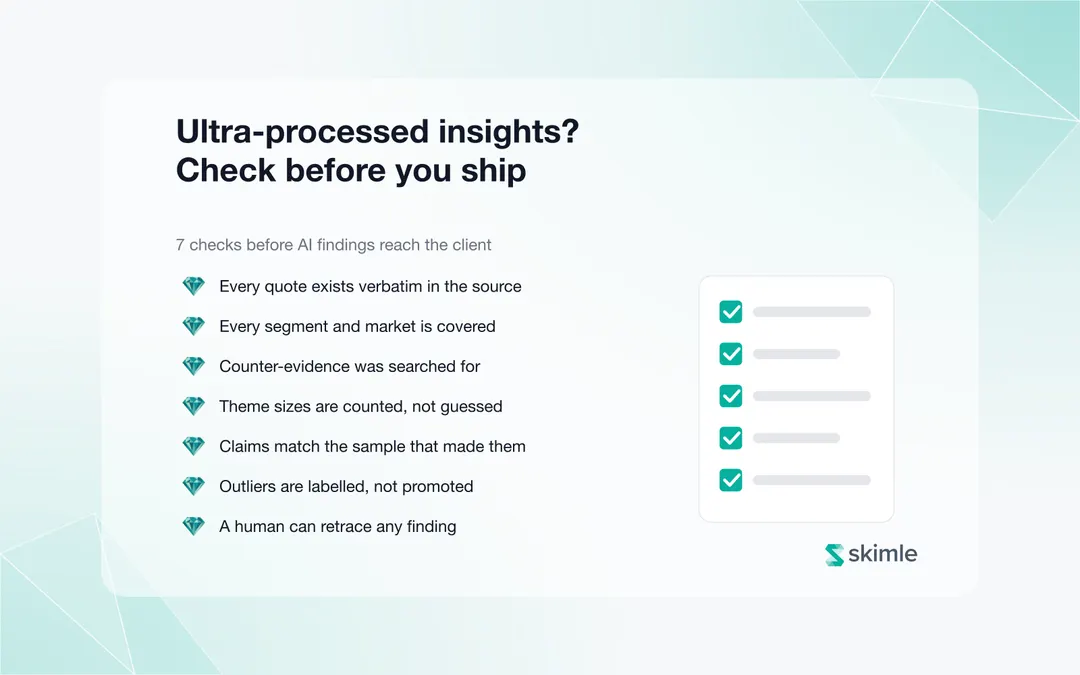
Whether you're evaluating a tool, reviewing a colleague's analysis, or preparing to defend your own findings to a client, the same short list of questions separates a defensible analysis from a plausible-looking one:
- Can I trace this specific finding back to its exact source passage, not just "somewhere in interview 14"?
- Can I open the source document and see what was coded and what wasn't, not just what was quoted?
- If something important was missed, would I actually notice, or would it just quietly not appear anywhere?
- Can I change a category or a coding decision directly, and does that change stay changed?
- If a client asked "where did this come from" right now, how long would the honest answer take?
A citation gets you through the first question. It has nothing to offer on the other four, and those four are usually the ones that decide whether a finding survives real scrutiny.
Try Skimle for defensible analysis
If you want every finding to trace to source and every document to show what was and wasn't coded, by default, it's worth testing on a real project.
Try Skimle for free and open a document to see the difference between a citation and a visible analysis.
Related reading:
- Two-way transparency: creating confidence in AI to make it useful for real work
- 9 design criteria for AI qualitative analysis tools
- How Skimle solves hallucinations, context limits, and black-box outputs
About the authors
Henri Schildt is a Professor of Strategy at Aalto University School of Business and co-founder of Skimle. He has published over a dozen peer-reviewed articles using qualitative methods, including work in Academy of Management Journal, Organisation Science, and Strategic Management Journal. His research focuses on organisational strategy, innovation, and qualitative methodology. Google Scholar profile
Olli Salo is a former Partner at McKinsey & Company where he spent 18 years helping clients understand the markets and themselves, develop winning strategies and improve their operating models. He has done over 1000 client interviews and published over 10 articles on McKinsey.com and beyond. LinkedIn profile