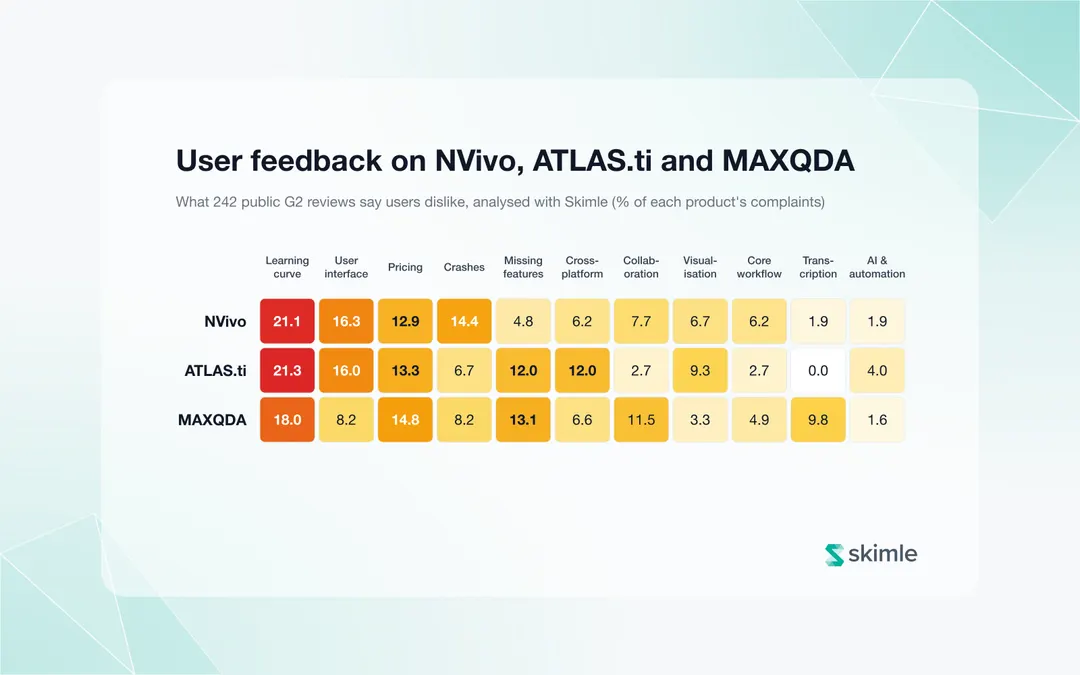
The best NVivo alternative depends on why you are leaving. For like-for-like manual coding, MAXQDA is the closest replacement. For AI-native analysis that codes every document and links each theme to verified quotes, Skimle is the strongest option. For no cost, Taguette and QualCoder work for basic coding. Dedoose and Quirkos suit small budgets and simple projects.
NVivo has been the default qualitative data analysis (QDA) tool in many universities for two decades, and it remains capable. But its pricing, ownership, desktop roots and manual coding workflow lead many researchers to evaluate alternatives, often for the first time. This guide compares nine tools with 2026 prices, explains the trade-offs and suggests which fits which situation. It merges our earlier guides to NVivo alternatives for academics and to NVivo and MAXQDA alternatives.
Which NVivo alternative fits your situation?
| If you need... | Choose | Why |
|---|---|---|
| A like-for-like replacement for manual coding | MAXQDA | Closest feature set, strong on Mac, independently owned |
| AI analysis of large datasets with full traceability | Skimle | Codes every document, verifies every quote, compares groups |
| Zero cost | Taguette or QualCoder | Free and open source |
| Collaborative coding on a small budget | Dedoose | Browser-based, monthly pricing, interrater statistics |
| The simplest tool to learn | Quirkos | Visual interface, low price |
| A beginner-friendly cloud tool with AI chat | Delve | Clean interface, transcript imports |
| To keep an existing ATLAS.ti workflow | ATLAS.ti | Mature toolkit with AI features added |
| A research repository for product teams | Dovetail | Video highlights and sharing, not academic coding |
Why do researchers look for NVivo alternatives?
Price. NVivo licences range from about $125 (€115) per year for students to roughly $1,100-1,200 (€1,000-1,100) per year for commercial use, and transcription is charged separately. Researchers without an institutional licence feel this most.
Ownership. NVivo is owned by Lumivero, a company formed in 2022 with private equity backing from TA Associates, which also acquired ATLAS.ti in 2024. The same parent also brought in XLSTAT, Palisade and Citavi, and the perpetual licence that let researchers buy NVivo once and use it for years has effectively gone. Researchers who once saw ATLAS.ti as the independent alternative are now comparing two products from the same parent, so the competitive check that independent ownership provided has gone too. That is why MAXQDA, still owned by VERBI, gets more attention.
The manual coding bottleneck. NVivo was designed for researchers who read and code every passage by hand. That works for a 15-interview dissertation with a year to spare. It works less well for 80 interviews on a three-month timeline, or for thousands of open-ended survey answers.
Learning curve and desktop roots. Most universities run multi-day NVivo training. The desktop workflow makes sharing a project with a supervisor or co-author harder than in a browser tool.
To be fair to NVivo, its 2026 NVivo AI Cloud adds AURA, a family of AI agents that identify key topics across sources and maintain a codebook as data arrives, with every AI action traceable and signed off by the researcher (Lumivero). For researchers committed to manual coding with AI support, it is a credible option. For a direct, short comparison, see Skimle vs NVivo.
The 9 NVivo alternatives at a glance
| Tool | Price (2026, approx.) | AI features | Runs in browser | REFI-QDA | Best for |
|---|---|---|---|---|---|
| NVivo (baseline) | ~€115/yr student, ~€1,000+/yr commercial | AI assistant in NVivo AI Cloud | Cloud version | Yes | Departments standardised on it |
| Skimle | Free trial, then from €20/user/month | AI-native analysis of every document | Yes | Yes (export) | Large datasets, traceable AI analysis |
| MAXQDA | From ~€230/yr academic | AI Assist add-on | Desktop + cloud | Yes | Like-for-like replacement, Mac users |
| ATLAS.ti | From ~€47/yr student, ~€615/yr commercial | AI coding and chat | Desktop + web | Yes | Existing ATLAS.ti users |
| Dedoose | ~€12-16/month | None | Yes | No | Collaborative mixed methods |
| Quirkos | ~€12/month academic, €63 one-off desktop | None | Yes + desktop | No | Simplicity, teaching |
| Delve | ~€16/month education | AI chat | Yes | No | Beginners |
| Taguette | Free | None | Self-hosted | No | Basic text coding at no cost |
| QualCoder | Free | None | No (desktop) | No | Free, offline analysis |
Prices change and vary by region and institution, so treat these as a starting point and check each vendor's site.
What are the best NVivo alternatives in 2026?
1. Skimle: the AI-native alternative
Skimle takes a different approach from every other tool on this list. Rather than adding AI to a manual coding environment, it uses AI for the systematic first pass so the researcher can focus on interpretation. You upload transcripts, recordings, PDFs or survey exports; Skimle reads every document, codes each passage and builds a category structure you can edit. Every theme links to supporting quotes, each mechanically checked to be verbatim in the source, and every document shows which passages were used.
Beyond analysis, Skimle includes transcription in 100+ languages, built-in anonymisation with a re-identification key you can keep or destroy, comparisons across metadata such as role, site or interview year, AI interviews through Skimle Ask, an agentic chat over your coded data, and presentations in PowerPoint, Word, PDF or online. It is EU-hosted and GDPR compliant, and exports to REFI-QDA so you can continue in NVivo, MAXQDA or ATLAS.ti. See the REFI-QDA export guide.
Pricing: free trial with full features, then plans from €20 per user per month. Best for: researchers analysing 20+ interviews, mixed sources or open-ended survey data who want a traceable AI-assisted workflow. Limitations: if your method requires fully manual coding with no AI involvement, such as some readings of reflexive thematic analysis, Skimle's core value does not apply.
2. MAXQDA: the closest like-for-like replacement
MAXQDA, owned by VERBI in Germany since the 1980s, is the closest equivalent to NVivo feature for feature. It handles text, PDFs, audio, video, images and survey data, supports hierarchical codes, memos and literature reviews, and integrates quantitative data through MAXQDA Analytics Pro. Its interface consistently scores better for usability than NVivo, and it offers full feature parity on Mac. AI Assist adds summaries and code suggestions, but the workflow stays manual.
Pricing: academic licences from about €230 per year; Analytics Pro about €430; commercial €465-1,600 depending on package, with AI Assist and TeamCloud extra. Best for: researchers who want NVivo-level depth without Lumivero, Mac users and mixed-methods projects. See MAXQDA pricing and Skimle vs MAXQDA.
3. ATLAS.ti: mature, with AI added
ATLAS.ti offers desktop and web versions with AI coding, conversational AI across documents and an MCP server. Since Lumivero acquired it in 2024, switching from NVivo to ATLAS.ti keeps you in the same portfolio. Its AI coding can generate a large volume of first-order codes that need substantial manual organisation.
Pricing: student licences from about €47 per year, commercial seats from about €615. Best for: researchers already trained in ATLAS.ti. See ATLAS.ti pricing and Skimle vs ATLAS.ti.
4. Dedoose: collaborative and affordable
Developed at UCLA, Dedoose runs in the browser, supports simultaneous coding by distributed teams and includes interrater reliability statistics. Descriptor variables let you compare codes across participant characteristics. It has no AI features and no REFI-QDA export. Pricing: about €16 per month, €12 for students. See the Dedoose review.
5. Quirkos: simple and visual
Quirkos represents codes as visual bubbles and is one of the easiest tools to learn, on Windows and Mac. It is not a deep analytical environment and has no AI. Pricing: about €12 per month academic, or a €63 one-off desktop licence. See the easiest QDA software to learn.
6. Delve: beginner-friendly with AI chat
Delve is a clean browser-based tool with a central codebook, collaboration and an AI chat for exploring interpretations, plus imports from Otter, Zoom and Dovetail. Its AI is conversational rather than systematic. Pricing: about €16 per user per month on the education plan. See the Delve review.
7. Taguette: free and open source
Taguette handles text documents with highlighting, tagging and full export, locally or on a server with free collaboration. It has no AI, multimedia or interrater tools. See free qualitative data analysis software.
8. QualCoder: free desktop analysis
QualCoder offers more depth than Taguette, including text, images, audio and video, memos and basic interrater reliability, all running locally. It has no collaboration or AI, and depends on volunteer development.
9. Dovetail: a repository, not an academic QDA tool
Dovetail is popular with UX and product teams for storing recordings, tagging highlights and sharing insights. It is not designed for academic coding and methods reporting. See Skimle vs Dovetail.
Looking at AI-native competitors as well? See our comparisons of Skimle with CoLoop, Listen Labs and DoReveal.
How does NVivo compare with Skimle?
| NVivo | Skimle | |
|---|---|---|
| Core workflow | Manual coding with an AI assistant | AI codes every document; you review and edit |
| Traceability | Codes linked to passages | Every insight linked to verified verbatim quotes, in both directions |
| Transcription | Separate paid service | Included, 100+ languages |
| Anonymisation | Done before import, outside NVivo | Built in, with consistent pseudonyms across files |
| Data collection | Import only | Import, or AI interviews with Skimle Ask |
| Group comparisons | Queries and matrices | Built-in comparisons by any metadata |
| Collaboration | Desktop projects or cloud subscription | Browser sharing with permissions |
| Exports | REFI-QDA, reports | REFI-QDA, Excel, Word, PowerPoint, PDF and online presentations |
| Pricing | ~€115-1,100 per year | Free trial, then from €20 per user per month |
How do you choose?
Start from the problem you are solving:
- If cost is the only problem, Taguette, QualCoder, Dedoose or Quirkos solve it.
- If ownership concerns you, MAXQDA is independently owned; Skimle is an independent European company.
- If the desktop workflow is the problem, Dedoose, Delve or Skimle run in the browser, and MAXQDA is the better choice on a Mac.
- If collaboration is painful, note that NVivo charges extra for it; Dedoose, Delve, Quirkos and Skimle are built for shared projects in the browser.
- If you worry about being locked in, NVivo, MAXQDA, ATLAS.ti and Skimle all support the REFI-QDA standard, so a coded project can move between them.
- If manual coding time is the problem, only a tool built around AI analysis changes the economics of the project.
- If you must deliver an NVivo project, run your analysis in Skimle and export to REFI-QDA, or stay with NVivo.
For academic researchers, the methodological question matters as much as the tool: see our guide to AI-assisted qualitative analysis and how Skimle fits academic research.
What does AI-assisted analysis mean for your workflow?
Researchers new to AI-native tools sometimes expect the AI to replace the analysis. That is not how any tool on this list works, and it would not be desirable for rigorous research.
In a tool like Skimle, the AI handles the systematic first pass: reading every document, finding the relevant passages, assigning codes and building an initial category structure. You then review that structure, challenge what the AI got wrong, add what it missed and reorganise where the concepts need adjusting. The interpretive judgements that make qualitative research worth doing remain yours, and because every insight links back to its source passage, you can check each one.
The time saving is large. Coding a one-hour interview transcript by hand typically takes four to six hours, so 30 interviews represent 120 to 180 hours of work before interpretation even begins. AI-assisted analysis moves the systematic pattern-finding to the machine and concentrates your time on interpretation. See how Skimle's analysis works, the AI for qualitative data analysis guide and the AI document analysis guide.
When does it make sense to stay with NVivo?
Stay with NVivo if your institution provides a free site licence, your discipline expects it in methods sections, your design depends on manual coding as interpretive practice, or you have years of NVivo projects you need to keep extending. Switching has real costs: retraining, re-coding and, for teams, agreeing a new standard.
What does switching involve?
Most tools import common document formats, so moving raw transcripts is easy. Moving coded work is harder. The open REFI-QDA (.qdpx) standard lets NVivo, MAXQDA, ATLAS.ti and Skimle exchange projects, though not every element survives the round trip. A low-risk route is to run a new project in the alternative in parallel with NVivo before committing; Skimle's free trial is fully functional for exactly this.
Frequently asked questions
What is the best free alternative to NVivo?
Taguette and QualCoder are free and open source. Taguette is simplest for basic text coding; QualCoder adds media support and memos on the desktop. Neither has AI features. Skimle offers a free trial with all features if you want to test AI-assisted analysis.
What is the closest alternative to NVivo?
MAXQDA is the closest like-for-like replacement for manual coding, with a similar feature set, better Mac support and independent ownership.
Is Skimle a good replacement for NVivo for academic research?
For many projects, yes. Skimle codes every document, verifies every quote against the source and keeps a traceable record that supports methods reporting. Researchers whose method requires fully manual coding may prefer NVivo or MAXQDA, or use Skimle alongside them.
Can Skimle export to NVivo?
Yes. Skimle exports in the REFI-QDA (.qdpx) format, which NVivo, MAXQDA and ATLAS.ti can import.
How much cheaper is Skimle than NVivo?
Skimle plans start at €20 per user per month with transcription included, after a free trial. NVivo licences run from about €115 per year for students to over €1,000 per year for commercial use, with transcription charged separately.
Which NVivo alternative is easiest to learn?
Quirkos and Delve get the best usability ratings among paid tools, and most users are coding productively within an hour. Taguette is quicker still because its feature set is minimal. Skimle needs little ramp-up because the AI does the first analytical pass, so you do not have to build a codebook before the data starts making sense. NVivo and MAXQDA usually take days to weeks before researchers feel confident.
Does Skimle meet the rigour and transparency academic research requires?
Yes, this is a core design principle. Every insight links to the verbatim quotes that support it, each checked against the source, and every document shows which of its passages were used. You can show exactly which passage supported which finding, which is what journals, supervisors and ethics boards ask for. See two-way transparency.
Which NVivo alternative works best on Mac?
MAXQDA offers full feature parity on Mac. Browser-based tools such as Skimle, Dedoose and Delve work on any operating system.
Does NVivo have AI analysis?
Yes. NVivo AI Cloud adds the AURA research assistant, AI summaries, suggested child codes and an auditable record of AI actions. The core workflow remains manual coding, whereas AI-native tools such as Skimle run a complete first pass over every document.
Ready to try an NVivo alternative? Start a free Skimle trial with every feature included, then continue from €20 per user per month.
About the authors
Henri Schildt is a Professor of Strategy at Aalto University School of Business and co-founder of Skimle. He has published over a dozen peer-reviewed articles using qualitative methods, including work in Academy of Management Journal, Organisation Science, and Strategic Management Journal. His research focuses on organisational strategy, innovation, and qualitative methodology. Google Scholar profile
Olli Salo is a former Partner at McKinsey & Company where he spent 18 years helping clients understand the markets and themselves, develop winning strategies and improve their operating models. He has done over 1000 client interviews and published over 10 articles on McKinsey.com and beyond. LinkedIn profile