Signal & Noise
Skimle's resource center dedicated to high quality analysis using modern methods

Content analysis vs thematic analysis: which method fits your research?
Content analysis counts and categorises text systematically; thematic analysis interprets patterns of meaning. Learn the 5 key differences and when to choose each method.

Interpretive phenomenological analysis (IPA): a guide for psychology and health researchers
IPA explores lived experience through small, purposive samples and deep individual case analysis. Learn when to use IPA, how the 6-step process works, and how it differs from thematic analysis.

Grounded theory methodology: a practical guide for qualitative researchers
Grounded theory generates theory from data through iterative coding and constant comparison. This guide covers the 3 main variants, the full coding process, and when to choose GT over thematic analysi...

Inductive, deductive, and abductive coding in qualitative research: when to use each
Inductive coding builds categories from data up. Deductive coding applies existing frameworks down. Abductive coding iterates between both. This guide explains when to use each — with examples.

Reflexive thematic analysis: what changed with Braun and Clarke's updated approach
Reflexive thematic analysis treats coding as interpretation, not extraction. Learn how Braun and Clarke's updated approach differs from the 2006 version and what it means in practice.

Interview transcript analysis: a practical guide
How to analyse interview transcripts systematically — preparing data, coding approaches, building themes, and writing up. Covers manual and AI-assisted methods.

How to anonymise and pseudonymise qualitative research data: IRB-compliant de-identification of interview transcripts
Step-by-step guide to anonymising and pseudonymising qualitative interview data for IRB, GDPR, and HIPAA compliance with Skimle Anonymise. Covers identifiers, audit trails, and methods documentation.

How many qualitative interviews are enough? Guest, Bunce & Johnson (2006), saturation, and what the evidence says
Guest, Bunce & Johnson (2006) found code saturation at 12 interviews. Here is what that finding actually means, its limitations, and how to set your qualitative sample size.

How to do qualitative research on a PhD budget: tools and methods that won't break the bank
NVivo costs over EUR 1000 per year and is rarely worth it for individual researchers. Here are the best free and affordable alternatives for PhD students doing qualitative analysis.

How to code qualitative data: inductive, deductive and abductive approaches explained
A practical guide to qualitative coding: what inductive, deductive, and abductive coding are, when to use each, and how AI tools are changing the process.

AI qualitative data analysis checklist: 20 questions before you publish
A practical pre-publication checklist for qualitative research that used AI tools — covering documentation, traceability, transparency, and peer reviewer expectations.
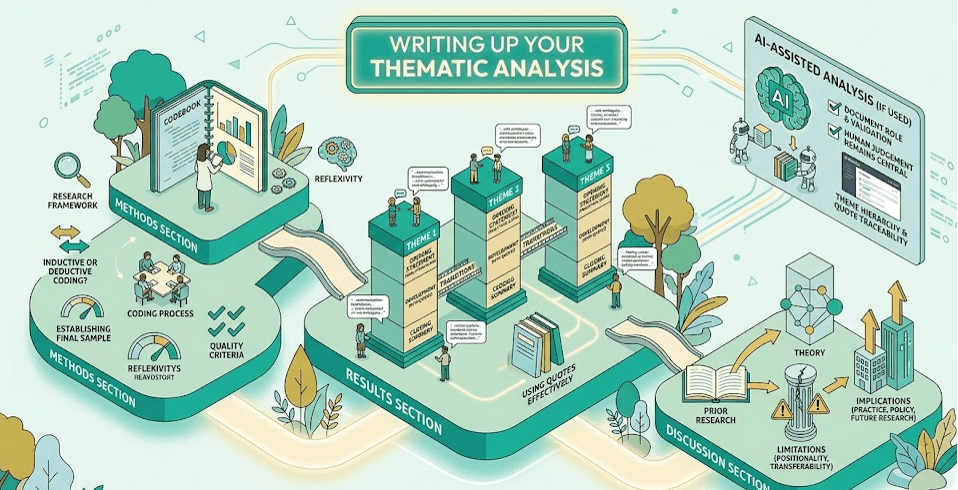
How to write up a thematic analysis: a step-by-step guide with examples
Step-by-step guide to writing up a thematic analysis: how to structure the methods, results and discussion sections, with worked examples and a final submission checklist.

How to write the perfect interview guide - 10 practical tips for preparing your questions
A well-crafted interview guide is the foundation of successful qualitative research. Learn how to structure questions, iterate as you learn, mix question types strategically, and use AI to test your g...

How many interviews do you need for qualitative research? A practical guide to sample size.
You're planning to do a series of interviews to gather information to solve a business problem, write an academic paper or perform due diligence. Many researchers and business people strugle to identi...

Thematic analysis: complete guide to methods, steps and applications
Thematic analysis explained — the six steps, inductive vs deductive coding, sample size guidance, AI-assisted approaches, and applications across academic and business research.