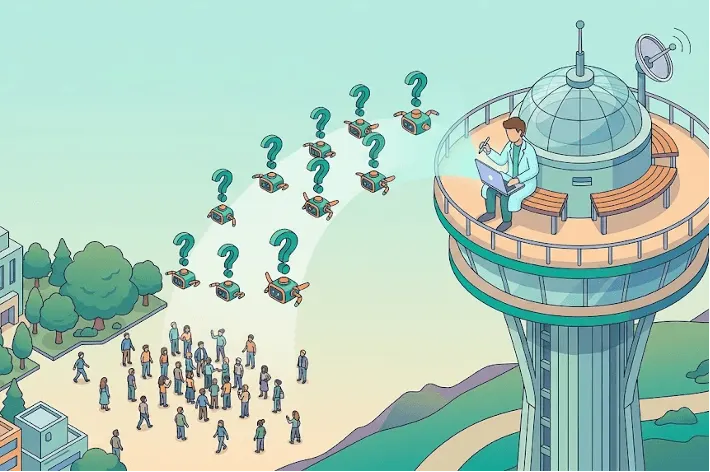
The promise of AI collaboration in qualitative research has been oversold and underdelivered. Not because AI is incapable of contributing to analytical work, but because the dominant approach to using it has been structurally flawed from the start.
The typical workflow goes like this: a researcher finishes a round of interviews, exports the transcripts, pastes them into ChatGPT, and asks for themes. The output looks plausible. It uses the right vocabulary. But there is no way to know whether it captured everything, missed a minority view, or subtly misrepresented what a participant said. The themes cannot be traced back to specific quotes with confidence. If a colleague asks "where does this claim come from?", the honest answer is "the AI said so."
This is not a collaboration between human and machine. It is outsourcing with a veneer of analysis. We have written about why this approach fails in can ChatGPT analyse qualitative data, and the short version is: without structure, AI tools produce outputs that feel like insight but behave like noise under scrutiny. It's no surprise there is a backlash against AI-assisted qualitative analysis when the common approaches are so rudimentary.
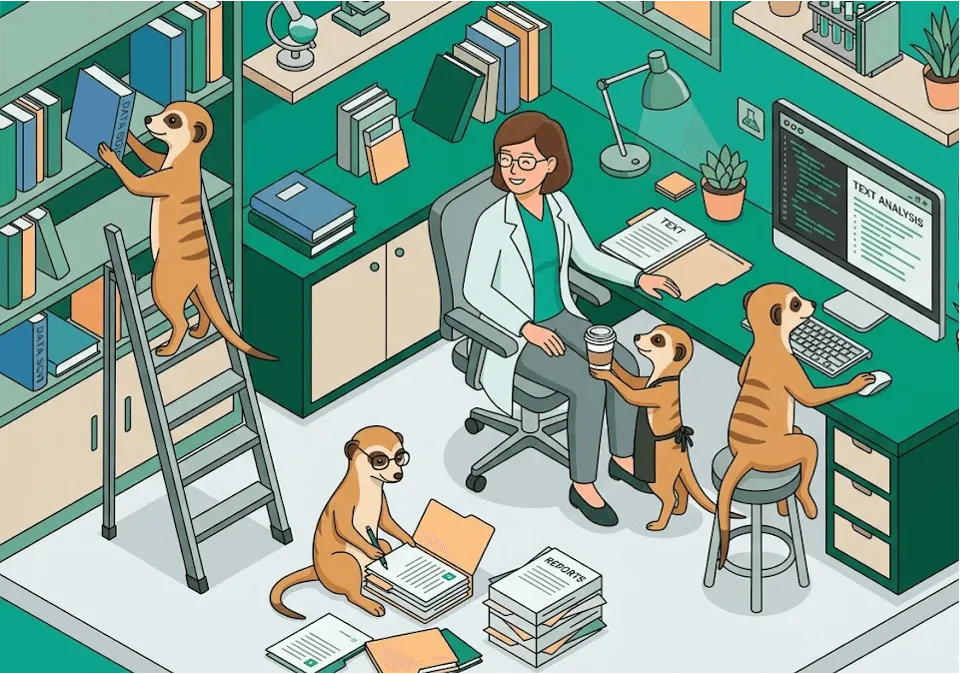
Skimle is built on a different premise, and our Agentic Chat is an example of our approach where AI is seen as a tool for the researchers to use to get deeper to their data, not as a replacement for proper analysis. In Skimle's approach, the agent does not receive a pile of raw text. It navigates a structured project, where insights have already been extracted, categories have been built, metadata has been assigned, and every claim traces back to a source. This changes what collaboration between human and agent actually looks like.
The structural advantage
When you open Agentic Chat in a Skimle project, the agent has access to a data model that reflects weeks or months of analytical work. Not the raw documents (though it can access those too) but the structured artefacts your analysis has produced.
That includes the category tree: a hierarchical taxonomy of themes that has emerged from the data, with each category populated by the insights that belong to it. It includes memos: your reflections, your emerging arguments, your notes to self about what still needs resolution. It includes metadata variables: the labels you have attached to each document that let you compare sub-groups (e.g., different customer segments, different interview rounds, different geographies). And it includes source traceability at every level: each insight links back to the passage it was drawn from.
This matters because an agent navigating structured data is doing something fundamentally different from an agent trying to make sense of raw text. It is not guessing at the shape of your analysis. It is operating within it.
Consider the difference in what the agent can reliably say. With raw transcripts: "here are some themes I noticed." With structured Skimle data: "Category 3 has 47 insights and 8 of them are flagged as conflicting with insights in Category 7. Here are the four specific insights that appear most directly contradictory, with their source documents."
The second answer is actionable and verifiable. It is the kind of output that supports real analytical decisions rather than creating an impression of them.
Five advantages of the structured approach for agentic work
1. Stable structure
The agent navigates a consistent data model. Every project has categories, documents, insights, metadata, and memos, and these mean the same thing every time. The agent does not have to infer structure from prose or decide on the fly what counts as a theme. This means its operations are reproducible (to a degree): the same query on the same data returns the same answer.
This stability is what makes agentic workflows safe to use in serious research. When we wrote about two-way transparency, the argument was that trustworthy AI outputs require a structure that can be interrogated. Skimle's data model provides that structure.
2. Source traceability
Every insight in Skimle is derived from a specific passage in a specific document. When the agent retrieves insights and reports on them, the source attribution travels with the data. This means that when you review what the agent has told you, you can click through to the original quote in the original document.
This is not a minor convenience feature. It is the mechanism that keeps human judgement in the loop. If the agent summarises a finding and it looks slightly off, you can check the underlying evidence immediately. The alternative, asking a general-purpose AI to summarise transcripts and trusting the output, has no such mechanism. The trail ends at the AI's answer.
Source traceability also matters for research integrity. In academic work, claims need to be grounded in specific evidence. In commercial analysis, clients ask "what does the data say?" and expect to be shown. Agentic Chat supports both, because the structure required for traceability is built into how Skimle stores data, not added as an afterthought.
3. Human control throughout
The division of labour in Agentic Chat is clear. The human analyses, interprets, and reviews decisions. The agent executes, organises, and retrieves based on human instructions. This is not a limitation of the technology; it is a deliberate design choice based on where each party adds value.
A researcher has contextual knowledge the agent does not: what was going on in the industry at the time of the interviews, what the project sponsor is likely to care about, which participant had unusual expertise, where the data collection was rushed and the insights should be treated cautiously. None of this is in the data. All of it should shape how the data is interpreted.
The agent, by contrast, is tireless, consistent, and fast at operations that are laborious for humans: retrieving all insights across forty documents that mention a specific concept, checking whether a newly proposed category overlaps with an existing one, counting how many insights across metadata groups hold a particular view. Giving the agent these tasks frees the researcher to spend time digging deeper.
The concern that AI is degrading analytical thinking is legitimate when AI replaces thinking. It is not warranted when AI handles retrieval and organisation so that the human can think more, not less.
4. Visualisations for the human layer
While the agent works in structured data, the Skimle interface gives the human a visual layer. Category trees, insight counts, metadata distributions, quote browsers, heatmaps and so on. They are for the human researcher, who needs to see the shape of the analysis to make good decisions about it.
The agent is good at traversing a data structure and reporting findings. The human is good at seeing a category tree and thinking "that category is doing too much work" or "these two branches feel like they belong together." Combining both gives you a more complete picture than either alone.
5. No need to re-read raw data
Once your documents are structured in Skimle, you do not have to return to the raw transcripts to answer most questions. The insights are already extracted, labelled, attributed, and categorised. The agent can retrieve them directly.
This is a significant practical advantage for any project with substantial volume. If you have analysed forty interviews, going back to the raw transcripts to answer a specific question takes hours. Querying the structured data takes seconds. The analytical value you built during the initial coding phase is preserved and accessible, not locked behind a re-reading exercise.
A concrete example workflow
Suppose a researcher has uploaded and analysed 40 interviews for a study on how organisations adopt new technology. Skimle has run its analysis, producing a category tree with 18 categories and approximately 600 insights. The researcher has reviewed the top-level categories and made some adjustments during the initial review.
Now they open Agentic Chat, available on the right hand side inside all Skimle projects.
They start with a broad orientation: "Give me an overview of the five largest categories and tell me if there are any that seem to have internal tension." The agent retrieves the full category tree and the insights for each of the top five. It comes back with a summary: Category 2 (governance structures) and Category 6 (accountability mechanisms) each have more than 50 insights, and several insights in each category reference the same set of themes. There are eight insights in Category 2 that use language very similar to insights coded in Category 6.
The researcher reads the comparison and agrees there is overlap. They have been treating governance and accountability as distinct, but looking at the evidence, they may be two labels for the same phenomenon in this particular industry context. They ask the agent: "Show me the five most similar insight pairs across categories 2 and 6." The agent retrieves specific examples, with source attribution.
The researcher decides to merge. They instruct the agent: "Merge category 6 into category 2 and rename the merged category 'governance and accountability'." The agent updates the category and reassigns all insights from the old category to the merged one.
The researcher then wants to write a memo capturing their reasoning. "Create a note summarising why we merged these two categories and what the merged category now represents." The agent saves a structured note to the project for later reference.
In twenty minutes of work, the researcher has resolved a structural question that would have previously required manually reviewing 100 insights across two categories, decided based on a broad read of the data. The work has a clear audit trail. Every step is documented. The human made every substantive decision; the agent handled retrieval, comparison, and execution.
The contrast with pasting into ChatGPT
When you paste transcripts into a general-purpose AI chat window, several things happen that have serious implications for research quality.
First, you lose structure. The AI receives text. It does not know which participant said what, whether documents belong to different sub-groups, what metadata is relevant, or what analytical categories you have already established. It starts from scratch every time.
Second, you lose provenance. The AI's output cannot be traced back to specific passages in specific documents, at least not reliably. When it reports a theme, it cannot tell you which participants held this view, in which documents the evidence appears, or whether the theme is supported by two participants or twenty.
Third, you lose cumulative work. If you paste in the transcripts on Tuesday and ask for themes, and then paste them in again on Thursday with a new question, the AI has no memory of what it decided on Tuesday. The analytical work does not accumulate. You are always starting over.
Skimle's structured approach preserves all three. Structure is built during analysis and maintained across sessions. Provenance is preserved through source attribution at the insight level. Cumulative work is stored in the category tree, memos, and tags, all of which the agent can access in any session.
The question of whether AI can contribute to qualitative analysis is not really about capability. It is about whether the infrastructure is in place to make AI contributions reliable and traceable. ChatGPT prompts for qualitative analysis have their place, but they work best as a supplement to structured analysis, not a replacement for it.
MCP for those who work in coding tools
For researchers and analysts who primarily work in development environments like Cursor or Windsurf, or who use Claude as their main interface, the same agentic experience is available from outside Skimle via MCP. The tools are identical. The data is identical. The only difference is the application you are sitting in when you use it.
Setup takes a few minutes and requires no coding. See the Skimle MCP page for step-by-step instructions.
Who benefits most
Researchers who have already invested time building well-structured projects in Skimle will see the most immediate value. If you have a project with clear categories, populated metadata variables, and a meaningful set of memos, Agentic Chat extends that structure with a conversational layer that makes it faster to navigate, compare, and reorganise.
But the benefits also scale back to the beginning of a project. Even at the point where categories are just emerging and the structure is still rough, having an agent that can retrieve insights, spot potential overlaps, and suggest organisational moves accelerates the early stages of analysis where the most important structural decisions get made.
For consultants and investors running time-sensitive engagements, the combination of fast structured retrieval and agent-assisted reorganisation is particularly valuable. The work of going from raw interviews to a structured, defensible set of findings compresses significantly when the agent handles the laborious parts.
For academic researchers, the traceability and audit trail that Agentic Chat provides are directly relevant to the methodological transparency that peer review requires. Being able to show not just what categories emerged but how they evolved, which decisions were made and when, and what the evidence base for each category is: these are things that structured agentic workflows make possible.
Call to action
Agentic Chat is available in every Skimle project. Open the Chat tab in any project to start exploring your structured data with agent support. If you prefer to work from an external AI tool, the MCP setup page has everything you need to connect.
For a practical walkthrough of using both features, see how to use Skimle Agentic Chat and MCP: a step-by-step guide.
About the authors
Henri Schildt is a Professor of Strategy at Aalto University School of Business and co-founder of Skimle. He has published over a dozen peer-reviewed articles using qualitative methods, including work in Academy of Management Journal, Organisation Science, and Strategic Management Journal. His research focuses on organisational strategy, innovation, and qualitative methodology. Google Scholar profile
Olli Salo is a former Partner at McKinsey & Company where he spent 18 years helping clients understand the markets and themselves, develop winning strategies and improve their operating models. He has done over 1000 client interviews and published over 10 articles on McKinsey.com and beyond. LinkedIn profile