Skimle pour les chercheurs universitaires
La rigueur académique à la vitesse de l'IA
Skimle a été conçu par des chercheurs pour des chercheurs. Le cofondateur, le professeur Henri Schildt, cumule des décennies d'expérience en recherche qualitative et des articles publiés dans les grandes revues de management, dont l'Academy of Management Journal et Organization Science. Lassé des flux de travail lents et laborieux de NVivo et MAXQDA, et inquiet de la façon dont ChatGPT est utilisé pour des analyses dépourvues de transparence et d'exhaustivité, il a construit Skimle comme la plateforme qui reproduit une méthodologie qualitative rigoureuse et transparente, avec l'IA au cœur du dispositif.
Le codage initial des entretiens peut prendre des semaines à la main. Skimle s'en charge sans sacrifier la rigueur méthodologique, et repère souvent des citations qu'un œil humain aurait manquées. Chaque thème renvoie à une citation textuelle vérifiée. La piste d'audit complète satisfait les évaluateurs. À noter : des remises universitaires sont disponibles.
Une analyse rigoureuse qui vous laisse vous concentrer sur votre contribution théorique
L'approche de Skimle s'inspire de la théorie ancrée (Glaser & Strauss ; Strauss & Corbin) et de la méthode Gioia. Elle produit l'analyse systématique et transparente qu'exige l'évaluation par les pairs, sans les semaines de codage mécanique qui consomment un temps mieux employé à la théorie. Elle fonctionne dans plus de 100 langues et prend en charge jusqu'à 1 000 documents par projet.
- Codage initial automatisé — chaque citation reliée à sa catégorie
- Piste d'audit bidirectionnelle complète pour l'évaluation par les pairs et la transparence méthodologique
- Une grille de codage que vous maîtrisez — fusionnez, scindez, renommez et réorganisez librement
- Fonctionne dans plus de 100 langues sans traduction
- Traite entretiens, audio et vidéo, ouvrages, documents et archives
- Skimle Academic — une formule à tarif réduit — est disponible


DE L'ENREGISTREMENT À UNE TRANSCRIPTION CONFORME AU RGPD
Transcrivez et anonymisez vos entretiens
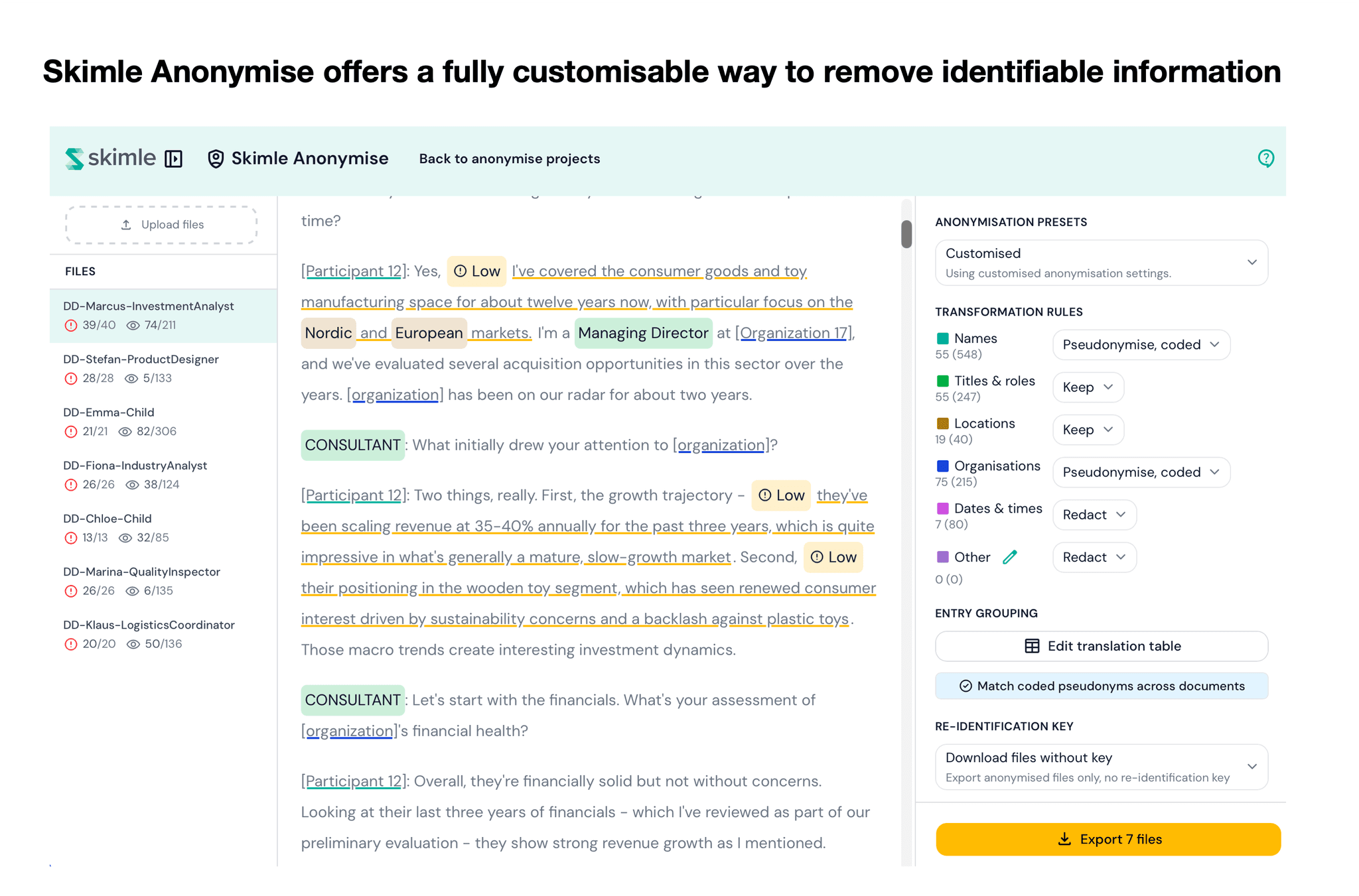
Transformer des enregistrements de terrain en données exploitables est lent et coûteux via un prestataire externe, et les transcriptions obtenues contiennent noms, affiliations et lieux qui créent des obligations RGPD et éthiques avant même de pouvoir partager, archiver ou citer. Skimle transcrit l'audio et la vidéo dans son environnement sécurisé hébergé dans l'UE, puis anonymise avec une pseudonymisation de qualité recherche : vous disposez le jour même d'une transcription conforme et prête à coder, sans que les données ne quittent jamais une infrastructure conforme au RGPD.
Comment ça marche
- 1. Importez de l'audio, de la vidéo ou du texte
Importez directement des fichiers MP3, M4A, WAV, MP4, MOV, PDF ou Word. Aucun service de transcription externe, et plus de 100 langues prises en charge nativement.
- 2. Transcrivez avec identification des locuteurs
Skimle transcrit l'enregistrement, repère les changements de locuteur et gère les accents comme les qualités audio variables. Vous relisez et corrigez le résultat avant le début de l'analyse.
- 3. Détectez automatiquement les identifiants
Skimle Anonymise repère les identifiants dans six catégories — noms, titres et fonctions, lieux, organisations, dates et divers — dans tous les documents, avec une cohérence entre fichiers pour qu'une même personne conserve le même pseudonyme.
- 4. Choisissez votre niveau d'anonymisation
Choisissez une pseudonymisation légère, une pseudonymisation forte ou une anonymisation de niveau HIPAA avec destruction de la clé. Réglez chaque catégorie indépendamment et ajoutez vos propres règles en langage courant.
- 5. Exportez avec la documentation d'audit
Exportez un rapport d'audit en PDF et une table de correspondance Excel pour votre comité d'éthique, puis injectez la transcription nettoyée directement dans le flux de travail de Skimle. L'audio source est ensuite supprimé de façon sécurisée.


DE SEMAINES DE CODAGE MANUEL À QUELQUES HEURES D'ANALYSE
Menez une analyse qualitative d'entretiens assistée par IA
Une recherche fondée sur plus de 40 entretiens devrait produire une contribution théorique riche (pour votre thèse, par exemple), mais le codage manuel — surligner, organiser, recoder, tenir des tableaux de suivi — absorbe l'essentiel du temps disponible et risque malgré tout de passer à côté de régularités importantes. Skimle lit chaque entretien de façon systématique et vous livre une hiérarchie de thèmes structurée, citations textuelles à l'appui, pour que vous consacriez votre temps à l'interprétation théorique que vous seul pouvez apporter.
Comment ça marche
- 1. Importez vos transcriptions
Glissez-déposez vos transcriptions d'entretiens en PDF, en Word ou en texte brut. Skimle accepte les documents dans tous les formats et prend en charge plus de 100 langues nativement.
- 2. Décrivez votre question de recherche
Fixez votre angle d'analyse, large ou précis. Skimle structure le codage initial autour de ce que vous cherchez à comprendre sur le plan théorique.
- 3. Examinez la structure de codage initiale
Skimle produit une hiérarchie de thèmes, chacun relié à des citations textuelles issues des transcriptions sources. Rien n'est inventé. Chaque code remonte au texte.
- 4. Affinez selon votre cadre théorique
Fusionnez, scindez, renommez et réorganisez les catégories pour coller à votre modèle théorique émergent. La transparence bidirectionnelle vous permet à tout moment de vérifier quelles citations appuient quels codes.
- 5. Exportez pour votre annexe méthodologique
Exportez votre grille de codage et les citations à l'appui en texte ou au format ouvert REFI-QDA (.qdpx), pris en charge par les outils CAQDAS traditionnels comme NVivo, Atlas.TI ou MAXQDA.




RELIER LES THÈMES QUALITATIFS À VOS VARIABLES
Menez une analyse en méthodes mixtes sur votre échantillon
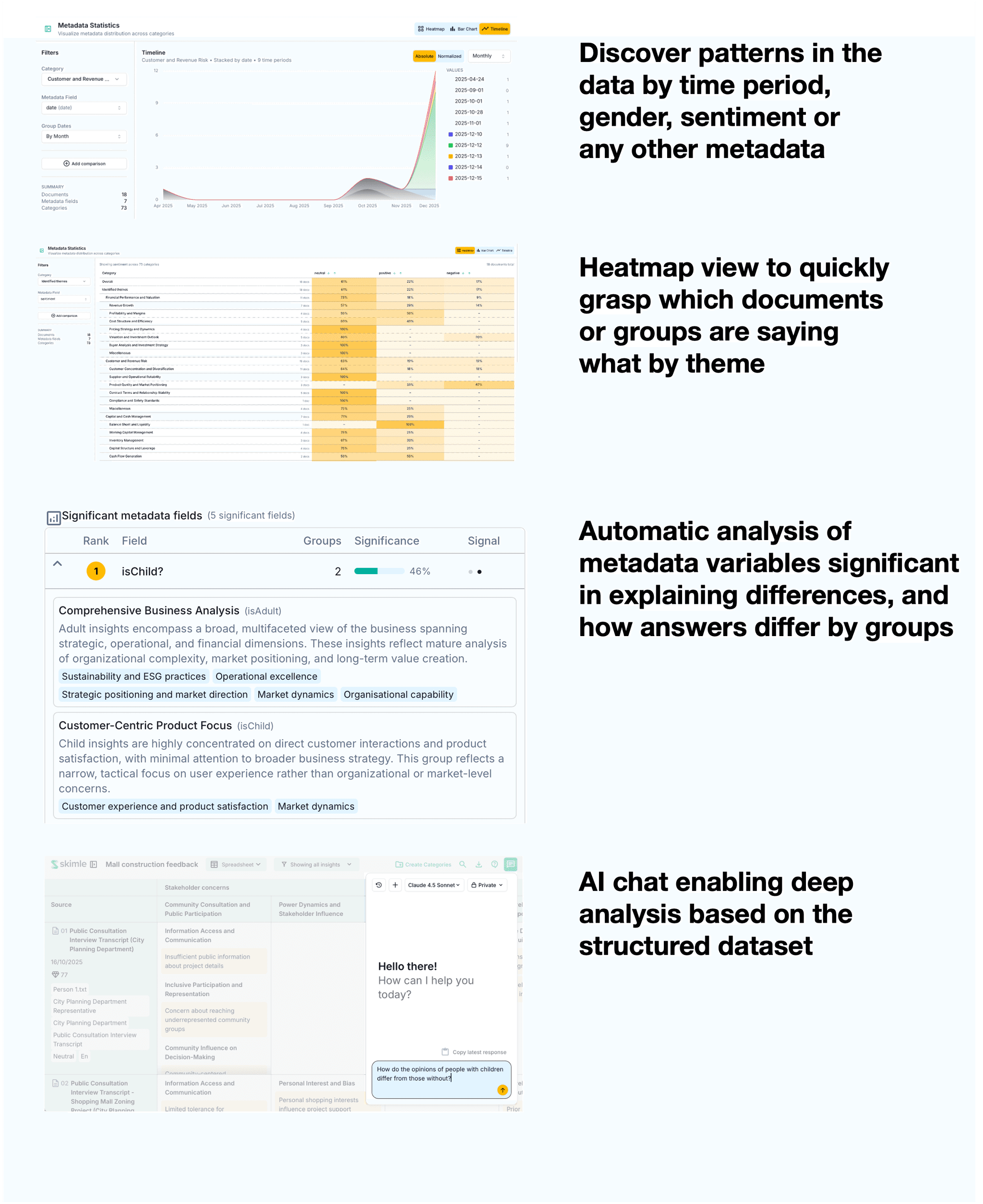
Les résultats qualitatifs pèsent davantage quand vous pouvez montrer comment ils varient au sein de l'échantillon : par cohorte, rôle, genre, site ou condition. Croiser à la main les thèmes avec les attributs des participants est fastidieux et propice aux erreurs. Skimle associe des métadonnées à chaque document et vous laisse segmenter la même structure de thèmes selon n'importe quelle variable : vous circulez entre citations textuelles riches et tendances quantifiées sans renoncer à l'une ou l'autre méthodologie.
Comment ça marche
- 1. Associez des métadonnées aux documents
Étiquetez chaque transcription avec les variables qui comptent pour votre protocole — cohorte, rôle, genre, site, vague ou condition expérimentale — manuellement ou depuis une colonne CSV.
- 2. Lancez l'analyse qualitative
Skimle construit une seule hiérarchie de thèmes sur tout le corpus, de sorte que chaque participant est codé selon la même structure.
- 3. Segmentez les thèmes par variable
Voyez comment chaque thème varie d'un groupe à l'autre, et repérez si une tendance est universelle ou propre à une seule cohorte.
- 4. Quantifiez la prévalence
Lisez les fréquences et les répartitions de thèmes pour indiquer à quel point un code est répandu selon les segments, chaque décompte restant traçable jusqu'aux citations qui l'ont produit.
- 5. Exportez les tableaux et les citations
Exportez les tris croisés et les citations à l'appui vers Excel ou Word pour la partie méthodes mixtes de votre article.


FAQ
Questions fréquentes
- Puis-je citer Skimle dans ma recherche ?
- Oui. Décrivez-le dans votre section méthodes comme un « logiciel de codage qualitatif assisté par IA », comme vous citeriez NVivo ou MAXQDA. Un article méthodologique de notre part est en cours d'évaluation et fournira une référence formelle ; en attendant, nous proposons une formulation sur demande.
- Les évaluateurs accepteront-ils une analyse assistée par IA ?
- De plus en plus, oui, avec une documentation appropriée. La piste d'audit de Skimle donne aux évaluateurs ce qu'ils attendent : un processus de codage documenté et systématique où chaque thème remonte à des citations précises — la section méthodes s'écrit ainsi en grande partie d'elle-même.
- Comment Skimle se compare-t-il à NVivo ou MAXQDA ?
- NVivo et MAXQDA conviennent aux chercheurs disposant de semaines pour l'analyse et d'une licence institutionnelle. Skimle automatise la phase de codage mécanique — de semaines à heures — tout en conservant la même méthodologie systématique et transparente, et la prise en main prend quelques minutes. Beaucoup de chercheurs utilisent les deux : Skimle pour la première passe de codage, NVivo pour l'intégration en méthodes mixtes.
- Skimle convient-il à la théorie ancrée ?
- Oui. Skimle prend en charge le codage inductif, où les thèmes émergent des données au lieu d'être imposés à l'avance. Partez d'un cadrage large et laissez la structure de catégories se construire par itérations, ce qui correspond de près au codage ouvert en théorie ancrée.
- Puis-je mener une analyse en méthodes mixtes ?
- Oui. Associez des variables de métadonnées à chaque document — cohorte, rôle, genre, site, condition — et segmentez la structure thématique selon n'importe laquelle. Vous obtenez les fréquences et les répartitions des thèmes par groupe, chacune traçable jusqu'aux citations textuelles et prête pour la partie méthodes mixtes de votre article.
- Mes données de recherche sont-elles en sécurité ?
- Vos transcriptions sont traitées sur une infrastructure hébergée dans l'UE et ne servent jamais à entraîner des modèles d'IA. Nous fournissons des accords de sous-traitance pour les exigences éthiques institutionnelles et pouvons répondre à la plupart des besoins de sécurité informatique. Contactez-nous avec vos exigences précises.
- Puis-je bénéficier d'une remise universitaire ?
- Oui. Les universitaires disposant d'une adresse institutionnelle valide et d'une page d'affiliation peuvent souscrire la formule Skimle Academic à tarif réduit. Contactez-nous pour une licence institutionnelle si vous avez besoin d'un accès en équipe pour un groupe de recherche ou un laboratoire.
À propos de Skimle
Conçu par des chercheurs pour des chercheurs
Skimle est conçu par des chercheurs pour des chercheurs, et par des professionnels du monde de l'entreprise pour leurs pairs. Le cofondateur, le professeur Henri Schildt, a publié dans l'Academy of Management Journal, Organization Science et le Strategic Management Journal, et a passé deux décennies à faire de la recherche qualitative à la dure. Le cofondateur Olli Salo est un ancien associé de McKinsey qui a mené plus de 1 000 entretiens clients. Nous avons construit Skimle parce que nous en avions besoin nous-mêmes.
Nous avons la confiance de ministères finlandais, de plus de 30 universités, de dizaines de cabinets de conseil et d'instituts d'études, ainsi que de grandes entreprises. Toutes les données sont hébergées dans l'UE et traitées conformément à notre politique RGPD stricte et à nos conditions d'utilisation.
Envie d'en savoir plus ? Explorez notre blog Signal & Noise, notre FAQ et nos cas d'usage par secteur. Nous serons aussi ravis de vous faire une démonstration ou d'étudier comment Skimle pourrait répondre à vos besoins.