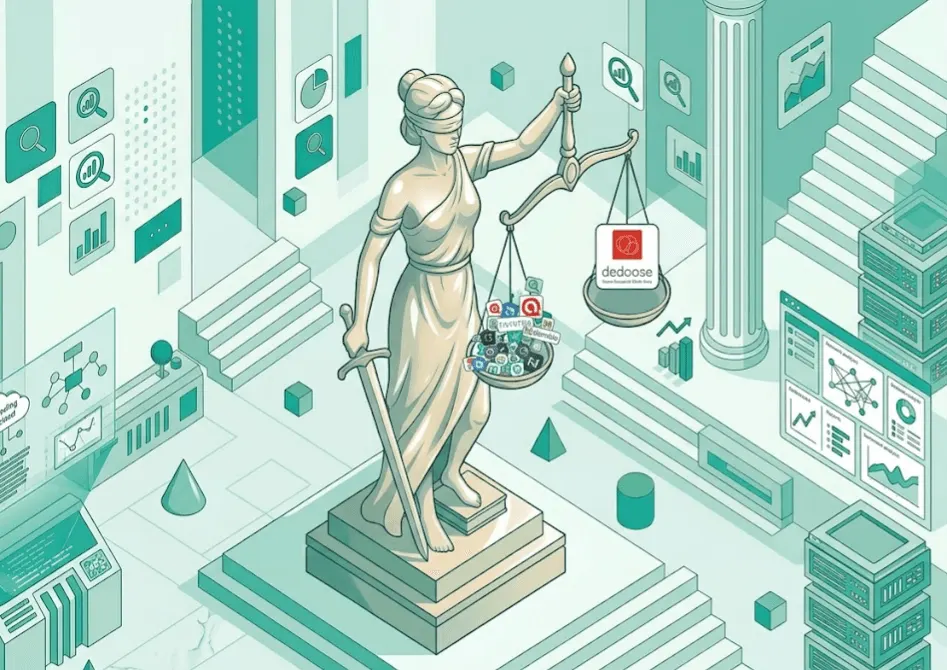
Dedoose is a cloud-based qualitative and mixed-methods analysis tool developed by researchers at UCLA, offering manual coding, interrater reliability tools, and collaborative team coding at a monthly subscription price significantly lower than NVivo or MAXQDA. For teams that need to code qualitative data collaboratively without a large upfront licence cost, it is a capable option. Its main limitations are a lack of meaningful AI features, an interface that has not kept pace with modern tools, and monthly costs that add up considerably on long projects. Compared to NVivo, Dedoose is cheaper and more collaborative but lacks NVivo's depth of analytical features and multimedia support. Compared to MAXQDA, it is more affordable and fully cloud-based but weaker on mixed-methods integration and visualisations. For researchers who want AI-assisted analysis with full traceability, Skimle is a stronger choice than any of the traditional manual coding tools, including Dedoose, and that is why it's gaining traction among academic and business users.
What is Dedoose?
Dedoose was created at the University of California, Los Angeles (UCLA) by a team of social scientists who wanted a collaborative qualitative analysis tool that ran in a browser rather than as a desktop application. The original design choices still define what it is today: fully web-based, built for distributed teams, priced on a monthly subscription, and oriented towards mixed-methods research that combines qualitative coding with structured demographic or survey variables.
The tool handles text, PDF documents, images, audio, and video, though audio and video functionality is more limited than what NVivo or MAXQDA offer. Its core analytical model is the same as the other traditional QDA tools: you import documents, create a codebook, apply codes to excerpts, and then run queries and visualisations across the coded material. What distinguishes Dedoose from its competitors is the combination of accessibility (cloud-based, any operating system), affordability (monthly subscription rather than annual licence), and built-in interrater reliability measurement.
It is worth being clear about what Dedoose is not. It is not a modern tool with AI assisted analysis. It doesn't have even the basic AI-assist features like MAXQDA's AI Assist or the rudimentary auto-coding features in ATLAS.ti, and compared to AI native tools like Skimle this means the workflow is extremely manual. If you are evaluating tools in 2026 partly on the basis of AI readiness, Dedoose is the weakest option in the traditional QDA category for that criterion.
For a broader overview of where Dedoose sits in the QDA landscape, the complete QDA software comparison for 2026 places all major tools side by side.
Dedoose features in 2026
Core coding and document management
Dedoose handles the fundamentals of qualitative coding reliably. You create a project, upload documents, build a codebook using a hierarchical structure, and apply codes to highlighted text excerpts. The interface runs in a browser, which means no installation and no platform compatibility issues. It works on Windows, Mac, Linux, and Chromebook without differences in functionality.
Code management is straightforward: codes can be nested to create parent-child hierarchies, and you can add memos to codes and to excerpts. The excerpt library lets you browse all coded passages across your corpus, which is useful for reviewing the evidence behind any given code before finalising your analysis.
The search and filter functionality is adequate for most projects. You can filter excerpts by document, code, participant characteristic, or researcher, and the query results can be exported to CSV or displayed within the interface.
Mixed-methods integration
This is Dedoose's most distinctive feature relative to other budget QDA tools. You can define descriptor variables for each document or participant (for example, gender, age group, role, or interview round) and then link these to your qualitative codes. Once you have coded your material, Dedoose can produce cross-tabulations showing how code application patterns vary across participant characteristics.
For a health researcher studying how patients of different age groups describe treatment experiences, or a social scientist comparing interview themes across demographic segments, this integration is genuinely useful without requiring a separate statistical package. It is less powerful than MAXQDA Analytics Pro's equivalent functionality, but it is significantly cheaper. It lacks the qualitative analysis of the differences between segments that Skimle's metadata analysis features offer.
Collaboration and interrater reliability
Multi-user access is included in the standard subscription rather than being a paid add-on. Multiple researchers can work on the same project simultaneously, applying codes independently and then comparing their work. Dedoose calculates interrater reliability statistics, including Cohen's kappa and percentage agreement, which matters for researchers who need to demonstrate coding consistency for publication or ethics review.
This is a meaningful differentiator relative to NVivo, where the Collaboration Cloud feature is a paid addition on top of individual licences. For a dissertation research team or a multi-site study with several coders, Dedoose's included collaboration is a real practical advantage.
Visualisations
Dedoose includes several visualisation types: bubble charts showing code frequency and co-occurrence, descriptor charts linking codes to participant variables, and excerpt charts for exploring patterns across the corpus. The outputs are functional and provide a reasonable analytical overview, but they are not publication-ready in the way MAXQDA's Visual Tools or Skimle's exports are. Researchers who need polished visual output for papers or reports will typically export the underlying data and recreate the visualisations in a dedicated tool.
Mobile and offline access
As a fully cloud-based tool, Dedoose requires an internet connection to function. There is no offline mode and no desktop application. This is a genuine limitation for researchers working in fieldwork settings without reliable connectivity, or in secure research environments where cloud data handling raises compliance concerns.
A mobile application exists for iOS, which allows field researchers to record notes and access their projects, though the full coding interface is not available on mobile.
Dedoose pricing in 2026
Dedoose uses a monthly subscription model rather than annual licences, which is one of its most significant differences from NVivo and MAXQDA.
Individual researcher: approximately $18 per month. This is the standard rate for a single user without institutional or group affiliation.
Student pricing: reduced rates are available for students, around $13 per month. Institutional and group rates are available for teams, with discounts that vary depending on group size. Check the current pricing at dedoose.com for exact figures, as rates may have been updated.
To put the monthly pricing in annual context: $18/month comes to $216 per year. That is cheaper than MAXQDA academic ($230–$280 per year) and significantly cheaper than NVivo academic individual ($295–$595 per year). For a short project of six to twelve months, Dedoose is the most affordable paid option with genuine collaborative features among the traditional QDA tools.
Dedoose does not offer a free tier, though a trial period is available.
What Dedoose does well
Genuinely accessible collaboration
The best thing about Dedoose is that it makes team coding genuinely easy without requiring additional licence purchases. In a distributed research team where multiple coders need to work on the same project from different locations and different machines, the setup is minimal. You create a project, invite collaborators, and they can code immediately from any browser. No installation, no sending project files back and forth, no version control headaches.
Combined with the built-in interrater reliability tools, this makes Dedoose a practical choice for systematic coding projects that require demonstrable consistency across coders. In health research, education research, and social science, these are often methodological requirements rather than nice-to-haves.
Affordability relative to NVivo and MAXQDA for short projects
For a researcher who needs a capable QDA tool for a six-month project, $14 (€13)/month is significantly easier to justify than an annual MAXQDA licence or NVivo's commercial pricing. The decision to use monthly pricing rather than annual subscriptions is explicitly budget-conscious, and it succeeds at what it sets out to do.
For PhD students and early-career researchers without institutional licence access, Dedoose's monthly pricing is often the most practical route to a proper QDA tool. The qualitative research on a PhD budget guide covers this scenario in more detail.
Mixed-methods integration at this price point
No other tool at Dedoose's price point handles mixed-methods integration as well. The ability to link qualitative codes to participant descriptor variables and then explore how themes distribute across demographic or contextual factors is a genuine analytical capability, not a surface feature. For researchers whose work is inherently mixed-methods — public health studies, programme evaluations, social policy research — this matters.
Platform independence
Running entirely in a browser means that Dedoose does not have the Mac-vs-Windows parity issues that affect NVivo, where the Mac version still lacks certain features available only on Windows. A research team mixing Mac and Windows users, or working on university-managed machines where software installation is restricted, finds Dedoose more straightforwardly accessible than desktop alternatives.
Where Dedoose falls short
No meaningful AI features
This is the most significant limitation in 2026. While NVivo, MAXQDA, and ATLAS.ti have all introduced AI-assisted coding in recent versions (with varying degrees of usefulness) and rigorous AI-native tools like Skimle are emerging, Dedoose has no equivalent capability. Every line of code application is manual. For a researcher analysing 50 interview transcripts, this means working through each document, identifying relevant passages, and applying codes by hand. At the scale that many modern research projects operate, this represents a very significant time investment.
The absence of AI features is not a temporary gap. Dedoose's architecture and positioning have not indicated a clear move in this direction, and as of 2026 it remains a tool built around the traditional manual coding paradigm without the AI layer that even the most conservative traditional tools have begun to add. For a researcher weighing tools partly on where the field is heading, this is worth taking seriously.
If AI-assisted analysis is a priority, the guide to using AI in qualitative research for academic researchers is useful context on what that actually means in practice.
Interface and user experience
Dedoose's interface is functional but dated. It has not been redesigned significantly in years, and compared to modern tools with cleaner interaction design, it can feel heavy and unintuitive on first contact. Common user complaints include the clicking-and-dragging interface for applying codes, which some researchers find less fluid than similar actions in MAXQDA or ATLAS.ti, and a general sense that the design language has not kept pace with tools built more recently.
This matters less once you are productive in the tool, but the initial learning curve is steeper than the tool's relatively simple feature set would suggest.
Performance and reliability at scale
For projects involving a large number of documents, Dedoose can become slow. Loading times for large corpora have been a consistent thread in user reports, and the browser-based architecture means that performance is partly dependent on the user's connection quality. For researchers working with very large datasets (100+ documents), this is worth testing carefully before committing.
No REFI-QDA export
Dedoose does not currently support the REFI-QDA standard for project exchange. This means that if you begin coding in Dedoose and later need to move your project to NVivo, MAXQDA, or ATLAS.ti (for example, because a collaborator uses a different tool, or because your institution requires data archiving in a specific format), you cannot transfer the coded project directly. You can export coded excerpts and codes as spreadsheet data, but the full project structure does not transfer. For researchers building long-term data archives or collaborating across institutions with different tool preferences, this is a practical limitation. NVivo, MAXQDA, ATLAS.ti, and Skimle all support REFI-QDA. See the manual coding and REFI-QDA export guide for context on why this standard matters.
Dedoose vs NVivo: which should you choose?
NVivo and Dedoose represent different ends of the traditional QDA spectrum. NVivo is the most feature-rich manual coding environment available, with deep support for multimedia data, complex matrix queries, and a very wide range of analytical tools built up over 35 years. Dedoose is leaner, cloud-native, and significantly cheaper on a per-user basis.
Choose Dedoose over NVivo if:
- Your institution does not provide NVivo access and you are paying individually (Dedoose's monthly pricing is substantially cheaper vs. NVivo)
- You have a distributed team coding simultaneously and do not want to pay extra for NVivo's Collaboration Cloud
- You need interrater reliability statistics built into the workflow
- You are working exclusively on text and do not need NVivo's multimedia coding capabilities
- Your project will run for twelve months or less, making monthly pricing advantageous
Choose NVivo over Dedoose if:
- Your institution has a site licence that removes the cost barrier
- You are working with video, audio, images, or social media data in a significant way
- Your project requires the full depth of NVivo's analytical query and visualisation tools
- Your field has established NVivo as the expected methodology tool in peer review
- Your project will run for multiple years, making NVivo's perpetual licence potentially more economical
For the full NVivo pricing breakdown, see NVivo pricing 2026: is it worth it?. For a broader comparison of NVivo alternatives for academic researchers, see NVivo alternatives for academic researchers in 2026.
Dedoose vs MAXQDA: which should you choose?
MAXQDA and Dedoose are both well-regarded in mixed-methods academic research, and the comparison between them is more closely contested than either's comparison with NVivo.
MAXQDA is desktop software (with a cloud option that is less capable than the desktop version), independently owned by VERBI GmbH, and available at annual licence pricing. It has stronger visualisation tools, more powerful mixed-methods integration through its Analytics Pro tier, and a cleaner interface than Dedoose. It has also added AI-assisted features in recent versions, though these are supplementary to manual coding rather than transformative.
Dedoose is cloud-native, genuinely collaborative out of the box, and cheaper for shorter projects. Its mixed-methods features are simpler but functional. It has no AI features.
Choose Dedoose over MAXQDA if:
- Your team is distributed across different operating systems or locations and you want zero-friction collaborative access
- Your project is twelve months or less, making Dedoose's monthly pricing more economical than MAXQDA's annual licence
- You need interrater reliability statistics and do not want to pay for MAXQDA's team pricing separately
- Your budget is genuinely constrained and MAXQDA's annual pricing, even at academic rates, is not feasible
Choose MAXQDA over Dedoose if:
- Your project involves structured content analysis, quantitative content coding, or you need the full mixed-methods integration of MAXQDA Analytics Pro
- You need publication-quality visualisations without exporting to another tool
- Your project will run for two years or more, at which point MAXQDA's annual pricing becomes more economical
- AI-assisted features matter to you, even if only as a starting point for manual coding
- Your project may need to move to another tool, and REFI-QDA compatibility matters
For a detailed cost comparison before deciding, see our MAXQDA pricing 2026 guide.
For a full comparison of MAXQDA and ATLAS.ti (and how they compare to each other), see MAXQDA vs ATLAS.ti qualitative analysis software 2026.
Dedoose vs Skimle: which should you choose?
This is a comparison between two tools that operate on fundamentally different models. Dedoose is a traditional manual coding environment that runs in a browser. Skimle is an AI-native analysis tool that processes your entire corpus systematically, produces a structured thematic representation, and then invites the researcher to review, challenge, and refine what the AI has found. The analytical paradigm is different, not just the interface.
In Dedoose, the researcher does the initial coding pass. You read each document, identify relevant passages, and apply codes. The tool helps you manage, query, and visualise the resulting coded material, but the manual work of going through the data is entirely yours.
In Skimle, the AI does the initial pass. It reads all your documents, identifies themes and supporting evidence, and structures the findings so the researcher can see them systematically. The researcher's role shifts to reviewing that structure: interrogating whether the themes make sense, looking for what the AI has missed, reframing categories where the AI's conceptualisation differs from yours. For most research projects, this is a substantially more efficient use of a researcher's time, because the heavy data processing is handled before you begin. The analytical judgement work is where researchers add the most value, and Skimle concentrates your time there.
For an academic researcher, the traceability question is important. Every theme in Skimle links directly to the source excerpts that support it, which links back to the original document following the principles of two-way transparency. This chain of evidence is needed to make rigorous AI-assisted analysis defensible in peer review. The AI qualitative data analysis checklist covers what you need to document when using AI tools in academic research.
Skimle also supports full manual coding, so researchers who want to apply additional codes beyond what the AI has found, or who want to work through specific documents in detail, can do so. The how to code qualitative data guide explains how manual and AI-assisted coding interact in practice.
In terms of pricing, Skimle's monthly cost to academic users on the academic plan comes to about 20 EUR per month vs. Dedoose's $18, meaning the added benefits of AI assisted analysis, transcriptions, anonymisation etc. practically do not cost extra.
Choose Dedoose over Skimle if:
- Your methodology requires you to manually code all material yourself, without AI involvement (for example, because your institution's ethics approval or methodology commits you to fully manual coding)
- Your project specifically requires interrater reliability statistics with multiple human coders, which Dedoose handles particularly well
Choose Skimle over Dedoose if:
- You want AI assistance to accelerate the initial coding pass and focus your time on interpretation
- Your project involves 20 or more interviews or you are concerned about the time investment of manual coding at that scale
- You want REFI-QDA export compatibility with other QDA tools
- You need to transcribe audio or video, collect qualitative AI-assisted survey data on platform or anonymise transcripts.
- Traceability and auditability of your analysis matter for peer review
- You want a modern interface built around AI-assisted workflows rather than a traditional coding paradigm
The NVivo, MAXQDA, ATLAS.ti vs Skimle comparison covers the Skimle positioning against traditional QDA tools in more depth.
Who should use Dedoose in 2026?
The clearest use case for Dedoose is a distributed academic research team that needs to code qualitative data collaboratively, has a project running for twelve months or less, and cannot afford or does not have access to NVivo or MAXQDA.
More specifically:
PhD students and dissertation researchers without institutional NVivo access will find Dedoose a practical and affordable route to a proper QDA tool. Monthly pricing fits graduate research budgets better than large annual licences. If the project involves multiple coders (for example, two researchers coding the same corpus to establish interrater reliability), Dedoose handles this more straightforwardly and cheaply than NVivo.
Mixed-methods researchers in health, social science, and education will find Dedoose's built-in descriptor variable linking genuinely useful. The ability to connect qualitative code patterns to participant characteristics without a separate statistical package covers a lot of common mixed-methods se cases at Dedoose's price point.
Teams in academic settings where funding is limited but where collaborative simultaneous coding is a requirement will find Dedoose more practical than tools that charge separately for collaboration. A research team of three coding simultaneously in Dedoose, each paying $18 (€15)/month, is considerably cheaper than an equivalent NVivo Collaboration Cloud setup.
Researchers where AI assistance is not appropriate (for methodological, ethical, or institutional reasons) and who want a cloud-based alternative to desktop QDA tools will find Dedoose a reasonable choice, provided they are comfortable with the interface and the project scope.
Dedoose is probably not the right tool for:
- Researchers who want meaningful AI assistance in their analysis
- Teams that may need to export their project in REFI-QDA format for interoperability
- Projects involving significant multimedia data (video, audio, images) where NVivo is considerably more capable
- Researchers in fields where NVivo is the established expectation in peer review
For researchers unsure whether traditional QDA software is the right category for their work at all, the qualitative analysis tools NVivo, MAXQDA, ATLAS.ti vs Skimle comparison is a useful starting point for thinking about the paradigm question rather than just the tool comparison within the traditional category.
Related reading:
- NVivo alternatives for academic researchers in 2026
- Qualitative data analysis tools: complete comparison
- How to use AI in qualitative research: a guide for academic researchers
About the authors
Henri Schildt is a Professor of Strategy at Aalto University School of Business.. He has published over a dozen peer-reviewed articles using qualitative methods, including work in Academy of Management Journal, Organisation Science, and Strategic Management Journal. His research focuses on organisational strategy, innovation, and qualitative methodology. Google Scholar profile
Olli Salo is a former Partner at McKinsey & Company where he spent 18 years helping clients understand the markets and themselves, develop winning strategies and improve their operating models. He has done over 1000 client interviews and published over 10 articles on McKinsey.com and beyond. LinkedIn profile
Sources
- Dedoose pricing — dedoose.com
- Dedoose official site — dedoose.com
- NVivo pricing — Lumivero
- MAXQDA pricing — VERBI GmbH
- REFI-QDA standard — Rotterdam Exchange Format Initiative
- Silver, C. & Lewins, A. (2014). Qualitative Data Analysis Software: A Call for Understanding, Transparency, Conscientious Use, and Reporting. Field Methods, 26(4), 369–377.