Skimle for academic researchers
Academic rigour at the speed of AI
Skimle was built by academics for academics. Co-founder Professor Henri Schildt has decades of experience in qualitative research and articles published in leading management journals including Academy of Management Journal and Organization Science. He got tired of NVivo and MAXQDA's slow, clumsy workflows, and was worried by the way ChatGPT is being used for analysis that lacks transparency and comprehensiveness. So he built Skimle as the platform that replicates rigorous, transparent qualitative methodology, but with AI at the core.
Initial coding of interviews can take weeks manually. Skimle handles it without sacrificing methodological rigour, often catching quotes a human would miss. Every theme links to a verified verbatim quote. The full audit trail satisfies peer reviewers. Note: academic discounted plans available.
Rigorous analysis that lets you focus on your theoretical contribution
Skimle's approach is inspired by grounded theory (Glaser & Strauss; Strauss & Corbin) and Gioia's method. It produces the systematic, transparent analysis peer review demands, without the weeks of mechanical coding that consume time better spent on theory. It works in 100+ languages and handles up to 1,000 documents per project.
- Automated initial coding — every quote linked to its category
- Full two-way audit trail for peer review and methods transparency
- Codebook you control — merge, split, rename, reorganise categories freely
- Works in 100+ languages without translation
- Handles interviews, audio/video, books, documents, archival materials
- Skimle Academic — a discounted plan — available
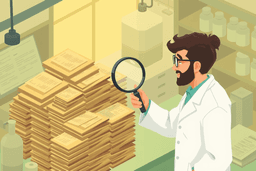


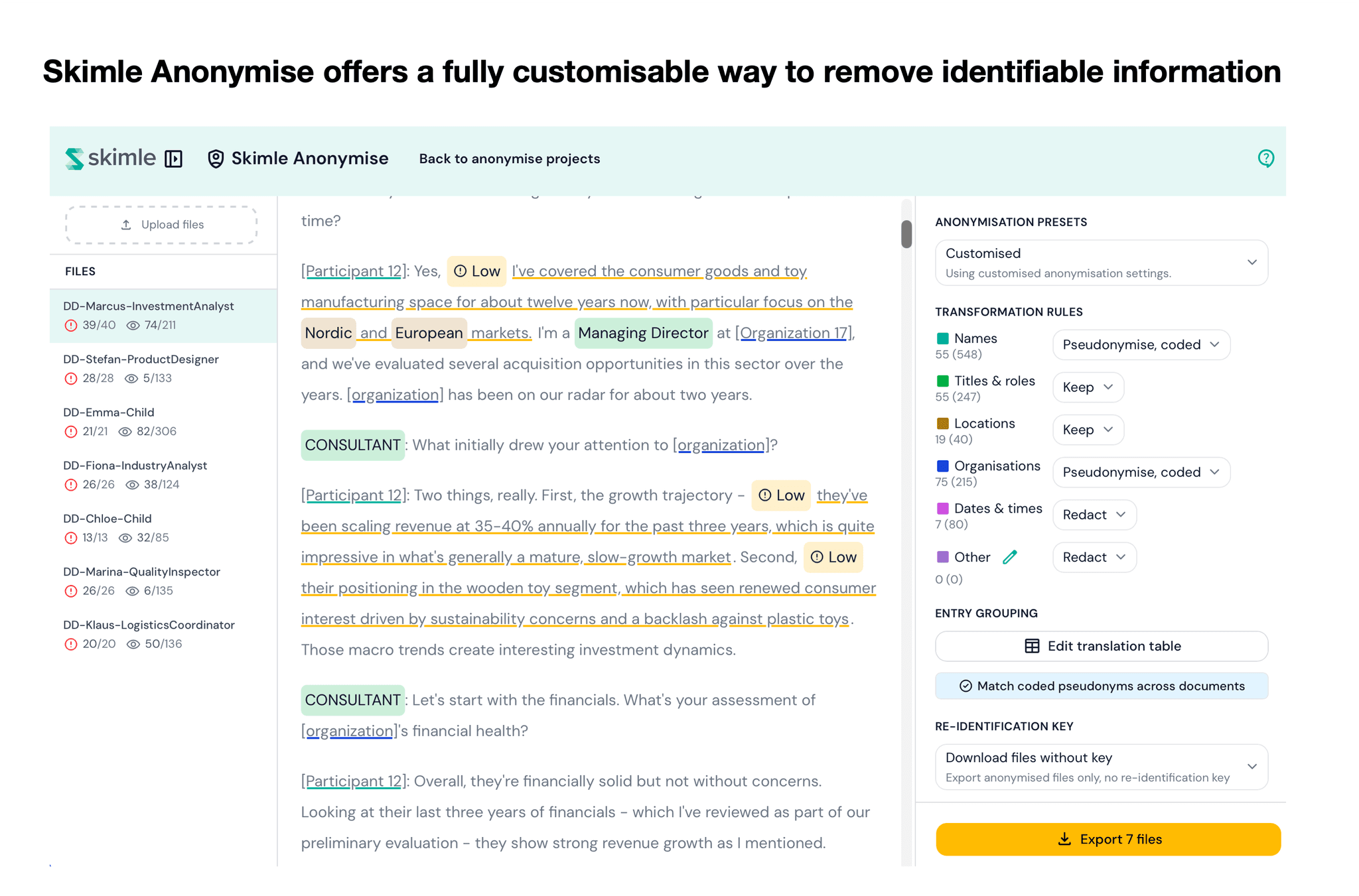
FROM RECORDING TO GDPR-READY TRANSCRIPT
Transcribe and anonymise interviews
Turning field recordings into usable data is slow and expensive through a third-party service, and the resulting transcripts carry names, affiliations, and locations that create GDPR and ethics obligations before you can share, archive, or quote them. Skimle transcribes audio and video inside its secure, EU-hosted environment, then anonymises with research-grade pseudonymisation, so you have a compliant, coded-ready transcript the same day, without the data ever leaving GDPR-compliant infrastructure.
How it works
- 1. Upload audio, video, or text
Upload MP3, M4A, WAV, MP4, MOV, PDF, or Word files directly. No external transcription service, and 100+ languages handled natively.
- 2. Transcribe with speaker labels
Skimle transcribes the recording, identifies speaker changes, and handles accents and varying audio quality. Review and correct the output before analysis begins.
- 3. Detect identifiers automatically
Skimle Anonymise flags identifiers across six categories — names, titles and roles, locations, organisations, dates, and other — across every document, with cross-file consistency so the same person keeps the same pseudonym.
- 4. Choose your anonymisation level
Pick light pseudonymisation, strong pseudonymisation, or HIPAA-grade anonymisation with the key destroyed. Tune each category independently and add custom rules in plain language.
- 5. Export with audit documentation
Export a PDF audit report and Excel translation table for your ethics board, then feed the clean transcript straight into Skimle's analysis workflow. Source audio is securely deleted afterwards.


FROM WEEKS OF MANUAL CODING TO HOURS OF ANALYSIS
Conduct AI-assisted qualitative analysis of interviews
Research based on 40+ interviews should produce a rich theoretical contribution (for example for your PhD), but manual coding — highlighting, organising, re-coding, building trackers — consumes most of the available time and might still miss important patterns. Skimle reads every interview systematically and gives you a structured theme hierarchy with verbatim quotes attached, so you can spend your time on the theoretical interpretation that only you can provide.
How it works
- 1. Upload your transcripts
Drag in interview transcripts as PDFs, Word files, or plain text. Skimle accepts documents in any format and handles 100+ languages natively.
- 2. Describe your research question
Set your analytical focus, broadly or specifically. Skimle structures the initial coding around what you are trying to understand theoretically.
- 3. Review the initial code structure
Skimle produces a hierarchy of themes, each linked to verbatim quotes from the source transcripts. Nothing is invented. Every code traces to text.
- 4. Refine to your theoretical framework
Merge, split, rename, and reorganise categories to match your emerging theoretical model. Two-way transparency lets you verify which quotes support which codes at any point.
- 5. Export for your methods appendix
Export your codebook and supporting quotes as text or as open source REFI-QDA (.qdpx) format supported by legacy CASQDA programs like Nvivo, Atlas.TI or MAXQDA.




CONNECT QUALITATIVE THEMES TO YOUR VARIABLES
Run mixed-methods analysis across your sample
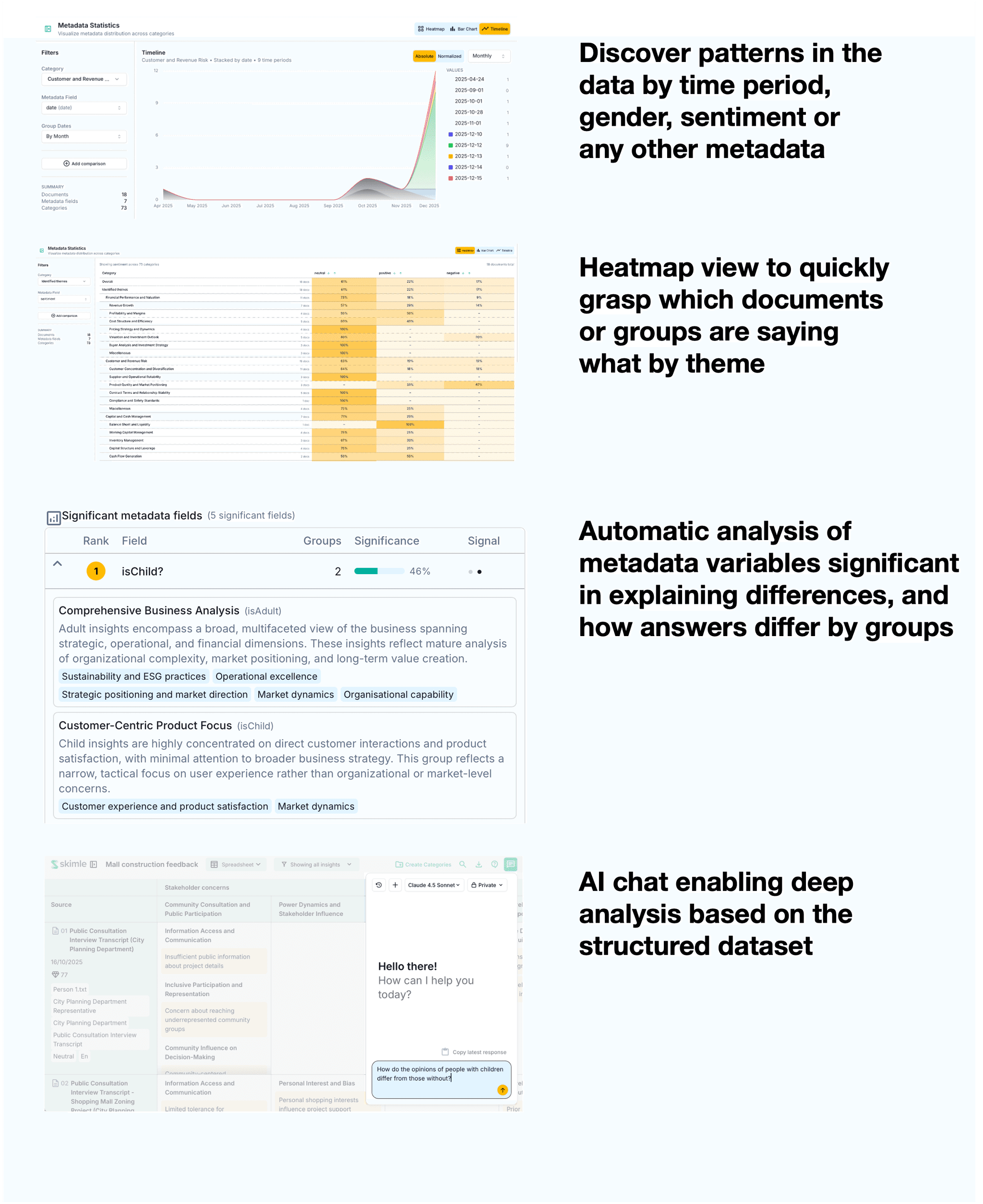
Qualitative findings carry more weight when you can show how they vary across the sample: by cohort, role, gender, site, or condition. Cross-tabulating themes against participant attributes by hand is tedious and easy to get wrong. Skimle attaches metadata to every document and lets you segment the same theme structure by any variable, so you can move between rich verbatim quotes and quantified patterns without leaving one methodology behind.
How it works
- 1. Attach metadata to documents
Tag each transcript with the variables that matter to your design — cohort, role, gender, site, wave, or experimental condition — manually or from a CSV column.
- 2. Run the qualitative analysis
Skimle builds one theme hierarchy across the whole corpus, so every participant is coded against the same structure.
- 3. Segment themes by variable
See how each theme varies across groups, and spot where a pattern is universal or specific to one cohort.
- 4. Quantify prevalence
Read theme frequencies and distributions to report how common a code is by segment, with every count traceable back to the quotes that produced it.
- 5. Export tables and quotes
Export cross-tabulations and supporting quotes to Excel or Word for the mixed-methods section of your paper.


FAQ
Frequently asked questions
- Can I cite Skimle in my research?
- Yes. Describe it as 'AI-assisted qualitative coding software' in your methods section, as you would cite NVivo or MAXQDA. We have a methods article in peer review that will provide a formal citation, and can suggest citation language on request in the meantime.
- Will peer reviewers accept AI-assisted analysis?
- Increasingly yes, with proper documentation. Skimle's audit trail gives reviewers what they expect: a documented, systematic coding process where every theme traces to specific quotes, so the methods section largely writes itself.
- How does Skimle compare to NVivo or MAXQDA?
- NVivo and MAXQDA suit researchers with weeks for analysis and an institutional licence. Skimle automates the mechanical coding phase — weeks to hours — while keeping the same systematic, transparent methodology, and the learning curve is minutes. Many researchers use both: Skimle for the initial coding pass, NVivo for mixed-methods integration.
- Does Skimle work for grounded theory?
- Yes. Skimle supports inductive coding where themes emerge from the data rather than being imposed in advance. Start with a broad focus and let the category structure develop iteratively, which maps closely to open coding in grounded theory.
- Can I run mixed-methods analysis?
- Yes. Attach metadata variables to each document — cohort, role, gender, site, condition — and segment the theme structure by any of them. You get theme frequencies and distributions by group, each traceable to verbatim quotes, ready for the mixed-methods section of your paper.
- Is my research data secure?
- Your transcripts are processed on EU-hosted infrastructure and never used to train AI models. We provide Data Processing Agreements for institutional ethics requirements and can accommodate most IT security needs. Contact us with specific requirements.
- Can I get an academic discount?
- Yes. Academics with a valid institutional email and affiliation page can buy the discounted Skimle Academic package. Contact us for institutional licensing if you need team access for a research group or lab.
About Skimle
Built by academics for academics
Skimle is built by academics for academics, and by business professionals for business professionals. Co-founder Professor Henri Schildt has published in Academy of Management Journal, Organization Science, and Strategic Management Journal, and has spent two decades doing qualitative research the hard way. Co-founder Olli Salo is a former McKinsey Partner who conducted over 1,000 client interviews. We built Skimle because we needed it ourselves.
We are trusted by Finnish government ministries, over 30 universities, dozens of consulting and market research firms, and large companies. All data is stored within the EU and processed according to our strict GDPR policy and terms of service.
Want to learn more? Explore our Signal & Noise blog, our FAQ, and use cases by sector. We are also happy to demo the product or explore how Skimle could fit your needs.