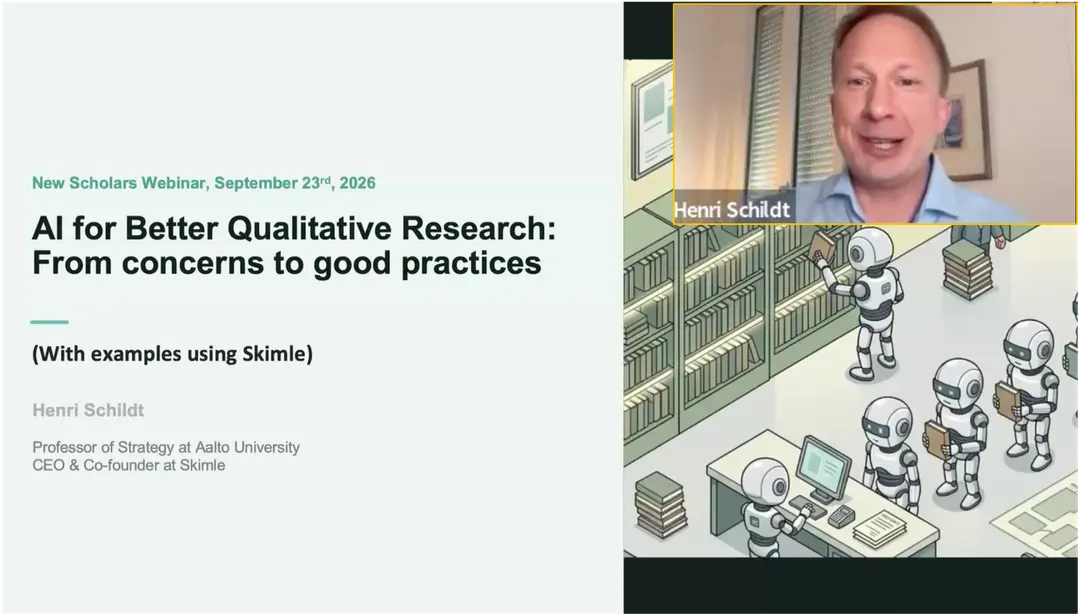
📄 New white paper on SSRN: "Designing AI for Qualitative Research: Predictability, Transparency, and Control in AI tool Skimle.com" — read the full paper here.
Large language models can read, summarize, and label text far faster than any human coder. That speed lets us work through hundreds of interviews and tens of thousands of pages of archival material, apply more theoretical lenses, and revisit our data far more often than we ever could by hand. In principle, AI even helps us combat our own biases by offering an "external" perspective on our interpretations.
Yet the reception of AI in qualitative research has been ambivalent. The same tools that promise speed also raise the prospect of analyses that are unreliable, opaque, and disconnected from interpretive judgment. If we want AI to augment expert researchers instead of automating them out of the loop, we need shared design principles for what a good tool looks like. Building on our experience building Skimle, this post lays out a starting set: three core criteria, plus a fourth that ties them together.
The core risks of AI in knowledge work
The early objections to LLMs in qualitative work were concrete: hallucination, privacy, and lack of comprehensiveness. Hallucinations, made-up content outputted by the AI model, is a serious concerns, since the credibility of any analysis is immediately destroyed if it contains a made-up quote the interviewee never said. These problems are largely solvable in professional-grade tools. Skimle uses smart software to verify that every quote suggested by the LLM appears verbatim in the source, reputable cloud providers (that we use) guarantee your data isn't used for training, and dedicated workflows can ensure all the data is analyzed equally rather than selectively sampled.
The deeper risk is cognitive offloading. In qualitative analysis, coding is not merely a means to an end. Reading transcripts closely, weighing alternative labels, and revising an emerging scheme are the activities that familiarize researchers with their data. When a tool automates that interpretive work, researchers can gradually relinquish cognitive control and adopt the AI's judgment as their own. Experimental evidence links heavy AI reliance to weaker independent judgment, and the effect depends on how much offloading a tool invites. The danger is that automation displaces augmentation, and that unchecked AI output introduces systematic biases a disengaged researcher never notices.
One of the main drivers of offloading is opacity. When tools behave like black boxes, producing themes and summaries without showing how they got there, a researcher is left to either trust the output blindly or re-verify everything. The criteria below are meant to address offloading and opacity directly.
The design criteria
The first three criteria keep the human expert in the analytical loop. The fourth makes sure the tool serves the researcher's method instead of dictating it.
| # | Criterion | What it means | Why it matters |
|---|---|---|---|
| 1 | Predictable processes | The same data and the same actions produce substantively the same results, in the same form, every time — a stable relationship between what the researcher does and what the tool returns. | Predictability lets users build tacit skill and expertise, the way a hammer or a guitar is useful because it responds consistently to the skilled user. Fully agentic systems that invent a fresh workflow each run abandon this. |
| 2 | Two-way, end-to-end transparency | The researcher can move from any conclusion down to the exact source passages behind it, and from any source see what was coded and what was ignored — across every stage of a multi-step analysis. | Seeing what the AI passed over is as important as seeing what it used; this allows the user to judge whether the analysis is aligned with their judgment or if it contains systematic bias. Without transparency, the researcher cannot stand behind the results. |
| 3 | Substantive researcher control | Codes can be edited, renamed, merged, and moved; passages reassigned; category structures reorganized as a routine part of the workflow. | Control is about how easily you can apply your own judgment to reshape the AI's draft. When edits are hard, researchers step back and offload; when they are easy, interpretive authority stays with the human. |
| 4 | Methodologically agnostic | The tool flexibly supports diverse approaches — from inductive, data-driven coding to theory-driven "constructivist" frames the researcher imposes on the data — rather than hard-wiring one method. | If inductive coding is effortless and theory-driven coding cumbersome, the tool silently nudges everyone toward data-driven analysis. A method-agnostic tool, built on transparency and flexibility, leaves room for methodological innovation. |
The first three criteria reinforce each other against cognitive offloading. Predictability lets the researcher anticipate what the AI is doing, transparency lets them check what it actually did, and control lets them act on that understanding and reshape the work. The fourth criterion follows from control: a tool that gives researchers real command over the analysis should not bind them to a single method.
Why "methodologically agnostic" deserves the fourth slot
I have encountered the assumption that because AI tools do symbolic processing, each one must follow a specific qualitative method. It is a reasonable guess, but a well-designed tool should support many methodological stances. The classic grounded theory view approaches data with as few preconceptions as possible, letting codes and categories emerge from informants' own words. Most contemporary authorities treat coding as an interpretive act shaped by the researcher's theoretical commitments, and reflexive thematic analysis makes the researcher's active viewpoint the engine of the work.
A good tool has to accommodate both. That means letting researchers define theory-informed categories to extract at any point, and reorganize coded material to reflect different conceptual frameworks, while still supporting bottom-up inductive coding when that is the goal. Ideally AI should let researchers do more than run existing methods faster; it should help them develop new approaches altogether. A tool too tightly bound to one established method forecloses that innovation.
This is something I overlooked initially with Skimle, as the first versions were highly inductive in their functioning. The current version allows users to easily restructure existing category trees based on their own theory-driven interpretations.
The unresolved tension: agentic AI
The hardest case for design is agentic AI. When agentic AI harnesses interact with the researcher to decide how to code and categorize data. Yet, they can also spot opportunities mid-analysis by drawing on metadata such as interview demographics or document dates, adjusting their focus as interesting patterns emerge. The agentic capabilities can create more powerful and complex analyses, but that power and complexity runs against the three criteria. The more control AI takes over the analysis, the less predictability, transparency, and methodological control the researcher retains. Harnessing agentic AI while preserving predictability, transparency, and control is one of the most important areas for future work, and one where current tools, including our own, have to be innovative.
These properties do not appear by accident; they have to be designed in. The field needs more practitioners from diverse traditions voicing their concerns and priorities, so that the tools we build augment expert judgment instead of displacing it.
Adapted from Henri Schildt, "Designing AI for Qualitative Research: Predictability, Transparency, and Control in AI tool Skimle.com" (working paper, June 2026).
About the Author
Henri Schildt is Professor of Strategy at Aalto University School of Business and co-founder of Skimle. He has published dozens of peer-reviewed articles using qualitative methods, including work in Academy of Management Journal, Organization Science, and Strategic Management Journal. His research focuses on organisational strategy, innovation, and qualitative methodology.
Henri developed Skimle after years of frustration with existing qualitative analysis tools that failed to leverage AI's potential while maintaining academic rigour. Google Scholar Profile