Skimle Ask is Doodle for interviews.
Doodle made it easy for anyone to run a quick scheduling poll without coordinating a chain of emails. Skimle Ask does the same thing for research: anyone can set up an AI-conducted interview, share a link, and collect real answers from tens or hundreds of people, without hiring an interviewer, booking meeting rooms, or spending weeks on analysis. One market research agency uses this to offer respondents a choice between a moderated call and a self-paced Skimle Ask interview within the same fixed project scope, which raises completion rates rather than just cutting cost; see why "3x faster" is the wrong pitch for AI in research for that example in full.
You can use it to find out what your team actually thinks about a new policy. To gather feedback on a product feature. To run a customer needs assessment. To collect quick ideas before a company event. To do a lightweight market research study. To survey an online community. To interview job applicants. To check in with employees across your organisation.
Skimle Ask is for people with questions that deserve a real answer, not a score of 1 to 5.
To get a sense of how the interviewer works, take a few moments to answer a demo Skimle Ask on employee experience.
Surveys give you numbers when you need answers
Most tools for collecting information from groups of people fall into two categories.
- On one side, surveys: fast to deploy, easy to analyse, but limited to the questions you thought to ask in advance, answered on whatever scale you chose.
- On the other side, interviews: rich, flexible, and capable of surfacing things you did not expect, but slow, expensive, and hard to run at any meaningful scale.
This trade-off has shaped how organisations and researchers gather insight for decades. If you needed breadth, you built a survey. If you needed depth, you ran interviews. Qualitative and quantitative researchers would have their own conferences and journals and only mingle after a few beers or in dedicated "Mixed methods" venues.
The result is that most of the insight-gathering that happens in organisations defaults to surveys, and surveys default to numbers. Rating scales. Likert items. Net Promoter Scores. These tools are good at producing data that is easy to aggregate and present in a dashboard. They are poor at capturing the things that matter most: what people actually think, in their own words, with the context and texture that makes findings actionable.
The poor open-text box at the end of a survey is a partial concession to this problem. In practice it rarely works well. By the time a respondent reaches it, they have already answered thirty structured questions and their patience is gone. And even when people do write something, the resulting pile of free-text responses usually sits unanalysed because reading and coding hundreds of short comments manually is more work than most teams can absorb.
Skimle Ask was built to change this.
What Skimle Ask actually is
Skimle Ask is a conversational AI interviewer. When a respondent opens your interview link, they enter a chat interface and have a real conversation with the AI. It works through the topics in the interview guide you created, asks follow-up questions when answers are interesting or vague, and manages the flow so that the conversation stays on track and within a reasonable time.
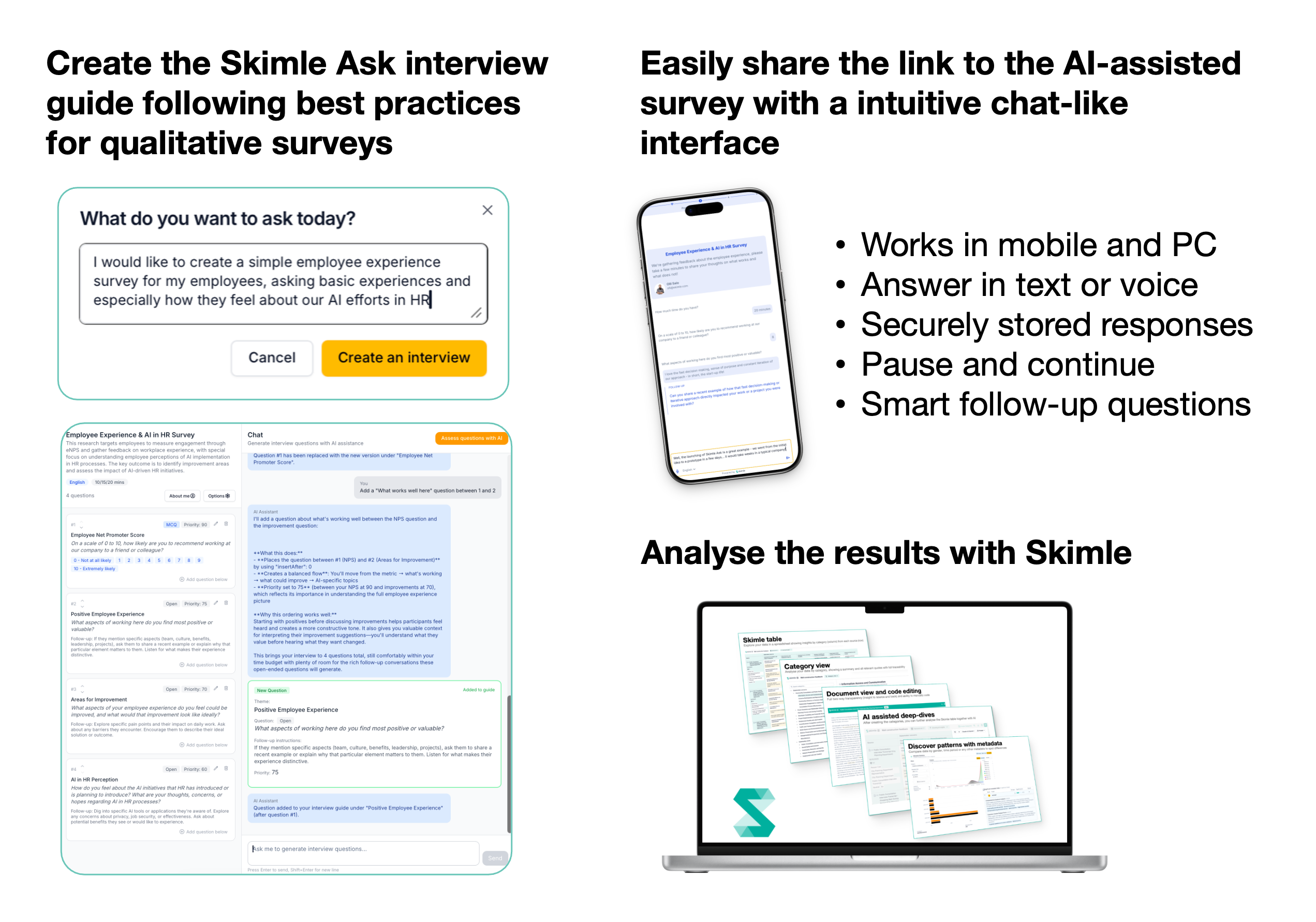
Respondents can answer from any device, at any time. There is no need to schedule anything. The experience is closer to messaging than to form-filling.
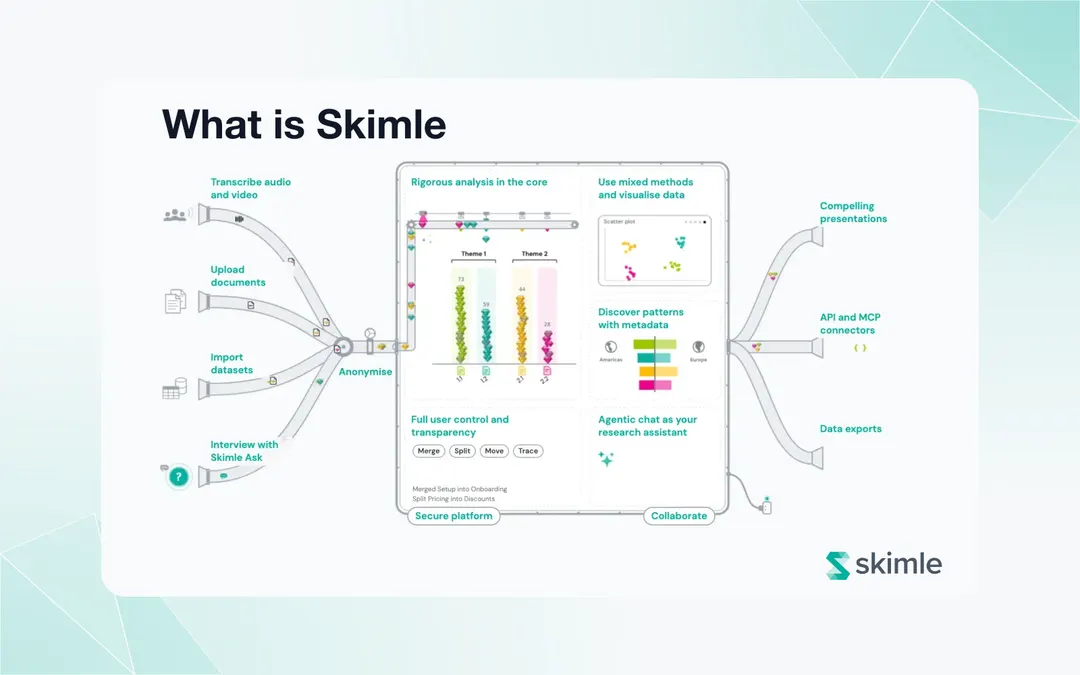
Once responses are collected, they can be fed directly into Skimle's analysis engine, where the AI identifies themes, structures the findings, and gives you a transparent, editable view of what people said and why. You can then export reports, slide decks, or data tables.
Setting up a quick survey takes minutes, and crafting a longer and more complex survey is fast as well because of the helpful AI assistant and intuitive interface. The AI-assisted analysis takes minutes to complete, and then you have your full transparent dataset ready for gathering insights and reporting.
Setting up your Skimle Ask interview
Creating the interview guide
When you create a new Skimle Ask project, the first step is defining your interview guide. You can write this from scratch, but most people start by describing their research objective in plain language and letting Skimle's AI draft a guide for them.
For example: "I want to understand how my team feels about the shift to a hybrid working model" or "I want to find out what customers like and dislike about our new onboarding flow." The AI produces a structured set of questions covering the topic, grouped into logical sections. Skimle Ask defaults to brief interview guides with three main questions and a few multiple-choice questions with follow-up questions afterward. We find people respond best to surveys that are brief and practical.
From there, you edit. You might rephrase questions to match your context, add topics you want to make sure are covered, or remove areas that are not relevant. The guide is just a starting point for the conversation, not a rigid script, so it does not need to anticipate every possible response. For guidance on what makes a strong interview guide, see our article on how to write a good interview guide.
Editing individual questions
For each question in the guide, you can configure several things:
Follow-up behaviour. You can set how many and what type of follow-up questions the AI should ask on a given topic. For areas where you want depth, you might allow two or three follow-ups. For topics that are lower priority, you can set it to zero, meaning the AI asks the question once and moves on. This gives you control over where the interview spends its time.
Priority. Questions can be scored for priority: e.g., a score of 100 marks essential questions the AI will always ask even if the conversation is running long, while lower scores mean they may be skipped if time is running short. This ensures that the most important topics are always covered, regardless of how talkative each respondent is.
Multiple choice and open text questions. You can define both qualitative interview questions as well as multiple choice questions (MCQ) where you give the list of possible answers (for example a Likert scale from 1 to 5, NPS questions from 1 to 10, or different answer options like "Male, Female, Other, Prefer not to say"). MCQ answers can be used as a variable to pivot the data in the analysis stage, for example to see how gender affects the answers.
Configuring the interview settings
Beyond the individual questions, you have a set of options that control the overall interview experience:
Time limit. You can set a maximum duration for the interview, for instance 10 or 20 minutes. The AI manages the pacing dynamically to finish within that window, prioritising essential questions and trimming follow-ups as needed. This is one of the most important settings for managing respondent experience, because people are more willing to start an interview if they know how long it will take.
Introduction and welcome message. You can write a brief message that respondents see before the interview begins. This is where you explain the purpose of the research, who is organising it, and what will happen with the responses. A clear, honest introduction significantly improves response rates and the quality of answers. Add your photo, website and email address for maximum credibility.
Anonymity settings. You can choose whether responses are collected anonymously or attributed to named respondents. Anonymous interviews typically produce more candid responses, particularly for sensitive topics. For studies where follow-up might be needed, attributed responses allow you to reach back out.
Response language. Respondents can answer in any language, and Skimle handles the analysis across languages. The survey language determines the initial user interface elements - set it up as the expected majority's language. Answers in different languages can easily be combined together in the analysis stage.
Sharing the interview
Once your guide is ready and settings are configured, Skimle generates a shareable link. You can send this link however makes sense for your context: email, Slack, Teams, WhatsApp, an internal newsletter, a website, a QR code in a physical location, or any other channel where your respondents are reachable.
There is no login required for respondents. They click the link and begin the interview. Nothing to install or register for. This simplicity matters becaseu every additional step between clicking a link and starting a conversation reduces response rates.
If you did not already do so, take a few moments to answer a demo Skimle Ask on employee experience to get a sense of how the interview looks and feels like.
You can also set a deadline for responses, after which new interviews are no longer accepted. This is useful when you need to close off data collection before beginning analysis.
How the interview engine works
Smart follow-ups, not rigid scripts
The core of Skimle Ask is the interview engine that conducts the actual conversation. It is designed around the way a skilled interviewer would behave, not the way a survey form or basic branching logic works.
When a respondent gives a clear, specific answer, the AI acknowledges it and moves on. When an answer is vague, it asks for a concrete example. When something unexpected and interesting comes up, it can probe to understand more before continuing with the main guide. When a respondent is going into a lot of detail on a lower-priority topic, it knows when to gently redirect.
This means the interview can surface things you did not think to ask about. Respondents who have something important to say can say it in full. Those who want to answer concisely can do that too.
The engine was developed by Henri and Olli based on years of experience on how to collect effective interviews. It was tested with the most demanding subjects known to science (teenagers). Since they would complete the survey with minimal eyerolling, we believe it also works in a corporate setting...
Designed to be as non-annoying as possible
This is something we thought about carefully. Most AI assistant experiences are built to be impressive, to demonstrate capability, to feel futuristic. Skimle Ask is built to be useful without getting in the way.
In practice, that means several specific design choices:
No futuristic voice, no pretty avatar. The interview is text-based chat, the same format people use for messaging every day. There is no synthetic voice reading questions aloud, no animated avatar to look at, no performance to sit through. Just a conversation in a clean, simple interface.
It feels like WhatsApp, not a corporate form. The messages are short and natural. The AI does not write in formal business prose. It is direct, friendly, and to the point, without being artificially upbeat. Respondents often describe the experience as more pleasant than a long survey.
Follow-ups are earned, not automatic. The AI does not ask follow-up questions after every answer just to seem thorough. It asks them when there is a genuine reason: for example the answer was too brief to be useful, it raised something worth exploring, or a key detail is missing. A respondent who gives a complete, clear answer will rarely see more than one or two follow-ups per topic.
Respondents can skip. Questions can be passed without penalty. The AI does not ask why or try to redirect. This respects the respondent's time and reduces the feeling that the interview is extracting information against their will.
Time is managed honestly. If the interview is approaching its time limit, the AI will say so and explain that it needs to move to the most important remaining questions. This transparency helps respondents feel in control of their time.
The result is a response experience that most people find straightforward and even enjoyable. That matters for data quality. Respondents who are comfortable give more thoughtful, detailed answers.
Analysing the responses
Once your interview has collected responses, they move into Skimle's core analysis engine. This is where the qualitative data becomes structured findings.
Skimle reads each response systematically, identifies the insights within it, and builds a category structure that organises those insights by theme. This is the same thematic analysis methodology that academic qualitative researchers use, automated with AI so that what would take a researcher weeks of manual work takes hours.
Every finding traces back to the specific quotes that support it. You can click any theme to see exactly which respondents mentioned it and what they said. You can click any quote to read it in the full context of that respondent's interview. This two-way transparency is what makes the findings credible, not just plausible.
The analysis is also fully editable. If you disagree with how the AI has coded a particular response, you can change it. If two categories should be merged, you can merge them. If an important theme is being missed, you can add it manually. You are always in control of the analysis, with the AI handling the labour-intensive parts.
You can also filter and cross-tabulate responses by any metadata variable, for instance comparing findings from different departments, age groups, or customer segments. This kind of comparative analysis, which reveals not just what people think but whether different groups think differently, is described in detail in our guide to discovering themes using metadata variables.
Exporting and sharing findings
From the Skimle analysis, you can generate outputs in several formats:
- Word report: a structured written document with sections for each theme, supporting evidence, and selected verbatim quotes. Useful for written briefings, stakeholder updates, and research documentation.
- PowerPoint deck: a presentation-ready slide set with key themes and supporting quotes. Useful for sharing findings in meetings or with people who will not read a full report.
- Excel export: the full structured dataset, including all responses, codes, and categories, for further analysis or integration with other data sources.
- REFI-QDA and coded documents: For those wanting to conduct deeper research in a legacy qualitative analysis tool, Skimle offers full exports to REFI-QDA open text format and as simple coded documents
More detail on how these exports work and how they fit into different workflows is covered in our article on importing and exporting data with Skimle.
What can Skimle Ask be used for?
The range of use cases is broad. Some examples from the kinds of people who find it useful:
HR professionals and people teams running engagement research, exit interviews, onboarding feedback, or culture assessments. We cover the HR use case in detail in a separate guide.
Consultants and organisational development practitioners who need to understand stakeholder views quickly as part of a wider project. The kind of expert interview methodology that consultants use can now be deployed at scale.
Market and customer researchers who want richer responses than surveys provide, without the cost and logistics of traditional qualitative research. See more on how Skimle supports market research workflows.
Anyone running a quick poll or consultation. This is the Doodle parallel. If you want to find out what your team wants to do for a team away-day, what your community thinks about a proposed change, or what customers want you to build next, Skimle Ask gives you a fast way to collect real answers rather than click-based votes.
The common denominator is a need to understand what people actually think, not just measure where they fall on a predetermined scale.
With Skimle Ask, anyone can conduct rich research combining the best aspects of qualitative and quantitative research.
Ready to collect your first AI-assisted interview? Try Skimle Ask for free and see how fast it is to set up and how much richer the responses are compared to a standard survey.
Want to understand how the analysis works? Read our guide on how Skimle's end-to-end workflow handles qualitative data, how metadata analysis surfaces patterns across respondent groups, and how to combine AI analysis with manual review.
Also: Skimle Ask: the simple way to do qual at scale | AI interviewing vs human interviewing
About the authors
Henri Schildt is a Professor of Strategy at Aalto University School of Business and co-founder of Skimle. He has published over a dozen peer-reviewed articles using qualitative methods, including work in Academy of Management Journal, Organisation Science, and Strategic Management Journal. His research focuses on organisational strategy, innovation, and qualitative methodology. Google Scholar profile
Olli Salo is a co-founder at Skimle and former Partner at McKinsey & Company where he spent 18 years helping clients understand the markets and themselves, develop winning strategies and improve their operating models. He has done over 1000 client interviews and published over 10 articles on McKinsey.com and beyond. LinkedIn profile
Frequently asked questions about Skimle Ask
How is Skimle Ask different from a regular survey tool like Typeform or Google Forms? Survey tools collect answers to fixed questions on predetermined scales. Skimle Ask conducts a real conversation: it listens to what a respondent says and follows up intelligently, so you get context, examples, and nuance that a tick-box format cannot capture. The result is qualitative data, not just scores.
Do respondents need to create an account or install anything? No. Respondents click a link and the interview starts immediately in their browser or mobile. There is nothing to install, register for, or sign in to.
How long does a typical Skimle Ask interview take? You control this. You can set a maximum duration when configuring the interview, and the AI manages the pacing to stay within that window. Most interviews are designed for 10 to 20 minutes, though shorter pulse checks can be as brief as five minutes.
Can I guarantee that responses are anonymous? Yes. You can configure the interview to collect responses without any identifying information. If anonymity is important for your research, this is a straightforward setting.
How many follow-up questions does the AI ask? You set this per question. You can allow zero, one, two, or more follow-ups for each topic in the guide. For lower-priority areas, you might set zero. For the core questions, 2-3 follow-ups is a common setting. The AI also uses judgement: if an answer is already thorough, it will not ask a follow-up just because the maximum allows it.
Can respondents answer in languages other than English? Yes. Respondents can write in any language, and Skimle handles cross-language analysis. This is useful for international teams, multilingual studies, or research conducted in countries where English is not the primary language.
What happens to the responses after the interview? They feed directly into Skimle's analysis engine, where the AI identifies themes, builds a category structure, and links each finding to the specific quotes that support it. You get a structured, editable view of the data rather than a pile of raw transcripts.
Is Skimle Ask only useful for large organisations? Not at all. The tool works equally well for a team of one, a group of five, a community of a hundred, or an organisation of thousands. The setup takes minutes and sending surveys is free.
Is my data kept secure and private? Yes. All data is stored and processed on European servers, in full compliance with GDPR. Your interview responses are never used to train AI models. Data Processing Agreements are available for institutional customers.