Skimle for market research & customer insights
Every respondent heard. Every insight traceable. Every deadline met.
Built for market research agencies delivering to clients, and for in-house customer insights teams delivering to the business. Both face the same squeeze: qualitative data is the richest signal you have, and there is far too much of it to read carefully by hand. Agencies are asked for deeper insight on shorter timelines at lower fees. In-house teams are asked to keep up with product and commercial decisions that will not wait a fortnight.
Skimle does the mechanical coding that eats most of an analyst's week. You do the interpretation, the “so what”, and the recommendation. Two weeks of coding becomes two days, and the nuance survives the compression.
Professional-grade analysis that scales with your research volume
60 depth interviews, 8 focus groups across four markets, or 5,000 NPS verbatims: the volume is beyond careful manual reading, and surface-level tools lose the nuance the client or the commercial director will ask about. Skimle scales without trading away depth.
- Handles interviews, focus groups, open-ended surveys, reviews, and support tickets in one project
- Every theme linked to verbatim customer quotes, from the full dataset, not a sample
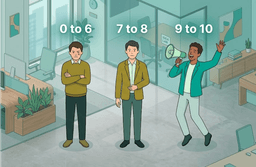
- Segment analysis built in: compare across demographics, product tiers, geographies, NPS bands
- 100+ languages in one project, no translation step required
- Presentation-ready exports to Word, PowerPoint, and Excel in minutes
- Full traceability, so you can show exactly where every insight comes from



FROM RAW CONVERSATIONS TO DEFENSIBLE FINDINGS
Analyse focus groups and customer interviews at scale
Focus groups are the hardest qualitative data to analyse well. One vocal participant looks identical to four independent voices unless you track the evidence. Depth interviews fail differently: at 20, 40, or 60 transcripts, coding the last one the same way you coded the first becomes the bottleneck. Skimle builds one theme structure across every session and shows what was consistent, what varied by segment, and what was a single outlier, so the finding holds when a client or a stakeholder pushes back.
How it works
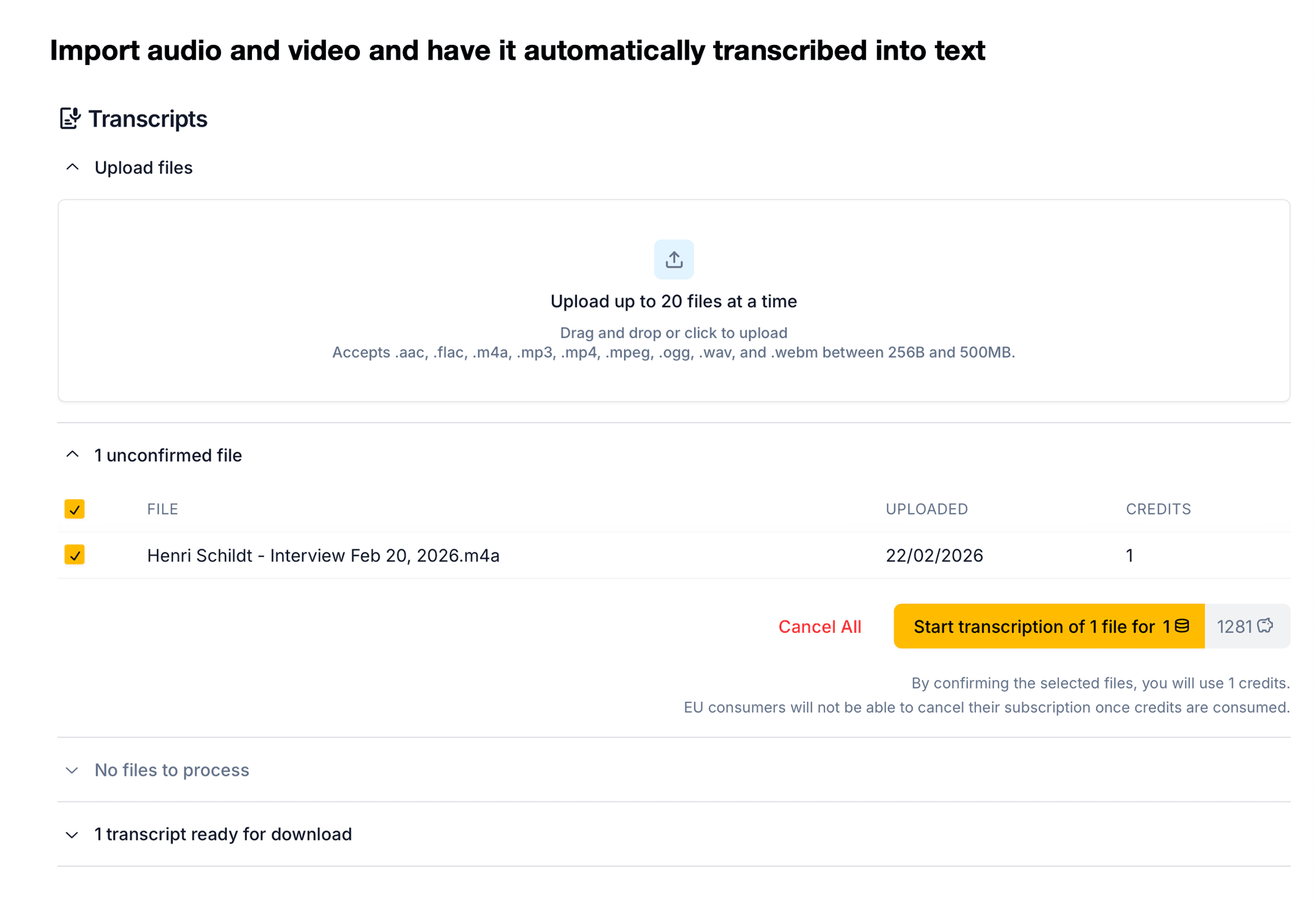
- 1. Import each session as a document
Upload transcripts or recordings from Zoom, Teams, Otter, or Fireflies. Skimle transcribes audio and video directly, so each session becomes one document ready to analyse.
- 2. Run analysis across all sessions
Skimle reads every transcript and builds themes from the content across all sessions. It discovers what was actually discussed rather than forcing a preset codebook.
- 3. See what was consistent and what varied
Each theme shows which groups contributed to it and how often, separating the universal signal from one session or one market.
- 4. Assess the evidence distribution
Click any theme to read the supporting quotes and see which sessions they came from. Judge dominant voice effects directly rather than from memory.
- 5. Export for the client
Generate the synthesis document with representative quotes by group, ready for the deck or the full report.



WHICH THEMES MATTER TO WHICH CUSTOMERS?
Code open-ended surveys and compare across segments
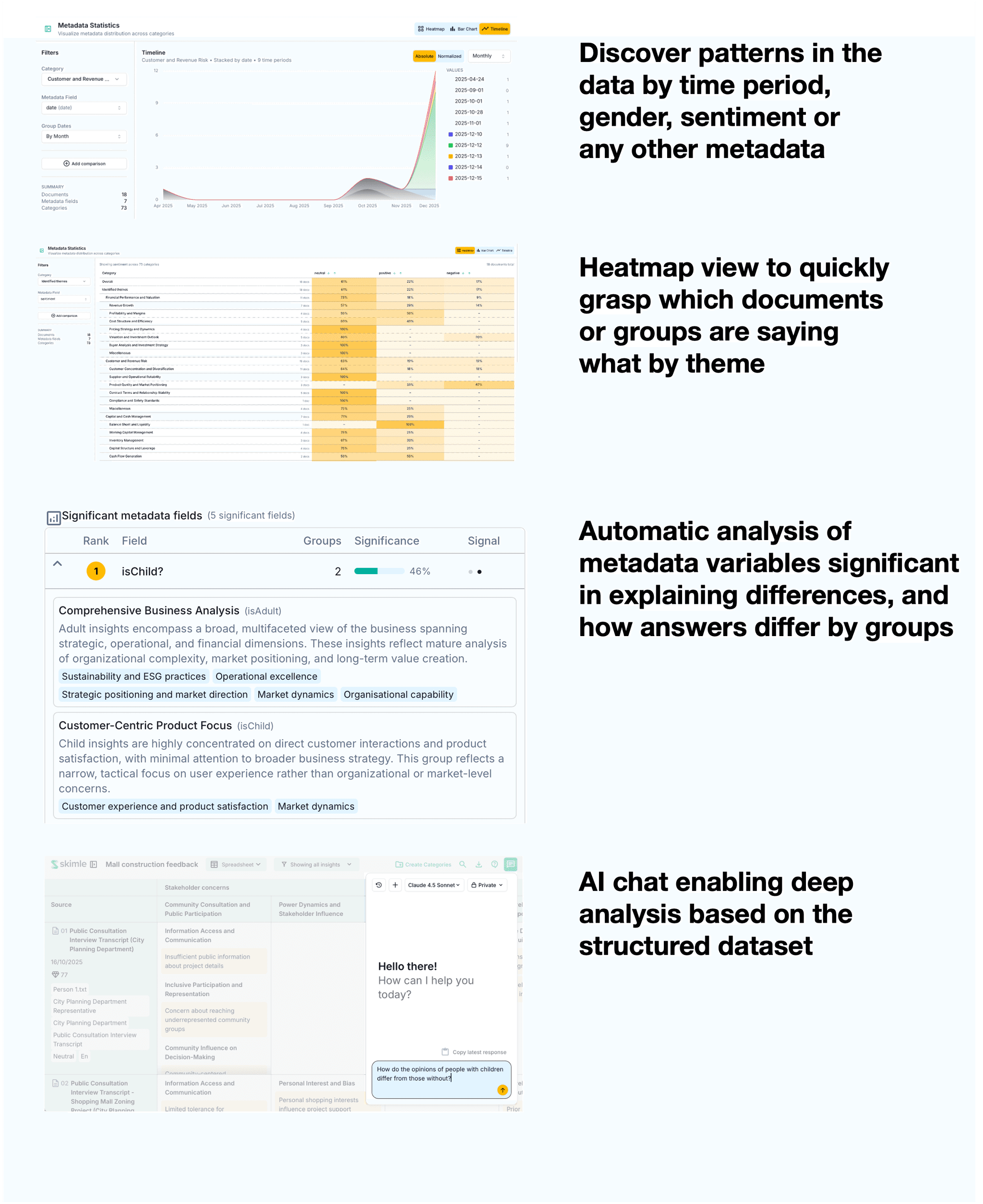
One overall theme list never answers the question the business actually asked: who feels this way, and how does that differ by segment? Faced with thousands of verbatims, most teams skim a sample and lose the minority views that carry the sharpest signal. Skimle codes every response and lets you slice the same theme structure by any metadata variable, whether that is an NPS band, a product tier, a market, or a demographic, turning the open ends of a tracker into a mixed-methods view you can act on.
How it works
- 1. Upload responses with metadata
Import open-ended responses as a CSV from SurveyMonkey, Typeform, or Qualtrics, with the respondent metadata columns alongside, so every answer carries its segment.
- 2. Build the full theme structure
Skimle codes every response into a hierarchy of themes, not only the common ones, so minority viewpoints stay visible.
- 3. Segment by any variable
Filter and compare themes by NPS band, product tier, geography, or demographics to see which issues matter most to which customers.
- 4. Verify the evidence
Every pattern traces to verbatim quotes, so a gap between two segments is backed by the exact responses that produced it.
- 5. Export client-ready output
Generate a themed report with verbatim quotes and cross-tabulations, in minutes rather than days.


ONE CATEGORY STRUCTURE ACROSS EVERY SOURCE
Bring every feedback channel into one insight picture
Interviews, NPS verbatims, support tickets, reviews, sales call recordings, win-loss debriefs, community threads, analyst and competitor reports. Each channel usually gets its own analysis, its own deck, and its own vocabulary, so nothing adds up and the same customer problem is reported three times under three names. Skimle codes every source against a single category structure in one project, then shows how each channel weights the same theme. Agencies use it to fold desk research and secondary material into a primary study. In-house teams use it to run an always-on view of the customer.
How it works
- 1. Pool the channels in one project
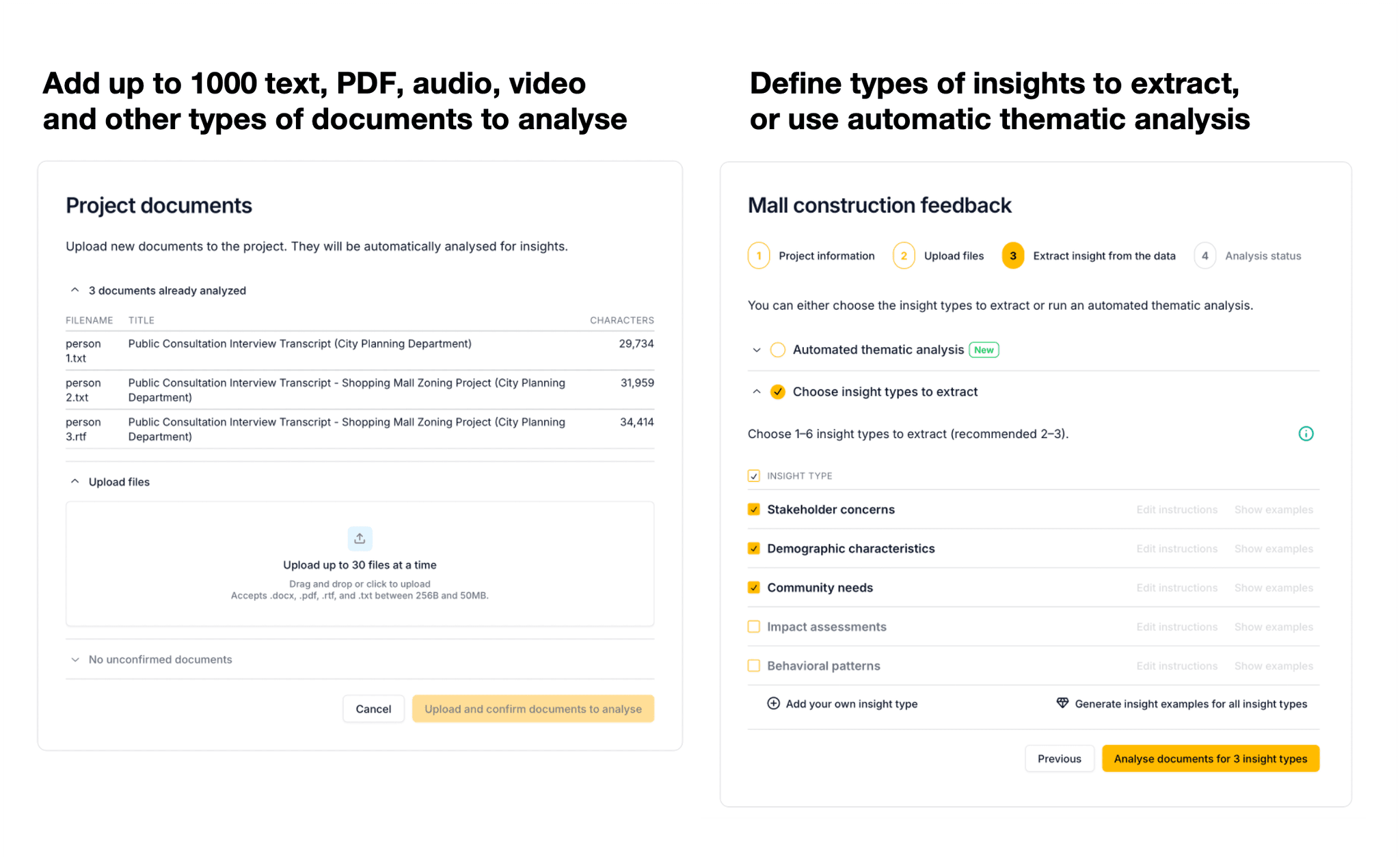
Upload transcripts, CSV exports, PDFs, and recordings side by side. Ticket exports, review dumps, analyst reports, and interview audio all become documents in the same project.
- 2. Tag each document with its channel
Channel, segment, market, and date go in as metadata, so every later comparison of sources is a filter rather than a fresh analysis.
- 3. Code everything against one structure
Skimle builds one theme structure across all sources, or applies the framework you already report against, so a finding means the same thing in every channel.
- 4. Compare what each channel is telling you
See where sources agree and where they contradict. A theme loud in tickets and absent from interviews is a finding, not a discrepancy to reconcile away.
- 5. Add the next wave without starting over
Next quarter's data is coded into the same structure, so the tracker keeps its comparability and the refreshed report is a re-export rather than a rebuild.


FAQ
Frequently asked questions
These are the questions insights teams and agency research leads put to us most often, including the ones that come straight out of a procurement process. Our vendor-neutral RFP checklist sets out the same questions to ask every vendor you are scoring, us included.
- How does this help us compete with cheap, shallow alternatives?
- Low-cost providers and thin AI wrappers compete on price with word clouds and a flat theme list. Skimle gives you depth at their speed, so an agency differentiates on the quality of the "so what" rather than on rate card, and an in-house team gets more studies out of a flat budget. Analyst hours move from mechanical coding to interpretation, which is the part anyone is actually paying for. See where the money in a qualitative study really goes →
- What do we say when a client or a stakeholder challenges AI-assisted analysis?
- Describe it accurately: the AI does the mechanical categorisation, a named researcher reviews every theme and writes the interpretation. Then show the evidence. Every claim in a Skimle report opens onto the verbatim quote and the document it came from, which is a stronger answer than manual synthesis can give, because there the coding logic only ever existed in someone’s head. 7 rules for using AI responsibly in qualitative market research →
- Does Skimle analyse the whole dataset, or a sample of it?
- The whole dataset. This is worth asking every vendor, because several tools retrieve a subset of your documents through an embedding search, analyse that, and never report which documents did not make it in. The output reads as though it covers the corpus and does not. Skimle codes every document, and you can open any one of them to see exactly which passages were coded and which were not.
- Can we apply our own codebook, or only accept what the AI produces?
- Either, and both on the same corpus. Bring an existing codebook and Skimle codes deductively against it, or let it build the structure inductively from the data. Categories can be merged, split, renamed, reordered and deleted afterwards, and the analysis follows your edits. Agencies running a tracker or a client-standard framework year after year usually work deductively; exploratory studies usually start the other way.
- What stops a fabricated quote reaching our report?
- Every quote is mechanically checked against the source document. If the model produces text that does not exist verbatim in your data, Skimle flags it and re-processes rather than showing it, so an invented quote does not reach a client deck. You can also open any document and see which passages were coded and which were not, which is how you catch the opposite failure of something being missed. How two-way transparency works →
- How should we evaluate Skimle against the other tools on our list?
- Run a pilot rather than watching demos. Take a corpus you have already analysed, so you know what the answer should be, write three tasks before you start (one coding, one segment comparison, one evidence hunt), time each including the correction work, and deliberately disagree with the tool to see how fast you can restructure its output. We are happy to run one live project in parallel with your incumbent, and the free tier lets one researcher form a view in an afternoon before any of that. The 7-domain RFP checklist and scoring template →
- How much data can Skimle handle, and in how many languages?
- Up to 1,000 documents per project, which covers everything from a 20-interview study to a global tracker with thousands of survey responses, and 100+ languages analysed natively with no translation step. A single project can mix English, Spanish, Mandarin, German and Arabic, build one theme structure across all of it, and keep every quote in its original language. If you regularly run at the top of that range, talk to us about volume arrangements.
- Is client data secure and confidential?
- All data is stored and processed inside the EU on AWS, in an environment configured by a certified third party, and customer data is never used to train models. Data Processing Agreements are available, we work under client NDAs, pseudonymisation is built into the workflow, and single-tenant or private-cloud deployment is available where data sovereignty requires it.
- What happens to our analysis if we stop using Skimle?
- You take it with you, on every plan. Export coded data as open-standard REFI-QDA (.qdpx) and continue in NVivo, ATLAS.ti or MAXQDA, or take Word, PowerPoint and Excel outputs with quotes organised by theme. We implement the interoperability standard precisely so that staying is a choice rather than a consequence.
- How does pricing work when our study volume swings?
- Skimle is a light per-seat subscription with an included credit allowance, plus credit packs you buy for the months a large study is running. The subscription keeps the whole team in the tool between projects; the packs attach the cost to the project that caused it, which matters for agencies recharging to clients. Stakeholders who only need to read findings do not need a seat, because exports and printable research reports cover that.
- Can several researchers work on the same project?
- Yes, simultaneously, with each person’s edits and annotations preserved. That suits peer review and quality control, and it suits splitting a large study between junior and senior researchers with one senior lead steering the category structure.
About Skimle
Built for professionals, by professionals
Skimle is based in Finland and built by people who spent careers doing qualitative analysis under real professional pressure. We built it because we needed it, and because the existing tools were too slow, too shallow, or too opaque to defend to a client.
We are trusted by research firms, agencies, Finnish government ministries, over 30 universities, and large companies. All data is stored within the EU and processed according to our strict GDPR policy and terms of service.
For agencies and insights functions looking at white-label arrangements, enterprise licensing, volume pricing, or reseller agreements, get in touch. Firm-wide arrangements and custom deployments are both on the table.