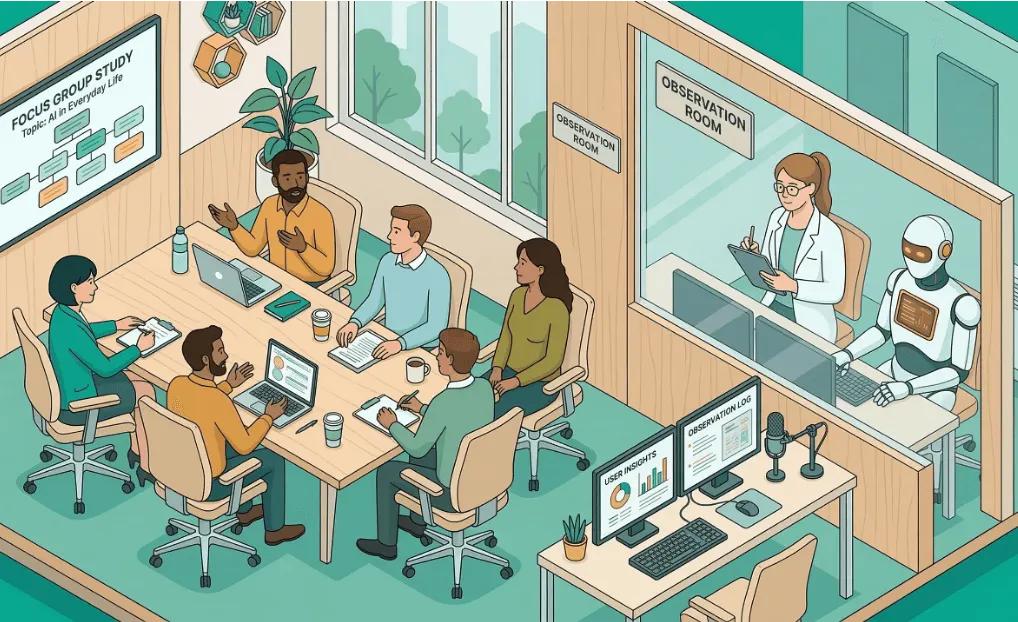
You have just wrapped up three focus groups with eight participants each. The transcripts are long, messy, and full of crosstalk. People talked over each other, one person dominated every session, and the group seemed to reach consensus on something that half the participants appeared uncomfortable with. Now you need to turn all of that into coherent, defensible findings.
If you approach focus group transcripts the same way you would approach individual interview transcripts, you will produce analysis that misses what makes focus groups distinctive as a method. Group data has its own logic, its own pitfalls, and its own strengths. This guide covers all of it: when focus groups are the right choice, what makes them genuinely hard to analyse, and how to work through the transcripts in a way that does justice to the data.
When focus groups are and are not the right method
Before getting into analysis technique, it is worth being honest about what focus groups are for. Researchers sometimes run them because they are cheaper and faster than doing 24 individual interviews, which is a reasonable pragmatic consideration. But that is not why focus groups were developed, and treating them as discounted interviews tends to produce weak data and weaker analysis.
Focus groups are at their best when you want to understand how people construct shared meaning, negotiate positions in conversation, or react to ideas collectively. Market researchers use them to explore how consumers talk about a product category, including the language they use spontaneously. Academic researchers use them when the social construction of a phenomenon is itself what is under study. Consultants use them to understand how teams or customer groups collectively frame a problem.
They are less well suited to gathering precise factual information, measuring the prevalence of attitudes across a population, or understanding individual experiences in depth. A participant who experienced something unusual or sensitive is unlikely to disclose it in a group setting. If you want to understand what individuals actually think, separate from social influence, you need individual interviews.
Once you are clear that a focus group was the right method for your research question, the analysis challenge becomes much more tractable, because you are not fighting against the data structure. You are working with it.
The unique challenges of group data
Attribution is complicated
In a one-to-one interview, every utterance belongs to one person. You can track an individual's position, notice how it evolves across the conversation, and quote them with confidence. In a focus group, the unit of analysis is rarely the individual. A comment made by one person may only have been made because of something another person said thirty seconds earlier. A view expressed may reflect genuine conviction, polite agreement, or a desire to move the conversation along.
This creates a real analytical tension. On one hand, you need to track who said what to understand the dynamics. On the other hand, over-attributing to individuals misrepresents how the data was generated. The usual resolution is to treat the group as the primary analytical unit for most purposes, while noting where individual positions diverged meaningfully from the group's emerging consensus.
Social desirability and group pressure
Group settings amplify social desirability effects. Participants are not just managing impressions with a researcher (as they are in individual interviews) but also with their peers. This can be a research asset, because it shows you what positions are publicly acceptable in a given community. It can also obscure genuine individual views.
Watch for the moments when a participant hedges, qualifies, or walks back a position after others have spoken. These are often the analytically interesting moments, and they are easy to miss in a long transcript if you are only skimming for content.
Dominant voices
Most focus groups have at least one highly vocal participant who steers discussion, interrupts others, and whose views disproportionately shape where the group ends up. A theme raised four times by one person in a group of eight is analytically quite different from a theme raised once each by four different participants. Both get four coded mentions, but they mean very different things.
Consensus versus outlier positions
Focus groups often produce a surface-level consensus that is arrived at somewhat artificially, through conversational dynamics rather than genuine alignment of views. Outlier positions deserve particular attention. A participant who holds out against group consensus, or who introduces a perspective that nobody else picks up, is often pointing at something real that the group dynamic suppressed. In thematic analysis, negative cases are treated as analytically productive precisely because they force you to sharpen or qualify your interpretation.
The emergent quality of group thinking
The hardest thing to capture in focus group analysis, and the most distinctive feature of the method, is the ideas that emerge only because people are talking together. Participants build on each other's remarks, use metaphors that others pick up and extend, and sometimes reach articulations of a shared experience that no single participant would have produced alone. If you are only coding individual utterances, you will miss it.
Analysing focus group transcripts with Skimle
The challenges above are real, but they become much more manageable when you have a structured view of the data across all your transcripts at once. This is where Skimle is practically useful.
Importing the transcripts
Import each focus group transcript as a separate document in Skimle. If your transcripts are auto-generated from Zoom or a tool like Otter or Fireflies, they can be imported directly. If you are working from a manual or corrected transcript, import the text file. The end-to-end setup guide covers the transcription workflow in detail if you are starting from audio. If participants were promised anonymity or if transcripts contain personal identifiers, Skimle Anonymise handles this systematically before analysis.
Skimle treats each document as a coherent unit, which maps naturally to focus group data: each group session is one document, and the analysis operates both within and across documents.
Letting Skimle identify themes across groups
Once the transcripts are imported, Skimle reads all of them and builds a theme structure from the bottom up. It does not start from a codebook you have defined in advance. It discovers what was actually discussed across your groups and organises it into themes.
For focus group data, this is valuable for two reasons. First, it surfaces themes that appeared consistently across all three groups, which are your strongest findings. Second, it surfaces things that appeared in one group but not others, which prompts the interpretive question of why. Was it a group-specific dynamic? A moderator prompt that only appeared in that session? Or a genuine difference between participant populations?
Each theme in Skimle links back to the specific passages from the source transcripts. You can see exactly which group raised a topic, how many times it came up, and read the actual language participants used. This is the transparency from finding to source that makes focus group analysis defensible: when a client or colleague asks "which groups said that?", you can show them directly.
Exploring patterns across groups
With themes identified, Skimle allows you to explore how they distribute across your documents. For focus group work, this means you can see at a glance which themes were consistent across all sessions and which were concentrated in one group.
This is where the dominant voice problem becomes easier to manage. Rather than relying on your memory of how much airtime different participants got, the theme view shows you the distribution of evidence. A theme that appears richly in Group 2 but barely registers in Groups 1 and 3 should be treated cautiously, regardless of how confidently it was expressed in that one session.
The cross-group comparison also helps you spot the emergent ideas that developed through dialogue. When a theme appears in a form that is notably more developed in Group 2 than in Group 1, and you can trace through the transcript how the group built towards that articulation, you are looking at the distinctive value of the focus group method.
Handling the group dynamics layer
Skimle handles the content layer well: what topics were discussed, how themes distribute across groups, what language participants used. The group dynamics layer, including the moderator effect, the social pressure moments, and the distinction between genuine consensus and manufactured agreement, still requires human interpretation.
The practical workflow is to use Skimle for the content analysis and then bring your own judgement to the dynamics questions. Once Skimle has given you a structured map of what was discussed and where, you can go back into specific transcripts with a focused interpretive question: in Group 2, was the consensus on pricing genuine, or did it follow one dominant participant's framing? The structured overview makes it faster to locate the relevant passages and answer that question.
This hybrid approach, AI for pattern recognition across the corpus, human interpretation for the contextual dynamics, tends to produce better results than either pure manual analysis or pure AI analysis. The question of what AI can and cannot do with qualitative data is worth reading if you are working out where to draw that line for your specific project.
From analysis to synthesis
Once you have reviewed the theme structure and applied your judgement to the dynamics questions, Skimle generates a report across the full set of transcripts. For focus group research, this gives you a structured starting point for the write-up: the main themes across all groups, representative quotes, and a view of where groups diverged.
The synthesis section of your report or deliverable should reflect the group dynamic rather than treating focus group data as a collection of individual opinions. "Across all three groups, participants consistently raised X, with Group 2 adding a qualification that..." is the right framing. "Eight participants said X" is not — it imposes an individual-unit logic onto data that was generated collectively.
If you are working across multiple languages, which is common in multi-country focus group research, Skimle analyses documents in multiple languages and applies consistent theme coding across them. The multi-language analysis guide covers the additional considerations.
Ready to bring more structure to your focus group analysis? Try Skimle for free and see how AI-assisted theme discovery can surface patterns across your transcripts while you focus on the interpretation that requires human judgement.
Want to go deeper on qualitative method? Read our complete guide to focus group analysis, our complete guide to thematic analysis, and our guide to analysing individual interview transcripts. For the full picture on what Skimle does, see the features overview.
About the authors
Olli Salo is a former Partner at McKinsey & Company where he spent 18 years helping clients understand the markets and themselves, develop winning strategies and improve their operating models. He has done over 1000 client interviews and published over 10 articles on McKinsey.com and beyond. LinkedIn profile
Frequently asked questions
How do I import focus group transcripts into Skimle?
Import each group session as a separate document. Skimle accepts plain text, Word documents, and PDF transcripts. If you have auto-generated transcripts from Zoom, Teams, Otter, or Fireflies, these import directly. For best results, make sure speaker labels are included in the transcript so the text carries the turn-taking structure of the conversation.
If your data is in audio or video format, Skimle can be used to automatically transcribe the interviews, including recognising and labelling multiple different speakers.
How does Skimle handle the dominant voice problem?
Skimle identifies themes from the content of the transcripts, not from how frequently one person spoke. Once themes are surfaced, you can see which documents and which passages support each theme. If a theme is heavily concentrated in passages from one vocal participant in one group, that will be visible in the evidence distribution and you can weigh it accordingly. The structured view makes this much easier to assess than reading transcripts sequentially.
Can I analyse focus groups in multiple languages in the same project?
Yes. Skimle applies consistent theme coding across documents in different languages. For a multi-country focus group programme where sessions were conducted in English, German, and French, you can run all transcripts in a single project and get a unified theme view. This is considerably faster than running separate analyses per language and then trying to reconcile them manually.
How do I handle a transcript where the audio quality was poor and the transcript has gaps?
Import it as-is. Skimle will analyse the content that is there. For passages marked as inaudible or significantly corrupted, add a brief note in the document before importing so you are aware during interpretation that certain sections have limited coverage. Gaps in one transcript do not affect the analysis of the others, and partial transcripts still contribute useful content to the cross-group theme picture.
How do I use Skimle's output when writing up focus group findings?
Use the theme view and report as your working document, not the final output. Review each theme, check which groups it appeared in and how it was discussed, read the supporting quotes, and write your synthesis from that structured picture. The dynamics layer — who drove consensus, where group pressure shaped responses, what the moderator introduced — you add from your own interpretive read of the transcripts. Skimle gives you the content map; you supply the contextual judgement.