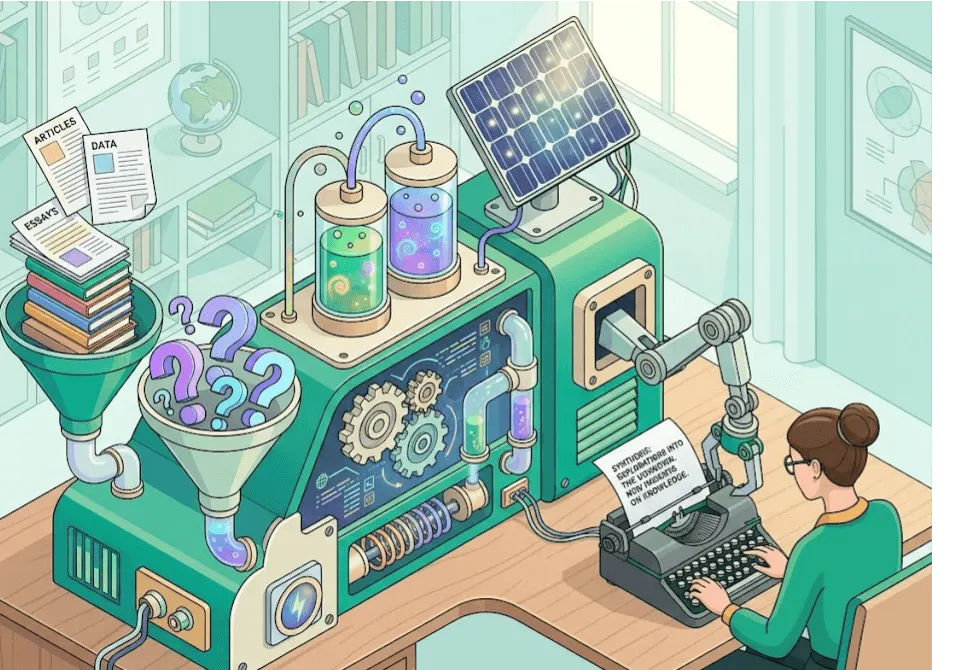
A thematic analysis results section presents each theme as a heading, opens with an analytical claim (not a topic label), and develops that claim through 2–4 verbatim quotes from multiple participants, each followed by interpretive commentary. The section typically runs 2,500–4,000 words for a journal article, organised around three to seven themes with subthemes nested as needed. Reviewers assess it on two criteria: whether the evidence is sufficient, and whether the interpretation goes beyond description to genuine analysis.
This post focuses specifically on how to write the results section. If you are looking for a guide to the full write-up — methods, results, discussion, and submission checklist — see how to write up a thematic analysis report. For a grounding in the methodology itself, the complete thematic analysis guide covers the analytical process from start to finish.
The purpose of a results section in thematic analysis
The results section has one job: to present the themes you found, with enough evidence and interpretation that a reader who was not present for the analysis can follow your reasoning and evaluate whether it holds.
That sounds simple, but it trips up a lot of writers. The confusion usually comes from not being clear about what the results section is and is not responsible for.
It is responsible for: showing what you found, with evidence. It is not responsible for: explaining what it means in relation to prior theory (that is the discussion), or defending how you found it (that is the methods).
Braun and Clarke — whose reflexive thematic analysis framework is the most widely cited in the social sciences — describe the results section as where you "tell the reader what the themes are and provide evidence for why these themes are warranted by the data." The 2006 paper in Qualitative Research in Psychology remains the definitive statement of this structure, and its guidance on presenting themes has not changed substantially in subsequent work.
One question that often comes up is whether results and discussion should be separate sections or combined. In reflexive thematic analysis, Braun and Clarke note that combining them is acceptable when the analysis is inherently interpretive and the line between "what" and "what it means" is thin. Many social science journals permit combined results and discussion sections. But for dissertations, and for journals that expect a standard IMRaD structure, keeping them separate makes the contribution clearer and makes peer review easier. The guidance in this post assumes separate sections, but the principles for developing individual themes apply equally to combined write-ups.
The basic structure: themes as headings
The standard approach is to give each main theme its own heading (## in a dissertation, a bold subheading in a journal article) and each subtheme its own subheading nested beneath it. This makes the thematic structure immediately visible to the reader.
Within each theme section, the structure follows a consistent four-part pattern:
- Theme name: a short descriptive label that hints at the analytical claim
- Opening claim paragraph: a clear statement of what the theme is and what it argues
- Supporting evidence: 2–4 verbatim quotes from different participants, each attributed
- Analytical commentary: interpretation explaining what each quote illustrates and how the evidence builds the theme's claim
The theme name is a label, but the opening claim paragraph is where the analysis actually lives. The name gives the reader a handle; the paragraph gives them the argument. A theme called "Ambiguity about decision-making authority" tells the reader the topic. The opening paragraph tells them what your analysis found about that topic.
Sub-themes follow the same internal structure: a heading, an opening claim, supporting quotes, and commentary. The difference is that subthemes are narrower in scope and the opening claim explicitly connects back to the parent theme.
How to write a theme description
The opening paragraph of a theme section is the most important paragraph in your results section. It is where reviewers decide whether you have actually done thematic analysis or just collected quotes under topic headings.
A well-written theme description has three components.
An analytical claim: state what the data shows, not what the topic is. "Participants experienced autonomy as contingent rather than granted" is a claim. "Participant autonomy" is a topic. The claim tells the reader something; the topic does not.
Scope and prevalence: indicate how widespread the pattern was. Not every claim needs a count ("8 of 20 participants"), but reviewers want to know whether this theme represents a majority view, a significant minority, or a pattern that recurred across different participant groups. Phrases like "across all occupational groups," "particularly among early-career participants," or "most prominently in the interviews conducted after the restructure" orient the reader without requiring quantification.
Connection to the research question: close the opening paragraph with one sentence that anchors the theme to your study's purpose. This is especially important in a long results section with many themes, where readers can lose sight of why each finding matters.
A four-to-six sentence opening paragraph is about right for most themes. Shorter and the claim is unsupported; longer and the paragraph becomes the analysis itself, leaving nothing for the evidence to do.
How to use verbatim quotes effectively
Quotes in a thematic analysis results section are evidence, not decoration. The discipline required is the same as in any evidenced argument: you introduce the claim, you present the evidence, and you explain what the evidence shows.
This three-part structure is sometimes called the "quote sandwich" technique in academic writing pedagogy, and it is the most reliable way to avoid the two most common quote-related mistakes in thematic analysis results sections.
The quote sandwich
Introduce: one or two sentences that tell the reader what to look for in the quote. Do not simply write "As one participant said" — tell the reader what the quote is about to illustrate. "The contingent nature of autonomy was explicit in how several participants described their experience of post-restructure working arrangements" is an introduction. "As Participant 7 said" is not.
Quote: the verbatim extract, attributed (Participant 7, female, senior manager, 12 years with the organisation). Use brackets for any clarifications you have inserted. Use an ellipsis for omissions. Keep the quote as short as the evidence allows, but not so short that the meaning is distorted.
Interpret: one to three sentences explaining what the quote shows and how it supports the theme's claim. Do not just restate the quote in your own words — that is description, not interpretation. Instead, explain the interpretive significance: what does this participant's phrasing reveal about the underlying experience?
How many quotes per theme
Two to four quotes per main theme is the standard range for a journal article. Fewer than two and the evidence base is too thin; more than four and the section starts to read as quote-dumping rather than analysis. For a dissertation, where length constraints are looser, four to six quotes per theme is acceptable if each one adds something new.
Critically, the quotes should come from different participants. A theme that is "supported" by five quotes from the same two participants is not demonstrated to be a pattern in the data — it is a pattern in those individuals' accounts. Reviewers catch this. Aim for quotes from at least three or four different participants per main theme.
For subthemes, two to three quotes is typically enough. The subtheme inherits some evidential weight from the parent theme's opening, so it does not need to build the full case from scratch.
Quote length and formatting
Short inline quotes (one to two sentences, fewer than 40 words) can be embedded in your analytical commentary without a line break. Longer quotes (three or more sentences, or more than 40 words) should be set as indented block quotes to aid readability.
Block quotes are appropriate when the full texture of what someone said is analytically relevant — when the way something was said matters as much as what was said. But use them sparingly. A results section dominated by block quotes signals that the writer has not yet done the interpretive work; they are showing the data rather than analysing it.
Always use consistent attribution formatting across the whole results section. Pick a format — "Participant 7, female, 8 years experience" or "P7 (F, 8yrs)" — and use it throughout. Inconsistency looks careless and is a distraction from the analysis.
Worked example: a full theme write-up
The following is a worked example drawn from a hypothetical employee wellbeing study. Twenty semi-structured interviews were conducted with employees across three UK firms that had implemented hybrid working arrangements in 2023. The research question was: how do employees experience wellbeing under hybrid working?
Theme 2: Boundary management as an individual burden
Participants consistently framed the management of work-life boundaries under hybrid arrangements as a personal responsibility rather than an organisational one. This theme emerged strongly across all three firms and was particularly pronounced among employees with caring responsibilities, for whom the removal of physical boundaries created new pressures rather than new freedoms. The theme speaks directly to the research question by identifying a structural feature of hybrid working that the wellbeing literature has tended to underemphasise: that flexibility without support can shift responsibility downwards rather than genuinely extend autonomy.
The experience of boundary erosion was described in strikingly consistent terms. Participants did not report formal pressure from managers to be available outside working hours; instead, they described an ambient expectation that had no clear source and no clear limit.
"Nobody says you have to reply at 9pm. But somehow it feels like you should. And I think I've just internalised that — I don't even question it any more, it's just what I do now." (Participant 4, female, team leader, two years with organisation)
The phrase "I don't even question it" is significant. This participant is not describing a coercive management practice but a habituated response to an organisational climate — one that has become invisible precisely because it is so thoroughly internalised. This reflects a pattern that appeared across multiple interviews, in which the absence of explicit expectations made the implicit ones harder to resist.
Where participants had developed strategies for managing these boundaries, the strategies were almost always individually improvised rather than organisationally supported.
"I started blocking the last hour of my day as 'focus time' in my calendar — not because anyone told me to, but because otherwise it just fills up with late-afternoon calls. I had to figure that out myself." (Participant 11, male, senior analyst, six years with organisation)
"My husband is much better at switching off than I am. I've been trying to copy his approach, honestly — he just closes the laptop and that's it. I'm not there yet." (Participant 17, female, project manager, four years with organisation)
The contrast between these two accounts is analytically important. Participant 11 has developed a structural workaround; Participant 17 is framing the problem as a personal deficit. Both responses reflect the same underlying condition — the absence of organisational scaffolding for boundary management — but they produce very different self-attributions. The theme thus reveals not just a wellbeing challenge but a potential source of inequity, in which employees with greater agency or social learning opportunities fare better than those without.
Notice what the worked example does and does not do. It opens with a claim (not just a label), attributes the theme to specific participant groups, connects it to the research question, and then develops it through three quotes from three different participants. Each quote is introduced before it appears and interpreted after. The interpretation adds to the claim rather than restating the quote. And the final interpretive paragraph does something that the individual quotes alone could not: it synthesises across the evidence to identify a structural pattern (inequity of burden) that is only visible once the accounts are read together.
This is what reviewers mean when they ask for "analysis rather than description." The quotes are the description; the interpretive commentary is the analysis.
How many themes should you report?
Three to seven main themes is the standard range for a thematic analysis of a focused qualitative dataset. Fewer than three suggests that either the analysis was not sufficiently fine-grained, or that the research question was so narrow that a thematic approach may not have been the right method. More than seven usually means that what are being reported as themes are actually subthemes, or that the research question was broader than a single study can sustain.
The right number depends on the complexity of the research question and the size of the dataset. A study of 12 interviews on a tightly bounded topic might legitimately produce three themes and six subthemes. A study of 40 interviews across a complex organisational change process might produce five themes, each with three or four subthemes, and this is appropriate. The qualitative research sample size considerations and the question of how many interviews to conduct both feed into this: larger samples that were designed for thematic depth tend to generate richer thematic structures.
What should drive the count is the data and the research question, not convention. If your analysis genuinely produces eight distinguishable themes that cannot be consolidated without losing meaningful analytical distinctions, report eight and justify the structure in your methods section. If your analysis produces two large themes, each with several subthemes, consider whether you are working at the right level of abstraction.
Avoid the temptation to add themes to increase apparent comprehensiveness. Reviewers who read thematic analysis regularly can tell the difference between a theme that does analytical work and one that was included to pad the findings. A well-developed five-theme results section is always stronger than an underdeveloped eight-theme one.
Common mistakes and how to avoid them
Over-quoting without interpretation
The most frequently cited problem in peer reviews of thematic analysis results sections is quotes presented without sufficient interpretive commentary. A paragraph that contains three quotes in a row, with only transitional phrases between them ("Another participant noted...", "This was echoed by..."), is not analysis — it is a curated selection of the data.
The fix is to apply the quote sandwich discipline rigorously: every quote needs an introduction and an interpretation. If you find yourself writing two consecutive "Another participant noted" phrases, stop and ask what analytical point you are trying to make and whether you need two quotes to make it, or whether one quote with stronger interpretation would be more effective.
Under-interpreting (describing rather than analysing)
The mirror image of over-quoting is writing commentary that only paraphrases the quote in more formal language. "As this quote shows, the participant found the experience challenging" does not interpret; it restates.
Interpretation means explaining the significance: why does this quote matter for the theme's claim? What does the participant's choice of words reveal? How does this account connect to others in the dataset? How does it add to or complicate what you have established so far in this theme? These are the questions your interpretive commentary should be answering.
Treating themes as a list rather than an argument
A results section is not a list of findings. It is a structured presentation of evidence for an argument about what the data shows. When themes are written as self-contained units with no connection between them, the results section reads as a table of contents with expanded notes.
Transition sentences between themes are essential. They do not need to be long — one or two sentences that tell the reader how this theme relates to the previous one, or where it sits in the argument you are building. "While Theme 1 addressed how boundary erosion was experienced individually, Theme 2 examines the organisational conditions that made such erosion both possible and predictable" is a transition sentence. It keeps the reader oriented and makes clear that the themes build toward a coherent account.
Inconsistent theme naming
Theme names establish a consistent register for the results section. If some of your theme names are analytical claims ("Boundary management as an individual burden") and others are topic labels ("Communication"), the inconsistency signals that the analysis is uneven. Choose one register and apply it throughout.
Most thematic analysis methodologists recommend naming themes as analytical claims rather than topic labels, for the reason discussed earlier: a claim tells the reader something, a topic does not. But if you are working in a tradition or for a journal where noun-phrase topic labels are conventional, at least be consistent.
Reporting themes supported by only one participant
A theme by definition requires a pattern across multiple accounts. A finding that only one participant expressed may be analytically interesting, but it is not a theme. If it belongs in your results section at all, it should be flagged as a deviant case or an outlying perspective and discussed as such, not presented as a theme on equal footing with patterns that recurred across many participants.
This is particularly important in smaller datasets where striking individual accounts can overshadow the less dramatic but more representative material. The guidance on coding qualitative data covers how to build the evidence base for themes systematically during the analysis phase, which makes it much easier to identify genuine patterns at the write-up stage.
Writing for journals vs dissertations
The principles of a well-written theme section are the same for journals and dissertations. The differences are in length, level of detail, and conventions around appendices.
Journal articles have strict word limits, typically 7,000–9,000 words total. The results section competes for space with methods and discussion. This means making choices: fewer quotes per theme, tighter analytical commentary, and more compressed theme descriptions. Journal results sections rarely include more than three or four quotes per theme, and inline quotes are preferred over block quotes wherever possible. Cross-references to appendices (for full codebooks, participant tables, or extended quotes) are standard practice and expected by reviewers.
Dissertations allow significantly more space. A PhD results chapter of 8,000–12,000 words is not unusual, and each theme can be developed with greater depth. More subthemes can be included, more quotes per subtheme, and more extended analytical commentary. The trade-off is that the writing needs to be tightly controlled: additional space is not an invitation to be less selective, it is an invitation to be more thorough without padding.
Appendix conventions differ by context. In a journal article, a participant demographics table in an appendix is standard and expected. In a dissertation, appendices often include the full interview guide, a sample of coded transcripts, and the codebook. Neither format expects you to include all the data; the appendix is for materials that support the write-up without interrupting it.
One consistent difference worth noting: journals expect the results section to be compressed and argued efficiently, while dissertation committees often want to see that you engaged deeply with the data. This means that for dissertations you should err on the side of more development per theme; for journals, you should err on the side of tighter selection.
The guide to analysing interview transcripts covers the analytical steps that precede the write-up, and understanding that process helps with the write-up: the cleaner your codebook and the more systematically you linked quotes to themes during analysis, the less difficult the results section becomes.
How AI-assisted analysis changes the write-up
AI tools are now part of many qualitative researchers' workflows, and they change some aspects of the results section write-up in ways that are worth understanding.
The most practically significant change is in quote retrieval. When you have analysed 25 or 40 transcripts, identifying all the quotes that support a given theme used to mean re-reading the transcripts or searching through a coded corpus. AI-assisted tools can surface quote candidates much faster, which means the challenge shifts from finding evidence to selecting and interpreting it.
This is genuinely useful for the results section, because the write-up quality depends heavily on quote selection. Having more candidate quotes to choose from allows you to be more selective: you can pick the quotes that illustrate the theme most precisely, ensure they come from different participants, and vary the register and context of the evidence.
Tools like Skimle generate a structured theme hierarchy with all supporting quotes traceable to the source transcript, which means the analytical structure you built during analysis maps directly onto the results section you need to write. Each theme comes pre-populated with linked quotes, and the quote-to-theme traceability makes it straightforward to meet the attribution requirements that reviewers expect. See the academic researchers use case for how this workflow fits into a typical research project.
When you use AI assistance in your analysis, the write-up needs to document this in the methods section (not the results section). The results section itself should look exactly as it would in any other thematic analysis: themes, quotes, interpretive commentary. The AI's role in generating candidate themes or surfacing quotes is a methodological detail, not a results-section disclosure. The AI in qualitative research guide for academics and the AI analysis checklist both cover how to handle this in ways that satisfy peer reviewers.
If you are working with both AI-assisted analysis and manual coding (a hybrid workflow that is increasingly common), the REFI-QDA export guide explains how to combine AI-generated themes with a traditional QDA workflow and document the combination credibly.
Ready to move from analysis to write-up faster? Try Skimle for free and produce a quote-linked theme structure that maps directly to your results section, with every quote traceable to its source transcript.
Related reading:
- How to write up a thematic analysis report — the full write-up guide covering methods, results, and discussion
- Demystifying thematic analysis — a practical guide to the methodology itself
- How to code qualitative data — inductive, deductive, and abductive approaches to coding
About the author
Henri Schildt is a Professor of Strategy at Aalto University School of Business and co-founder of Skimle. He has published over a dozen peer-reviewed articles using qualitative methods, including work in Academy of Management Journal, Organisation Science, and Strategic Management Journal. His research focuses on organisational strategy, innovation, and qualitative methodology. Google Scholar profile