In the early days, my pitch to market researchers and customer insights people was simple: Skimle makes qualitative analysis three times faster. It's true. It's also, as a market research and consulting company CEO pointed out over coffee to me, exactly the wrong thing to lead with.
Her logic was hard to argue with. Three times faster analysis, taken at face value, implies three times shorter projects. Three times shorter projects means cutting revenue to a third for the same engagement (or your headcount if you are internal...), and splitting an analyst's attention across three times as many projects at once. Neither is a pitch a research team, in-house or agency, should want to hear, and neither is what actually happens when AI is used well.
Prefer to watch? The short video below covers the same argument.
What's wrong with the speed pitch?
AI-assisted coding genuinely does compress the time it takes to turn a corpus of transcripts into a structured set of themes. The problem is what "faster" implies to a client or a budget owner who hasn't thought it through: that the same output should now cost less and take less time, full stop.
That framing has a quiet, corrosive effect on how research gets valued. If speed is the pitch, the natural client response is to ask for a lower price or a shorter timeline, and both of those instincts push in the same direction: smaller scope, thinner analysis, less time actually spent understanding what customers said. Racing that expectation is exactly the trap that commoditises research work, because a tool built purely to be cheap and fast will always out-compete a professional team pitching the same terms.
What should the freed-up time actually be spent on?
AI compresses the mechanical part of analysis, that time doesn't have to disappear into a smaller invoice. It can go to the parts of research that were always the actual value: talking to more customers, going deeper with the ones you already talk to, and spending more time with the client turning findings into decisions.
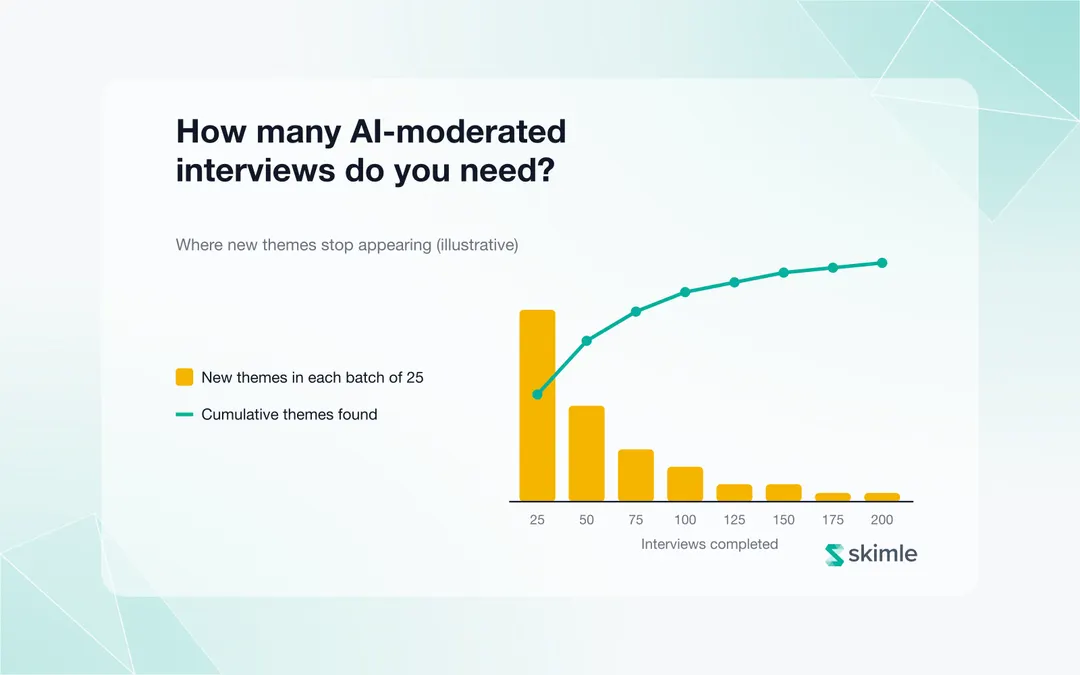
More interviews, or longer ones. The same budget that used to fund 20 interviews and three weeks of manual coding can now fund 30 interviews, or the same 20 conducted at greater depth, because the coding no longer eats the schedule. More conversations, or richer ones, produce a stronger evidence base for the same overall project cost.
More angles on the same data. Time freed from mechanical coding can go into exploring the data from further directions: cross-tabbing by segment, checking whether a theme holds across regions, following up on a pattern that looked interesting but wasn't the original research question. This is where genuinely new findings tend to come from, and it's exactly the work manual timelines usually don't leave room for.
More time with the client, not less. Analysis compressed from three weeks to three days doesn't have to mean the engagement ends three weeks sooner. It can mean the same six-week engagement now has five extra weeks for workshops with the client's leadership team: interpreting findings together, developing recommendations, and planning what happens next. That client-facing work is where research actually changes decisions, and it's the part a fast, cheap AI tool used alone cannot replace.
A concrete example: flexible interview formats
One market research agency Skimle has worked with runs a fixed scope of 40 interviews per typical project, in line with industry peers. Rather than treating that scope as fixed in format too, they now offer respondents a choice: a traditional moderated interview, or an AI-assisted Skimle Ask interview they can complete on their own schedule.
The effect isn't primarily about cutting cost, though moderation costs do fall. It's that offering a choice increases the response rate: respondents who wouldn't commit to a scheduled call will complete a self-paced AI-assisted interview, which means the agency captures voices that a purely moderated approach would have missed entirely. More completed interviews, at the same fixed scope, for a lower marginal moderation cost. That's a better client outcome than "faster," and a materially different pitch than "cheaper."
See our guide to gathering rich data with AI interviews for how this works in practice, and Skimle Ask as an alternative to opinion-survey tools for the qual-at-scale angle specifically.
Why the reframe matters commercially, not just semantically
The version of this argument that only lives in the tone of a pitch deck doesn't hold up under a client's first hard question. What makes the reframe defensible is that it's true: tools that promise dramatic across-the-board savings, and get used to justify identically dramatic cuts to scope, produce exactly the thin, defensible-in-name-only research that erodes trust in AI-assisted work generally. Every rushed, under-coded study delivered under a "we're 90% faster" banner makes the next client more sceptical of the next agency that says the same thing, whether or not that agency actually did the work properly.
Positioning AI-assisted time savings as "more depth for the same investment" rather than "the same depth for less investment" isn't just better marketing. It's the version of the claim that survives scrutiny, and the version that keeps the research itself worth paying for.
What to say instead of "3x faster"
If the old pitch was "we're three times faster," the accurate and more defensible version is closer to: "the same budget that used to buy you a themes summary now buys you systematic coverage of every interview, cross-tabbed by segment, with time left over to sit down with your team and work through what it means."
That's a longer sentence. It's also the one that actually describes what happens when AI is used to raise the ceiling on research quality rather than lower the floor on research cost, and it's the pitch that holds up when a sophisticated client asks a follow-up question.
Maybe the accurate version of the old line isn't "3x faster" at all. It might be closer to: spend 3x more time in deep analysis, and emerge with 3x more valuable insights.
That can be worth millions when big decisions are at stake.
Try Skimle to free up time for digging deeper
Try Skimle for free and see where the saved time could go on your next engagement.
Related reading:
- What a qualitative study actually costs in 2026
- The commoditisation trap: why cheap AI research makes agencies replaceable
- Gathering rich data with AI interviews: introducing Skimle Ask
About the authors
Olli Salo is a former Partner at McKinsey & Company where he spent 18 years helping clients understand the markets and themselves, develop winning strategies and improve their operating models. He has done over 1000 client interviews and published over 10 articles on McKinsey.com and beyond. LinkedIn profile