A client asks your agency for a proposal. Somewhere in the brief, or more likely in the pause before it, is an unstated comparison: a synthetic-respondent platform quoting $2 per interview against your $500, or an AI survey tool promising results in days against your six-week timeline. You do not see the comparison. You feel its effect on the fee the client is willing to discuss.
This is the position most market research agencies are in now, whether or not anyone has said it out loud internally. Clients expect AI to make research cheaper and faster. The available response, matching that expectation, leads somewhere agencies do not actually want to go.
What does the commoditisation trap actually look like?
It rarely arrives as a single dramatic moment. It arrives as a slow drift across a handful of decisions that each seem reasonable on their own.
Smaller scopes, same fee expectations. A client that used to commission 30 interviews now asks for 15, "since AI can get more out of fewer conversations." The fee compresses with the scope, but the client's expectation of depth does not.
More "we did it ourselves." A client runs an AI-assisted survey internally for a question that used to be an agency engagement, not because the internal team has better methodology, but because a chatbot-adjacent tool made it feel achievable without one. The agency loses the project entirely, and finds out only when the client cites their own findings in a meeting.
Price anchored against tools, not against expertise. Once a client has seen a demo of an AI platform promising results in hours, a six-week agency timeline reads as slow by comparison, even when the six weeks buys something the demo cannot: a defensible sample, a documented method, and a researcher whose name is on the findings.
None of these are irrational client behaviours. They are a rational response to a genuine capability shift, applied by clients who cannot always see the difference between "AI made this faster" and "AI made this good enough to skip a professional." The industry's own data reflects the shift: AI research platforms are being marketed with cost reductions in the range of 60 to 90% against traditional agency pricing. Whether that number holds up under scrutiny matters less than the fact that it is now the number clients have heard.
Why racing the price war makes it worse
The instinctive response to this pressure is to compete on the same terms: cut the scope, cut the price, add "AI-powered" to the pitch deck, and hope volume makes up the margin. This is the trap, not the escape from it.
A price war selects against you by design. If the differentiator a client evaluates is speed and cost, the winner in that comparison is whoever can be fastest and cheapest, and a well-funded AI-native tool will always be able to out-cheap a professional services agency with real payroll. Competing there is competing on the one dimension structurally guaranteed to lose.
Smaller projects don't just cut revenue; they cut depth. A 15-interview study answers a narrower question than a 30-interview study, with less room to check whether a finding holds across segments. Deliver enough narrow, thin studies and the agency's actual track record of insight quality, the thing that justified the premium in the first place, quietly erodes alongside the fee.
"We did it ourselves" research still needs someone to catch what it misses. A client that ran a DIY AI-assisted study and got an answer they didn't fully trust does not automatically call the agency back. More often they either act on a shaky finding or shelve the question. Either way, the agency's expertise never gets invited into the room to add the judgement that was missing.
The GreenBook Research Industry Trends report on the 2026 insights industry found that mid-size research firms (101-500 employees) currently lead the industry in revenue growth and capability expansion, while the largest firms are three years into a deliberate move away from fieldwork execution and toward consulting and analytics. Read together, that is an industry sorting itself by exactly this axis: firms competing on execution speed and cost are ceding ground to firms competing on judgement and depth.
What competing on depth actually requires
The alternative to racing the price war is not refusing AI. It is using AI to make the case for depth cheaper to deliver, rather than using it to make speed the pitch.
Use AI to do more with the same scope, not less scope for the same fee
The accurate version of AI-assisted research is not "we can do 15 interviews for the price of 30." It is "we can now afford to code every single one of the 30 interviews systematically, instead of skimming for themes that feel right." According to our own cost modelling of a typical 40-interview B2B study, AI realistically compresses total project cost by around 35%, not the 90% the marketing suggests, because recruitment and moderation, the majority of the budget, do not get cheaper. What does get cheaper is analysis and reporting, and the sound use of that saving is more studies, or more depth per study, not a smaller invoice for the same work.
Don't use the same tools your client could use themselves
There is a version of "using AI" that makes the commoditisation problem worse rather than better: an analyst pasting transcripts into ChatGPT, copying out a themes summary, and reformatting it into a slide. That is not a proprietary capability. It is the exact same thing the client's own team can do with the same free tool, and every project run this way quietly teaches the client that the agency relationship is optional.
If the underlying method is a generic chatbot with a prompt, the agency has not added expertise to the analysis; it has added a markup. A client who works this out, and sophisticated clients eventually do, stops paying day rates for something they can reproduce themselves in an afternoon. That is the fastest route to commoditisation there is: not competing on price, but competing with nothing the client cannot already access directly.
Generic AI tools are built to be adequate at everything, not rigorous at one thing, and chatting with a model that has skimmed a document once is not the same activity as a systematic analysis, whatever the output looks like on the page. The agency's differentiation has to sit in tooling and process the client does not have access to: systematic coverage of the full corpus, coding that traces back to source, a category structure built and defended by a named researcher, not just labour applied to a tool anyone can open in another tab. Specialist tooling is what makes the deliverable different in kind, not merely faster to produce.
Sell defensibility, not speed
A client choosing between a $2 synthetic interview and a $500 real one is not actually choosing on price alone. They are choosing on how much weight the finding needs to bear. For decisions worth real money, the question that matters is not "how fast can you get me an answer" but "can I stand behind this answer in front of my board." A citation is not an analysis: being able to show exactly which quote supports which finding, and what the corpus contained that a summary might have missed, is the thing a cut-rate tool structurally cannot offer, because the researcher's judgement is the product, not the byproduct.
Make transparency part of the pitch, not just the delivery
Most agencies already do rigorous work. Few show the client how rigorous it is. If a category structure was built systematically and every finding traces back to a specific passage in a specific transcript, that is worth demonstrating in the proposal and the debrief, not just doing quietly in the back office. Clients who have seen an AI demo promising instant themes are primed to ask "how do I know this is right," and an agency that can answer that question in thirty seconds, rather than "trust our process," wins the comparison the price-focused competitor cannot.
Redirect freed-up time toward the client relationship, not toward more volume
If AI compresses the mechanical part of analysis, the freed time has two possible destinations: more projects at the same margin per project, or more time with the client on this project, more workshop time interpreting findings together, more follow-up conversations, more of the work only a human researcher does well. The second path is the one that actually defends against commoditisation; the first path just runs the price race faster.
What this looks like in a real proposal
A commoditising proposal leads with speed and price: "AI-accelerated analysis, results in half the time, at a reduced fee." A depth-competing proposal leads with what the client actually gets: "Every one of your 30 interviews coded systematically against a shared category structure, cross-tabbed by customer segment, with every finding traceable to source, delivered by a named senior researcher who will walk your leadership team through what it means."
Both proposals may use exactly the same tool underneath. The difference is what gets sold, and that difference determines whether the client remembers your agency as a vendor they compared on price, or a partner whose findings they trusted enough to act on.
Try Skimle to support the depth-first pitch
If your team wants to demonstrate systematic, traceable coverage of every interview in a project, rather than a themes summary that's hard to defend under questioning, it's worth testing what that looks like on a real project.
Try Skimle for free and run it against your next client engagement.
Related reading:
- What a qualitative study actually costs in 2026
- A citation is not an analysis
- Qualitative research tools for market research agencies in 2026
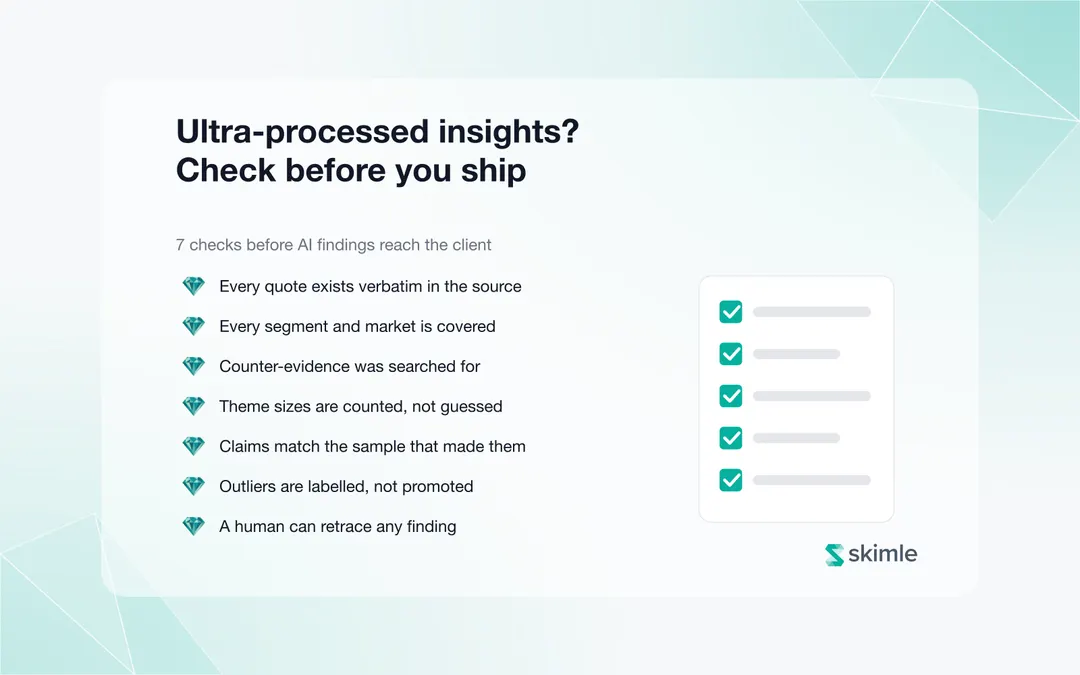
- 7 checks before AI-generated insights reach the client
- How to write a qualitative topline report in 24 hours
About the authors
Henri Schildt is a Professor of Strategy at Aalto University School of Business and co-founder of Skimle. He has published over a dozen peer-reviewed articles using qualitative methods, including work in Academy of Management Journal, Organisation Science, and Strategic Management Journal. His research focuses on organisational strategy, innovation, and qualitative methodology. Google Scholar profile
Olli Salo is a former Partner at McKinsey & Company where he spent 18 years helping clients understand the markets and themselves, develop winning strategies and improve their operating models. He has done over 1000 client interviews and published over 10 articles on McKinsey.com and beyond. LinkedIn profile