A 40-interview B2B qualitative study costs roughly $22,000 to $35,000 (€20,400 to €32,300) fully loaded in 2026, depending on how it is transcribed and analysed. Recruitment and incentives take 25 to 40% of that, researcher time 50 to 70%, and tooling under 15%. AI compresses two of the six lines, transcription and analysis, so realistic savings land near 35% of total cost, not the 90% the marketing suggests. Agencies that pitch the 90% figure to clients anyway are walking into the commoditisation trap.
Ask what qualitative research costs and you get one of two unhelpful answers. Agencies quote a project fee that bundles everything, so you cannot see what you are paying for. Software vendors quote a subscription price, which covers about 5% of what a study actually consumes.
Neither helps an insights lead who has to defend a budget, decide whether to bring a study in-house, or explain to a finance partner why 40 interviews cost more than a 2,000-person survey.
This is the line-by-line version, with 2026 rates. It is written for in-house customer insights teams and market researchers who need to build a business case rather than accept a quote. The uncomfortable part, which we get to near the end, is that the share of a research budget AI can actually touch is smaller than most people assume.
What are the 6 cost lines of a qualitative study?
Every qualitative study, however it is delivered, consumes the same six things. The only question is whether they appear on an invoice or on your payroll.
| Cost line | What it covers | Typical 2026 rate | Share of budget |
|---|---|---|---|
| Recruitment | Screening, scheduling, no-show replacement | $40–$98 (€37–€90) per participant in platform fees | 10–15% |
| Incentives | Participant payment | $25–$500 (€23–€460) per hour by audience | 15–25% |
| Moderation | Guide design, interviewing, debriefs | $75–$120 (€70–€110) per researcher hour | 20–25% |
| Transcription | Audio to text | $0.07–$0.25 (€0.06–€0.23) per audio min AI, $1.99 (€1.83) human | 1–10% |
| Analysis | Coding, theme development, verification | 3–7 researcher hours per interview hour | 25–40% |
| Reporting | Synthesis, deck, presentation, follow-ups | 30–50 researcher hours per study | 10–15% |
The two lines people underestimate are analysis and reporting. Together they are typically 40 to 50% of a study's cost, and they are the two lines that are invisible in an agency quote because they arrive as "insight".
CleverX's 2026 budget planning benchmarks put the split at 25 to 40% for incentives and recruitment combined, 50 to 70% for researcher time, and 5 to 15% for tool subscriptions. That last number is worth holding onto when a software decision starts consuming disproportionate attention.
How long does analysis actually take?
Most published estimates of analysis time are anecdotal, which is why budgets get this line wrong. One of the few empirical measurements comes from Charlotte Ullrich and colleagues at Heidelberg, who timed the coding of 94 interviews across five health services research studies and published the results in Gesundheitswesen in 2025.
Their headline number looks reassuringly small: 76 hours of focused coding across 52 hours 44 minutes of interview audio, a mean of 32 minutes per interview, and a coding-time-to-interview-time ratio averaging almost exactly 1. Read carelessly, that says coding costs about an hour per interview hour.
The decomposition is what makes it useful. The authors measured only the third of four analytical stages. In their own words, the preceding steps of familiarisation, open coding and first analytical memos "take at least two to three times the interview duration", and consolidating analytical themes then continues into write-up over a period of weeks. They also note a comparison study which reported a ratio of 5.5 because it counted the whole process including independent double coding and adjudication of disagreements.
So the full arithmetic for a traditional manual analysis is roughly 2 to 3 times interview duration for familiarisation and open coding, about 1 times for focused coding, and weeks more for theme development and write-up. That is where the 3 to 7 hours per interview hour in the table comes from, and it explains why the range is so wide: it depends almost entirely on how much of the front end you do properly.
Two secondary findings are worth knowing when you plan. Coding gets faster as an analyst works through a corpus, with the ratio falling from a mean of 1.34 on the first interview to 1.00 by the eleventh, so front-loading your estimate on the first few transcripts overstates the total. And the studies that ran consensus meetings spent 4 to 5 hours per project on them, which is cheap for what it buys and is the first thing cut when a timeline slips.
What do participants actually cost?
Incentives are the line most likely to be wrong in a first budget, because the rate scales steeply with how hard the audience is to reach.
| Audience | Incentive per hour | Fully loaded per participant |
|---|---|---|
| General consumer | $25–$75 (€23–€70) | $60–$120 (€55–€110) |
| General B2B professional | $75–$150 (€70–€140) | $150–$250 (€140–€230) |
| Senior B2B professional | $125–$250 (€115–€230) | $200–$350 (€185–€320) |
| Specialised professional | $150–$400 (€140–€370) | $250–$500 (€230–€460) |
| C-suite executive | $250–$500 (€230–€460) | $400–$800 (€370–€735) |
Fully loaded means the incentive plus platform and recruitment fees. Self-service platforms charge $40 to $98 (€37 to €90) per recruited participant on top of the incentive. Respondent.io adds roughly 30 to 40% of the incentive as a platform fee, and User Interviews B2B sessions run $150 to $400 (€140 to €370) all in. Drive Research's 2026 cost update puts focus group incentives at $75 to $150 (€70 to €140) for the general public and $200 to $250 (€185 to €230) for business professionals.
Two things reliably blow this line. The first is no-shows: budget 15 to 20% over-recruitment for consumer studies and more for senior B2B, because a rescheduled C-suite interview can cost you two weeks of elapsed time as well as the incentive. The second is screening strictness. A tight screener on a rare audience can multiply the number of people you pay to screen, and that cost appears nowhere in the headline rate.
I would be really suspicious towards sample providers that offer respondents at significantly lower rates, especially if they are online anonymous respondents. In my earlier consulting life I commissioned multiple quantiative surveys where you could narrow the respondents down to senior executives of large companies yet still pay only $25–$40 per response. I know a lot of senior executives and none answer random online surveys with small incentives as a hobby, so I suspect the actual respondents we got were people pretending to be in that role but actually just doing it for the money. Now in the age of AI, maybe the cheap respondents are actually just AI bots clicking through hundreds of surveys per hour to make money to their owner.
What does an agency charge, and for what?
Agency and consultancy pricing is more transparent than it looks once you know the two models: day rates and project fees.
Day rates, from CleverX's 2026 consultancy pricing benchmarks:
| Level | Day rate |
|---|---|
| Junior consultant (3–5 years) | $500–$800 (€460–€740) |
| Mid-level consultant (5–8 years) | $800–$1,500 (€740–€1,380) |
| Senior specialist (8–12 years) | $1,500–$2,200 (€1,380–€2,020) |
| Principal or director (12+ years) | $2,200–$3,500 (€2,020–€3,220) |
| Boutique agency, blended | $1,200–$2,500 (€1,100–€2,300) |
Project fees for common qualitative shapes:
| Study | Typical fee |
|---|---|
| Exploratory interviews, consumer, 8–10 participants | $8,000–$18,000 (€7,350–€16,550) |
| Exploratory interviews, B2B, 6–8 participants | $14,000–$28,000 (€12,900–€25,800) |
| Focus groups, 2 groups of 8 | $12,000–$25,000 (€11,000–€23,000) |
| Diary study, 2 weeks, 10–15 participants | $20,000–$45,000 (€18,400–€41,400) |
| In-depth interviews, 10–15 | $5,000–$15,000 (€4,600–€13,800) |
Note the B2B premium. Six to eight B2B interviews cost roughly what eight to ten consumer interviews cost twice over, almost entirely because of recruitment difficulty and incentive levels.
The useful way to read an agency quote is to divide it by the day rate and ask whether the implied number of days is plausible for the work described. A $20,000 (€18,400) project at a blended $1,600 (€1,470) rate is 12 or 13 days. If recruitment, 12 interviews, analysis and a readout are supposed to fit in 12 days, something is being done thinly, and it is usually the analysis.
A worked example: 40 B2B interviews
Take a realistic study. Forty interviews, 45 minutes each, with operations managers at mid-market manufacturers, run to answer a segmentation question.Thirty hours of audio.
Run in-house, analysed manually:
| Line | Calculation | Cost |
|---|---|---|
| Recruitment and incentives | 40 × $200 (€185) fully loaded, plus 15% over-recruitment | $9,200 (€8,450) |
| Moderation | 40 × 1.5 hrs (prep, interview, debrief) at $100 (€92)/hr | $6,000 (€5,500) |
| Transcription | 1,800 audio mins, human transcription at $1.99 (€1.83)/min | $3,600 (€3,300) |
| Analysis | 30 audio hrs × 4 hrs coding at $100 (€92)/hr | $12,000 (€11,000) |
| Reporting | 40 hrs at $100 (€92)/hr | $4,000 (€3,700) |
| Tooling | Analysis and transcription subscriptions, study share | $300 (€275) |
| Total | $35,100 (€32,300) |
Elapsed time: 10 to 14 weeks, of which 4 to 6 are analysis and reporting.
The same study commissioned from a boutique agency lands between $30,000 and $55,000 (€27,600 and €50,600) depending on seniority and how much analysis depth is specified. You are paying roughly the same underlying costs plus margin, and buying speed, access to a panel, and someone else's methodology.
The same study in-house with AI-assisted analysis:
| Line | Change | Cost |
|---|---|---|
| Recruitment and incentives | No change | $9,200 (€8,450) |
| Moderation | No change | $6,000 (€5,500) |
| Transcription | 1,800 audio mins, AI transcription at $0.10 (€0.09)/min | $180 (€165) |
| Analysis | 120 hrs of coding becomes ~35 hrs of framework design, review and correction | $3,500 (€3,200) |
| Reporting | Slightly faster, evidence already assembled | $3,000 (€2,750) |
| Tooling | Analysis platform | $300 (€275) |
| Total | $22,180 (€20,400) |
That is a saving of about $12,900 (€11,900), or 40%, and roughly three weeks of elapsed time.
Two lines moved, not one. Transcription drops from $3,600 to $180 because AI transcription at $0.10 per minute is roughly a twentieth of a human transcriptionist's rate, and analysis drops by two thirds. Note that the transcription half is partly a quality trade rather than pure efficiency: human transcription is routinely quoted at 99% accuracy against 94 to 97% for AI on clean audio, so budget some checking time on names, jargon and product terms, and expect the gap to widen on poor recordings or strong accents. For most commercial research that trade is worth making. For verbatim-sensitive work such as legal or clinical material it may not be.
Why AI does not cut a research budget by 90%
This is the part that gets oversold, and getting it right is what makes a business case survive contact with a finance partner.
AI changes two lines of six. Recruitment does not get cheaper: finding operations managers at mid-market manufacturers costs what it costs. Incentives do not get cheaper, and if anything they are rising. Moderation of human interviews does not get cheaper either. In the worked example those three lines are 43% of the study, and no analysis tool touches any of them. That is the hard floor under a research budget.
Transcription is the smaller of the two that do move. Against a human transcriptionist at Rev's published rate of $1.99 per audio minute, AI transcription at $0.10 per minute takes a $3,600 line down to $180. That is a real saving, and it is also the point at which most teams stopped paying for human transcription some years ago, so for many the baseline is already the cheap one and there is nothing further to win.
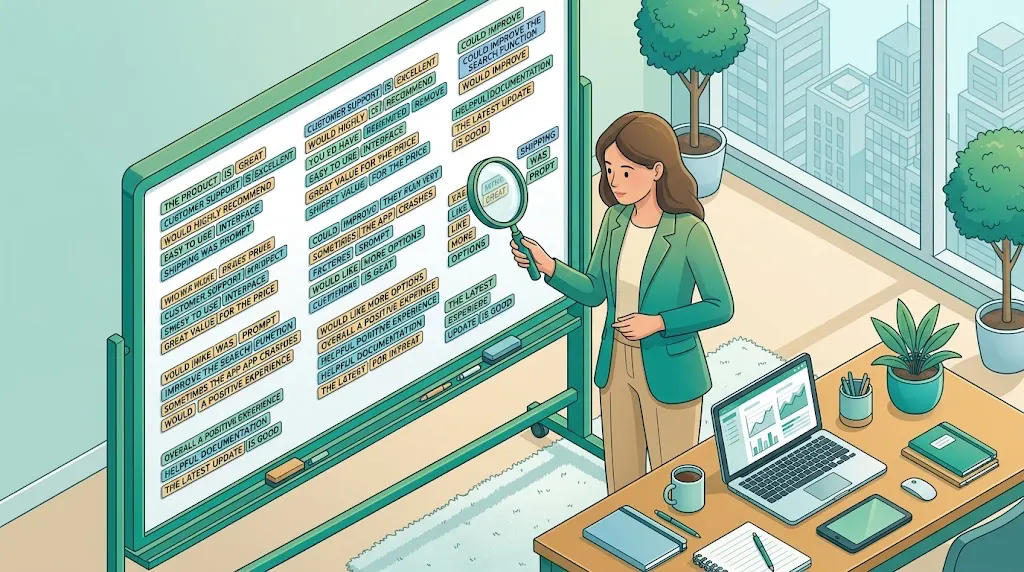
Analysis is where the money is. As the Heidelberg figures above show, manual analysis runs at 3 to 7 researcher hours per hour of interview once familiarisation, open coding and focused coding are all counted, which is why a 40-interview study consumes weeks. AI-assisted coding replaces most of that with framework design and review. You should not push it to zero, because the review is the part that keeps the analysis defensible.
Add the two together and about 35 to 40% is the realistic total saving, roughly what the worked example shows. Even zeroing out transcription, analysis and reporting entirely would cap it near 56%. Anyone quoting more than that is measuring one line and calling it the budget, or assuming nobody checks the output.
There is a second-order effect that matters more than the saving, though it is harder to put in a budget. When analysis costs $12,000 (€11,000) per study, you run few studies and analyse each one thinly. When it costs $3,500 (€3,200), the constraint moves back to fieldwork, and the sensible response is usually to run more research rather than to bank the difference. That is the argument we made in 8 ways to turn customer data into a shareable insight: the small study becomes viable, and small studies compound.
There is also another way to look at the whole equation: now that AI gives more bang for the buck, what if I keep the costs the same and use the effectiviness for getting richer and broader insights? Can I recruit more or more senior respondents? Can I spend more time in analysing the findings and planning for action? As a market research agency, can I promise more time with the clients thinking about the so-what and less time in the back-office transcribing and coding interviews?
What does the elapsed time cost?
A study that answers a question after the decision was made has a return of zero regardless of what it cost.
A conventional 40-interview study can take around 10 weeks. Roughly half of that is fieldwork and scheduling, which is largely irreducible. The other half is analysis and reporting, which is where compression is available. Cutting six weeks to three does not just save salary cost; it changes which decisions the research can inform.
Some teams also have moved from a waterfall aproach to more continuous discovery. With AI assisted analysis, why don't we rapidly analyse the emerging themes after say five interviews, and then use them to both redirect our subsequent interviews as well as to drive some first low-risk decisions?
This is worth quantifying in a business case even roughly. If your product roadmap locks quarterly, a study that lands in week 12 misses the cycle and waits three months to matter. Framed that way, the cost of slow analysis is not the analyst's time. It is a quarter of decisions made without the evidence. The freed-up weeks are also worth reinvesting deliberately rather than banking as pure savings; see why "3x faster" is the wrong pitch for AI in research for what that reinvestment should look like.
For teams running continuous programmes rather than discrete studies, always-on customer research covers the operating model, and combining insights across feedback channels covers how to make each new study cheaper by reusing a stable category structure.
Agency or in-house: what the numbers say
| Factor | Agency | In-house |
|---|---|---|
| Cost per study | Higher (margin, but no fixed cost) | Lower marginal, higher fixed |
| Break-even | Better below ~4 studies/year | Better above ~6 studies/year |
| Speed to start | Fast, no hiring | Slow initially, fast once staffed |
| Methodological control | Theirs | Yours |
| Institutional memory | Leaves with the project | Compounds |
| Panel access | Included | You buy it |
| Credibility with stakeholders | External validation | Sometimes discounted internally |
The break-even is roughly four to six studies a year for a single mid-level researcher, though the more decisive factor is usually institutional memory rather than cost. An agency delivers a study; an in-house team accumulates a corpus. By the third year the in-house team can answer questions from material it already holds, which is a capability no per-project engagement produces.
The hybrid that works well in practice: agency for fieldwork and recruitment on hard-to-reach audiences, in-house for analysis and synthesis. That keeps the expensive, hard-to-replicate capability outside and the compounding capability inside. Using tools like Skimle makes it easy to analyse previous transcripts so you can start to mine for answers from existing findings rather than always start a new study.
Frequently asked questions
Is qualitative research more expensive than quantitative?
Per respondent, dramatically. An online survey costs a few dollars per response (although caveats apply for respondent quality as noted above); an in-depth interview costs $500 to $1,500 (€460 to €1,380) all in. Per decision informed, the comparison often reverses, because a survey tells you what proportion hold a view and an interview tells you why, which is the input a decision usually needs. The two are complements. The mistake is running a survey because it is cheaper when the question is a "why" question, and then commissioning the qualitative study anyway three months later.
How much should an insights team budget per year?
A reasonable planning heuristic for an in-house function is one fully loaded researcher plus $60,000 to $120,000 (€55,000 to €110,000) of fieldwork per researcher per year, which supports six to ten qualitative studies of the size modelled above. Tooling should be under 15% of total spend; if it is more, either fieldwork is under-funded or you are paying for seats nobody uses. Full workspaces like Skimle cost around $1000 per year per user.
What is the cheapest defensible qualitative study?
Ten to fifteen interviews with an audience you can reach without a panel, transcribed automatically and analysed with a documented framework, comes in around $4,000 to $8,000 (€3,700 to €7,350) in-house. Below that you are usually trading away either sample adequacy or analytical rigour. Re-analysing feedback you already hold costs almost nothing and is often the better first move.
Do AI-moderated interviews change these numbers?
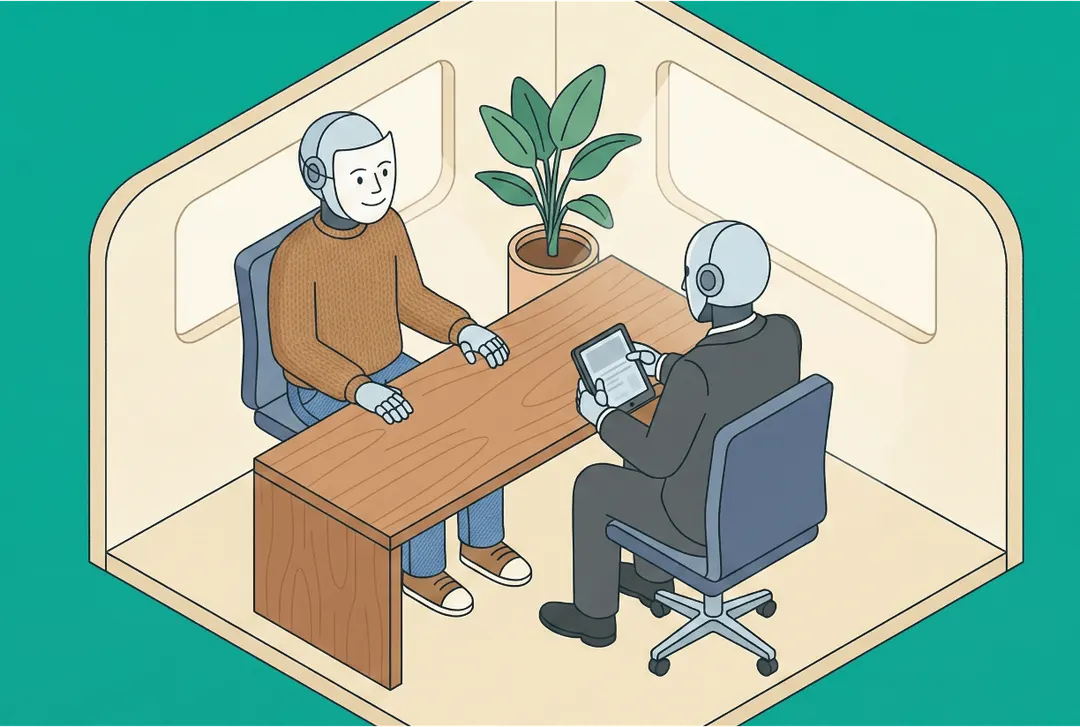
They change the moderation and incentive lines, which is where most of the remaining cost sits. Removing scheduling and live moderation lets you field far more interviews for the same money, and response incentives can be lower for a 15-minute asynchronous interview than for a booked video call. The trade is depth of probing on complex topics. Our comparison of AI versus human interviewing covers where each is appropriate, and Skimle Ask is our implementation.
How do I present this to finance?
Show the six lines, show which one the software changes, and state the saving conservatively. A business case claiming 25% is believed and delivered; one claiming 80% is challenged, discounted, and remembered when it misses. Pair the cost saving with the elapsed-time argument, which is usually the more persuasive half.
Want to see what the analysis line looks like in practice? Try Skimle for free and run a real study through it. Upload your transcripts, code them against your own framework, and see how long the review actually takes on your own material rather than on a vendor's benchmark.
Related reading: See our guides on how to analyse customer interviews at scale, combining customer insights across feedback channels, and qualitative consumer insights research. If you are evaluating software, see how to evaluate qualitative analysis software and the customer and market researchers use-case page.
About the author
Olli Salo is a former Partner at McKinsey & Company where he spent 18 years helping clients understand the markets and themselves, develop winning strategies and improve their operating models. He has done over 1000 client interviews and published over 10 articles on McKinsey.com and beyond. LinkedIn profile
Sources
- Assessing the time required for qualitative analysis: A comparative methodological study of coding interview data in health services research, Ullrich, Wensing, Klafke, Fleischhauer, Brinkmöller, Poß-Doering and Arnold, 2025, Gesundheitswesen 87 (Suppl. 3), S299-S308
- How Much Does Market Research Cost? 2026 Update, Emily Taylor, November 2025 - Drive Research
- User research budget planning: costs, allocation and ROI, March 2026 - CleverX
- Research consultancy pricing benchmarks 2026, June 2026 - CleverX
- Rev Pricing: How Much Does Rev Really Cost in 2026, July 2026 - Sonix