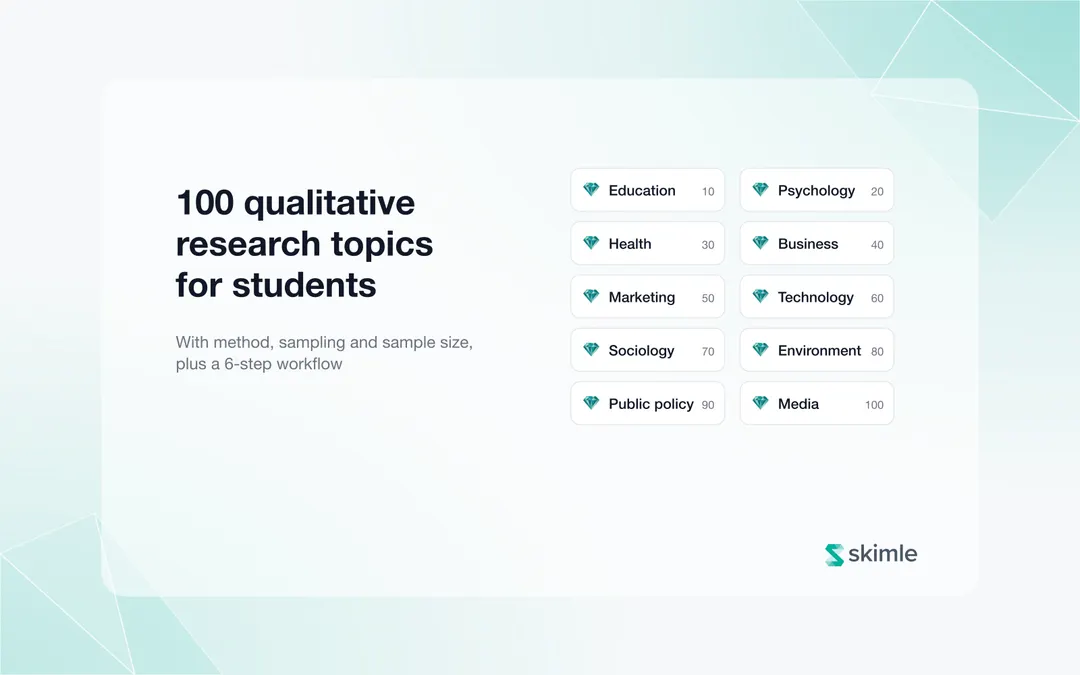
A good qualitative research topic for a master's student asks how or why people experience something, can be studied with 10-20 interviews, a few focus groups or an existing dataset, and fits a three to six month timeline. Below are 100 topics across ten subjects, each with a suggested method, sampling approach and sample size, followed by a six-step workflow using Skimle.
Most topic lists online stop at the question. That is the easy part. The hard part is knowing whether a topic is doable: who you would talk to, how many of them, and what you would do with the data afterwards. This guide gives you all three for every topic, then shows how to run the study from data collection to a finished write-up.
What makes a good qualitative research topic for a master's thesis?
A qualitative topic works when it asks about experience, meaning or process rather than frequency. "How many students use AI for essays?" is a survey question. "How do students decide when using AI for an essay crosses a line?" is a qualitative one, because the answer lives in people's reasoning.
Five tests separate a doable master's topic from an attractive but impossible one:
| Test | Ask yourself | Warning sign |
|---|---|---|
| Access | Can I reach 10-20 people, or a dataset, within a month? | The participants are senior executives, children or patients and you have no gatekeeper |
| Scope | Can one research question cover it? | You need three sub-studies to answer it |
| Ethics | Can my department approve it in time? | Vulnerable groups, illegal behaviour or clinical settings |
| Contribution | Does it add a setting, group or angle the literature lacks? | It repeats a well-known study with no new context |
| Fit | Does my supervisor know the area and method? | Nobody in the department has used the method |
If you are new to the field, start with our guide to what qualitative research is and its main methods.
How to read the topic tables
Each topic comes with three design choices, so you can judge feasibility before falling for a question:
- Method is how you collect the data: semi-structured interviews, focus groups, document analysis, open-ended survey answers, diaries, or AI-led interviews with Skimle Ask.
- Sampling is how you choose who or what to include. Most master's projects use purposive sampling: you pick participants because they have the experience you are studying.
- Sample is a realistic size for a master's project. Interview studies typically reach saturation within 9-17 interviews when the group is fairly similar; broader groups or comparisons need more.
Treat these as starting points to discuss with your supervisor, not fixed rules.
Education research topics
| # | Topic | Method | Sampling | Sample |
|---|---|---|---|---|
| 1 | How do university students decide when using generative AI for coursework is acceptable? | Semi-structured interviews | Maximum variation across disciplines | 15-20 students |
| 2 | How do first-generation students describe their sense of belonging in the first year? | Semi-structured interviews | Criterion (first in family at university) | 12-16 students |
| 3 | How do teachers adapt lessons for students with diagnosed ADHD? | Interviews | Purposive, primary and secondary teachers | 10-14 teachers |
| 4 | What do international students find hardest about group work? | Focus groups | Homogeneous groups by region of origin | 4-5 groups of 5-6 |
| 5 | How do lecturers redesign assessment in response to AI tools? | Interviews plus course documents | Purposive across faculties | 10-12 lecturers |
| 6 | How do parents experience home schooling decisions after the pandemic? | Interviews | Snowball through parent networks | 10-15 parents |
| 7 | What do students say drives them to drop out of online courses? | Open-ended survey answers | Census of course exit survey | 200-500 answers |
| 8 | How do newly qualified teachers describe their first year? | Diary study plus interviews | Criterion (first year in post) | 8-12 teachers |
| 9 | How do universities present wellbeing support in their public communications? | Document analysis | Stratified sample of university websites | 30-40 institutions |
| 10 | How do students experience feedback on their written work? | AI-led interviews (Skimle Ask) | Convenience within one programme | 40-80 students |
Psychology and wellbeing research topics
| # | Topic | Method | Sampling | Sample |
|---|---|---|---|---|
| 11 | How do young adults describe the effect of social media on their self-image? | Semi-structured interviews | Purposive, ages 18-25 | 12-16 people |
| 12 | How do remote workers manage loneliness? | Interviews | Maximum variation by sector | 12-15 workers |
| 13 | How do athletes describe coping with performance anxiety? | Interviews | Purposive across sports | 10-12 athletes |
| 14 | What helps or hinders students in seeking mental health support? | AI-led interviews (Skimle Ask) | Convenience, anonymous link | 50-150 students |
| 15 | How do new parents experience sleep deprivation and identity change? | Diary study | Criterion (first child under one year) | 8-12 parents |
| 16 | How do people describe recovering from burnout? | Interviews | Snowball through support groups | 10-14 people |
| 17 | How do mindfulness app users describe their routines and drop-off? | App store reviews | Random sample of reviews | 300-600 reviews |
| 18 | How do older adults make sense of retirement? | Interviews | Purposive, retired within two years | 10-15 retirees |
| 19 | How do gamers describe the line between hobby and problem? | Online forum posts | Purposive sample of threads | 100-200 posts |
| 20 | How do people talk about therapy on podcasts? | Document analysis of transcripts | Purposive sample of episodes | 20-30 episodes |
Health and nursing research topics
| # | Topic | Method | Sampling | Sample |
|---|---|---|---|---|
| 21 | How do nurses experience moral distress during staff shortages? | Interviews | Purposive across wards | 12-15 nurses |
| 22 | How do patients with long-term conditions experience telehealth appointments? | Interviews | Maximum variation by age and condition | 12-18 patients |
| 23 | What do carers of people with dementia need from respite services? | Focus groups | Purposive through carer organisations | 3-4 groups of 6 |
| 24 | How do junior doctors describe handover between shifts? | Interviews | Criterion (first two years of practice) | 10-12 doctors |
| 25 | How do patients describe their experience of the emergency department? | Patient feedback comments | Random sample of comments | 300-500 comments |
| 26 | How do midwives talk about continuity of care? | Interviews | Purposive across hospital and community | 10-14 midwives |
| 27 | How do people decide whether to get a vaccine booster? | AI-led interviews (Skimle Ask) | Quota by age band | 60-120 people |
| 28 | How do health apps frame personal responsibility for health? | Document analysis | Purposive sample of app descriptions | 30-50 apps |
| 29 | How do pharmacists experience expanded prescribing roles? | Interviews | Purposive, community pharmacies | 10-12 pharmacists |
| 30 | How do patients with chronic pain describe being believed by clinicians? | Existing interview archive | Purposive selection of transcripts | 20-30 transcripts |
Business and management research topics
| # | Topic | Method | Sampling | Sample |
|---|---|---|---|---|
| 31 | How do managers build trust in fully remote teams? | Interviews | Purposive, managers of remote teams | 12-15 managers |
| 32 | How do employees experience four-day week trials? | Interviews | Criterion (worked in a trial company) | 12-16 employees |
| 33 | How do start-up founders decide when to pivot? | Interviews | Snowball through incubators | 10-14 founders |
| 34 | How do family firms handle succession? | Multiple case study | Purposive, 2-4 firms | 3-4 interviews per firm |
| 35 | What do exit interviews reveal about why people leave a sector? | Existing exit interview notes | Census within one organisation | 50-150 records |
| 36 | How do companies explain AI adoption to shareholders? | Document analysis of annual reports | Purposive, one industry | 20-40 reports |
| 37 | How do middle managers experience organisational change? | Interviews | Purposive across departments | 12-15 managers |
| 38 | How do gig workers describe fairness on delivery platforms? | Existing dataset or interviews | Purposive | 15-20 workers |
| 39 | How do small businesses choose software suppliers? | Interviews | Maximum variation by size | 10-14 owners |
| 40 | How do employees talk about company culture on review sites? | Employer review comments | Random sample per company | 200-400 reviews |
Marketing and consumer behaviour research topics
| # | Topic | Method | Sampling | Sample |
|---|---|---|---|---|
| 41 | Why do consumers choose second-hand fashion? | Interviews | Purposive, regular second-hand buyers | 12-15 consumers |
| 42 | How do followers judge the trustworthiness of influencers? | Focus groups | Homogeneous by age group | 4 groups of 5-6 |
| 43 | What do customers say about a brand in their product reviews? | Review analysis | Random sample across ratings | 300-600 reviews |
| 44 | How do consumers react to sustainability claims on packaging? | AI-led interviews (Skimle Ask) | Quota by age and gender | 80-150 people |
| 45 | How do people decide to cancel a subscription? | Interviews | Criterion (cancelled in last six months) | 12-15 people |
| 46 | How do brands respond to complaints on social media? | Document analysis of public replies | Purposive, 5-8 brands | 200-300 replies |
| 47 | What makes a loyalty programme feel worth it? | Open-ended survey answers | Convenience through a retailer | 150-300 answers |
| 48 | How do first-time buyers experience buying a home? | Interviews | Criterion (bought in last year) | 10-14 buyers |
| 49 | How do consumers talk about plant-based food on forums? | Online posts | Purposive sample of threads | 150-250 posts |
| 50 | How do shoppers describe trust in self-checkout and cashierless stores? | Interviews | Convenience at store exits, with permission | 15-20 shoppers |
Technology and digital life research topics
| # | Topic | Method | Sampling | Sample |
|---|---|---|---|---|
| 51 | How do knowledge workers integrate AI assistants into daily work? | Interviews | Maximum variation by profession | 12-18 workers |
| 52 | How do older adults learn to use smartphones? | Interviews plus observation | Purposive through community centres | 10-12 people |
| 53 | How do software developers talk about burnout on public forums? | Online posts | Purposive sample of threads | 150-250 posts |
| 54 | How do parents set screen time rules? | AI-led interviews (Skimle Ask) | Convenience through schools | 50-100 parents |
| 55 | How do users describe privacy trade-offs in fitness apps? | Interviews | Purposive, active app users | 12-15 users |
| 56 | How do people decide to leave a social media platform? | Open-ended survey answers | Convenience | 150-300 answers |
| 57 | How do content moderators describe their work? | Existing interview reports and testimony | Purposive | 15-25 accounts |
| 58 | How do companies describe responsible AI in public policies? | Document analysis | Purposive, 20-30 company policies | 20-30 documents |
| 59 | How do remote students experience online exams with proctoring software? | Interviews | Criterion (sat a proctored exam) | 12-15 students |
| 60 | What do users complain about after a major app redesign? | App store reviews | Census for two months after release | 300-800 reviews |
Sociology and communities research topics
| # | Topic | Method | Sampling | Sample |
|---|---|---|---|---|
| 61 | How do residents of a gentrifying neighbourhood describe belonging? | Interviews | Maximum variation by length of residence | 15-20 residents |
| 62 | How do migrants navigate their first year of work in a new country? | Interviews | Snowball through community groups | 12-15 people |
| 63 | How do volunteers describe why they keep volunteering? | AI-led interviews (Skimle Ask) | Convenience through an organisation | 40-80 volunteers |
| 64 | How do young people experience precarious housing? | Interviews | Purposive through housing charities | 10-14 people |
| 65 | How do couples divide household work when both work from home? | Interviews with couples | Purposive, dual-earner couples | 10-12 couples |
| 66 | How do people describe loneliness after moving to a city? | Interviews | Criterion (moved in last two years) | 12-15 people |
| 67 | How do local Facebook groups handle conflict? | Online posts | Purposive, 3-5 groups | 150-300 posts |
| 68 | How do religious communities adapt rituals to online worship? | Interviews plus observation | Purposive, 2-3 communities | 10-14 members |
| 69 | How do fans build community around a sports club? | Focus groups | Homogeneous by supporter group | 3-4 groups |
| 70 | How do oral histories describe a factory closure? | Existing oral history archive | Purposive selection | 20-30 transcripts |
Environment and sustainability research topics
| # | Topic | Method | Sampling | Sample |
|---|---|---|---|---|
| 71 | How do farmers describe adapting to climate change? | Interviews | Maximum variation by farm type | 12-15 farmers |
| 72 | Why do households adopt or reject heat pumps? | Interviews | Purposive, adopters and rejecters | 12-16 households |
| 73 | How do young climate activists sustain motivation? | Interviews | Snowball through activist groups | 10-14 activists |
| 74 | How do companies describe net zero targets in sustainability reports? | Document analysis | Purposive, one sector | 20-30 reports |
| 75 | How do residents respond to a planned wind farm? | Public consultation responses | Census of submissions | 100-400 responses |
| 76 | How do commuters decide whether to cycle? | AI-led interviews (Skimle Ask) | Convenience through workplaces | 60-120 commuters |
| 77 | How do restaurants manage food waste? | Interviews | Purposive across restaurant types | 10-12 managers |
| 78 | How do people talk about eco-anxiety online? | Online posts | Purposive sample of threads | 150-250 posts |
| 79 | How do coastal communities experience flooding risk? | Focus groups | Purposive by area | 3-4 groups |
| 80 | How do consumers explain repairing rather than replacing products? | Interviews | Criterion (used a repair café) | 12-15 people |
Public policy and public sector research topics
| # | Topic | Method | Sampling | Sample |
|---|---|---|---|---|
| 81 | How do civil servants use AI tools in policy work? | Interviews | Purposive across ministries | 10-14 officials |
| 82 | What do citizens say in a public consultation on a new law? | Consultation responses | Census of submissions | 100-1,000 responses |
| 83 | How do social workers balance caseloads and care? | Interviews | Purposive across teams | 12-15 social workers |
| 84 | How do police officers describe community policing? | Interviews | Purposive, neighbourhood officers | 10-12 officers |
| 85 | How do NGOs describe their relationship with funders? | Interviews plus reports | Purposive, 8-12 organisations | 10-14 interviews |
| 86 | How do refugees experience the asylum interview? | Existing testimony and NGO reports | Purposive | 20-30 accounts |
| 87 | How do parliamentarians frame housing affordability in debates? | Parliamentary speeches | Purposive by party and period | 50-150 speeches |
| 88 | How do municipalities evaluate participatory budgeting? | Multiple case study | Purposive, 2-3 municipalities | Documents plus 3-4 interviews each |
| 89 | How do people on benefits describe the application process? | Interviews | Snowball through advice centres | 12-15 people |
| 90 | How do evaluators describe using qualitative evidence in programme evaluation? | Interviews | Purposive, practising evaluators | 10-12 evaluators |
Media, communication and politics research topics
| # | Topic | Method | Sampling | Sample |
|---|---|---|---|---|
| 91 | How do journalists verify information from social media? | Interviews | Purposive across newsrooms | 10-14 journalists |
| 92 | How do newspapers frame artificial intelligence? | Document analysis of articles | Random sample over two years | 100-200 articles |
| 93 | How do young voters decide whom to trust on political news? | Focus groups | Homogeneous by age | 4 groups of 5-6 |
| 94 | How do politicians talk about immigration in campaign speeches? | Speech transcripts | Purposive by party | 30-60 speeches |
| 95 | How do podcast hosts build relationships with listeners? | Interviews | Purposive, independent podcasters | 10-12 hosts |
| 96 | How do readers comment on climate news? | Online comments | Random sample under articles | 300-500 comments |
| 97 | How do organisations communicate during a crisis? | Case study of press releases and posts | Purposive, 2-3 crises | 50-100 documents |
| 98 | How do fact-checkers choose which claims to check? | Interviews | Purposive, fact-checking organisations | 8-12 fact-checkers |
| 99 | How do students consume news on TikTok? | AI-led interviews (Skimle Ask) | Convenience within a university | 50-100 students |
| 100 | How do TV debates portray expert disagreement? | Transcripts of debates | Purposive by topic | 15-25 debates |
Want ready-made data for any of these? Many topics marked "existing" can use our list of free datasets for qualitative research, from interview archives to parliamentary speeches.
How do you turn a topic into a finished study in 6 steps?
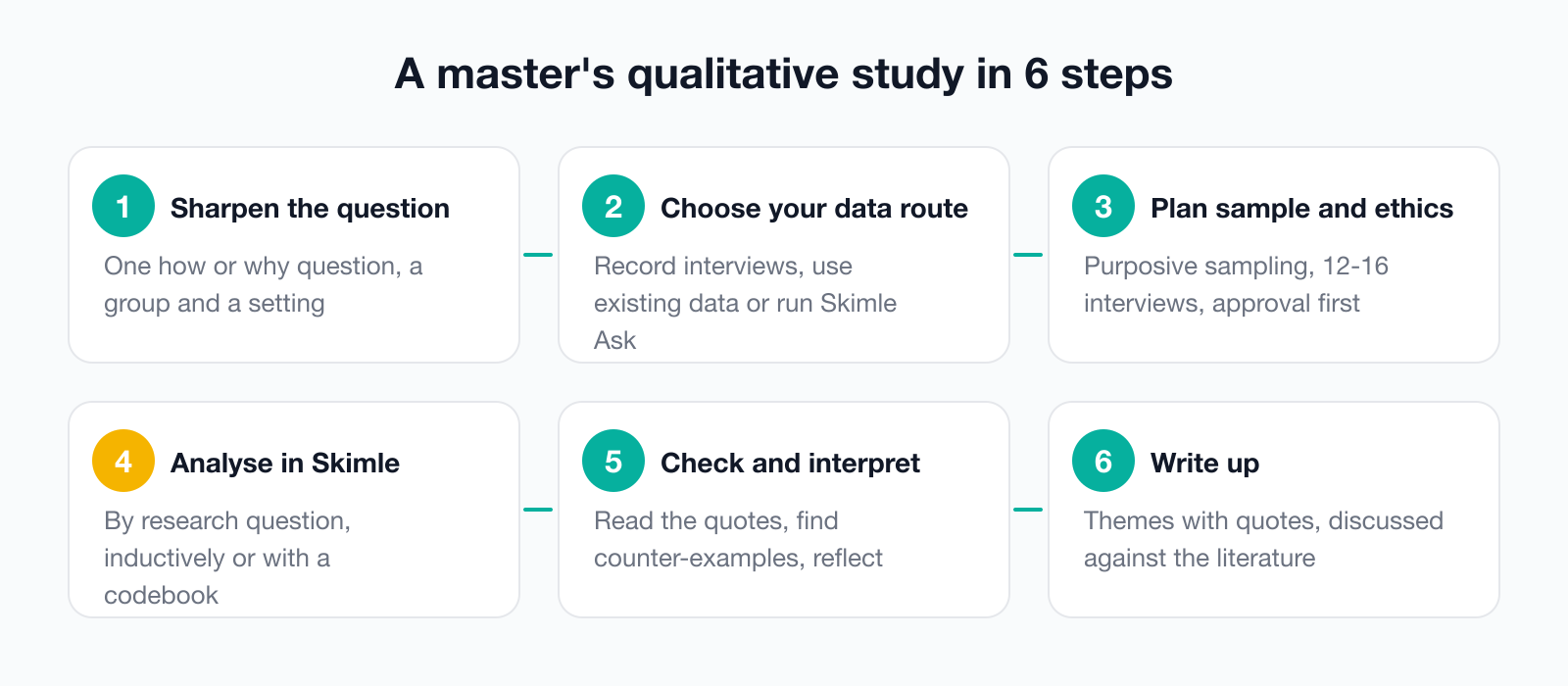
The workflow below takes you from topic to final report. It assumes a master's timeline of three to six months and uses Skimle for transcription, analysis and reporting, though the steps apply whatever tools you use.
Step 1: Sharpen your research question
Turn the topic into one research question that starts with "how" or "why" and names a group and a setting. "How do first-year nursing students in Finland describe their first clinical placement?" is better than "Nursing students' experiences", because it tells you who to recruit and what to ask. Write two or three sub-questions that your interview guide or analysis will cover.
Step 2: Choose your data route
There are three practical ways to get qualitative data for a master's project. Pick the one that fits your access, ethics approval and timeline.
| Route | Best when | Time to collect | What to watch |
|---|---|---|---|
| Interviews you record | You need depth from a specific group | 4-8 weeks | Recruitment, consent, transcription |
| Existing data | Ethics approval is slow or the group is hard to reach | 1-2 weeks | Fit with your question, licence terms |
| AI-led interviews with Skimle Ask | You want interview-style depth from 30-200 people | 1-3 weeks | Clear questions, a link people will open |
Interviews you record. Write a semi-structured interview guide with 6-10 open questions and probes, ask for consent to record, and record on a phone, Zoom or Teams. Upload the recordings to Skimle and they are transcribed in over 100 languages with speaker labels, so you skip days of typing. If your ethics approval requires it, switch on anonymisation so names and places are pseudonymised before analysis, and choose to delete recordings once transcribed.
Existing data. Secondary analysis is a legitimate and often faster route: archived interviews, open-ended survey answers, consultation responses, speeches or reviews. Our list of free datasets for qualitative research is a good starting point, and Skimle imports text, PDFs and spreadsheets where each row becomes a document.
AI-led interviews with Skimle Ask. Skimle Ask runs your interview guide as an online conversation: respondents answer in text or voice, and the AI asks follow-up questions like an interviewer would. It suits topics where you want more participants than you could interview yourself, and the answers flow straight into analysis. See how many AI-moderated interviews you need to plan your sample.
Step 3: Plan your sample and ethics
Decide your sampling strategy and target size before you start, and write down why. Examiners look for this reasoning in your methods chapter. For interview studies, plan 12-16 participants and stop when new interviews add little that is new, a point known as data saturation. Get ethics approval before you contact anyone, and check your university's policy on using AI tools with research data. Skimle is hosted in the EU and never trains AI models on your data, which most ethics boards will ask about.
Step 4: Analyse your data in Skimle
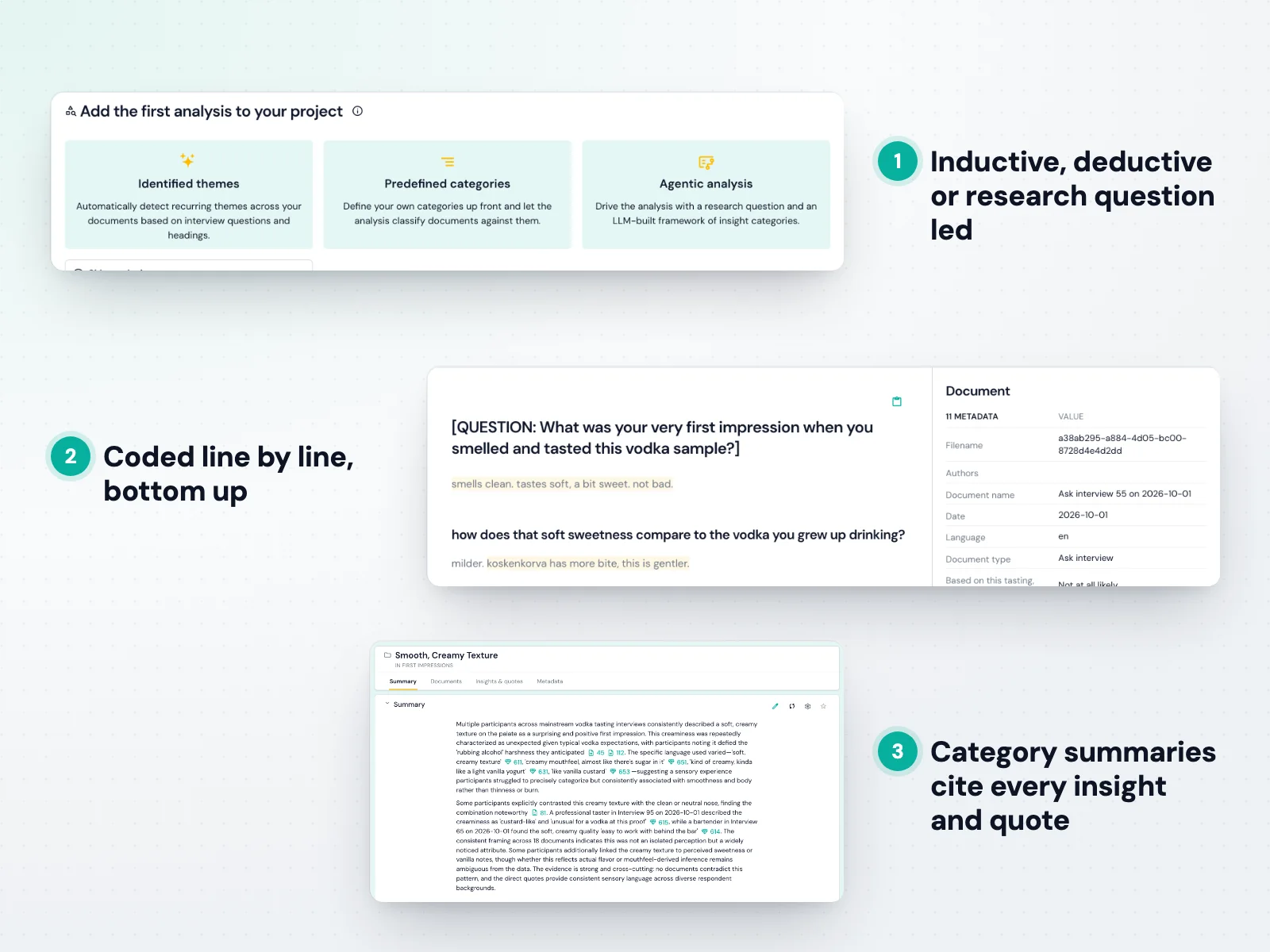
Skimle reads every transcript or document and codes it into themes, with each theme linked to the verbatim quotes behind it. You can analyse in three ways, depending on your method:
| Approach | Use it when | In Skimle |
|---|---|---|
| Through your research question | You have a clear question and want themes that answer it | Agentic analysis: state the question, agree a framework, get coded data plus written themes |
| Inductively | You want themes to emerge from the data, as in thematic analysis or grounded theory | Automatic thematic analysis: no prompts or codebook needed |
| Against a codebook from theory | Your literature review gives you a framework to test or extend | Predefined categories: code deductively, with subcategories emerging from the data |
Whichever you choose, you stay in charge of the interpretation. Merge, rename and split themes until they match your reading of the data, and check the quotes behind each one. If you collected metadata such as role, age group or site, compare what different groups said. For a methodological grounding, read our guides to thematic analysis and inductive, deductive and abductive coding, and our guide on how to use AI in qualitative research for what supervisors expect when you disclose AI use.
The screenshot below shows the three analysis modes in Skimle, a transcript coded line by line, and a category summary that cites every insight and quote it rests on.
Step 5: Check, compare and interpret
Before you write, test your findings. Read the quotes behind each theme and ask whether they say what the label claims. Look for counter-examples and participants who disagree, because a theme with no exceptions is often too broad. Note how your own background shaped your reading, which is what reflexivity means in practice. Skimle's AI chat helps here: ask "who disagrees with this?" and it answers with quotes you can verify.
Step 6: Write up your findings
A qualitative findings chapter is organised by theme, not by participant or by question. For each theme, state the claim, show two or three well-chosen quotes, and explain what they mean in light of your literature. The table below shows a typical master's structure.
| Chapter | What it contains | Typical length |
|---|---|---|
| Introduction | Problem, research question, contribution | 8-10% |
| Literature review | What is known, the gap, your framework | 20-25% |
| Methodology | Approach, sampling, data collection, analysis, ethics, AI use | 15-20% |
| Findings | 3-5 themes with quotes | 25-30% |
| Discussion | What the themes mean against the literature | 15-20% |
| Conclusion | Answer to the question, limitations, further research | 5-8% |
Skimle can export your analysis to Word, Excel or PowerPoint with attributed quotes, or as an online presentation for your defence. If your department expects NVivo or MAXQDA, export to REFI-QDA and continue there. Our guide to writing up thematic analysis results has worked examples of findings sections.
What does a qualitative study cost a student?
Very little, if you plan it. Recording is free on a phone or Zoom. Transcription services typically charge per minute, which adds up across 15 one-hour interviews. Skimle includes transcription, anonymisation and analysis in one tool: the free trial covers about 200 pages or 200 minutes, and paid plans start at €20 a month, so a three-month thesis project costs less than a textbook. Universities can also buy academic licences; see pricing and how Skimle fits academic research. For more tips on keeping costs down, read qualitative research on a PhD budget.
Frequently asked questions
What is a good qualitative research topic for a master's student?
A good topic asks how or why a specific group experiences something, can be studied with 10-20 interviews, a few focus groups or an existing dataset, can get ethics approval quickly, and adds a new setting or angle to existing research. Topics about your own profession or community are often the easiest to access.
How many interviews do I need for a master's thesis?
Most master's interview studies use 10-20 participants. Research on saturation found that 9-17 interviews were usually enough when the group was fairly similar and the question focused. Broader questions, diverse groups and comparisons between groups need more. Agree the number with your supervisor and justify it in your methods chapter.
Can I use existing data for a qualitative dissertation?
Yes. Secondary analysis of interview archives, open-ended survey answers, documents, speeches or reviews is an accepted approach and can save months of recruitment and ethics review. Check the licence terms and that the data actually answers your research question.
Can I use AI to analyse qualitative data for my thesis?
Most universities allow it if you disclose it and remain responsible for the interpretation. Use a tool that links every theme to verbatim quotes, keeps your data private and lets you edit the coding, and describe how you used it in your methods chapter. Check your university's AI policy first.
What is the easiest qualitative method for students?
Semi-structured interviews are the most common and the easiest to justify, because the method is well documented and you control the questions. Document analysis is often the fastest, since there is no recruitment. AI-led interviews with Skimle Ask combine interview depth with survey reach.
How long does a qualitative master's project take?
Plan three to six months: about a month for the research question and ethics, one to two months for data collection, a month for analysis and a month for writing. AI-assisted transcription and coding can shorten analysis from weeks to days, leaving more time for interpretation.
Ready to start your study? Try Skimle for free: transcribe, analyse and write up your qualitative research in one place, from €20 a month after the trial.
Related reading:
- What is qualitative research? Methods, types and examples
- Purposive sampling in qualitative research
- Free datasets for qualitative research
- The best qualitative research tools for PhD students
About the authors
Henri Schildt is a Professor of Strategy at Aalto University School of Business and co-founder of Skimle. He has published over a dozen peer-reviewed articles using qualitative methods, including work in Academy of Management Journal, Organisation Science, and Strategic Management Journal. His research focuses on organisational strategy, innovation, and qualitative methodology. Google Scholar profile
Olli Salo is a former Partner at McKinsey & Company where he spent 18 years helping clients understand the markets and themselves, develop winning strategies and improve their operating models. He has done over 1000 client interviews and published over 10 articles on McKinsey.com and beyond. LinkedIn profile
Sources
- Hennink and Kaiser (2022). Sample sizes for saturation in qualitative research: a systematic review of empirical tests. Social Science & Medicine
- Braun and Clarke (2006). Using thematic analysis in psychology. Qualitative Research in Psychology
- Palinkas et al. (2015). Purposeful sampling for qualitative data collection and analysis in mixed method implementation research. Administration and Policy in Mental Health
- Heaton (2008). Secondary analysis of qualitative data: an overview. Historical Social Research