Skimle for consultants & investors
Spend 80% of your time on insights, not organising data
Consulting and investment work is won or lost on the quality of qualitative analysis — expert calls, management interviews, data room documents, market research. The tools for quantitative work are solid. The qualitative side is still being hacked together with Word docs and Excel trackers.
Skimle gives consulting teams and investors the same rigour they apply to financial modelling, but for text. Upload expert transcripts, data room documents, or research reports. Skimle reads everything, surfaces themes, flags outliers, and links every finding to a verbatim quote — so you can defend your recommendation in a steering committee without breaking a sweat.
Analysis that matches client expectations for depth and speed
What took weeks of analyst time takes hours with Skimle, without sacrificing the rigour partners and investment committees demand. Skimle was built by a former McKinsey Partner who ran over 1,000 client interviews and knows exactly where qualitative analysis breaks down under project pressure.
- Every expert call, data room document, and market report in one workspace
- AI surfaces themes, consensus views, outlier opinions, and red flags in minutes
- Full traceability — every finding links to a specific verbatim quote
- Works in 100+ languages across global and multi-country projects
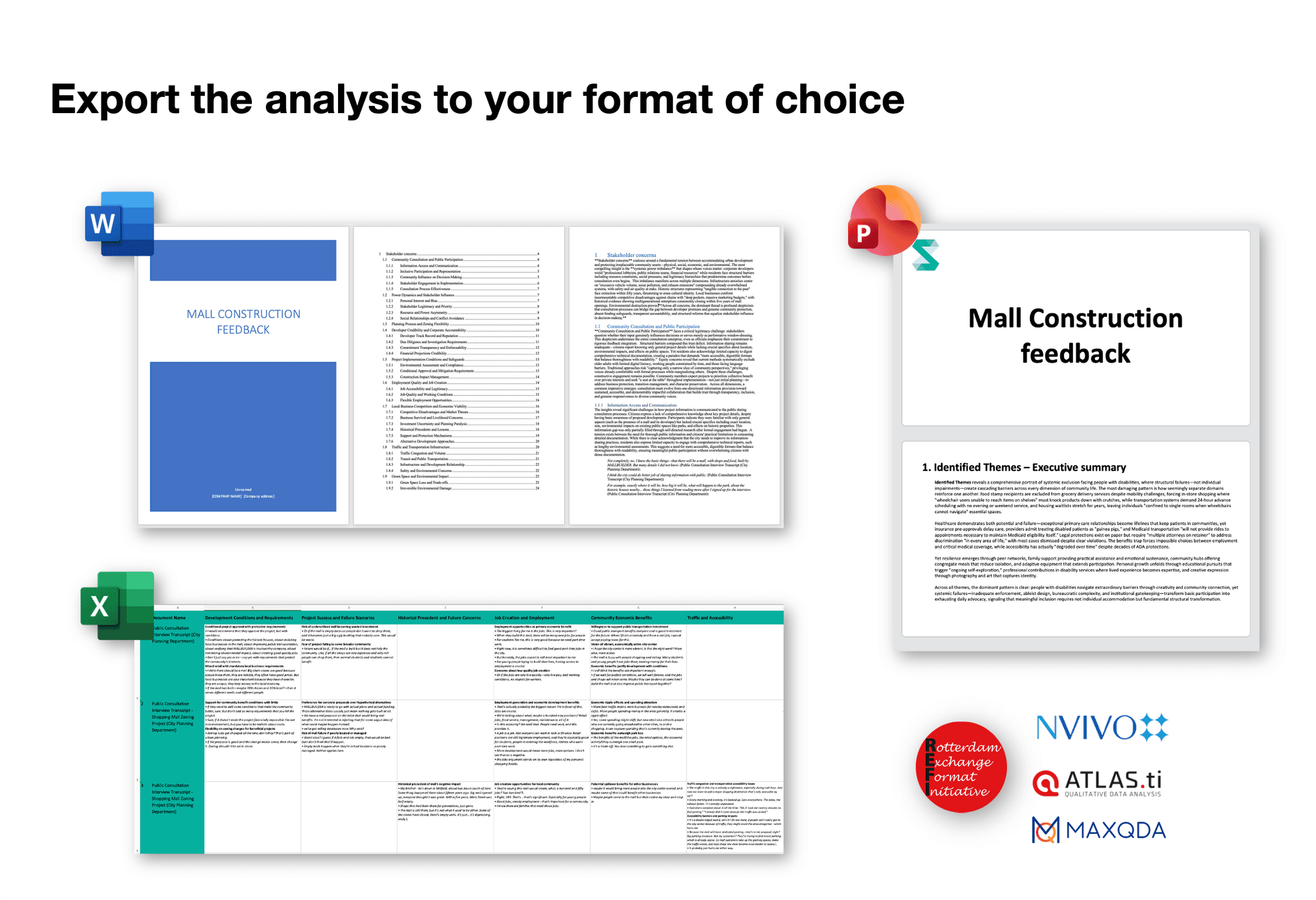
- Client-ready exports to Word, PowerPoint, and Excel
- Data stays in the EU — GDPR-compliant, with DPAs available



FROM 40 CALLS TO A DEFENSIBLE SYNTHESIS
Distil insights from expert, stakeholder, and client calls
You have run 40 expert network calls, 20 client discussions, and 10 internal problem-solving sessions, and the synthesis deck is due Monday. How do you pull the signal from thousands of pages without skimming and hoping you caught what matters? Skimle reads every document, builds a bottom-up structure of consensus views, contradictions, and outlier opinions, and links each finding to the exact quote that supports it.
How it works
- 1. Upload all documents
Export transcripts from any expert network platform and any other source. Mix call notes, interview transcripts, and written submissions in one project.
- 2. Orient around your hypothesis
Describe what you are looking for in plain language. Skimle structures the analysis around what you are trying to validate or disprove, creating sub-categories and pulling the supporting facts from each document.
- 3. Review consensus and outlier views
Skimle surfaces themes across all transcripts, flags where experts agree, and highlights the dissenting views that carry analytical weight.
- 4. Verify every finding
Click any theme to see the supporting quotes and which expert said what. Partners review the logic directly — no black boxes or “computer said so” moments.
- 5. Combine with the wider evidence base
Cross-reference expert views against management claims, contracts, and market data held in the same project, so contradictions surface before the read-out, not after.



YOUR HYPOTHESIS FRAMEWORK, FILLED WITH EVIDENCE
Structure findings into an organised issue tree
A pile of themes is not a story. Partners and investment committees think in issue trees: a clear hierarchy of questions, each answered by evidence. Building that structure by hand, across a 1,000-document data room, is where diligence and strategy work bogs down. Skimle lets you define the top branches of your issue tree, then reads every document to populate each branch with sub-categories and the exact facts that support or challenge them.
How it works
- 1. Upload the full document set
Drag in PDFs, Word documents, presentations, and spreadsheet exports — up to 1,000 documents per project, no sorting or pre-processing needed.
- 2. Define your top-level branches
Frame the analysis around your issue tree, investment thesis, or diligence framework. Skimle organises findings to match your deal logic, not generic categories.
- 3. Let Skimle populate the tree
Skimle builds sub-categories under each branch, surfaces red flags, and cross-references management claims against interviews and contracts.
- 4. Reshape the structure freely
Merge, split, and rename branches as your thinking evolves. Every move keeps its link back to the source document and passage, so partners can drill in and challenge any node.
- 5. Query across the whole corpus
Ask targeted questions — “What did CFOs say about pricing pressure?” or “Where do regulatory risks cluster?” — and get sourced answers in seconds.



FROM ANALYSIS TO A CLIENT-READY DELIVERABLE
Export client-ready reports and decks
The last mile eats analyst evenings: copying quotes into slides, formatting tables, reconciling different analysts' write-ups across workstreams and languages. Skimle turns the analysed structure straight into an export — Word, PowerPoint, or Excel — with representative quotes, source references, and market-by-market breakdowns already in place, so the deck starts from a defensible draft rather than a blank page.
How it works
- 1. Consolidate every workstream
Keep all sources, languages, and geographies in one project, so the export draws on the full evidence base rather than a reconciled patchwork.
- 2. Choose your output format
Export to Word, PowerPoint, or Excel — a synthesis narrative, a slide-ready summary, or a cross-tab of themes by segment.
- 3. Keep quotes and references attached
Each finding carries representative verbatim quotes and a reference to its source document, so the appendix builds itself and every claim is defensible.
- 4. Separate global from local
Break results down by market or workstream, with cross-market patterns clearly separated from one-off local findings.
- 5. Deliver, then defend
When the steering committee pushes back, drill from any line in the report to the underlying quotes and documents in seconds.

FAQ
Frequently asked questions
- Will clients accept AI-assisted analysis?
- Yes, if you position it correctly. Frame it as AI-assisted human analysis: the AI handles data organisation, you provide the strategic interpretation. Skimle's full traceability lets you defend every recommendation with evidence, which is stronger than manual synthesis where the coding logic stays invisible.
- Can we use this for confidential client data?
- Yes. Data is processed securely, stored in the EU, and never used to train AI models. Skimle provides Data Processing Agreements for institutional clients and supports single-tenant deployments for firms with stricter data sovereignty needs.
- How does this work with GLG, AlphaSights, or Tegus transcripts?
- Export transcripts from any expert network platform and upload them directly. Skimle handles any transcript format and centralises all expert-call analysis in one project, alongside data room documents and market research, rather than fragmenting it across platform-specific tools.
- What if partners need to review the analysis?
- Skimle keeps a full audit trail. Partners see exactly which sources support which conclusions and drill into any node directly, which makes review faster than asking analysts to pull supporting quotes on demand.
- Does this replace junior analysts?
- No, it makes them more effective. Juniors spend less time organising quotes and building trackers, and more time on client interviews, analysis, and recommendations. They can take on more complex projects earlier, with more consistent quality.
- Can we run multiple workstreams in one project?
- Yes. Tag documents by workstream, geography, or source type, then filter themes and patterns by those tags. A market-entry project with four country workstreams runs in one project, with both workstream-level and cross-market views available.
- How much does Skimle cost versus hiring research support?
- A due diligence project that takes 300 analyst hours manually takes around 48 hours with Skimle. Individual plans start at €20 per month on annual billing (€25 month-to-month), with organisational and enterprise plans available. Contact us to discuss options for consulting firms and PE shops.
Choosing your analysis approach
Skimle vs. other consulting analysis approaches
When evaluating analysis methods for consulting projects, consider project economics and competitive positioning.
| Manual Excel / Word | Ad hoc AI ChatGPT / Claude | Outsourced team | Skimle | |
|---|---|---|---|---|
| Speed | Slow (2–3 weeks) | Fast (hours) | Medium (1+ week) | Fast (1–2 days) |
| Quality / rigour | Good (if time allows) | Poor — no traceability | Excellent | Excellent |
| Handles complexity | Breaks down at scale | Limited context | Yes (expensive) | Yes |
| Multi-source integration | Manual | Limited | Manual | Built-in |
| Client-ready outputs | Manual formatting | Needs heavy editing | Yes | Automated |
| Defend recommendations | Manual documentation | Difficult | Good | Full traceability |
| Cost (typical project) | Analyst time (€5k–15k) | ~€100 | €10k–25k | €100–500 |
| Scales across projects | No knowledge retention | No | High staff costs | Yes |
| Verdict | Best only for very small projects where personal synthesis is faster than setup time. | Fine for quick drafts — but partners will ask “How do you know this?” and you won't have a good answer. | When you have deep bench capacity, no time pressure, and project economics support the analyst hours. | 15+ expert interviews, large data rooms, tight deadlines, or when you need to defend recommendations with a full evidence trail. |
About Skimle
Built for professionals, by professionals
Skimle is based in Finland and co-founded by a former McKinsey Partner and a Professor of Strategy at Aalto University — people who have spent careers doing qualitative analysis under real professional pressure. We built Skimle because we needed it ourselves.
We are trusted by Finnish government ministries, over 30 universities, dozens of consulting and market research firms, and large companies. All data is stored within the EU and processed according to our strict GDPR policy and terms of service.
For consulting firms and PE shops interested in team plans, enterprise licensing, or white-label arrangements, get in touch. We are happy to discuss firm-wide agreements and custom deployments.