Most enterprise companies run one big customer survey per year. The results come back weeks after the survey closes, an analysis team writes a report, and the report shapes the strategy deck for the following quarter. By the time anything changes, the feedback is many months old.
Startups and scale-ups work differently. They ship weekly, revise pricing monthly, and lose customers they cannot quite explain. The annual survey model was never designed for them, and the best of them know it. They are nimble enough to respond to insight quickly, but only if the insight arrives continuously and in a form that drives understanding rather than just data.
The problem is that most growing companies still default to one of two approaches: doing nothing systematic about customer research, or occasionally blasting a static survey and hoping the responses say something useful. Neither approach gives them what they actually need. The point of continuous research is to reinvest the time AI-assisted analysis frees up into more customer contact, not less; see why "3x faster" is the wrong pitch for AI in research for that argument in full.
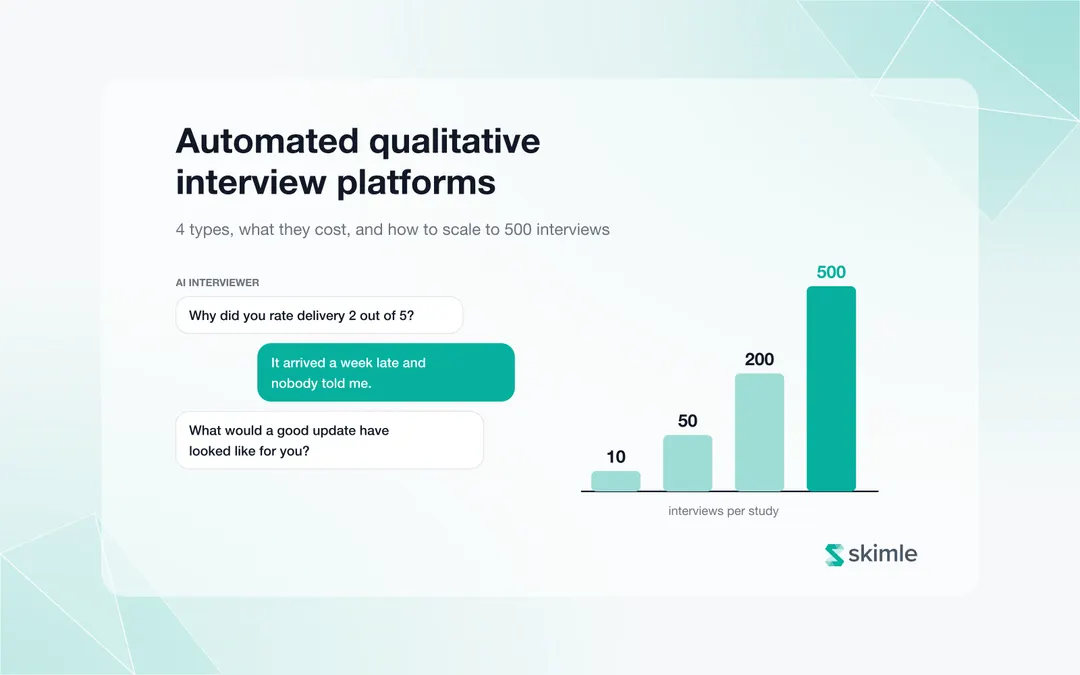
This guide is about a better model: embedding brief, AI-guided interviews at the five moments in your product lifecycle where understanding matters most. No research team required. No interview scheduling. Just embed a snippet or send a link, and let the conversations happen automatically.
Why the annual survey model does not fit fast-moving products
The enterprise feedback model was built around a specific set of constraints: large research budgets, quarterly review cycles, and the assumption that collecting customer data at scale is hard. For a company with 50,000 users and a dedicated insights team, running a structured annual survey and producing a benchmarked report makes sense.
For a startup with 300 paying customers and a two-person product team, it does not. What matters at that stage is not benchmarks, it is depth. You do not need 400 people to tell you your onboarding is confusing. You need ten people to explain, in their own words, exactly where they got stuck and why.
The research on startup failure is instructive here. CB Insights consistently reports that "no market need" is the leading reason startups fail, cited in 42% of post-mortems. The product was built before the customer problem was properly understood. That is a research failure before it is a product failure.
The good news is that fixing it does not require a research budget. It requires embedding the right questions at the right moments, and using AI to handle the follow-up that turns those questions into genuine understanding. A fast-moving company that gathers rich qualitative insight continuously has a structural advantage over one that runs a form twice a year and reads the aggregate.
The five touchpoints that matter
Customer discovery: validate assumptions before you build
Customer discovery is the most upstream form of product research and the most likely to be skipped. The typical pattern: a founder has an idea, builds an MVP, launches, and then discovers the market assumed to exist is smaller or different than expected.
A structured discovery interview with potential users, conducted before significant engineering investment, catches this early. The questions are familiar: what problem are you trying to solve, how are you solving it today, what frustrates you about that approach? The value comes from the follow-up. When someone says "I spend hours manually copying data between tools," the next question should be which tools, and which step takes the most time. A static form moves on to the next question. An AI-guided interview asks it.
Deploy discovery interviews as a link in cold outreach, on a landing page ("tell us about your current process"), or through professional networks. Aim for 15-20 responses before drawing conclusions. Our guide to qualitative research sample size explains why that number is usually sufficient, and our guide to writing effective interview guides covers how to structure the questions themselves.
Onboarding: understand why people actually signed up
Most products ask "how did you hear about us?" as a dropdown. The options are Google, LinkedIn, word of mouth, other. This is almost useless for product decisions.
What you actually want to know is: what problem were you hoping this product would solve? What made you sign up today rather than last month? What almost stopped you from signing up?
These answers shape your positioning, your onboarding flow, and your content strategy. They tell you which messages are actually landing and which customer segments are arriving with mismatched expectations. A startup that knows the precise language its best customers use to describe the problem they were solving has a significant advantage in every channel.
Onboarding is the ideal moment to ask because motivation is at its highest. The person just decided to try your product. A brief AI interview at this point, three to five questions with follow-up, takes about four minutes to complete and gives you data no dropdown can match.
Deploy as an embedded widget on your post-sign-up confirmation page or as a link in your welcome email. In-app and onboarding surveys typically achieve response rates of 30-45% when properly timed, compared to 15-25% for standard email surveys. The onboarding moment is as well-timed as it gets.
In-product interviews: catching users mid-journey
Not all insight needs to be captured at the beginning or end. Some of the most useful feedback comes from users in the middle of their experience, after they have used a feature enough to have an informed view but before they have decided whether to stay or leave.
Useful triggers for a brief AI interview include: completing a key workflow for the first time, reaching a 30 or 60-day tenure milestone, or using a feature you recently shipped. The question set is short: what has been most valuable so far, what almost made you give up, what are you still trying to figure out?
This type of mid-journey research is particularly valuable for identifying what users actually need versus what they request. Users often ask for features that address symptoms rather than root causes. A conversational interview that probes the underlying problem gives your product team far more actionable input than a feature upvote or a usage metric. You can read more about this type of research in the context of product managers, or see our practical guide to qualitative research for product managers.
Deploy as an embedded widget triggered by in-app events, or as a timed email after a milestone is reached.
Feature requests: the need behind the ask
When a user submits a feature request, they are expressing a real need in an imperfect way. "I want a CSV export" often means "I need to get this data into another system and I do not know how else to do it." "I want a mobile app" sometimes means "I want to access one specific thing quickly and the current interface is slow on my phone."
If you build the feature as literally described, you may solve the wrong problem. If you ignore the request, you lose insight into what the user was actually trying to accomplish.
A brief AI interview triggered after a feature submission fills in the context the request lacks. Ask what the user was trying to accomplish, how they are currently solving it, and how important it is relative to other improvements they would like to see. This turns a feature request queue into a prioritisation tool grounded in real user needs, rather than a list of wishes with no context.
Deploy as a link sent automatically in response to every feature request submission.
Churn interviews: the conversation most companies never have
Churn is the most consequential and most under-researched area of customer feedback. Most companies either have no exit process at all, or they present a cancellation form with a short list of checkbox reasons: too expensive, missing features, switching to a competitor. The customer ticks the least embarrassing option and leaves.
Only 1 in 26 unhappy customers complain; the rest simply go. If you are not proactively asking why people leave, you are guessing at your biggest retention problem.
The data on systematic churn research is clear. CSMs who conduct structured exit interviews have, on average, a 5.1% lower monthly churn rate than those who do not. Across a subscription business, that difference compounds quickly.
An AI-guided churn interview, deployed as a link in the cancellation confirmation email, asks the questions a good account manager would ask: what made you decide to leave today, was there a specific moment or trigger, what would have needed to be different for you to stay? Because it follows up on each answer, it surfaces specific, actionable reasons rather than checkbox categories.
You can read more in our dedicated guide to exit interview analysis and in HR surveys and exit interviews using AI, both of which cover approaches that apply equally to product churn.
How embedding works in practice
Skimle Ask can be deployed in two ways, both of which take a few minutes to set up.
Embed code: Copy a snippet from the Skimle Ask dashboard and paste it into any page on your website. This works well for landing pages (discovery research), post-sign-up confirmation pages (onboarding), and cancellation screens (churn). The interview loads as part of your page rather than redirecting the user elsewhere.
Shareable link: Copy a URL and paste it anywhere: a welcome email, a cancellation confirmation, a feature request response, a Slack message, or a cold outreach sequence. The link takes the recipient to a hosted interview page. No embed code required.
For most touchpoints, a shareable link is the fastest way to get started. The embed code becomes more valuable when you want the research to feel like a native part of your product experience rather than an external tool.
Both options work on mobile and desktop. The conversational, one-question-at-a-time format means completion rates are significantly higher than traditional multi-question forms, which is important when your audience is busy users rather than survey panellists.
What this looks like end to end
Consider a B2B SaaS company with 500 paying customers and a two-person product team. They set up five Skimle Ask interviews in an afternoon:
- Discovery: linked on their landing page for visitors who have not yet signed up. Captures the language and problems of people in the consideration stage.
- Onboarding: embedded on the post-signup confirmation screen. Captures motivation and expectations at the moment of highest intent.
- Milestone: sent by email at 30 days after sign-up. Captures early experience and friction points.
- Feature requests: linked in the automated response to every feature request submission. Captures context behind the ask.
- Churn: linked in the cancellation confirmation email. Captures the real reason people are leaving.
Each interview runs three to five questions with AI-guided follow-up. The product team reviews the emerging themes in Skimle's analysis platform once a week. They can see whether the problems mentioned in discovery interviews match the problems mentioned in churn interviews, and whether requested features align with the pain points customers describe in their own words.
This is the kind of continuous customer understanding that used to require a dedicated research team. With the right tooling, a small team can run it systematically with perhaps two hours of review per week.
Frequently asked questions
How many responses do I need to get useful insights from each touchpoint?
For qualitative research, you are looking for pattern saturation rather than statistical significance. In practice, consistent themes typically emerge after 8-15 responses. For a small SaaS with 200 customers, even 10 churn interview responses per month will surface patterns quickly. Our guide to qualitative research sample size covers this in detail.
How long should an AI interview be?
Three to five core questions with AI-guided follow-up is the right length for embedded product research. Because the AI asks follow-up questions automatically, the total number of exchanges is typically seven to ten. At this length, most interviews take three to five minutes to complete, which is short enough to achieve reasonable completion rates without sacrificing depth.
How do I add Skimle Ask to my website?
Copy the embed code from the Skimle Ask dashboard and paste it into the HTML of the page where you want the interview to appear. If you prefer not to embed, use the shareable link in any email, in-app message, or external communication. No developer skills are required for either option.
Will users find it annoying?
Timing matters more than the fact of asking. A question triggered immediately after sign-up, at a feature milestone, or at the moment of cancellation is contextually appropriate. People generally respond well to being asked for their opinion at a moment when they have one. The key is keeping the interview short, making it feel conversational rather than bureaucratic, and making clear that the responses will be read. Checkbox surveys sent at random intervals are annoying. A brief, relevant conversation at the right moment is not.
How do I analyse responses from multiple touchpoints together?
Skimle's analysis platform allows you to tag, theme, and cross-reference responses from different interview sources. You can see whether the problems mentioned in discovery interviews are the same ones mentioned in churn interviews, or whether certain customer segments describe consistently different experiences. Our guides to thematic analysis and to analysing open text responses at scale explain how this works in practice.
Can I use Skimle Ask in multiple languages?
Yes. Skimle Ask supports multi-language interviews, which is particularly useful if your product serves multiple markets. You can run the same discovery or churn interview in English, French, German, and Finnish simultaneously, and the analysis platform handles responses across languages.
How is this different from just using Typeform?
Typeform presents a fixed sequence of questions. If a respondent gives an interesting answer, Typeform moves on to the next question. Skimle Ask follows up on what the respondent actually said. This is the difference between a questionnaire and a conversation. In the context of customer discovery or churn, the most valuable insights almost always live in the follow-up, not the initial answer. We compare the tools in detail in our guide to Typeform vs SurveyMonkey vs Skimle Ask.
Do I need a dedicated research team to manage this?
No. Configuration is lightweight: set up the interview, generate an embed code or link, and deploy it. The AI handles the follow-up questions in real time. You review the themes on a cadence that suits your team. The Skimle analysis platform surfaces patterns across responses so you are not reading individual transcripts line by line.
The difference it makes
Most product decisions at fast-growing companies rest on some combination of quantitative metrics (usage data, conversion rates, churn numbers) and gut feel. The quantitative data tells you what is happening. The gut feel fills in the why. Both are imperfect.
Continuous customer research, embedded at the moments that matter, replaces gut feel with something more reliable: the actual words of actual people using your product. When your usage data shows a drop-off after onboarding and your onboarding interviews consistently mention the same confusion point, you have a problem worth solving. When your discovery interviews reveal a pain point your product does not address, you have a roadmap input worth taking seriously.
The Userlytics State of UX 2025 report found that 21% of companies now conduct user research daily and most do it weekly. That cadence is no longer unusual. For a product team that wants to understand its customers rather than just measure them, it is increasingly the baseline expectation.
The barrier to getting there has never been lower. An embedded AI interview takes minutes to set up and runs continuously without any intervention. For a startup or scale-up that is already moving fast, this is exactly the kind of lightweight infrastructure that supports decisions as they happen rather than three months after the fact.
Ready to add continuous qualitative research to your product lifecycle? Try Skimle Ask for free and set up your first embedded AI interview in minutes.
Related reading:
Which automated interview platforms suit CX teams researching churn drivers
Typeform vs SurveyMonkey vs Google Forms vs Skimle Ask: which gives you insights?
Customer advisory board feedback synthesis: turning CAB notes into themes
About the author
Olli Salo is a former Partner at McKinsey & Company where he spent 18 years helping clients understand their markets, develop strategies, and improve operating models. He has conducted and analysed over 1,000 client interviews and published more than 10 articles on McKinsey.com and beyond. Olli left McKinsey in November 2025 to build Skimle. You can connect with him on LinkedIn.