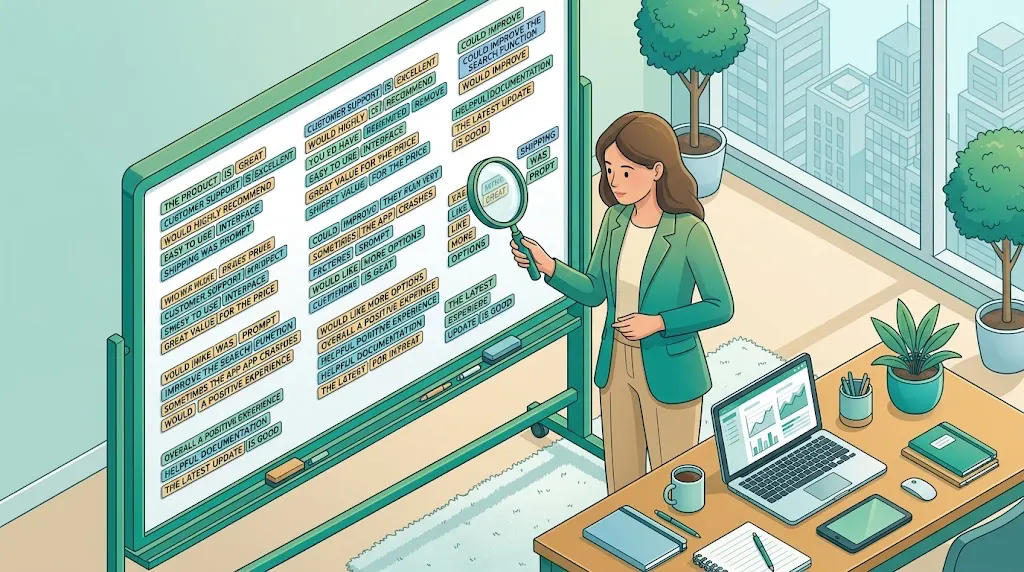
Your customers are your best source of competitive intelligence. Interview data, NPS verbatims, support tickets, and win-loss calls all contain unprompted competitive mentions that reveal how rivals are perceived, where they are winning, and where they are vulnerable. Skimle's thematic analysis can surface competitive themes across hundreds of documents automatically — turning scattered customer comments into a structured competitive picture. And one of the most underused sources sits inside your own organisation: the salespeople, retail staff, and channel partners who hear competitive comparisons every day and currently have no structured way to pass that knowledge back.
Most competitive intelligence programmes focus on what competitors say about themselves: their website, their pricing page, their job listings, their press releases. These are useful, but they are curated. What your customers say about your competitors — unprompted, in their own words, when talking to you — is far more revealing. This guide explains how to collect, organise, and analyse qualitative competitive intelligence systematically.
Where qualitative competitive intelligence lives
Customer interviews. The richest source. When customers describe why they chose you, what they evaluated, what they almost chose instead, or what they miss from a previous tool, they reveal how they actually perceive the competitive landscape — which is rarely how competitors perceive themselves.
Win-loss calls. Structured conversations with recent deals — both wins and losses. Losses in particular are a gold mine for competitive intelligence: customers who chose a competitor over you will explain why, in direct terms, if you ask well and create enough safety.
NPS verbatims. Open-text NPS comments frequently contain competitive comparisons, especially in detractor responses. "We've moved to [competitor] and it's much better for X" is competitive intelligence.
Support and success conversations. Support tickets and customer success calls surface switching risks and competitor comparisons that formal research never captures. "Our last tool did this automatically" is a competitive feature gap hiding in a support request.
Churn surveys and exit interviews. When customers leave, they often tell you exactly where you lost. The analysis approach from the exit interview guide applies here — the difference is that you are looking for competitive rather than retention themes.
Setting up collection for competitive intelligence
For competitive intelligence to be useful, it needs to be collected consistently. A few practical steps:
Add competitive questions to your standard interview guides. "What other tools did you evaluate before choosing us?" and "What do you see competitors doing that we should be doing?" are questions that should be standard in every customer interview, not occasional additions. The interview guide writing guide covers how to embed these naturally.
Create a consistent tagging approach for support and success. If your customer success and support teams know to flag competitive mentions in their notes, you build a passive intelligence feed that requires no additional interviews.
Run dedicated win-loss calls. Ad hoc win-loss insights are useful; a systematic win-loss programme is far more useful. Aim for calls within four to six weeks of a deal closing or churning, before the decision memory fades. A third-party interviewer, or at minimum someone from the company not involved in the deal, produces more candid data.
Tapping your frontline: competitive intelligence from sales, retail, and channel teams
Your salespeople hear competitive comparisons daily. Your retail staff hear customers comparing products at the shelf. Your channel partners see win and loss patterns across their whole portfolio, not just yours. This is some of the richest competitive intelligence available — and most organisations collect almost none of it systematically.
The typical approach is a monthly sales meeting where someone asks "what are you hearing about competitors?" and a few anecdotes surface, then disappear. Slightly better organisations run quarterly "competitive feedback" tick-box surveys: "Which competitors did you encounter this quarter? Check all that apply." These produce a frequency count but no insight. Knowing that Competitor X was mentioned 47 times tells you nothing about what was actually said, in which contexts, or why it mattered.
Skimle Ask changes the economics of frontline intelligence collection. Rather than a tick-box survey, you configure a short structured AI interview — 5 to 8 minutes — and send the link to your entire sales force, retail network, or channel partner base. Each person completes it in their own time. The AI asks the core questions ("What competitive comparisons did customers raise this month?", "Where did you feel we were at a disadvantage?") and follows up on substantive answers to get specifics: which product, which context, what exactly the customer said.
The result, across 100 or 200 frontline respondents, is a corpus of rich qualitative competitive intelligence that would take months to collect through traditional interviews. Uploaded to Skimle, the transcripts are analysed together — themes surface across the full respondent base, and you can filter by region, product line, or role to see whether the competitive patterns are consistent or concentrated in specific parts of the business.
The difference between this and tick-box surveys is not just volume. It is specificity. "Competitor X keeps coming up on pricing" is a tick-box output. "Competitor X is undercutting on the entry tier but our enterprise customers specifically mention that Competitor X's support response times are much worse — three different reps heard this independently in the last month" is what a Skimle Ask survey surfaces. That is a usable insight.
For a B2B sales organisation, running this quarterly gives you a competitive intelligence cadence that is both scalable and qualitatively rich — without adding to the research team's workload.
Analysing competitive themes
The analysis follows the same thematic approach as any qualitative research, but the coding framework is competitive rather than experience-oriented.
The five competitive themes worth coding systematically:
Perceived differentiation. What do customers say you do better than competitors, in their own words? This is your actual competitive positioning, as opposed to the positioning you claim. The gap between the two is often instructive.
Competitive gaps and weaknesses. Where do customers say competitors are better, or where do they mention features you do not have? These are your product roadmap inputs with customer validation already attached.
Switching triggers. What specific events or experiences cause customers to consider a competitor? Budget reviews, new joiners who used a different tool at their last company, a specific product failure, a contract renewal conversation — these are moments of competitive vulnerability worth understanding.
Competitive framing. How do customers categorise you against competitors? Do they see you in the same category as the tools you think you compete with, or in a different one? Mismatches between your competitive category and customers' mental model are significant.
Deal context. In win-loss data specifically: what was the decision process, who was involved, what criteria were used, and what ultimately decided it? This is the input to your sales strategy as much as your product strategy.
Processing at scale
For an organisation doing continuous customer research, competitive mentions accumulate across hundreds of conversations over time. Reading them all manually is not feasible — but aggregating them into a structured competitive picture is exactly the kind of analysis where Skimle's thematic analysis adds the most value.
Upload your interview transcripts, win-loss call notes, or NPS verbatim exports to Skimle, and the analysis will surface competitive themes across the full corpus. Using metadata variables, you can segment the competitive picture by customer segment, deal size, product area, or time period — which is how you move from "customers mention Competitor X" to "enterprise customers in financial services increasingly prefer Competitor X's compliance features."
The always-on customer research guide covers how to build continuous qualitative intelligence into your product and go-to-market workflow.
Making competitive intelligence actionable
Competitive intelligence that sits in a research document is decoration. To make it actionable, it needs to reach the people who can act on it — in a form they can use.
Product teams need: competitive feature gaps with customer validation, switching trigger patterns, and the frequency with which specific competitor capabilities are mentioned.
Sales and marketing need: the language customers use to describe competitive differentiation (not your language — their language), deal-level win-loss patterns, and the objections most commonly raised when competitors are being evaluated.
Leadership needs: the trend — is the competitive positioning getting stronger or weaker over time? Are new competitors emerging in customer conversations? Are your claimed differentiators reflected in what customers actually say?
The format that works for each audience is different. Product needs a prioritised gap analysis. Sales needs a competitive battlecard. Leadership needs a trend summary. The same underlying qualitative data can produce all three, if the analysis is structured well enough.
For advice on making qualitative findings land with sceptical audiences, see how to present qualitative research findings to executives.
What qualitative competitive intelligence cannot tell you
Qualitative competitive intelligence is directional, not definitive. It tells you what customers say and perceive — which matters enormously, because perception shapes decisions. But it does not tell you:
- Whether competitor X is actually better at Y, or just perceived to be better
- What the competitive landscape looks like for customers who did not talk to you
- How competitor capabilities will change (customers can only comment on what they have seen)
Use qualitative competitive intelligence to generate hypotheses and priorities. Combine it with quantitative data (win rates by segment, feature usage analytics, pricing comparisons) to build the full picture.
Ready to systematically mine your customer conversations for competitive intelligence? Try Skimle for free and run a competitive theme analysis on your existing interview data.
Related reading:
How to analyse interview transcripts: 5 steps from raw data to synthesis
How to summarise expert interviews: 5 steps from call notes to insights
Always-on customer research: how to embed AI interviews at every stage
Earnings call transcript analysis with AI: a guide for IR teams and analysts
FOIA document analysis with AI: finding the story in released records
Consultants and investors: rigorous analysis of expert calls and data room documents
About the authors
Henri Schildt is a Professor of Strategy at Aalto University School of Business and co-founder of Skimle. He has published over a dozen peer-reviewed articles using qualitative methods, including work in Academy of Management Journal, Organisation Science, and Strategic Management Journal. Google Scholar profile
Olli Salo is a former Partner at McKinsey & Company where he spent 18 years helping clients understand their markets, develop winning strategies and improve their operating models. He has done over 1000 client interviews and published over 10 articles on McKinsey.com and beyond. LinkedIn profile