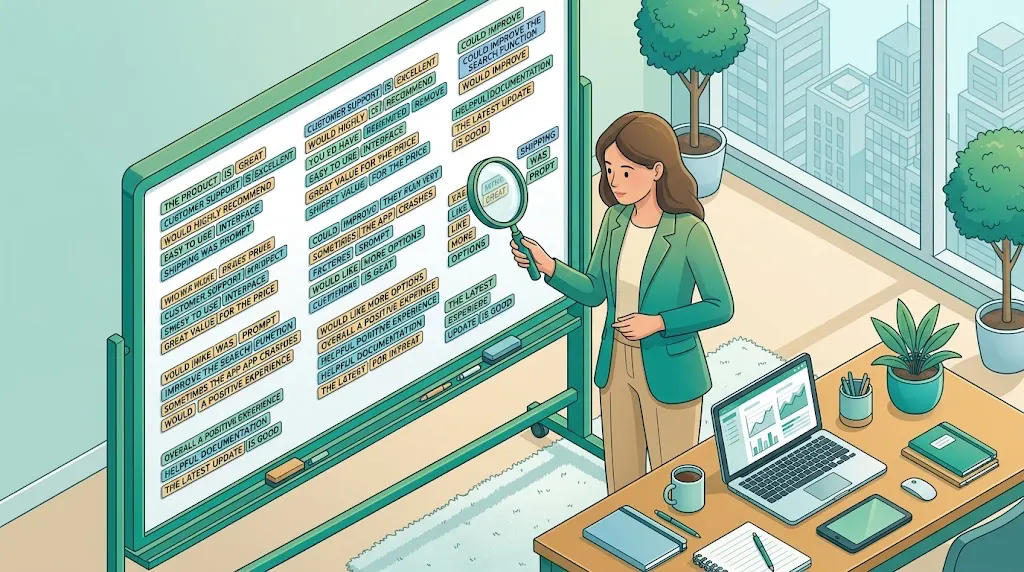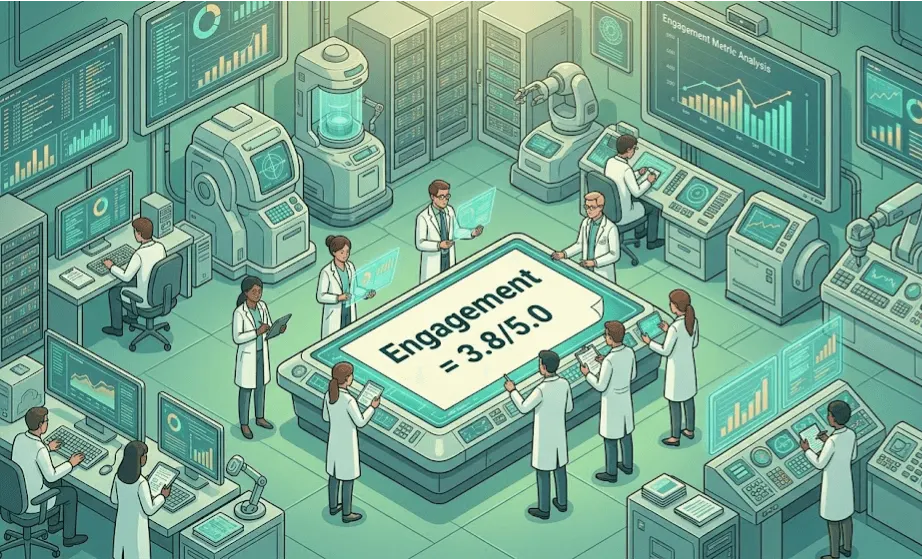
The survey results are in. The dashboard shows a score of 3.8 out of 5 for "sense of purpose," down from 4.1 last year. The slide is ready. The number is sitting there, waiting to be presented to the executive team.
But what does 3.8 actually mean? Which employees feel that loss of purpose most acutely? Is it concentrated in one team, one function, one layer of the organisation? And, crucially, what is driving it? Is it unclear strategy, poor management, repetitive work, a lack of career progression, or something nobody thought to put in a rating-scale question?
This is where most employee survey processes stall. The numbers tell you that something has changed. They do not tell you what to do about it.
This guide is for HR managers and People and Culture leaders who want to move past the score and actually understand what their survey data is saying. That requires a different approach to analysis, one that takes the open-text responses seriously, uses metadata to find where issues are concentrated, and produces findings credible enough to drive real decisions.
What aggregate scores can and cannot tell you
Scores are genuinely useful. A 3.8 for "sense of purpose" establishes a baseline, enables year-on-year comparison, and lets you segment by team, tenure, or seniority to see where the number varies. That diagnostic function is valuable, and dismissing quantitative survey data entirely would be a mistake.
The problem is when the score becomes the finding rather than the starting point.
When you present a score, you answer the question "where?" (which teams are affected) and "how much?" (by how much). You cannot, from the score alone, answer "why?" That is because a Likert-scale question captures an outcome, not a cause. The person who selected 2 for "sense of purpose" might be reacting to a strategic pivot they do not understand, a manager they do not trust, a job that has become more administrative over the past year, or a lingering frustration with how a redundancy round was handled. The scale cannot distinguish between those explanations.
Research consistently demonstrates the gap between survey scores and actual experience. Gallup's State of the Global Workplace finds that only around 23% of employees globally feel genuinely engaged, yet most organisations' engagement scores look considerably higher. This suggests that rating scales capture a particular kind of response that is not always the same as what people genuinely think and feel.
The aggregate score is the beginning of the investigation. The analysis work is everything that happens next. For a broader view of how surveys can move from tracking metrics to generating real understanding, see our piece on HR surveys: moving from meaningless numbers to deep insights.
The open-text problem
Most quantitative employee surveys include at least one open-ended question. "Is there anything else you'd like to share?" or "What one thing would you change about working here?" These questions, in principle, are where the explanation lives. When someone writes a paragraph about why they rated "sense of purpose" at 2, they are telling you what the score cannot.
In practice, open-text responses are almost universally underanalysed. The reasons are entirely understandable.
Volume. A survey of 400 employees might yield 200 open-text responses, ranging in length from a single word to several paragraphs. Reading all of them carefully takes several hours at minimum.
No systematic method. Without a structured approach, reading through comments produces a vague impression rather than reliable findings. You notice the responses that are strongly worded or emotionally resonant. You miss the quieter pattern that is actually more widespread. This is not negligence; it is how human attention works when faced with unstructured data.
No traceability. Even if someone reads all the comments and notes down themes, the resulting summary ("people mentioned workload several times") is almost impossible to interrogate. How many is "several"? Which teams? How were the comments worded? These are questions stakeholders are entitled to ask, and the manual approach typically cannot answer them.
The credibility gap. Qualitative findings can be dismissed in a way that scores cannot. "Our analysis suggests people feel unclear about the strategy" can be met with "but how do you know that's representative?" Scores are perceived as objective. Qualitative findings have historically been treated as impressionistic.
What gets lost when open-text responses are ignored is precisely the explanatory layer that would make the quantitative findings useful. The person who wrote three sentences about how the company's strategic direction has become unclear since the merger is providing a more actionable insight than the 3.1 score for "clarity of direction", provided someone reads it, takes it seriously, and connects it to other responses saying similar things.
Our guide on how to analyse open-text responses at scale covers this challenge in depth from a survey methodology perspective.
A step-by-step method for analysing open-text responses properly
What follows is the method that rigorous HR analysts and qualitative researchers use. It is more systematic than reading through comments and noting themes, but less laborious than manual coding at response-by-response level, particularly when supported by AI tools.
Step 1: Clean and prepare your data
Export your survey results to a spreadsheet with one row per respondent. Each column should contain a distinct piece of information: the open-text response in one column, and all relevant metadata in separate columns (department, team, tenure band, seniority, location, and the quantitative scores they gave).
Clean the data before you begin. Remove duplicate submissions. Standardise department names if they have been entered inconsistently. Check for any responses that are clearly not meaningful (test submissions, single-character responses).
Keeping responses tethered to metadata from the start is essential. An open-text comment that you cannot connect back to which team it came from loses most of its analytical value.
Step 2: Import into an analysis tool with metadata intact
A spreadsheet is a starting point, not an analysis environment. To do this properly, you need a tool that can hold the full dataset, including metadata, and let you analyse the open-text responses in relation to it.
The import format matters here. Ensure the metadata columns travel with each response so that when you identify a theme, you can immediately ask which departments it is concentrated in and how it correlates with quantitative scores. Our guide to importing and exporting data with Skimle walks through how to structure your CSV for this kind of analysis.
Step 3: Let AI identify themes from the bottom up
This is where modern AI-assisted analysis changes what is practically achievable. Rather than creating categories in advance and sorting responses into them, let the AI read all the responses and identify the themes that are actually present in the data.
The distinction matters. When you pre-categorise, you find what you were looking for. When you let themes emerge from the data, you find what people were actually saying, which is sometimes quite different.
A good AI analysis tool will generate a structured theme hierarchy: major themes with sub-themes beneath them, each linked to the specific responses that informed it. Every theme should trace back to verbatim quotes. This is the foundation of rigorous thematic analysis applied to survey data.
You should expect to review and refine what the AI generates. Merge themes that are too similar. Split themes that are too broad. Rename categories to use language that makes sense in your organisation's context. The AI gives you a sound starting structure; your judgement refines it. The principle of keeping human oversight throughout is central to trustworthy AI-assisted analysis.
Step 4: Cross-cut themes against metadata
Once you have a theme structure, the analytical work begins in earnest. This is where having the metadata attached to each response pays off.
For each significant theme, ask:
- Which departments or teams does this come from? Is it concentrated or spread evenly?
- How does it correlate with quantitative scores? Do the people who mentioned this theme tend to be the low scorers on a particular question?
- Does it vary by tenure? New joiners and long-tenured employees often experience the same organisation very differently.
- Is it more prevalent at certain seniority levels?
This cross-cutting analysis is what transforms a list of themes into an actionable finding. "People mentioned unclear strategy" is a theme. "Unclear strategy is mentioned predominantly by team leaders in the operations division with 3-7 years of tenure, who also gave the lowest scores on 'sense of purpose' and 'confidence in leadership'" is a finding you can do something with.
For a detailed guide to this kind of metadata-driven analysis, see our piece on discovering themes using metadata variables.
Step 5: Identify outliers and spikes
Not all patterns are widespread. Some of the most important findings in an employee survey are things that are highly concentrated: a theme that appears in 80% of responses from one team but almost nowhere else, or a concern that is expressed almost exclusively by people who gave very low quantitative scores.
Look for:
- High concentration in one segment. If a theme appears in 60% of responses from a specific department but only 5% elsewhere, that is not a general finding. It is a signal about that department.
- Correlation with low scores. Themes that cluster among people who gave very low scores are prime candidates for root-cause investigation.
- Absence where you expected presence. If a theme is entirely absent from a particular group, that is worth noting too.
- Single strong signals. Occasionally one or two responses will describe something specific and concrete that nobody else mentioned but that represents a genuine issue. These can get lost in aggregate analysis. A well-structured analysis preserves them as notable outliers rather than discarding them as statistical noise.
The distinction between a dispersed theme and a concentrated one matters enormously for the response. A company-wide sentiment requires a company-wide response. A concentrated issue in one team requires a targeted intervention.
Step 6: Connect back to verbatim quotes
When you move from analysis to reporting, the link between your findings and the actual words employees used is what gives those findings credibility.
Every theme you report should be supported by a small selection of illustrative verbatim quotes, chosen to represent the range of how that theme was expressed rather than cherry-picked for dramatic effect. The quotes are not the finding; they are the evidence for the finding.
This serves two purposes. First, it grounds stakeholders in the actual experience of employees rather than an analyst's interpretation of it. Second, it makes your findings auditable. If a senior leader pushes back on a finding, you can show them precisely which responses informed it and let them form their own view.
This is why maintaining traceability from theme back to source quote is non-negotiable in serious analysis. Tools that show you a summary without letting you trace it back to the underlying responses are doing half the job.
Step 7: Act and close the loop with employees
The final step is often treated as an afterthought, but it may be the most important one for the long-term credibility of your survey process.
Employees who complete a survey and then hear nothing are less likely to engage honestly next time. The expectation of action (or at least of being heard) is what motivates thoughtful responses. If you want your survey data to improve over time, closing the loop is essential.
This does not mean acting on everything. It means being explicit with employees about what you heard, what you have decided to prioritise, and why. "We heard X from a significant number of people in this area. We are going to address it by doing Y. We heard Z but have decided not to change that because of W" is a more honest and ultimately more trust-building communication than silence or a generic thank-you message.
The value of giving employees visibility into what happened with their input is explored further in our piece on democratisation of qualitative insights through AI.
Tools for the job
The approach above can be done with varying levels of tooling, and it is worth being honest about the trade-offs.
At the manual end, you can conduct this analysis in Excel or Google Sheets, reading responses and applying labels by hand. This is methodologically sound if done carefully and gives you full control. The realistic constraint is time: a dataset of 300 open-text responses will take a skilled analyst two to three days to process properly at this level of rigour.
Sticky notes and affinity mapping (either physically or in tools like Miro) work well for smaller datasets or workshop settings where the collaborative process itself has value. They are impractical above about 60-80 responses.
Generic AI tools (ChatGPT, Claude, Gemini) can process text and identify patterns, but as our guide on using ChatGPT for qualitative data explains, they lack the structural rigour for serious analysis. Categories shift between sessions, traceability to source data is absent, and there is no systematic way to cross-cut themes against metadata.
Purpose-built qualitative analysis platforms like Skimle are designed specifically for this workflow. They import structured datasets with metadata, apply systematic AI-driven thematic analysis, keep every theme traceable to source quotes, and allow you to filter and cross-cut by any metadata variable. What would take several days manually can be done in a few hours, without sacrificing the rigour that makes the findings credible.
If you have used this kind of workflow for other feedback sources, the logic is identical to what is described in analysing customer feedback with Skimle. The same method that works for customer data applies directly to employee survey responses.
For HR teams looking to run richer data collection alongside their quantitative surveys, it is also worth knowing that AI-driven interviewing can supplement or even replace the open-text box with a proper conversational interview. Skimle Ask conducts structured AI interviews at scale, producing far richer qualitative data than an open-text box typically yields.
Communicating findings to leadership
Analysis that does not reach decision-makers changes nothing. Knowing how to present qualitative findings persuasively to a senior audience is its own skill.
A few principles that make the difference.
Lead with findings, not process. Leadership does not need to know how many responses you read or how the thematic coding was structured. They need to know what the data says and what you recommend doing about it. Start with the headline finding, support it with two or three pieces of evidence, then invite discussion. Save methodological detail for an appendix or a follow-up question.
Quantify what you can. "A significant minority of employees mentioned X" is weaker than "Thirty-four percent of respondents in the engineering division mentioned X, predominantly in the two or three years' tenure band." If your analysis tool tracks how many responses each theme draws on, use those numbers. They are not a statistical sample size in the academic sense, but they anchor your claims in something concrete.
Use quotes strategically. One or two strong verbatim quotes do more for a finding than a paragraph of paraphrase. Choose quotes that are specific and articulate rather than vague or heavily emotional. The goal is credibility, not shock.
Connect the qualitative to the quantitative. Where you can show that a theme in the open-text responses correlates with a specific low score on a quantitative question, make that connection explicit. It demonstrates that the qualitative findings are not impressionistic; they are the explanation for the patterns in the numbers.
Be clear about confidence. If a finding comes from 200 responses it is more robust than if it comes from 15. Be transparent about this. Stakeholders who trust that you will flag limitations are more likely to trust your findings overall than those who suspect you are overselling.
Separate findings from recommendations. Present the findings first and let the room absorb them before moving to recommendations. A finding is what the data says. A recommendation is your view of what to do about it. They deserve to be presented in that order.
This last point matters because it invites conversation rather than demanding acceptance. Leaders who feel they contributed to forming a conclusion are far more likely to act on it.
A note on survey design
This guide has focused on analysing the data you already have. But if your current survey structure makes analysis hard (too few open-text questions, no consistent metadata, overlapping question wording), it is worth addressing in the next cycle.
The design principle that most improves analysability is this: for every quantitative question that measures an outcome, include a follow-up open-text question that invites explanation. "On a scale of 1-5, how clear is the company's strategic direction?" followed by "What has most influenced your view of this?" gives you both the score and the context needed to interpret it.
Collecting richer qualitative data at scale, beyond what a standard open-text box produces, is the next frontier for HR teams that want to go deeper. AI-driven interviewing tools are making that genuinely practical. If you are curious about what that looks like, the piece on HR surveys moving from meaningless numbers to deep insights sets out the approach in detail.
Ready to stop leaving your open-text data unanalysed? Try Skimle for free and see how systematic AI-assisted analysis can turn your employee survey responses into findings that actually move the conversation forward.
Want to go deeper on the methodology? Our guides on demystifying thematic analysis and how to analyse open-text responses at scale cover the analytical foundations in more detail. If you are thinking about how to collect richer qualitative data in the first place, introducing Skimle Ask explains how AI-driven interviewing works at the scale of a survey.
About the authors
Henri Schildt is a Professor of Strategy at Aalto University School of Business and co-founder of Skimle. He has published over a dozen peer-reviewed articles using qualitative methods, including work in Academy of Management Journal, Organisation Science, and Strategic Management Journal. His research focuses on organisational strategy, innovation, and qualitative methodology. Google Scholar profile
Olli Salo is a former Partner at McKinsey & Company where he spent 18 years helping clients understand the markets and themselves, develop winning strategies and improve their operating models. He has done over 1000 client interviews and published over 10 articles on McKinsey.com and beyond. LinkedIn profile
Sources
- State of the Global Workplace 2024 - Gallup
- Where employee surveys on burnout go wrong - Harvard Business Review
- The problem with employee surveys - MIT Sloan Management Review
- Getting More From Employee Surveys - SHRM
- Rethinking the employee survey - Deloitte Insights
- Using Thematic Analysis in Psychology - Braun & Clarke, Qualitative Research in Psychology