Laddering is an interviewing technique that uncovers why people value a product by repeatedly asking "why is that important to you?" Each answer climbs one rung, from a product attribute to its consequences for the person and finally to a personal value. Analysing many ladders together produces a hierarchical value map showing which attributes connect to which values.
The method comes from means-end chain theory, set out most completely by Thomas Reynolds and Jonathan Gutman in the Journal of Advertising Research in 1988. It has been a staple of brand positioning and advertising strategy ever since, because it answers a question surveys struggle with: which product features matter, and what do they mean to people?
This guide is written for brand and consumer researchers and covers how to run laddering interviews, how to analyse them, and where AI makes the analysis faster without flattening it.
What is means-end chain theory?
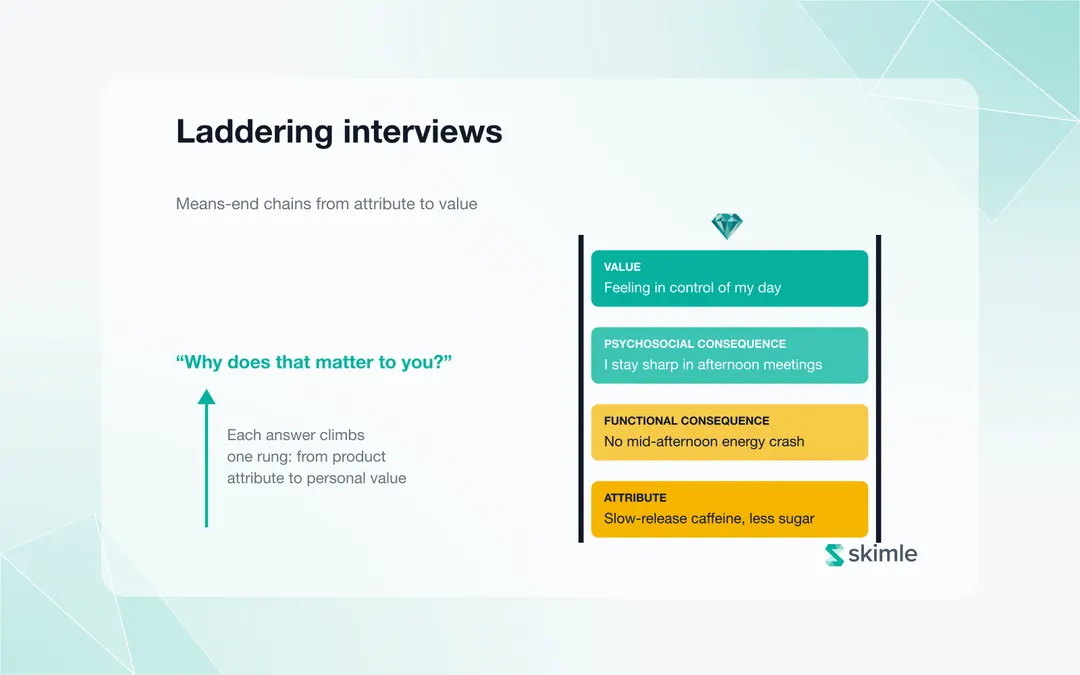
Means-end chain theory says that people choose products as a means to an end. They do not want a slow-release energy drink for its own sake. They want what it does for them (no afternoon crash), what that does for them in turn (staying sharp in meetings), and ultimately what that says about who they are (feeling in control of their day).
The chain has three levels, often split into five:
| Level | What it is | Example |
|---|---|---|
| Attribute | A feature of the product, concrete or abstract | Slow-release caffeine, less sugar |
| Functional consequence | A direct, tangible result of using it | No energy crash mid-afternoon |
| Psychosocial consequence | How that result feels or how others see you | I stay sharp in meetings |
| Instrumental value | A preferred way of being | Being capable, being responsible |
| Terminal value | An end state worth having for itself | Feeling in control, self-respect |
The cover image of this post shows one complete ladder. Marketing uses these chains because the same attribute can lead to different values for different people, and advertising that speaks to the value lands harder than advertising that lists the attribute.
How do you run a laddering interview?
A laddering interview is a semi-structured one-to-one conversation, usually 30 to 60 minutes. It has two phases.
Phase 1: elicit the attributes. Find out which features distinguish products for this person. Common techniques:
- Triadic sorting: show three brands and ask how two of them are similar and different from the third.
- Preference ranking: ask the person to rank options and explain the order.
- Occasion-based questions: "Think about the last time you bought an energy drink. Why that one?"
Phase 2: ladder each attribute up. For each important attribute, keep asking why it matters:
- "Why is less sugar important to you?"
- "And why does avoiding the crash matter?"
- "What does staying sharp in meetings give you?"
Stop when the person reaches a value (they start repeating themselves, or the answer is self-evidently an end in itself: "because I want to feel in control"). Then start a new ladder from the next attribute.
Laddering is harder than it looks, and good laddering interviewers use a set of recovery techniques when respondents get stuck:
- Negative laddering: "What would happen if it didn't have that?"
- Third-person probing: "Why might someone else care about that?"
- Going back in time: "When did you first start caring about this?"
- Silence: let a pause sit, and people often fill it with the next rung.
Avoid leading the respondent up the ladder with your own words. "So it makes you feel more confident?" puts a value in their mouth. For more general interviewing guidance, see our interview guide checklist and good interview questions to ask.
Can AI interviewers do laddering?
Partly, and better than many researchers expect. Laddering is structured: a known probe ("why is that important?") repeated until a stopping condition. That is exactly the kind of follow-up rule an AI interviewer can follow consistently across hundreds of conversations.
Where AI interviewers struggle is the judgement in between: noticing that a respondent has reached a value, choosing a recovery technique when they get stuck, and avoiding probes that feel repetitive or rude after the third "why". A practical design is to let the AI ladder two or three attributes per interview, with a cap on the number of probes, and to run a smaller set of human-moderated interviews alongside for depth. Our comparison of AI and human interviewing covers this trade-off in general.
How do you analyse laddering interviews?
Analysis follows the same four steps whether you have 20 ladders or 2,000. The difference is how much of it you can do by hand.
Step 1: code each ladder into elements
Read each transcript and break every ladder into its elements: the attribute, each consequence and the value it ends in. Different respondents will describe the same idea in different words ("no crash", "steady energy", "I don't hit a wall at 3pm"), so you need a shared code for each.
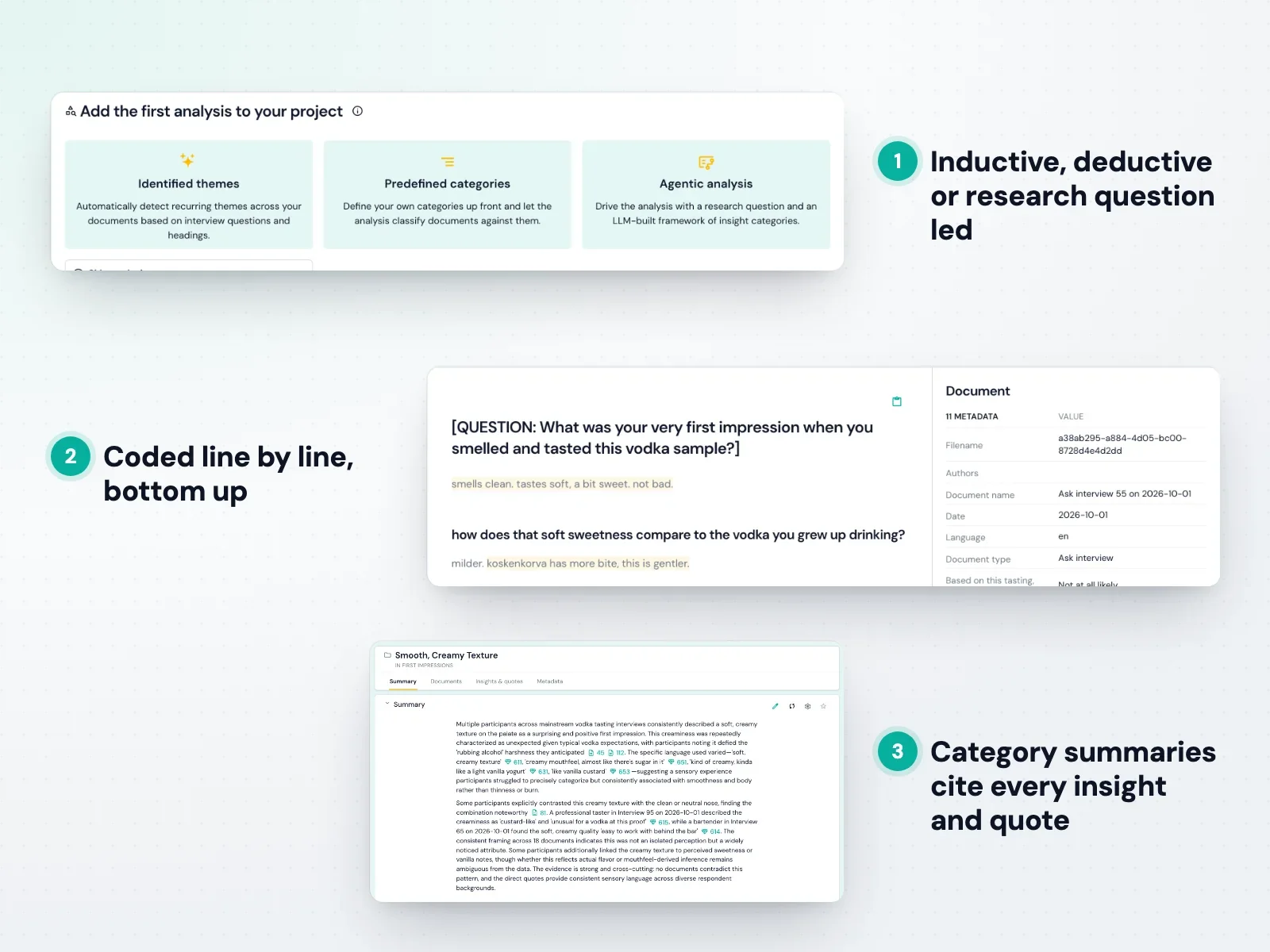
This is a standard qualitative coding task, and it is where most of the time goes. Skimle codes every interview line by line into categories you can then merge, split and rename, as in the screenshot below. For laddering, set up three top-level categories (attributes, consequences, values) and let the analysis place each element under the right one, then review the codes.
Step 2: build the implication matrix
The implication matrix is a square table with every code as both a row and a column. Each cell counts how many respondents linked the row element to the column element. Reynolds and Gutman distinguished direct links (adjacent rungs in a ladder) from indirect links (elements in the same ladder with others in between). Most analysts work from direct links and use indirect links as a check.
Step 3: choose a cut-off
A map that shows every link is unreadable. Choose a cut-off so that only links mentioned by at least a set number of respondents appear. A common starting point is the level at which about two thirds of all links are still represented. Try several cut-offs and keep the one that tells a clear story without hiding important minority chains.
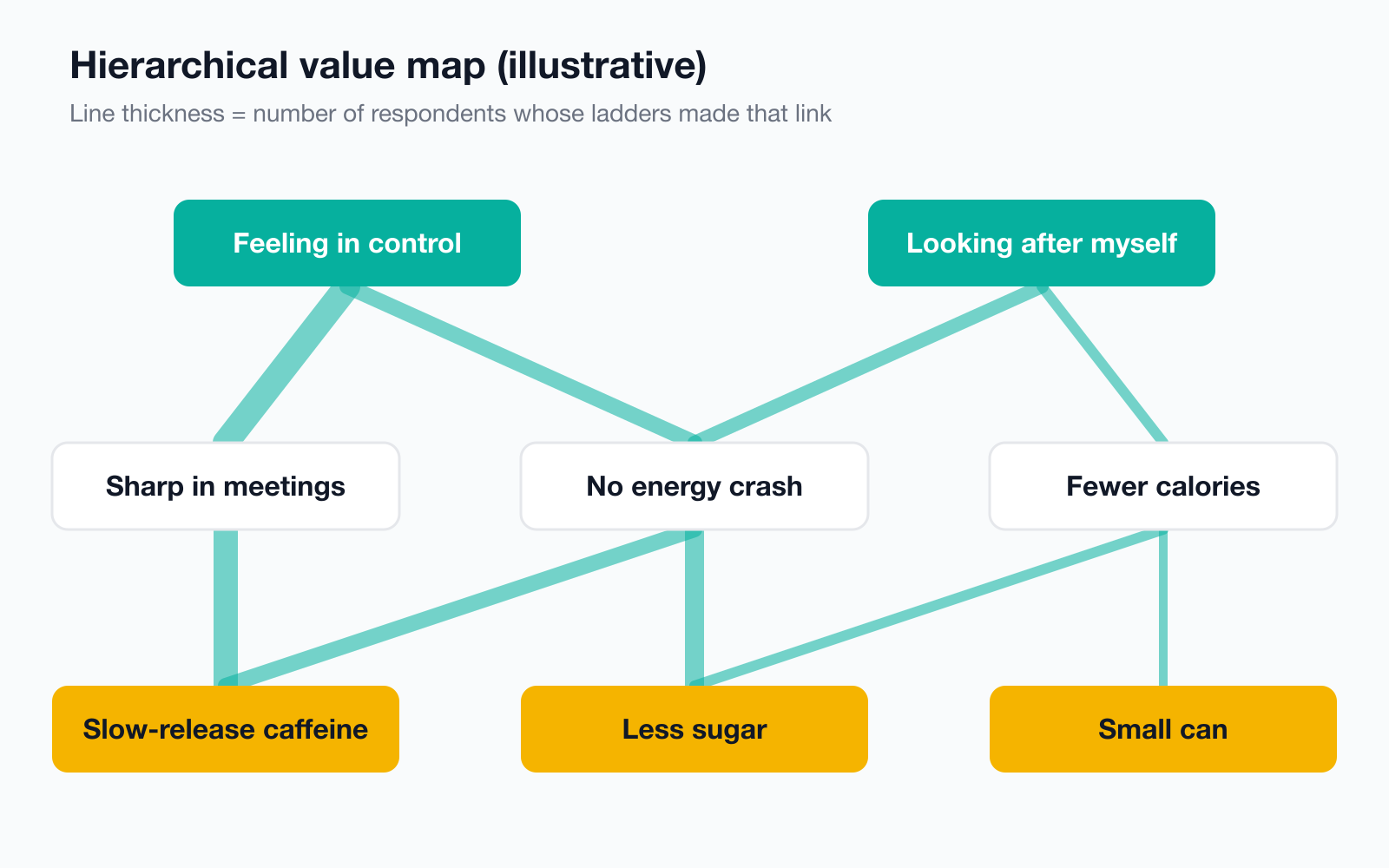
Step 4: draw the hierarchical value map
Draw attributes at the bottom, consequences in the middle and values at the top, and connect them with lines whose thickness shows how many respondents made the link. The map below is an illustrative example for an energy drink. The thickest chains are the dominant meanings of the product; the thin ones are niche positioning opportunities.
If you run consumer or brand research, see how this fits the market research and customer insights workflow.
How do you turn a value map into positioning?
The value map is a means, not an end. Three readings are useful.
- The dominant chain is your current positioning, whether you chose it or not. If most ladders run from "less sugar" to "looking after myself", that is what the brand means to buyers.
- The underused chain is a positioning opportunity. A strong attribute linked to a weakly owned value can be claimed in communication.
- The segment split shows whether different groups climb different ladders from the same attribute. Comparing value maps across segments is where metadata earns its keep: attach each respondent's segment and compare which chains dominate in each.
Means-end research also fed into an advertising planning model, MECCAS (means-end conceptualisation of components for advertising strategy), which maps each level of the chain to a part of the advertising brief: attribute to message element, consequence to consumer benefit, value to the driving force. It remains a useful checklist when you brief a creative team from laddering results.
What are the limitations of laddering?
- It is tiring for respondents. Repeated "why" questions can feel like an interrogation. Keep ladders short and the tone warm.
- It assumes a hierarchy. Not every purchase is driven by deep values. For low-involvement categories, ladders often stop at functional consequences, and that is a finding in itself.
- Coding is interpretive. Whether "I stay sharp" is a consequence or a value depends on the analyst. Agree definitions before coding and keep an audit trail of decisions.
- Counts can mislead. Link counts depend on how many ladders each respondent produced. Report the number of respondents making a link, not the number of ladders.
Laddering pairs well with Jobs-to-be-Done interviews: use JTBD to understand the circumstances that trigger a purchase, and laddering to understand what the product means to the buyer.
Frequently asked questions
How many laddering interviews do you need?
Classic laddering studies use 20 to 60 interviews per segment, which typically produces enough ladders for a stable value map. If you plan to compare value maps between segments, size each segment separately. See how many interviews are enough for the general evidence.
What is the difference between hard and soft laddering?
Soft laddering is the conversational interview described above, where respondents speak freely. Hard laddering uses a structured questionnaire or online form that forces respondents to produce ladders step by step. Hard laddering scales more easily; soft laddering produces richer, more natural chains.
What is a hierarchical value map?
A diagram that summarises many ladders: attributes at the bottom, consequences in the middle, values at the top, with lines showing how often respondents linked each pair. It is built from the implication matrix after applying a cut-off.
Can I do laddering in a survey?
You can run hard laddering in a survey with repeated "why is that important?" open questions. Expect shorter ladders and more drop-outs than in interviews, and code the open answers carefully. Our guide to analysing open text at scale covers that step.
Have a stack of laddering transcripts? Try Skimle for free and code attributes, consequences and values across every interview, with each element linked to the quote it came from.
Related reading:
- Jobs-to-be-Done interviews: methodology guide
- AI-assisted persona generation from qualitative research
- Qualitative consumer insights research guide
About the author
Olli Salo is a former Partner at McKinsey & Company where he spent 18 years helping clients understand the markets and themselves, develop winning strategies and improve their operating models. He has done over 1000 client interviews and published over 10 articles on McKinsey.com and beyond. LinkedIn profile
Sources
- Reynolds, T. J. and Gutman, J. (1988). Laddering theory, method, analysis, and interpretation. Journal of Advertising Research, 28(1), 11-31
- A review and comparative analysis of laddering research methods - Review of Marketing Research (2008), Emerald
- Applying laddering data to communications strategy and advertising practice - Journal of Advertising Research, via WARC