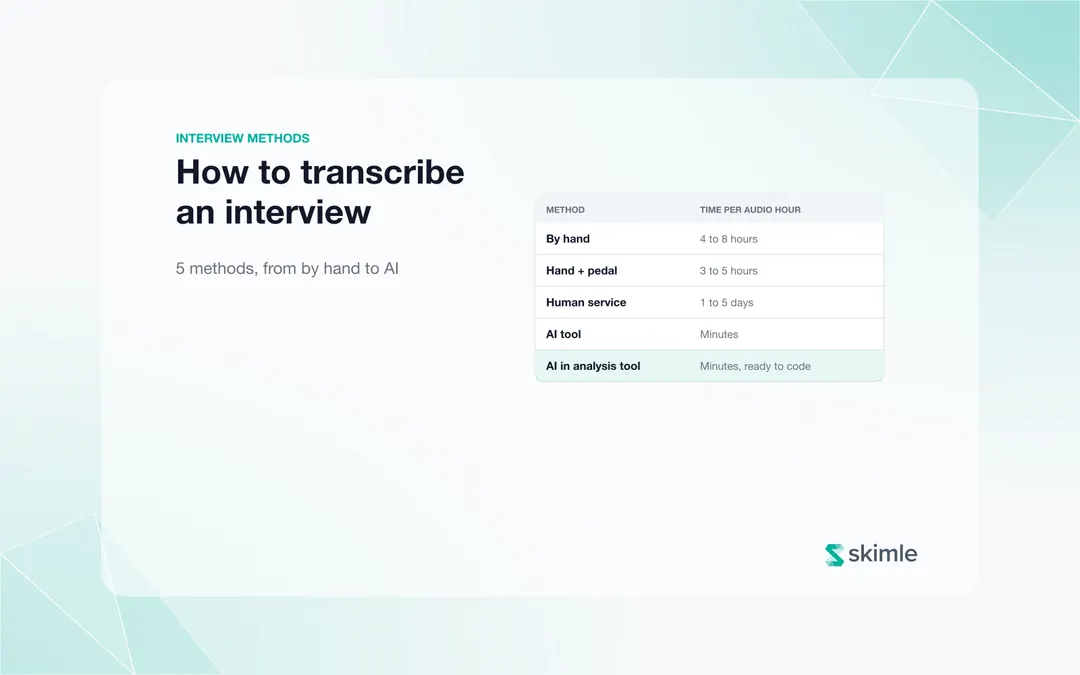
To transcribe an interview, record it clearly, choose a transcription style (verbatim or clean verbatim), convert the audio to text by hand or with an AI tool, then check the transcript against the recording, label speakers, add timestamps and remove identifying details. Typing a one-hour interview by hand takes four to eight hours. A human service costs about $90 to $150 and takes a day or more. AI transcription takes a few minutes and costs between nothing and about $30 per hour of audio, plus 10 to 15 minutes of checking.
This guide compares the five ways to transcribe an interview, shows what a good transcript looks like, explains the notation researchers use, and gives a checklist for getting from recording to a transcript you can analyse and quote.
The short video below compares the five methods, shows verbatim and clean verbatim side by side, and ends with AI transcription in practice.
What is an interview transcript?
An interview transcript is a written record of a recorded interview: every speaker's words, in order, labelled by speaker and usually timestamped. It is the main data in most qualitative interview studies, because coding, analysis and quotes all work from the text rather than the recording. Here is a short example in clean verbatim style:
[00:04:12] Interviewer: How did the move to the new system go for your team?
[00:04:16] P07: Well, the first month was rough. We lost about two days a week to workarounds, and nobody on the floor had been asked what they needed. [pause] It got better once IT sat with us.
[00:04:41] Interviewer: What changed when they sat with you?
[00:04:44] P07: They saw the double entry. That was the moment. [laughs] After that it was fixed in a week.
The participant is labelled with a code (P07) rather than a name, every turn has a timestamp so a quote can be checked against the recording, and non-verbal events that matter for meaning, such as a pause or laughter, are noted in square brackets.
What are the 5 ways to transcribe an interview?
| Method | Time per hour of audio | Cost per hour of audio | Accuracy | Best for |
|---|---|---|---|---|
| 1. By hand | 4 to 8 hours of typing | Your time | High, if you are careful | Small studies, learning your data closely |
| 2. By hand with a transcription aid | 3 to 5 hours | Free to ~$100 one-off (pedal) | High | Researchers who must transcribe themselves |
| 3. Human transcription service | 1 to 5 days turnaround | ~$90 to $150 | Highest, even on poor audio | Difficult recordings, legal or medical exactness |
| 4. AI transcription tool | A few minutes, plus 10 to 15 minutes checking | Free to ~$30 | High on clear audio | Most interviews |
| 5. AI transcription inside your analysis tool | A few minutes, plus checking | ~€5 to $30 | High on clear audio | Studies you will code and analyse |
1. Transcribing by hand
You play a few seconds of the recording, pause, type what you heard, and repeat. Most methods texts estimate four to eight hours of work per hour of audio, and more for focus groups, poor recordings or detailed verbatim notation. It costs nothing but time, and it brings you very close to the data: many researchers notice their first analytic ideas while typing. On a study of 20 interviews, though, it is 80 to 160 hours of work.
2. By hand with a transcription aid
Free tools such as oTranscribe, or the manual transcription modes in MAXQDA and ATLAS.ti, put the audio player and the text in one window, with keyboard shortcuts to pause, rewind a few seconds and slow playback. A foot pedal frees both hands for typing. Together these cut hand transcription to roughly three to five hours per audio hour.
3. Human transcription services
A professional transcriber, through services such as Rev or Amberscript, or a freelancer, returns the transcript in one to five days. Expect about $1.50 to $2.50 per minute of audio, more for several speakers, strong accents or rush delivery. Human transcription is still the most accurate option for difficult audio, but at 30 interviews it costs thousands, and you must check the service's confidentiality terms against your ethics approval.
4. AI transcription tools
Free webinar
Using videos in Skimle: a 7 minute tutorial
AI transcription converts a one-hour recording in a few minutes, with speaker labels and timestamps, in dozens of languages. Options range from free (Whisper, run on your own computer) to subscription tools such as Otter.ai and Happy Scribe. On clear audio, accuracy is high enough for qualitative analysis once you check names, technical terms and the passages you will quote. Our comparison of AI transcription tools covers the main options.
5. AI transcription inside your analysis tool
The newest option skips the export step: you upload the recording into the tool where you will code it, and the transcript appears there with the recording attached. Skimle, NVivo, MAXQDA and ATLAS.ti all offer this, at very different prices; see interview transcription software for researchers compared. The advantage is less about speed than about the chain of evidence: in Skimle, every quote in your analysis can be played from the moment it was said.
How do you transcribe an interview step by step?
- Record well. Use a quiet room, put the microphone 30 to 60 centimetres from the speakers, and record a few seconds of test audio. Recording quality affects accuracy more than any tool. Our practical interview setup guide covers phones, microphones and online calls.
- Get consent for recording and transcription. Say who will hear the audio, whether a service or AI tool will process it, where, and when the recording will be deleted.
- Choose a transcription style before you start, so every transcript follows the same rules (see the next section).
- Transcribe using one of the five methods above. Name files consistently:
P07_2026-10-14_interview.m4abecomesP07_2026-10-14_transcript. - Check the transcript against the recording. Search for names, product names, acronyms and key terms first, correct them, then skim the rest. Listen again to any passage you plan to quote.
- Label speakers and add timestamps. Use codes rather than names (Interviewer, P07), and keep timestamps at least at each turn.
- Anonymise. Replace names, employers, places and other identifiers with consistent pseudonyms before sharing. See how to anonymise interview transcripts.
- Store and analyse. Keep transcripts and recordings in an approved, access-controlled place, and record your transcription choices for your methods section. Then move to analysing the interview transcripts.
For most studies, transcribing with AI and then listening carefully during the check gives you most of the closeness to the data that hand transcription offers, in a fraction of the time. Skimle transcribes recordings in minutes, keeps them beside the transcript so you can click any word to hear it, and moves straight into coding every transcript, with each finding linked to quotes you can play back. See how it works for academic researchers and market research teams.
Should you use verbatim or clean verbatim transcription?
The transcription style decides what goes into the text besides the words. Choose it according to your analysis method:
| Style | What it keeps | Example | Use for |
|---|---|---|---|
| Full (true) verbatim | Every word, filler, false start, repetition, pause and overlap | "So, um, I, I think we, we kind of (.) didn't really get it at first" | Conversation analysis, discourse analysis, linguistic research |
| Clean (intelligent) verbatim | All meaningful words; drops fillers and false starts; keeps meaningful pauses and laughter | "I think we didn't really get it at first" | Most thematic, content and framework analysis |
| Edited | Meaning, lightly rewritten for readability | "At first we did not understand it" | Reports and journalism; rarely suitable for research analysis |
Most qualitative interview studies use clean verbatim. Whatever you choose, say so in your methods section; and never correct a participant's grammar in a quote you publish, because that changes their voice. For focus groups, where overlaps and who-responded-to-whom matter more, see focus group transcription: 5 challenges.
Which transcription symbols should you use?
There is no single standard, but these conventions are widely used in qualitative research. Define them at the top of your transcripts or in an appendix.
| Symbol | Meaning |
|---|---|
[inaudible 00:12:31] | Words could not be heard; timestamp so you can recheck |
[unclear: brand name?] | Your best guess at a word you are not sure of |
[crosstalk] | Two or more people speaking at once |
[pause] or (.) | A noticeable pause; (3) for a three-second pause |
[laughs], [sighs] | Non-verbal sounds that affect meaning |
[name], [employer] | Identifying detail removed during anonymisation |
... | Speech trails off |
- | Speaker cuts themselves off or is interrupted |
How long does it take to transcribe a one-hour interview?
By hand, four to eight hours for a typical one-to-one interview, and up to ten for a focus group or poor recording. With a transcription aid and practice, three to five hours. With AI, the transcription itself takes a few minutes; checking takes 10 to 15 minutes for clear audio, or 30 minutes or more for difficult audio or where you need every word exact.
Across a study of 20 one-hour interviews, that is roughly 100 hours by hand against five to ten hours with AI and careful checking. The saved time is better spent on analysis: reading across the transcripts, comparing participants and testing your interpretations. Our guide for PhD students analysing interviews covers how to plan that time.
Can you transcribe interviews in other languages?
Yes. AI transcription now handles most widely spoken languages, but accuracy varies more by language and accent than vendors' English figures suggest, so test one of your own recordings first. Keep quotes in the original language and translate only the ones you publish. We cover specific language groups in three short guides: Finnish, Swedish, Norwegian and Danish, German, French, Spanish and Italian, and Hindi, Vietnamese, Filipino, Indonesian and Thai.
Frequently asked questions
What is the fastest way to transcribe an interview?
Upload the recording to an AI transcription tool. A one-hour interview is transcribed in a few minutes, with speaker labels and timestamps; allow 10 to 15 minutes to check it.
What is the best free way to transcribe an interview?
Whisper, OpenAI's open-source model, is free and accurate but needs some technical setup. Without setup, free tiers such as Skimle's (more than three hours) or Rev's (45 minutes a month) cover a few interviews. Zoom and Teams can also produce transcripts of online interviews, though their speaker labels and accuracy are weaker than dedicated tools.
Can I use ChatGPT to transcribe an interview?
General chatbots are not built for long recordings: they may summarise rather than transcribe, often lack speaker labels and timestamps, and may process data in ways your ethics approval does not cover. Use a dedicated transcription tool, then analyse the transcript with a tool that links findings to quotes.
Should I transcribe my own interviews?
Transcribing by hand builds close familiarity with the data, which some methods, such as reflexive thematic analysis, value. You can get much of the same familiarity by checking an AI transcript while listening to the recording. If your supervisor or method requires hand transcription, use a transcription aid to save time.
How do you format an interview transcript?
Start with a header (participant code, date, interviewer, duration, transcription style), then label each turn with the speaker code and a timestamp, use a new paragraph for each turn, and note relevant non-verbal events in square brackets. Keep the format identical across all transcripts.
What does verbatim mean in transcription?
Verbatim means word for word. Full verbatim keeps every filler and false start; clean verbatim keeps every meaningful word but drops ums, ahs and repetitions. Most qualitative studies use clean verbatim.
Want to skip the typing? Create a free Skimle account and upload a recording: you get a speaker-labelled transcript in minutes, ready to analyse, with every quote playable from the moment it was said.
Related reading:
- Interview transcription software for researchers in 2026: 8 tools compared
- Transcribing audio and video interviews with Skimle
- How to analyse interview transcripts
- Interview transcript analysis
About the authors
Henri Schildt is a Professor of Strategy at Aalto University School of Business and co-founder of Skimle. He has published over a dozen peer-reviewed articles using qualitative methods, including work in Academy of Management Journal, Organisation Science, and Strategic Management Journal. His research focuses on organisational strategy, innovation, and qualitative methodology. Google Scholar profile
Olli Salo is a former Partner at McKinsey & Company where he spent 18 years helping clients understand the markets and themselves, develop winning strategies and improve their operating models. He has done over 1000 client interviews and published over 10 articles on McKinsey.com and beyond. LinkedIn profile