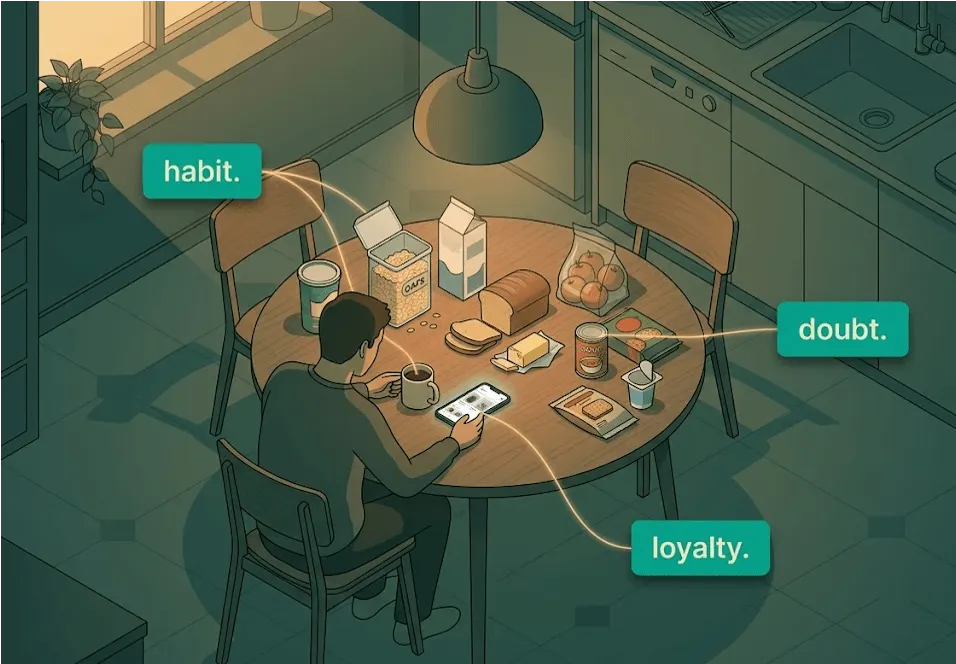
Qualitative consumer insights research uses depth interviews, focus groups, online communities, and ethnographic methods to understand why consumers behave the way they do — their motivations, attitudes, barriers, and the language they actually use. Where surveys tell you what proportion of consumers prefer one option over another, qualitative research tells you what is driving those preferences and what it would take to shift them. The typical workflow runs from method selection and recruitment through moderation and recording, then into systematic analysis of transcripts and open verbatims, and finally into synthesis and presentation to brand teams. Tools like Skimle handle the analysis stage by processing transcripts and open text automatically, organising evidence by theme so researchers can focus on interpretation. Skimle also offers Skimle Ask, an AI-moderated interview tool that makes consumer interviewing scalable when depth and breadth are both required.
For market researchers, consumer insights professionals, and brand researchers running work for FMCG clients or agency-side, this guide covers the entire process — from the initial decision about whether qualitative market research is the right approach, through method choice, recruitment, moderation, analysis, and the final step of making findings land with a brand team. For the definitional groundwork, including how this kind of work differs from market research proper, see customer insights research: how to find the real why behind customer behaviour.
When to use qualitative consumer research (and when not to)
The core question in qualitative consumer research is "why." When you already know what consumers are doing and you need to understand the underlying reasons, qualitative is the right approach. It is also the right approach when you are exploring territory you have not mapped before: new categories, emerging attitudes, unmet needs that do not yet have names.
Qualitative is less suited to questions that require statistical precision. If you need to know what proportion of your target market holds a particular view, or whether a new pack design scores significantly higher than the existing one, quantitative methods are what you need. Many of the most valuable research programmes use both in sequence: qualitative first to generate hypotheses and develop language, quantitative second to validate and size.
Qualitative consumer research is well-suited to:
- Understanding the emotional and social context behind purchase decisions
- Exploring reactions to new concepts, products, or communications before committing to development
- Surfacing the language consumers use to describe a category (for use in positioning and messaging)
- Identifying barriers and triggers that drive category entry and brand switching
- Unpacking NPS verbatim comments and open-text survey responses to build explanatory frameworks (see how to analyse NPS verbatim comments)
Qualitative consumer research is not suited to:
- Measuring incidence or prevalence of attitudes across a population
- Definitively validating whether a product or concept will succeed in market
- Producing projectable data for business cases that require confidence intervals
Knowing the difference saves projects. More than one research budget has been spent on qualitative work that was really trying to answer a quantitative question.
Choosing your method
Depth interviews (IDIs)
Individual depth interviews give you the richest picture of a single consumer's experience, decision-making process, and underlying attitudes. They are the right choice when you need to understand personal journeys — how someone came to adopt a brand, what triggers a consideration set review, how a health concern affects category behaviour.
IDIs work particularly well for sensitive topics (spending, health, family decisions) and for research where individual variation is the point rather than a problem. If you are trying to understand why your heaviest users behave differently from light users, you need clean individual data, not group-level discussion.
The main drawback is volume. Conducting and analysing 30 depth interviews takes real time, even with AI-assisted analysis. For a full treatment of the trade-offs against group formats, see focus groups vs individual interviews.
Focus groups
Focus groups are the method most associated with consumer research, and with good reason. When you want to observe how consumers discuss a topic together — the vocabulary they share, the social norms that shape behaviour, the group dynamics around a brand or category — a well-run group is hard to beat.
They are particularly valuable for concept testing, where watching participants react and debate in real time surfaces objections you might not have thought to probe in a one-to-one setting. They are also efficient for vocabulary mapping: understanding how a market segment categorises a product space, what terms they use, and where they draw distinctions.
The limitations are real, though. Group settings produce conformity pressure. Sensitive topics — financial stress, health anxiety, brand disloyalty — are systematically under-reported in groups. Dominant voices skew outputs. And the scheduling complexity of assembling eight consumers in the same room (or the same Zoom session) at the same time should not be underestimated.
For guidance on analysing what comes out of groups, how to analyse focus group transcripts covers the specific challenges of multi-voice data.
Online communities and ethnography
Online communities — bulletin boards running over several days or a week, WhatsApp-style diary studies, longer-running insight communities — give you a different kind of data. Participants have time to reflect, upload photos of actual in-home behaviour, and respond to follow-up probes. The data is often richer and less performance-driven than what you get in a two-hour focus group.
Ethnographic approaches (accompanied shops, in-home interviews, shop-alongs) go further still, getting researchers into the contexts where consumption actually happens. The data quality is high; the practical logistics are demanding.
For research programmes that need to work across multiple consumer segments in multiple markets, the analysis challenge grows accordingly. Having a consistent way to code and compare data across methods and markets is what separates programmes that produce clear insight from those that produce boxes of transcripts. See how to analyse open text responses at scale for practical approaches to that challenge.
AI-moderated interviews (Skimle Ask)
A newer approach that is gaining traction in consumer insights is AI-moderated interviewing. Skimle Ask allows researchers to design an interview guide and deploy it to large numbers of respondents simultaneously, with an AI conducting the actual conversation and probing responses in real time.
The practical appeal for market researchers is scale. You can run 200 consumer interviews at a fraction of the cost of 200 human-moderated IDIs, with the outputs automatically transcribed and ready for analysis. Agencies pitching that scale purely on price rather than on what it lets them cover in depth risk the commoditisation trap. For exploratory research, tracking studies, or projects where you need to cover multiple segments, this makes consumer interviewing economically viable in situations where it previously was not.
The trade-offs relative to human moderation are worth understanding. AI interviewers follow the guide faithfully and probe consistently across all respondents, which is a genuine advantage for systematic coverage. They do not pick up on non-verbal cues, and they will not follow an unexpected tangent the way a skilled moderator would. For a detailed comparison of what each approach is and is not good for, see AI interviewing vs human interviewing.
Decision guide: when to use each
| Method | Best for | Typical sample |
|---|---|---|
| Depth interviews | Personal journeys, sensitive topics, heavy user understanding | 8–15 per segment |
| Focus groups | Concept testing, vocabulary mapping, social norms | 2–4 groups (6–8 per group) |
| Online communities | Longitudinal behaviour, in-context capture, multi-market | 20–50 participants |
| Skimle Ask | Scale, multi-segment coverage, systematic probing | 50–500+ respondents |
Recruiting participants
Recruitment is where many consumer research projects run into trouble — not in the moderating room, but in the specification of who you actually need to talk to.
Screener design
A screener is a short questionnaire that determines whether a potential respondent qualifies for the study. Good screener design requires being explicit about what you need from each participant. Claiming behaviour is rarely sufficient on its own — you usually want respondents who can speak to a specific experience: someone who switched brands in the past six months, a category lapsee who stopped buying entirely, a heavy user who buys every week.
Avoid overcrowding screeners with demographic requirements. More criteria means smaller incidence rates, which means longer field times and higher costs. Prioritise the behavioural and attitudinal criteria that actually affect what someone can contribute to the research question.
Sample size for consumer qual
The conventional consumer qual project runs 8 to 12 depth interviews per segment, or 2 to 4 focus groups per cell. These numbers reflect a practical balance between theoretical data saturation (the point at which new respondents stop producing new themes) and the budgets that consumer goods clients are typically working with.
If you are covering multiple consumer segments — for instance, heavy users, light users, and lapsees across two age cohorts — plan each cell independently. Running fewer than eight respondents in any cell makes it hard to distinguish genuine segment-level patterns from individual variation.
For a more rigorous treatment of how sample size relates to data saturation in qualitative research, see qualitative research sample size and how many interviews for qualitative research.
Agency vs DIY recruitment
Specialist consumer recruitment agencies carry panels of screened consumers and can turn around fieldwork quickly. They are worth the cost for projects with tight timelines and precise incidence requirements. For more exploratory work, or for projects where your client can provide direct access to their customer base, DIY recruitment through email, social media, or existing panels is viable and substantially cheaper.
Designing the discussion guide
A good discussion guide has a funnel structure: broad, open questions at the start to surface the themes respondents find important without leading them, narrowing progressively towards the specific topics your client needs to understand.
Typical structure for a consumer IDI:
- Warm-up and life context (category usage, daily routines related to the topic)
- Category understanding: how respondents think about the category, what matters to them
- Brand landscape: unprompted brand awareness and perceptions, then prompted
- Deep dive on specific topic areas (concept, message, product)
- Close: anything they want to add, changes they would want to see
Keep the guide tight enough to cover reliably in the time available. A 45-minute IDI guide should have five or six main sections, not fifteen. Treat the guide as a map, not a script — the best moderators know their guide well enough to pursue an unexpected thread without losing their place.
Projective techniques
Projective techniques are useful when you need to access attitudes that respondents find difficult to articulate or socially uncomfortable to express directly. Common approaches in consumer research include:
- Personification: "If this brand were a person, who would they be?"
- Completion tasks: Sentence completions to surface implicit associations
- Mood boards and visual sorts: Asking respondents to select images that represent their feelings about a category
Use projectives strategically. They work best when you have evidence that direct questioning is not producing honest or rich responses.
Task-based exercises
For product or UX research, getting respondents to complete a real task — using a website, navigating a pack, comparing two propositions side by side — produces more reliable data than asking them to imagine what they would do. The observation of behaviour is the data, and the interview then probes what drove it.
Moderating and recording
In-person vs remote
The shift to remote moderation, accelerated by pandemic-era necessity, has become the default for many consumer research programmes. Remote delivery (Zoom, Teams, specialist qual platforms) reduces logistics significantly, opens access to nationally representative samples without travel costs, and creates a recording and transcript automatically.
The genuine trade-off is in stimulus handling and group dynamics. Showing physical products, conducting in-home observation, or capturing the full social dynamics of a group discussion are all harder on screen. For research where the physical context is part of what you are studying, in-person remains worth the additional cost. For the majority of concept and attitude work, remote delivers comparable quality.
For technical guidance on setting up recording and transcription workflows, practical setup for interviews using audio recording, automated transcription, and AI-assisted analysis covers the options in detail. And for projects recorded via Zoom or Teams, analysing Zoom and Teams call transcripts for customer discovery is directly relevant.
Note-taking
Even when sessions are recorded, having a note-taker is valuable. The note-taker captures what the moderator, focused on the conversation, cannot: the moment when three respondents exchanged glances, the throwaway comment that might be a key insight, the timing and energy of particular responses.
Notes from different sessions should follow a consistent template so they can be compared across the fieldwork programme. At minimum, capture: the main themes that came up, any surprises, verbatim quotes that stood out, and the note-taker's overall impression of how the session went.
Analysing consumer qualitative data
Thematic coding for consumer insights
Consumer qualitative analysis uses thematic coding to organise the data — assigning labels to meaningful passages of text so you can see what is said about each theme across the full dataset. The practical difference in consumer research, compared to academic or UX research, is the type of codes that matter most.
For consumer insights work, the most useful coding categories are typically:
- Attitude codes: Positive, negative, or ambivalent orientations towards the brand, category, or concept
- Barrier codes: Specific obstacles to purchase, usage, or category entry
- Trigger codes: What prompts consideration set review, trial, or switching behaviour
- Language and verbatim codes: The exact words and phrases consumers use to describe experiences (invaluable for communications)
- Segment pattern codes: Views or experiences that appear to vary by age, usage frequency, lifestage, or geography
For a systematic walkthrough of thematic coding as a methodology, the complete guide to thematic analysis is the right starting point.
The importance of segment cuts
Consumer research almost always involves more than one consumer type, and the differences between segments are often more actionable than the overall picture. Heavy users of a category typically have different barriers, triggers, and attitudes from light users. A brand that resonates with over-50s may mean something quite different to 25-to-34-year-olds.
Segment cuts are only possible if you capture the metadata to power them. Every interview or respondent record should be tagged with the variables you care about: usage frequency, age band, region, channel preference, claimed brand loyalty. This information then becomes the basis for comparing how different groups express different themes.
Using metadata variables in Skimle to compare segments
Skimle's metadata variables allow you to tag each document (interview transcript, focus group transcript, survey open text) with the attributes of that respondent — segment, age, market, usage tier, whatever variables matter for the project. When you run the analysis, you can filter or compare by those variables to see whether a theme is concentrated in one segment or consistent across all.
For a consumer insights project covering heavy users, medium users, and lapsees, for instance, you can immediately see which barrier codes appear only in the lapsee segment and which are shared across usage groups. That kind of segment-level comparison is what makes consumer qualitative research actionable for brand teams rather than interesting in a general way.
Skimle works across languages, which matters for multi-market consumer programmes where fieldwork is conducted in French, German, or Spanish but reporting happens in English. The analysis runs on the source language and can be reported in any language the team needs.
For market researchers and consumer insights professionals who regularly work across multiple consumer segments and markets, this is where AI-native tools start to pay back meaningfully relative to manual workflows.
Synthesising findings: from themes to insights
What an insight actually is
Themes are not insights. A theme is a pattern in the data: "consumers express uncertainty about the health credentials of the category." An insight goes one step further: "younger consumers distrust health claims in this category because previous products have disappointed them — so they need evidence before a claim lands, not reassurance."
The difference is the "so what" — the interpretive step that connects the pattern to a cause and implies an action. A good consumer insight has four components:
- Who: The consumer type or segment
- What: The behaviour, attitude, or belief you observed
- Why: The underlying driver or cause
- Implication: What this means for the brand, product, or communications
Working through this four-part structure for each major theme is the discipline that separates a list of findings from a genuine insight deck.
How to structure a consumer insights report
Consumer insights reports typically work best with a layered structure: a short executive summary with the top three to five insights, then a fuller evidence section where each insight is supported by representative quotes and any relevant segment breakdowns.
Brand teams are time-pressed and often have pre-formed views. Leading with the insight — not the method, not the participant breakdown — gets the findings into the room quickly. Supporting quotes then do the work of demonstrating that the insight is grounded in real consumer language, not researcher interpretation.
For guidance on how to structure the synthesis narrative before you reach the presentation stage, how to synthesise user research covers the practical steps from themes to a coherent story.
Tools for consumer qualitative research in 2026
The software landscape for qualitative analysis has changed significantly in the past two to three years, primarily because large language models have made AI-assisted analysis viable for the first time. The choice of tool now depends on how much manual coding control you need, how large your datasets typically are, and whether consumer research is your primary use case.
NVivo remains the reference standard for academic qualitative analysis. Its depth of coding functionality is unmatched, and it is the expected tool in peer-reviewed research contexts. For most consumer research projects, however, it is significantly over-engineered. The learning curve is steep, the interface has not kept pace with modern workflows, and there is no native AI assistance for the coding and analysis steps. Pricing in 2026 runs to around $1,130 (€1,040) per user per year for the perpetual licence option. For a full assessment of whether it makes sense for your context, see NVivo pricing 2026.
Dovetail has a strong following in UX and product research teams, where the repository and collaboration features are well-suited to ongoing research operations. For consumer research, where projects are often discrete rather than continuous and the client relationship requires specific deliverable formats, Dovetail's UX-first design can feel misaligned. The analysis tools are capable but lean towards tagging and surfacing highlights rather than systematic thematic analysis. See our full comparison of Dovetail and Condens alternatives for market research and customer insights teams for a deeper look at this gap.
Skimle is designed around the kind of analysis that consumer and market researchers actually need to do: processing a set of transcripts or open verbatims, surfacing a thematic structure across the full dataset, and making it easy to cut findings by segment. The AI analysis runs automatically on upload, which means a set of 20 focus group transcripts or 300 open-text survey responses can be processed and structured in minutes rather than days. Researchers retain full control over the category structure — merging, splitting, renaming, or adding codes as they review. Every insight links back to the supporting passages in the original data, which makes the evidence transparent to clients and stakeholders. Skimle Ask extends the platform to AI-moderated consumer interviewing, bringing scale to what has historically been a labour-intensive data collection method.
For a systematic comparison across the major platforms, qualitative data analysis tools: a complete comparison covers the options in detail.
Presenting consumer insights to brand teams
Brand teams want three things from a consumer insights presentation: clarity on what consumers think and feel, specificity about which consumers, and enough evidence to support a decision. What they do not want is a methodology section, a lengthy account of the research process, or a list of observations that require the audience to do the interpretive work themselves.
What brand teams actually need
The most effective consumer insights presentations follow an "insight ladder" structure:
- The insight: A clear, evidence-based statement about consumer attitudes, behaviour, or need
- The evidence: Representative quotes, frequency data (how many respondents, which segments), any relevant supporting data
- The implication: What the brand or marketing team should do in response
Working down the ladder in that order keeps the presentation focused on decisions rather than data. Brand teams do not need to see every theme that emerged from the research — they need to see the themes that matter for the brief they gave you.
Supporting transparency
One practical challenge in presenting qualitative research to brand teams is the question of credibility. Unlike a survey with a sample size of 2,000, a programme of 30 depth interviews can feel anecdotal to a sceptical audience. The antidote is transparency about both frequency and evidence.
Being explicit about frequency language helps: "20 of 26 respondents raised this unprompted" is more persuasive than "many consumers feel." Supporting every major finding with at least two or three verbatim quotes from different respondents demonstrates pattern rather than outlier. And being clear about what the research did and did not resolve — where there was genuine disagreement across segments, where the picture is still incomplete — builds credibility rather than undermining it.
Skimle's traceability features support this kind of evidence-based presentation directly: every theme in the analysis links back to the specific passages that generated it, and those passages can be pulled into a client deck as attributed evidence. For guidance on the broader craft of presenting qualitative findings to audiences who may not be familiar with the method, see presenting qualitative research findings to executives.
PowerPoint exports and deliverable formats
The practical reality of consumer research delivery is that findings end up in PowerPoint. The discipline here is in the translation from analysis to slide — making sure that the rigour of the analysis process is visible in the clarity and specificity of the outputs, not buried in an appendix that no one reads.
Each insight slide should have: a headline that states the insight (not the topic), supporting quotes in the consumer's own language, a note on which segments the insight applies to, and the implication for the brand. That structure keeps presentations action-oriented and makes it easy for brand teams to take findings into their planning process.
Ready to analyse your consumer qualitative data more efficiently? Try Skimle for free — upload your interview transcripts, focus group recordings, or open verbatims and let the analysis surface themes across your full dataset in minutes, with every finding traceable back to the original source.
Related reading:
About the authors
Henri Schildt is a Professor of Strategy at Aalto University School of Business and co-founder of Skimle. He has published over a dozen peer-reviewed articles using qualitative methods, including work in Academy of Management Journal, Organisation Science, and Strategic Management Journal. His research focuses on organisational strategy, innovation, and qualitative methodology. Google Scholar profile
Olli Salo is a former Partner at McKinsey & Company where he spent 18 years helping clients understand the markets and themselves, develop winning strategies and improve their operating models. He has done over 1000 client interviews and published over 10 articles on McKinsey.com and beyond. LinkedIn profile