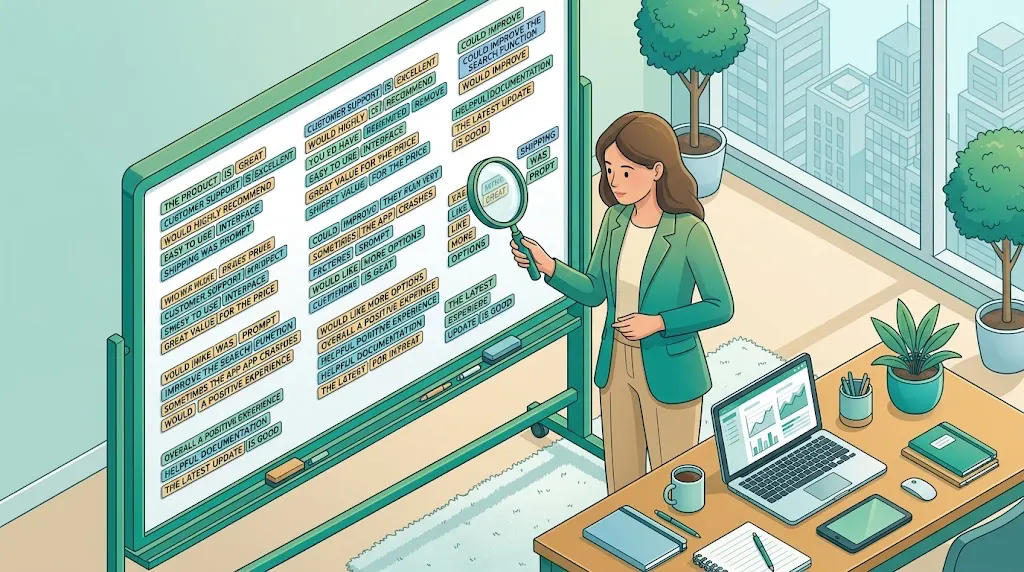
Product feedback arrives constantly: app store reviews, NPS verbatims, in-app surveys, support tickets, customer interviews, community posts. Most product teams process this feedback into a list of feature requests, organised by frequency and sentiment. That list is useful. But it is not where the most important insights are, and when each channel gets analysed separately, the resulting picture is often more fragmented than it looks.
The deeper work is understanding why customers want what they say they want, what they are actually trying to accomplish, and what gaps in the current product are generating the requests, workarounds, and friction that feedback surfaces. This guide covers how to get from the surface (likes and dislikes) to that deeper level of product understanding.
Why most product feedback analysis stays shallow
The shallow form of product feedback analysis works like this: collect feedback, read through it, identify recurring topics, and create a spreadsheet with columns for "feature request," "bug report," "positive feedback," and "other." Count the items in each category. Present the most frequent requests to the product team and use them to justify roadmap decisions.
This process is quick, requires no specialist analytical skills, and produces output that looks actionable. The problem is what it misses.
It treats requests as specifications. "I want a bulk export feature" is not a specification; it is a symptom. The actual need might be: customers are downloading data one item at a time because a workflow limitation in the product forces them to, and this takes hours per week. Understanding the underlying need might lead to a completely different solution from the one the customer requested.
It ignores what is not explicitly requested. Customers express what they notice. They do not express what they have stopped expecting. A customer who has developed a workaround for a product limitation may never request the feature that would eliminate the workaround, because they have normalised the workaround as part of their workflow. Systematic analysis of how customers describe their workflows, not just what they request, reveals these invisible opportunities.
It weights by volume, not by strategic value. The most frequently requested feature may be the most commonly felt annoyance, not the most important gap. If 40% of customers request feature A and 8% request feature B, feature A appears more important on a frequency basis. But if feature B is blocking customers from achieving a critical use case, and feature A is a convenience improvement, the strategic priority is reversed.
What sources of product feedback are most valuable?
| Source | Volume | Depth | Actionability |
|---|---|---|---|
| App store reviews | High | Low | Low-medium |
| NPS verbatims | High | Low-medium | Medium |
| In-app feedback widgets | Medium | Low | Medium |
| Support tickets | High | Medium | High (specific) |
| Customer interviews | Low | Very high | High (strategic) |
| Usability studies | Very low | Very high | High (UX-specific) |
| Community / forum posts | Medium | Medium | Medium |
| AI-powered interviews (Skimle Ask) | Medium-high | Medium-high | High |
No single source gives you the full picture. The most valuable combination is typically: systematic analysis of high-volume sources (reviews, verbatims, support tickets) for continuous monitoring, and periodic deep-dive qualitative research (interviews, usability studies) for strategic understanding.
The 5 levels of depth in product feedback analysis
Level 1: Sentiment scoring
The most basic analysis: is this feedback positive, neutral, or negative? What is the overall ratio across your feedback corpus? How is that ratio changing over time?
Useful for: monitoring product health; flagging sudden shifts in customer sentiment that might indicate a quality issue or competitive event; executive dashboards.
Not useful for: understanding what customers actually care about or what to do about it.
Level 2: Topic extraction
Classify feedback by topic: which product areas are mentioned? Is feedback about the onboarding flow, the core feature, the reporting, the export, or the pricing?
Useful for: understanding which parts of the product are generating the most feedback; routing feedback to the right team; identifying which areas need qualitative investigation.
Not useful for: understanding what customers are trying to accomplish or why a feature is generating friction.
Level 3: Thematic coding
Apply a richer coding scheme that captures not just the topic but the nature of the feedback: is this a bug report, a workflow friction point, a feature request, a comparison to a competitor, or a workaround description? What is the customer actually trying to accomplish?
This is where qualitative analysis begins. Thematic coding requires a coding scheme that goes beyond topic categories to capture the meaning and context of what customers are expressing. For more on how to build and apply a coding scheme, see how to code qualitative data.
Useful for: understanding the nature of feedback, not just the topic; identifying workarounds and unmet needs; connecting specific feedback to specific product decisions.
Level 4: Mental model analysis
Customers express themselves through a mental model of the product: how they think it works, what they expect it to do, and how they understand their own workflow in relation to the product. These mental models are often implicit and emerge through language choice.
A customer who says "I expected the data to update automatically" has a mental model in which the product is a live feed, not a snapshot. A customer who says "I always export to Excel and work from there" has a mental model in which the product is a data source, not an analysis tool. These mental models tell you more about the design requirements for the product than the explicit requests do.
Identifying customer mental models requires reading feedback with attention to the assumptions embedded in the language, not just the surface request. This is the kind of analysis that benefits most from careful human interpretation alongside AI-assisted processing.
Level 5: Jobs-to-be-done discovery

Recommended reading
Jobs-to-be-done interviews: how to run them and analyse what you find
The deepest form of product feedback analysis asks: what is the customer actually trying to accomplish, independent of the current product design? What progress are they trying to make in their lives or work? What are they hiring this product to do?
This framing, from Clayton Christensen's jobs-to-be-done methodology, reframes feedback from requests about the current product to requirements for the job the product needs to do. A customer who requests a bulk export feature is not asking for an export button; they are asking for a way to get their data into the systems where they do their work. The job is "integrate product data into my workflow." Understanding the job opens up a much larger solution space than the specific request.
Jobs-to-be-done analysis cannot be done from feedback alone. It requires qualitative interviews specifically designed to uncover the jobs, the circumstances that trigger product use, and the alternatives the customer is comparing the product against. See customer discovery interviews for a practical guide to this type of research.
A practical workflow for deeper product feedback analysis
Step 1: Consolidate your sources
Bring all your unstructured product feedback into a single workspace: NPS verbatims, app store reviews, support ticket summaries, interview transcripts, community posts. Most teams have this data in 4-6 different places and never see it together.
Skimle accepts all common text and document formats, including direct upload of CSV files with open-text columns, making it straightforward to consolidate feedback from different sources. See how Skimle works for more on the import workflow.
Step 2: Tag by source and customer segment
Before analysing content, add metadata: source (support ticket, NPS verbatim, interview, review), date, and any customer attributes you have available (plan tier, tenure, industry, use case). This makes it possible to cross-tabulate themes by segment later and to track how themes evolve over time.
Step 3: Run systematic thematic coding
Apply a coding scheme that captures topic, nature of feedback, and the underlying need or job where identifiable. Skimle's AI analysis automatically identifies themes and codes excerpts, producing a structured view of the feedback corpus that you can then review and refine.
The output of this step is a structured view of what your feedback corpus contains: not a count of positive/negative, but a map of what customers are expressing and what it means.
Step 4: Identify the patterns that matter
Look for:
- Themes that appear disproportionately in churned customers' feedback
- Themes that appear across multiple feedback sources (an issue that surfaces in support tickets, NPS verbatims, and community posts is more significant than one that appears in only one channel)
- Workaround descriptions (these are unmet needs in disguise)
- Mental model mismatches (where customers describe the product doing something different from what it actually does)
- Themes that are growing in frequency over time
Step 5: Connect to customer interviews for depth
Systematic feedback analysis tells you what the patterns are. Customer interviews tell you why. When thematic analysis of your feedback corpus surfaces a pattern you do not fully understand, that is the brief for a targeted interview study: recruit customers who showed the pattern in their feedback and explore it in depth.
This combination, large-scale analysis for signal detection and targeted interviews for depth, is the most efficient structure for a continuous product feedback programme. See voice of customer research guide for how to design this as an ongoing capability.
Step 6: Translate findings into product requirements
Connect each major theme to a product requirement in terms of the job to be done, not the specific feature requested. "Customers need to be able to get their data into the tools they already use, without a manual step" is a better product requirement than "customers want a bulk export button," because it opens up the full solution space (integrations, API, automated exports, or a better native data view) rather than specifying a single solution.
For product managers and UX researchers, this kind of jobs-level requirement framing is the difference between a roadmap that solves the right problems and one that delivers features that do not move the metrics they were supposed to move.
How AI is changing product feedback analysis
The main obstacle to deeper product feedback analysis has historically been time. Reading 3,000 NPS verbatims carefully enough to identify mental model patterns takes weeks. Most product teams lack that capacity and default to shallow processing as a result.
AI-assisted analysis changes this constraint directly. A structured AI analysis of 3,000 NPS verbatims, coded for themes at the level described above, takes hours rather than weeks. The researcher's job shifts from doing the first-pass coding to reviewing the AI's output, making interpretive judgements, and developing the product implications.
Skimle's approach is to process feedback through a structured coding pipeline that maintains full traceability from every theme back to the specific excerpts that support it. This means you can move from "the AI found this theme" to "here are the 47 specific customer quotes that constitute this theme" in a single click, which is essential for validating findings and presenting them credibly to product leadership.
For teams running always-on feedback programmes, continuous AI-powered interviews combined with systematic analysis can replace the periodic large-batch feedback analysis cycle with a continuous signal that updates as new data arrives.
Frequently asked questions
How often should you run product feedback analysis?
For high-volume sources (NPS verbatims, app store reviews, support tickets), continuous or monthly analysis is appropriate. For qualitative interview studies, quarterly cycles are common for product teams with an active research function. Annual or semi-annual deep-dive studies are appropriate for strategic questions about product direction.
How do you prioritise features from qualitative feedback?
Prioritisation based on qualitative feedback should consider: frequency of theme occurrence (how many customers express this?), strategic importance of the customer segment expressing it (are these churned customers, enterprise accounts, or power users?), and the nature of the underlying job (is this friction in a core job or a peripheral one?). Qualitative findings work best when combined with quantitative data: if you can connect a theme from feedback analysis to a measurable outcome (churn rate, NPS, engagement), the prioritisation decision becomes much more defensible.
Should product feedback analysis be done by the product team or a research team?
Both approaches work, and many organisations use both. A dedicated research function brings methodological rigour and independence (product teams sometimes hear what they want to hear from feedback). Product managers doing their own analysis brings closer connection to the product implications and faster turnaround. The best setup is a research function that sets the methodology and trains product managers in how to apply it, with a shared platform (Skimle) that makes the raw data and analytical output available to both.
What is the difference between product feedback analysis and user research?
Product feedback analysis works with feedback that customers have chosen to express through existing channels (reviews, surveys, support). User research (interviews, usability studies, diary studies) actively elicits the information the researcher needs. Feedback analysis is better for continuous monitoring and for identifying problems customers have chosen to express. User research is better for understanding the jobs, mental models, and unmet needs that customers have not expressed but that are shaping their behaviour.
Ready to move from a feature request list to real customer understanding? Try Skimle for free and see how systematic AI-assisted analysis of your product feedback surfaces the patterns that drive product decisions.
Related reading: Customer discovery interviews: a practical guide | How to synthesise user research findings | Voice of customer research: a practical guide
About the authors
Henri Schildt is a Professor of Strategy at Aalto University School of Business and co-founder of Skimle. He has published over a dozen peer-reviewed articles using qualitative methods, including work in Academy of Management Journal, Organisation Science, and Strategic Management Journal. His research focuses on organisational strategy, innovation, and qualitative methodology. Google Scholar profile
Olli Salo is a former Partner at McKinsey & Company where he spent 18 years helping clients understand the markets and themselves, develop winning strategies and improve their operating models. He has done over 1000 client interviews and published over 10 articles on McKinsey.com and beyond. LinkedIn profile