Customer sentiment analysis is the process of identifying and interpreting how customers feel about a product, service, or experience from the language they use. It covers everything from automated positive/negative scoring of NPS verbatims to deep qualitative analysis of 50-interview customer discovery studies. The gap between those two approaches, in terms of depth and business impact, is enormous, and most organisations are operating much closer to the shallow end than they realise, often because sentiment from each channel is scored in isolation rather than reconciled into one coherent picture.
This guide covers the full spectrum: what sentiment analysis actually is, where its standard forms fall short, how to use unstructured customer data to build genuine understanding of customer perspective, and what tools and methods support each level of depth.
What is customer sentiment analysis?
At its simplest, customer sentiment analysis means reading customer text and classifying it as positive, neutral, or negative. A customer who writes "I love how easy it is to export data" is positive about the export feature. A customer who writes "the export is completely broken" is negative about it. A machine learning model can classify these statements at scale without human review.
This form of sentiment analysis, sometimes called opinion mining, has been available as a commercial product for over a decade. It is embedded in most major customer experience platforms and is often applied automatically to NPS verbatim text, app store reviews, and social media mentions.
The limitation is what it cannot do. Positive/negative classification tells you the direction of sentiment but nothing about the content. You know customers are unhappy with export; you do not know whether they mean the file format options, the export speed, the destination integrations, or the data completeness. You know some customers are positive about the product overall; you do not know which specific elements are driving that positivity or how durable it is.
The deeper forms of customer sentiment analysis (the ones that actually tell you what customers think and why) require qualitative analysis of unstructured data. That analysis is more demanding and has historically been more expensive. The payoff is insight that drives decisions rather than insight that fills dashboards.
What are the main sources of unstructured customer data?
Unstructured customer data is any customer expression that does not fit a predefined response category. It includes:
Customer interviews: Semi-structured conversations in which customers describe their experience in their own words. The richest source of customer insight available, and the one most likely to surface what customers actually care about rather than what your survey assumed they cared about. For more on running and analysing these, see how to analyse customer interviews.
NPS and CSAT verbatims: The open-text question that follows the score. "Why did you give that score?" produces the most concentrated form of customer opinion available: a customer who has just formed a view and is being asked to express it. Most organisations have far more verbatim text than they know what to do with.
App store reviews and rating-site comments: Publicly available, unsolicited, and often highly specific. Customers writing app store reviews are self-motivated, which means their feedback tends to be more pointed than survey responses. The limitation is that only a fraction of customers write them, and those who do skew toward strong feelings (positive or negative). See analysing app store reviews at scale.
Customer support tickets: Support conversations contain an enormous volume of customer expression about specific product problems, workarounds, and frustrations. Most companies treat support data as an operational metric (ticket volume, resolution time) rather than as a source of customer insight. The verbatim content is typically richer than any survey.
Social media and community content: Customer posts in communities, forums, and social channels. High volume, low signal density: you need to process a lot of content to extract reliable patterns. Useful for tracking sentiment over time and for catching emerging issues before they surface in formal feedback channels.
Focus group and usability study transcripts: Research-generated data that is often transcribed and then filed rather than systematically analysed. A well-run focus group contains substantially more insight than the summary report typically captures.
Why standard sentiment scoring is not enough
The most widely deployed sentiment analysis tools produce a score (how positive or negative is this text?) and sometimes break that score down by topic (if the vendor has trained a topic classifier on similar data). This is useful for monitoring: you can see when overall sentiment drops or when a particular topic starts generating negative sentiment.
What it cannot produce is understanding. Three problems are fundamental:
1. Sentiment without context is misleading. A customer who says "I can't believe how fast this loads" is positive. A customer who says "I can't believe how fast this loads... until it crashes" is negative. Simple sentiment classifiers frequently misread sarcasm, negation, and conditional statements. The error rate increases with text that is more colloquial, more technically specific, or more nuanced.
2. Negative is not the same as important. A minor usability annoyance and a product-breaking bug may both generate negative sentiment, but they require completely different responses. Standard sentiment analysis cannot distinguish between them.
3. The most valuable insight is often not in the sentiment at all. The customer who describes a workaround they have developed ("I always do this in two steps because the single-step method doesn't work for our data structure") is not expressing sentiment. They are expressing a product insight that your product team needs. Standard sentiment analysis is not looking for this. Open text analysis: how to find the themes you didn't know to look for covers the same blind spot from the angle of theme discovery: a sentiment score can flag that a response is negative without ever surfacing what the new, unanticipated complaint actually is.
How to go deeper: qualitative analysis of customer voice
The alternative to sentiment scoring is systematic qualitative analysis of what customers actually say. This means coding customer text for themes (not just positive/negative, but the specific topics, concerns, mental models, and workarounds that customers express) and then analysing patterns in those themes across customer segments, time periods, and product areas.
Step 1: Collect across all unstructured sources
Do not limit your analysis to one channel. Customers who are frustrated often do not write NPS verbatims but will post on community forums. Customers with feature requests often express them in support tickets rather than surveys. The full picture of customer sentiment requires integrating data from multiple sources.
Step 2: Code for themes, not just sentiment
Apply a coding scheme that goes beyond positive/negative. A useful starting point for product-focused analysis:
- Problems and pain points: specific things that do not work or are harder than they should be
- Workarounds: how customers cope with product limitations (these reveal unmet needs better than explicit requests)
- Comparisons: when customers mention competitors or prior tools (the specific comparisons reveal what customers value)
- Mental models: how customers conceptualise what the product does (mismatches between customer mental model and product design are a major source of friction)
- Aspirations: what customers are trying to achieve, expressed in their own language
Step 3: Cross-tabulate by customer segment
Theme coding becomes most powerful when you can cross-tabulate themes by customer attributes: tenure (do newer customers express different problems from experienced ones?), plan tier (do enterprise customers have different needs from SMB customers?), industry, or use case.
Skimle's metadata analysis handles this cross-tabulation automatically: add customer attributes as metadata fields and the platform identifies which themes are statistically associated with which segments. The Visualisations then let you explore these patterns interactively.
Step 4: Track changes over time
Sentiment is not static. A pattern that appears strongly in customer feedback for two months and then disappears may reflect a problem that was fixed (or that customers gave up trying to express). Tracking when themes appear and disappear over time is one of the most valuable outputs of systematic customer sentiment analysis. Cross-tabulating by response date reveals trends that snapshots cannot.
Moving from qualitative insight to action
Qualitative customer sentiment analysis produces findings. Making those findings drive decisions requires connecting them to the people and processes that can act on them.
Connect themes to specific product areas. A theme like "export instability" maps directly to an engineering team and a product backlog. Themes should be categorised by which team owns the relevant experience.
Prioritise by frequency and intensity combined. A theme mentioned by 60% of churned customers in strongly negative terms is more urgent than a theme mentioned by 5% of active customers in mildly negative terms. Frequency and intensity are both relevant; neither alone is sufficient.
Use direct quotes as evidence. Product decisions are easier to defend and easier to implement when they are accompanied by the actual words customers used. "Five customers said they need an API endpoint for this feature" is less compelling than the quotes themselves. Skimle maintains traceable links from every theme to the specific quotes that support it, making this kind of evidence presentation straightforward.
Report to the audience that can act. Customer sentiment findings for a product engineering team look different from findings for a marketing team or a customer success team. The same underlying analysis should produce different outputs for different audiences. For guidance on shaping qualitative findings for senior audiences, see presenting qualitative research findings to executives.
When to go even deeper: customer discovery interviews
Systematic analysis of existing feedback channels (NPS verbatims, support tickets, reviews) tells you what customers have chosen to express through existing channels. What it misses is what customers have not thought to express or do not know is worth expressing.
For deeper customer understanding, particularly when developing a new product area or trying to understand churn in a segment that is not expressing dissatisfaction clearly, customer discovery interviews are the appropriate tool. These are open-ended conversations designed to understand customers' actual workflows, decision processes, and frustrations — including the ones they have never thought to raise as feedback.
Voice of customer research programmes typically combine both: systematic analysis of existing feedback channels for continuous monitoring, and periodic deep-dive interview studies for strategic understanding. Platforms like Skimle make it practical to run both from the same workspace, integrating feedback data and interview transcripts into a unified analytical view.
Frequently asked questions
What is the difference between customer sentiment analysis and voice of customer research?
Sentiment analysis is one technique within the broader field of voice of customer (VoC) research. VoC research encompasses all the methods used to understand customer perspective: surveys, interviews, feedback analysis, usage data, and competitive monitoring. Sentiment analysis specifically focuses on classifying the emotional direction of customer expression. A comprehensive VoC programme uses sentiment analysis as one input alongside qualitative depth analysis.
How many customer verbatims do you need for reliable sentiment analysis?
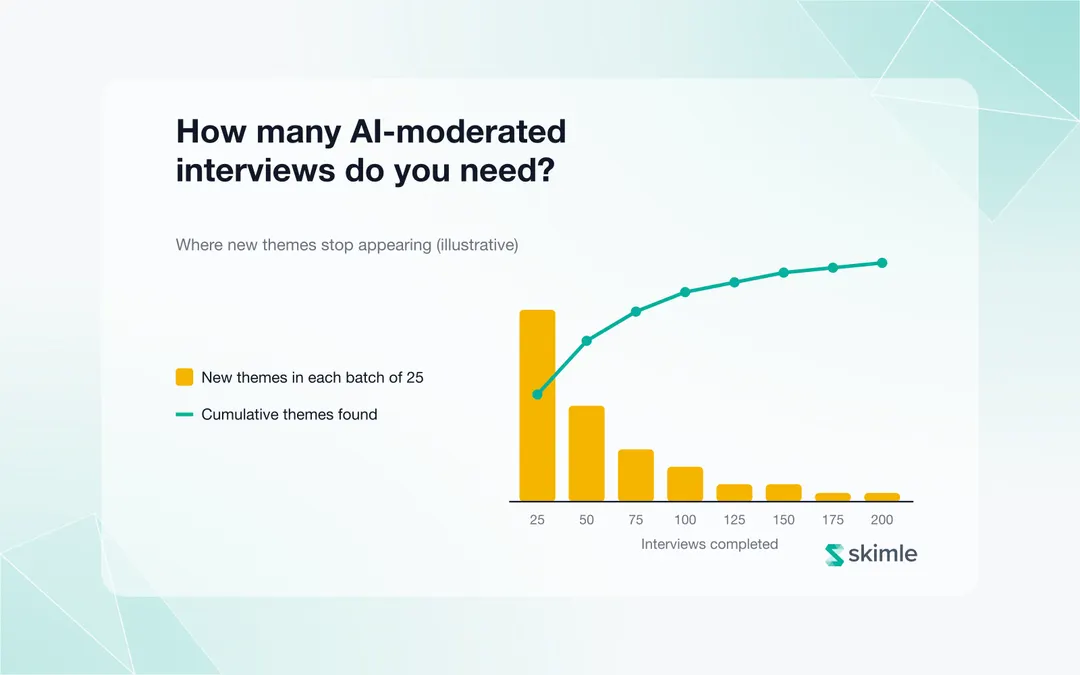
For automated positive/negative scoring, hundreds or thousands of verbatims are typical, and the larger the corpus the more reliable the signal. For qualitative thematic analysis, theoretical saturation typically occurs between 100-400 verbatims for a well-defined product or experience area, depending on how diverse your customer base is. For more nuanced segment-level analysis, you need enough verbatims per segment to reach saturation within that segment.
Can sentiment analysis replace customer interviews?
No. Sentiment analysis of existing feedback channels tells you what customers have chosen to express through those channels. Customer interviews reveal what customers experience but have not chosen to express — including the problems they have normalised, the workarounds they have developed, and the comparisons to competitors they make when no one is watching. For most organisations, the highest-value customer intelligence comes from interviews, not from feedback channel analysis.
What is the best tool for customer sentiment analysis?
The right tool depends on the depth of analysis you need. For automated positive/negative scoring at scale, purpose-built sentiment scoring tools (many CRM and CX platforms include this) are efficient. For thematic analysis of what sentiment is about, qualitative analysis tools like Skimle are more appropriate. Skimle processes interview transcripts, open-text feedback, support tickets, and review text through the same structured analysis pipeline, making it practical to run a unified analysis across all your unstructured customer data. See qualitative data analysis tools complete comparison for a broader comparison.
Ready to move beyond positive/negative scores to genuine customer understanding? Try Skimle for free and see how systematic qualitative analysis turns your unstructured customer data into the kind of insight that drives product and strategy decisions.
Related reading: Voice of customer research: a practical guide | How to analyse NPS verbatim comments | Customer discovery interviews: a practical guide
About the authors
Henri Schildt is a Professor of Strategy at Aalto University School of Business and co-founder of Skimle. He has published over a dozen peer-reviewed articles using qualitative methods, including work in Academy of Management Journal, Organisation Science, and Strategic Management Journal. His research focuses on organisational strategy, innovation, and qualitative methodology. Google Scholar profile
Olli Salo is a former Partner at McKinsey & Company where he spent 18 years helping clients understand the markets and themselves, develop winning strategies and improve their operating models. He has done over 1000 client interviews and published over 10 articles on McKinsey.com and beyond. LinkedIn profile
Sources
- Voice of the Customer — Griffin & Hauser (1993), Marketing Science
- Opinion Mining and Sentiment Analysis — Pang & Lee (2008), Foundations and Trends in Information Retrieval
- The Innovator's Solution — Christensen & Raynor (2003), Harvard Business Review Press
- Competing Against Luck: The Story of Innovation and Customer Choice — Christensen et al. (2016), HarperBusiness