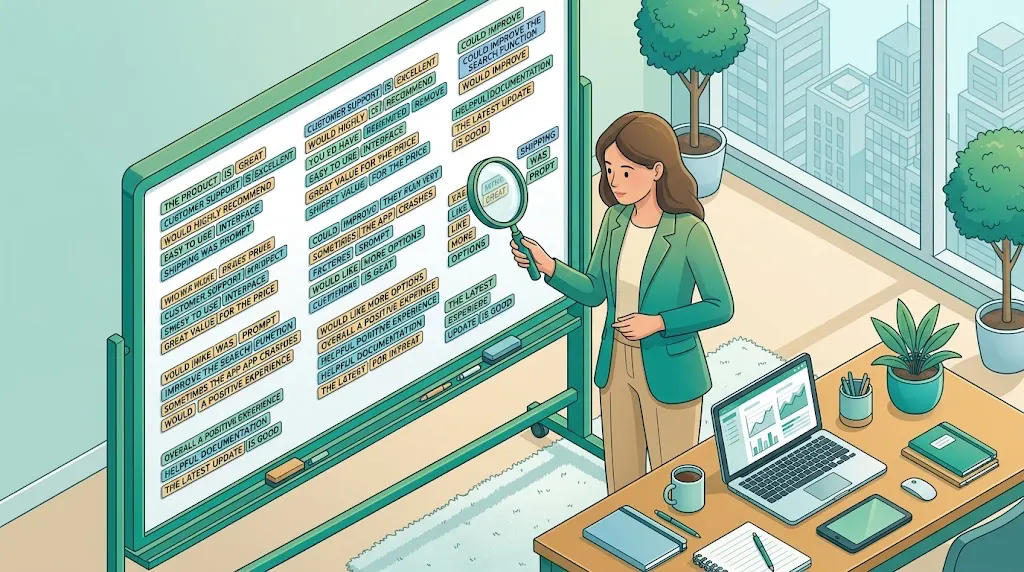
Most VoC programmes collect data across 4 sources (interviews, surveys, support tickets, and AI-powered interviews) but never properly analyse the qualitative parts. The surveys get dashboarded; the open-text responses get archived. This guide covers how to close that gap: how to design a VoC interview for depth, how to analyse qualitative feedback at scale using tools like Skimle, and how to build a programme that actually changes product and commercial decisions rather than sitting in a slide deck.
According to Forrester, 84% of businesses that improved customer experience based on VoC data reported increased revenue. Despite this, only 12% of CX professionals rate their VoC programme's maturity as high or very high. Most programmes are collecting data — surveys, NPS, support tickets — without the analytical infrastructure to turn it into actionable insight. The volume is there; the synthesis is not.
This guide covers the four main VoC data sources, how to design a VoC interview for depth, how to analyse feedback at scale, and how to build a programme that product and commercial teams will actually use.
What is voice of the customer?
Voice of the customer (VoC) is the practice of systematically capturing what customers think, feel, and need, in their own words, and turning it into insight that guides decisions. It spans every channel where customers express themselves: interviews, surveys, reviews, support conversations, and social media. The goal is not just to measure satisfaction but to understand the "why" behind it.
VoC feedback comes in three forms:
| Type | Where it comes from | Example |
|---|---|---|
| Direct | Feedback customers give you on purpose | Interviews, surveys, NPS verbatims, feedback forms |
| Indirect | Feedback customers give about you, elsewhere | Reviews, social media, forums, analyst reports |
| Inferred | Signals from customer behaviour | Support tickets, churn, product usage, call logs |
A mature programme combines all three: direct feedback for intent, indirect for unfiltered perception, and inferred for what customers do rather than say. VoC is a measurement discipline at heart; for the broader interpretive work of explaining why customers behave as they do, see customer insights research: how to find the real why behind customer behaviour.
What are the 4 main types of VoC data?
Effective VoC programmes draw from multiple sources because each captures a different type of customer signal. No single source is sufficient on its own.
| Data source | What it captures | Strengths | Limitations |
|---|---|---|---|
| Customer interviews | Motivations, workarounds, unmet needs, emotional context | Rich, contextual, exploratory | Time-intensive; requires skill to avoid leading |
| Structured surveys (NPS, CSAT, CES) | Satisfaction scores, specific event ratings | Fast and scalable; trackable over time | Closed-ended; doesn't explain the "why" |
| Support tickets and reviews | Pain points, feature requests, failures | Unprompted; large volume; real language | Negatively biased; limited positive signal |
| AI-powered interviews (e.g. Skimle Ask) | Contextual feedback at scale, without scheduling overhead | Combines depth with breadth; 24/7; consistent questioning | Less flexible than human-led; not suited for highly sensitive topics |
The most useful VoC programmes use qualitative sources (interviews, AI interviews, open-text feedback) for depth and understanding, and quantitative sources (surveys, tickets, reviews) for volume, frequency, and trend-tracking. Neither alone gives you the full picture.
Why do most VoC programmes fail to influence decisions?
The problem is almost never data collection. Most organisations are swimming in customer feedback. The problem is synthesis — the ability to turn hundreds of individual comments into clear, confident insights that product managers and executives will act on.
Four patterns explain most VoC programme failures:
1. Over-reliance on NPS. Net Promoter Score is a useful health metric, but "our NPS is 42" tells you nothing about why customers are unhappy or what would make them more likely to stay. NPS should be a trigger for investigation, not the investigation itself.
2. Qualitative data sits in silos. Call recordings are in Gong, support tickets in Zendesk, interview notes in a shared drive, survey open-text in a spreadsheet. Nobody synthesises across these systematically because it is too time-consuming. This is the problem Skimle is built to solve: import the full set of transcripts, call notes, and open-text responses into one project, and automatic thematic analysis surfaces the patterns across all of them — with every insight traceable back to the source quote. For what this fragmentation actually costs an organisation in re-litigated decisions and repeated research, see the real cost of a fragmented VoC programme.
3. Research is episodic, not continuous. A quarterly customer research sprint produces insights that are already 3 months old by the time they reach the product team. Fast-moving businesses need a continuous signal, not periodic deep dives.
4. Insights don't travel. Research findings sit in a slide deck that gets presented once and then filed. Product teams, marketing, customer success — none of them have access to the underlying evidence. See our guide on building a research repository that people actually use for how to solve this.
How do you design a VoC interview for depth?
Surveys tell you what customers chose; interviews tell you why. A good VoC interview is not a satisfaction survey with open questions — it is a structured exploration of the customer's situation, goals, and experience.
The most effective VoC interview structure:
1. Context (5-10 minutes): Start with the customer's role, their day-to-day workflows, and their goals. "Walk me through how you typically handle [the problem your product solves]." This surfaces the context in which your product sits, and often reveals competing priorities and constraints you would not see from product usage data.
2. Current experience (10-15 minutes): "Tell me about a recent time you used [product or process] to do X. What prompted you to do it that way? What happened? What got in the way?" Specific recent events produce concrete, useful data. Generic questions ("what do you think about X?") produce vague, unreliable answers.
3. Unmet needs and workarounds (5-10 minutes): "What's the part of this that you wish worked differently? What do you do when it doesn't work the way you need?" Workarounds are the most revealing signal in VoC research — they show where customers have given up waiting for you to solve the problem and built their own solution.
4. Priorities and trade-offs (5 minutes): "If you could change one thing, what would it be? What would that be worth to you?" These questions connect the insight to business value.
For a deeper look at interview technique, see our guides on how to conduct effective business interviews and how to write a perfect interview guide.
How do you collect VoC data at scale?
Individual interviews give you depth; scale gives you confidence. A mature VoC programme combines periodic deep-dive interviews with continuous lighter-weight signals.
Periodic interviews (quarterly or per-cohort): 15-25 interviews with customers across segments, tenure, and use patterns. These produce the deep understanding of motivations, workarounds, and unmet needs. Analyse themes across the full corpus, not just the most memorable quotes. If you are building a B2B programme specifically, see our guide on running a VoC programme for B2B companies for the specific challenges of account-level vs individual respondent analysis.
Continuous AI-powered interviews: Skimle Ask allows you to run structured AI-led conversations with customers triggered by product events (onboarding completion, upgrade, churn risk, support ticket resolution). Each conversation follows a consistent guide, and responses feed directly into analysis. This creates a continuous stream of qualitative data that surfaces emerging issues before they show up in NPS drops. See gathering rich data with AI interviews for more on how this works.
Passive feedback mining: App store reviews, G2 and Capterra reviews, support tickets, and community forum posts are all sources of unprompted customer language. NPS verbatim comments are particularly underused — see how to analyse NPS verbatim comments at scale for the workflow. For open-text survey analysis more broadly, see how to analyse open-text responses at scale.
For a detailed comparison of whether AI or human interviews are better for your VoC goals, see AI interviewing vs human interviewing.
How do you analyse VoC data?
The analysis framework that works best for VoC research is organised around what customers are trying to accomplish, not what they said about your product. For teams with more than a handful of interviews, doing this manually — reading through transcripts, building a theme taxonomy, cross-referencing quotes — quickly becomes the bottleneck that stalls the whole programme. Our guide on how to analyse customer interviews at scale covers the full workflow for large interview sets. Loading your interview transcripts and open-text responses into Skimle and running thematic analysis gives you a coded, searchable structure across the full corpus in hours rather than days, with the underlying quotes visible for every theme so you can verify and refine the findings.
Which tool you use shapes how far this scales: general-purpose repositories organise verbatims, while analysis-led tools code them. Our comparison of voice of customer tools breaks down that difference on price and capability.
A useful structure for coding VoC interviews:
Jobs — What is the customer trying to achieve? Functional jobs ("process invoices faster"), emotional jobs ("feel confident I'm not missing anything"), social jobs ("look effective to my team"). The job defines the context of value.
Outcomes — How does the customer know when the job is done well? What does success look and feel like? What does failure look and feel like?
Constraints — What gets in the way? Technical, organisational, skill-related, time-related.
Language — How do customers describe the problem in their own words? This is the raw material for positioning and messaging. The specific phrases customers use to describe their frustration or their success are more valuable than anything a copywriter invents.
Across a dataset of 20-30 interviews, patterns in the above dimensions become the substance of your VoC insight. Skimle's metadata analysis lets you compare these patterns across customer segments — by company size, tenure, industry, or role — so you can see whether the main job for enterprise customers is different from what SMB customers care about.
How do you turn VoC findings into output that gets used?
VoC research only adds value if it changes decisions. The two most useful outputs:
Customer insight brief (2-4 pages): A written synthesis of the main jobs, outcomes, and constraints across your research cohort. Concrete, specific, with direct quotes. Designed to be read in 10 minutes by a product manager or commercial leader. Not a slide deck — a document.
Job story repository: A structured collection of anonymised quotes and coded insights, organised by job and segment. This should be searchable and accessible to the full product and marketing team, not locked in a research drive. When a PM is writing a spec, they should be able to pull the 5 most relevant customer quotes in two minutes.
For academic and professional researchers doing consumer insights work, the qualitative consumer insights guide covers the full research workflow in more detail.
How do you build a voice of the customer programme in 6 steps?
- Set the decision it serves. Define which product, retention, or commercial decisions the programme will inform. A VoC programme without a decision to feed becomes a dashboard nobody reads.
- Choose your sources and metrics. Combine direct, indirect, and inferred feedback, and pick the metrics you will track, such as NPS, CSAT, or CES, alongside the qualitative signal.
- Collect continuously, not once. Run always-on interviews and capture open-text feedback across the customer lifecycle, rather than in an annual survey burst.
- Analyse the qualitative parts systematically. Code interviews, tickets, and open-text responses into themes with tools like Skimle, so the "why" is not lost. See how to analyse customer feedback.
- Close the loop internally. Turn themes into a customer insight brief and a searchable quote repository that product, marketing, and leadership actually use.
- Act and measure. Feed findings into decisions, then track whether the metrics and themes move. VoC earns its budget only when it changes something.
Frequently asked questions
What is voice of customer research?
Voice of customer (VoC) research is a structured method for capturing what customers expect, need, and value in their own words — not through sales reports or satisfaction scores, but through direct interviews, surveys, and feedback channels. The goal is to understand the jobs customers are trying to do, the outcomes they care about, and the gaps between what they need and what they get. Done systematically, VoC drives product decisions, positioning, and retention strategy from actual customer evidence rather than internal assumptions.
How do you run a VoC programme?
A VoC programme has three components: data collection (interviews, surveys, support feedback, and AI-led conversations), analysis (thematic coding across the full dataset, not just memorable quotes), and distribution (routing findings to the teams that can act on them). The most common failure point is the second step: most organisations collect data but lack the analytical infrastructure to synthesise it reliably. Starting with 15–20 structured interviews per quarter, using a consistent interview guide, and running systematic thematic analysis across the full corpus is a repeatable foundation. See the sections above for the full workflow.
What are the best VoC methods?
The three highest-value VoC methods are structured customer interviews (for depth and motivation), open-text survey analysis (for scale and trend-tracking), and continuous AI-led interviews (for volume without scheduling overhead). Each captures different signals: interviews surface the "why" behind behaviour, survey open-text reveals the language customers use naturally, and continuous AI interviews catch emerging issues before they surface in NPS drops. A mature programme uses all three in combination. For a detailed look at which VoC platforms handle qualitative data well, see our VoC tools comparison.
How many customer interviews do you need for a VoC programme?
For initial discovery of the main customer jobs and pain points, 15-20 interviews across your main segments will surface the core patterns. For ongoing VoC, 8-10 interviews per cohort (segment × time period) is a reasonable cadence. The goal is to notice when something new appears, not to achieve statistical significance.
Is VoC research the same as user research?
They overlap but are not identical. User research (UX research) focuses on how people use a product — usability, task completion, mental models. VoC research is broader: it captures why customers chose you, what jobs they are trying to do, what they value, and what would make them leave. UX research informs design decisions; VoC research informs product strategy and commercial decisions.
What is the difference between VoC and NPS?
NPS measures one thing: the likelihood that a customer will recommend you. It is a lagging indicator of satisfaction. VoC research explains the drivers behind that score — why promoters are promoters, why detractors are detractors, and what would move customers from one category to the other. NPS without VoC qualitative data tells you there is a problem without telling you what it is.
Can VoC research replace market research?
They serve different purposes. VoC research focuses on existing customers — their experience, their jobs, their workarounds. Market research typically has a broader scope: understanding market size, non-customers, competitive positioning, and segment definition. For most B2B SaaS companies, VoC is more immediately actionable than market research. For companies entering new markets, traditional market research is also necessary; see our guide to qualitative market research.
How do you handle customer confidentiality in VoC research?
For B2B interviews, agree on what can and cannot be attributed before you start. Most customers are comfortable with anonymised aggregation ("several enterprise customers mentioned that...") but uncomfortable with direct attribution. Keep a clear record of consent. For AI-interview programmes like Skimle Ask, inform users how their responses will be used in the product flow before they begin.
Ready to collect and analyse customer feedback at scale with full traceability? Try Skimle for free — process interview transcripts, analyse Skimle Ask conversations, and slice findings by customer segment with metadata. If you work in market research or customer insights, see how Skimle supports customer and market researchers.
Related reading:
- How to analyse customer interviews in a market research context
- How to analyse customer interviews at scale
- How to run a VoC programme for B2B companies
- AI interviewing vs human interviewing: a practical comparison
- Always-on customer research: how to embed AI interviews from discovery to churn
- How to analyse NPS verbatim comments at scale
- Customer advisory board feedback synthesis: turning CAB notes into themes
- Patient experience qualitative analysis with AI
- Skimle Ask: the simple way to do qual at scale
- Building personas from real research data with AI
About the authors
Henri Schildt is a Professor of Strategy at Aalto University School of Business and co-founder of Skimle. He has published over a dozen peer-reviewed articles using qualitative methods, including work in Academy of Management Journal, Organisation Science, and Strategic Management Journal. His research focuses on organisational strategy, innovation, and qualitative methodology. Google Scholar profile
Olli Salo is a former Partner at McKinsey & Company where he spent 18 years helping clients understand the markets and themselves, develop winning strategies and improve their operating models. He has done over 1000 client interviews and published over 10 articles on McKinsey.com and beyond. LinkedIn profile