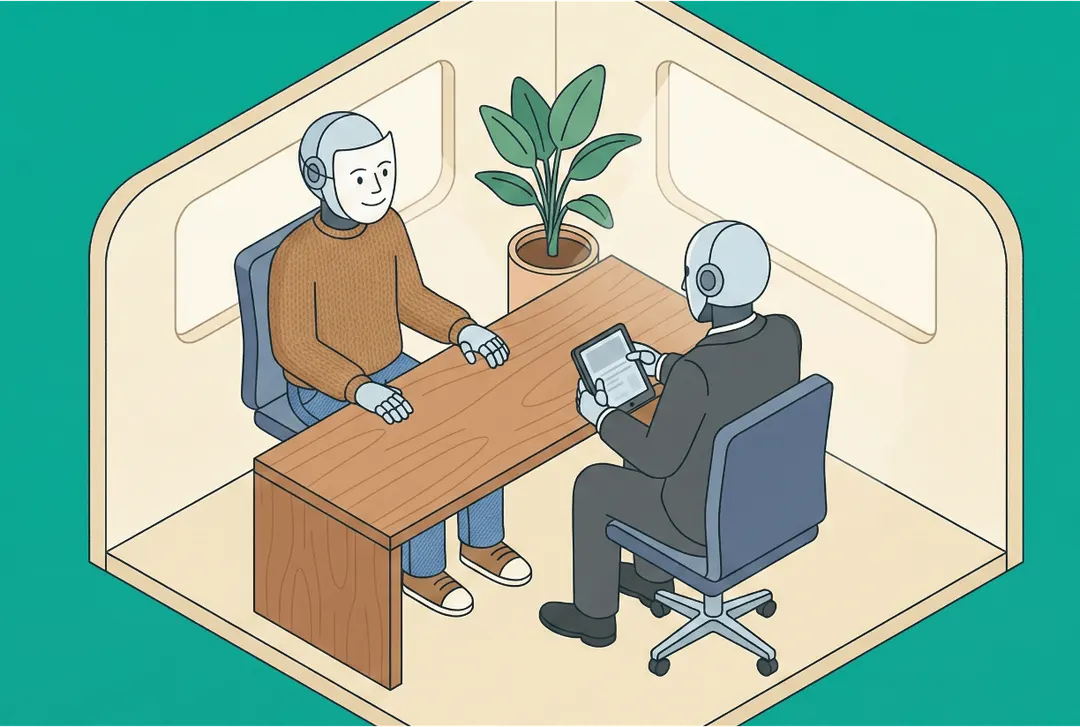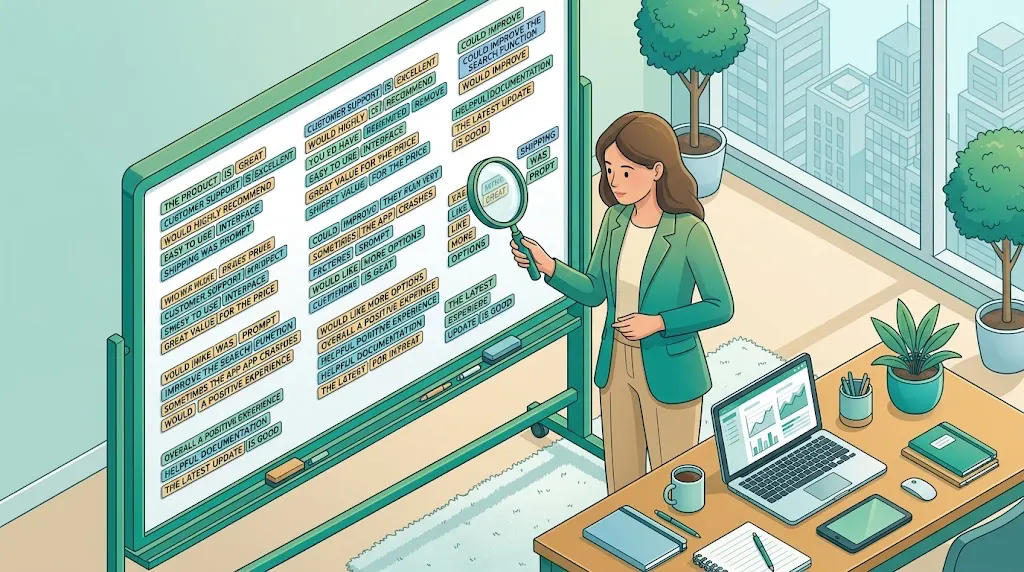
Consulting engagements typically involve a lot of interviews. A commercial due diligence might include 30 expert calls and 20 customer conversations. A customer strategy project might add another 15 internal stakeholder interviews. A market assessment might pull in 25 expert perspectives from across an industry.
The interviews are the easy part. The hard part is the synthesis: moving from dozens of conversations to a coherent, evidence-based narrative that tells the client something they did not already know.
This guide covers the full workflow: how to structure notes for later analysis, how to find the themes across a large interview corpus, and how to translate themes into a client-ready output. It is worth being honest about which direction that workflow runs in; see the bottom-up rigour problem in commercial research for the difference between finding themes and fitting evidence to themes decided in advance.
What makes consulting interview synthesis different
Consulting synthesis is not academic qualitative research. The differences matter for how you approach the workflow.
Hypothesis-driven from the start. Consulting engagements begin with a hypothesis (or a set of hypotheses) that the interview programme is designed to test and refine. You arrive with an issue tree, a set of priority questions, and a view on where you expect the data to land. The interviews either confirm, qualify, or challenge that view. This is a deductive starting frame, not the inductive blank-slate approach of exploratory academic research.
Time pressure is severe. A typical commercial due diligence has 3-4 weeks from kick-off to final report. The synthesis of 30-50 interviews needs to happen in parallel with data collection and in time to write up findings before the deadline. There is no time for the iterative, multi-pass coding that academic thematic analysis prescribes.
Defensibility matters as much as depth. Clients will push back on findings they do not like. "Our customers are happy" is not a finding if you cannot specify how many said so, in what context, and what qualifications they offered. Every claim in a consulting synthesis needs to be traceable to specific evidence.
The output is a narrative, not a codebook. Academic thematic analysis produces a rich account of the themes. Consulting analysis produces a set of answers to the questions in the issue tree, supported by evidence from the interview corpus, framed around implications for the client's decision.
How to take interview notes that are analysable later
The quality of your synthesis depends significantly on the quality of your notes. Notes taken with synthesis in mind are much more useful than notes that capture everything indiscriminately.
Separate observation from interpretation
The most useful note format distinguishes between:
- What the participant said (verbatim where possible for key statements)
- What you concluded from it (your interpretation, clearly marked as such)
Mixing these is the primary source of analytical error in consulting research. By the time you are writing the synthesis, you cannot remember which of your "findings" came directly from participants and which were your inference from what they said.
A practical convention: write participant statements in quotation marks or in a separate column. Write your interpretations in a clearly marked section ("My read: this suggests X").
Capture the specific, not just the general
The most valuable data in an interview is almost never the general summary statement ("the integration process is difficult"). It is the specific detail that illustrates the general claim ("when they upgraded to version 4.2, the API changes broke their billing integration and they were down for three days before getting a resolution"). Specifics are defensible. Generalities are not.
Train yourself to note the specific incident, example, or number whenever you are about to write a general statement. "Several customers mentioned integration problems" becomes useful only when backed by who they were, what the specific problem was, and how they characterised its severity.
Finding the themes: the consulting synthesis workflow
Step 1: Start with the issue tree
Before looking at your notes in aggregate, review your issue tree. The issue tree defines the questions you are trying to answer. Every finding should ultimately connect to one of those questions.
For each branch of the issue tree, you have a hypothesis about what the data will show. Write it down before you read the data. You will look for evidence that confirms, qualifies, or contradicts each hypothesis.
This is the deductive frame: start from the structure, then read the data within it. The risk (confirmation bias) is managed in Step 3.
Step 2: Pull the evidence for each issue tree branch
For each branch of the issue tree, gather all the notes and quotes that are relevant to that question. If you coded your notes as you went, this is a filtering exercise. If not, it requires a read-through.
Summarise what the data shows for each branch in 2-3 sentences. At this point you are not yet writing the narrative; you are building an evidence summary per branch.
Note the distribution: how many interviews gave you relevant evidence on this branch? Of those, how many were consistent with your hypothesis, how many were qualified or mixed, and how many contradicted it?
Step 3: Look for what the issue tree missed
This is the step that distinguishes a good consulting synthesis from a merely competent one.
After mapping all your evidence to the issue tree, ask: what did I hear repeatedly that does not fit anywhere in the issue tree? What were participants telling me that the issue tree did not have a branch for?
Unexpected findings are often the most valuable findings. If 15 of your 30 interviews mentioned a topic that your issue tree had no branch for, that is analytically significant. It means either the issue tree was incomplete or participants are experiencing something that the engagement brief did not anticipate.
If you find significant evidence outside the issue tree, add a branch for it. The issue tree is a tool for organising thinking, not a constraint on what you can conclude.
Step 4: Test the patterns
For each theme or issue tree branch where you have a finding, apply three tests before including it in the synthesis:
Coverage test. How many interviews gave evidence for this finding? A finding based on 2 out of 30 interviews is weak; a finding based on 22 of 30 is strong. State the distribution in your synthesis.
Consistency test. Were the signals all pointing the same direction, or were they mixed? If 15 participants described a problem and 8 described it as a non-issue, you do not have a clean finding; you have a pattern of variation that needs to be explained (perhaps by participant segment or context).
Specificity test. Can you back the finding with specific, concrete evidence (verbatim quotes, specific incidents, numerical claims from participants)? If you can only back it with general impressions, the finding is weak.
Findings that pass all three tests are ready for the synthesis. Findings that fail one or more need either more evidence or more qualification.
Step 5: Build the narrative
A consulting synthesis is structured around the questions in the issue tree, not around the themes as the data presents them. The difference matters: you are answering the client's questions with evidence, not presenting an account of everything you heard.
For each branch of the issue tree:
- State the finding (one sentence: what does the data show about this question?)
- Provide the quantification (how many interviews, what proportion, with what variation by segment?)
- Illustrate with 2-3 specific quotes or examples
- Note the exceptions and qualifications
- State the implication for the client's decision
This structure gives the client both the evidence and the so-what in one block per issue. It is the format most conducive to the follow-up question "but how do you know?" because the evidence is right there with the finding.
Handling large corpora: when AI-assisted synthesis pays off
For a standard 20-30 interview study, an experienced consultant can do the synthesis above manually in 15-25 hours. For a 50+ interview corpus, or for a study where the same research is running repeatedly across time periods, manual synthesis becomes impractical.
AI-assisted analysis changes the workflow at scale. For Skimle:
- Upload all interview notes or transcripts
- Tag each document with the relevant issue tree dimensions as metadata
- Run the analysis, which processes the full corpus and identifies themes with supporting quotes
- Map the AI's themes to your issue tree branches (they will often overlap with high fidelity, and the gaps are analytically interesting)
- Review the supporting evidence for each theme and select your best quotes
- Write the synthesis narrative using the AI's thematic output as the draft structure
For 50+ interviews, this reduces the synthesis time from what would be 40-60 hours of manual work to 15-25 hours of AI-assisted work, with the advantage that every finding is supported by a comprehensive read of all transcripts rather than whatever subset the analyst had time to code.
Noren, a Helsinki-based strategy consultancy, found that before adopting this approach, over 50% of their research time was consumed by back-office work: managing transcripts, coding data, and running preliminary analyses. The AI-assisted approach freed that time for the analytical and client-facing work that actually creates value.
For the practical step-by-step on the upload and analysis workflow, see how to find themes across a large set of interviews.
Presenting qualitative findings: the evidence requirement
In consulting, qualitative findings have a credibility problem. Clients who are accustomed to financial models and market sizing data sometimes treat interview-based findings as impressionistic rather than rigorous. The way to counter this is evidence density: every significant finding backed by specific, attributed quotes.
Use verbatim quotes, not paraphrases. "Customers said they find the integration difficult" is much weaker than "The Head of IT at [company type] told us: 'When we moved to version 4.2 we had our billing API down for three days before we got a response from support.'" Verbatim quotes are real; paraphrases are interpretations.
State the distribution, not just the anecdote. "One customer mentioned this" is different from "22 of 30 customers raised this issue without prompting." Always state how many interviews generated the evidence for each finding.
Separate what participants said from what you inferred. In the slide or document, make visible which statements are direct from participants and which are your analytical interpretation. "Participants consistently described X" is different from "This suggests that the company has a structural problem with Y."
Anticipate and pre-empt the pushback. If you know the client hopes the data will show something different from what it shows, address this directly. "You might expect the primary driver to be pricing, and pricing was mentioned in 12 of 30 interviews. But the evidence on integration quality was more consistent (24 of 30 interviews) and more emotionally salient across the participant set."
For detailed guidance on structuring the presentation of qualitative findings to a leadership or board audience, see presenting qualitative research findings to executives.
Frequently asked questions
How many interviews do you need before synthesis is meaningful?
For a focused research question with a relatively homogeneous participant group, 12-15 interviews often produces stable themes: additional interviews are not generating new patterns. For diverse participant groups (multiple customer segments, multiple stakeholder types, multiple geographies), you need enough interviews within each subgroup to have confidence in the segment-level findings, which typically means 20-35+ in total. For the full analysis of sample size and saturation, see qualitative research sample size.
What do you do when different interviewers took the notes?
Standardise note format before the interview programme begins: agree on what must be captured verbatim, how observations and interpretations are distinguished, and how issue tree tagging works. Review a sample of notes from each interviewer early in the programme and give feedback on consistency. When synthesising notes from multiple interviewers, be transparent about the variation in note quality and adjust your confidence in findings accordingly.
How do you handle contradictory evidence?
Do not average it away. Contradictions in a dataset are analytically significant. If 20 participants describe their satisfaction as high and 10 describe it as low, the finding is not "mixed satisfaction." The finding is: there is a systematic split in the participant set, and the most important analytical task is to understand what explains it. Which segments are satisfied and which are not? What is the difference between the two groups? The contradiction is the finding.
Is it acceptable to use AI to generate the synthesis narrative?
AI-generated drafts of analytical narrative require careful review. The risk is that AI prose sounds confident and structured even when the underlying analysis is weak or the evidence is thin. Use AI tools to process and organise the evidence; write the synthesis narrative yourself, at least for the sections that will face the most scrutiny. The framing of what the findings mean for the client's decision is human work.
Running large interview programmes and need to synthesise faster without sacrificing rigour? Try Skimle for free and see how AI-assisted analysis scales your synthesis capacity without compromising the evidential standard.
Related reading: Turning interview notes into insights at scale | Presenting qualitative research findings to executives | Evidence-based strategy: making sense of unstructured data
About the authors
Olli Salo is a former Partner at McKinsey & Company where he spent 18 years helping clients understand the markets and themselves, develop winning strategies and improve their operating models. He has done over 1000 client interviews and published over 10 articles on McKinsey.com and beyond. LinkedIn profile