Evidence-based strategy means grounding strategic decisions in systematic analysis rather than intuition or seniority. In practice, it means collecting data from the market (customer interviews, competitor intelligence, industry reports, regulatory filings, expert perspectives) and synthesising that data into a rigorous, defensible picture of what is happening and why. The challenge is that most of the data that matters comes in unstructured form: text, transcripts, documents, call notes. This guide covers how to work with it.
What makes strategy evidence-based?
The phrase is sometimes used to mean "we have data to back up our view." That is a low bar. Genuine evidence-based strategy requires three things:
Systematic collection. The evidence base needs to be constructed deliberately, not assembled after the conclusion has been formed. If you are only collecting data that confirms your hypothesis, you have not built an evidence base; you have built a brief for a position you already hold.
Structured analysis. Evidence needs to be processed through an analytical framework, not just read through and summarised. The framework might be simple (what are the main themes? what are the key disagreements? where is the evidence strongest?) or more sophisticated. The point is that the analysis is explicit and reproducible, not the product of a single person's judgement about what the interviews "said."
Transparent connection from findings to recommendations. Strategic conclusions should be traceable back to the evidence. "We recommend exiting this market" should connect, visibly, to what the customer interviews revealed about the competitive dynamics and what the expert calls surfaced about the structural economics.
Most strategy work falls short of this standard, not because the people doing it are not smart, but because the tools for processing unstructured evidence at scale have not kept pace with the volume of data available.
What types of unstructured data matter for strategy?
Customer and user interviews
The richest source of strategic insight, and the most systematically under-used. Customers can tell you things that no amount of transaction data can reveal: why they chose you, why they are considering alternatives, what job they are actually hiring the product or service to do, and what would need to change for them to increase their spending with you.
For consultants, this typically means primary research interviews with the client's customers or with customers in the target market. For internal strategy teams, it often means commissioning a programme of voice of customer research that is run regularly enough to surface changes in the market before they appear in quantitative metrics.
Expert interviews
Expert interviews compress knowledge acquisition. A 45-minute conversation with someone who has spent 20 years in an industry can surface structural dynamics, informal conventions, and competitive dynamics that would take months to assemble from published sources.
The analytical challenge with expert interviews is managing perspective bias. Experts have views. Those views are usually valuable, but they are the views of someone with a specific vantage point in the industry, which may not reflect the full picture. Systematic analysis of multiple expert interviews, coded for where views converge and where they diverge, is considerably more reliable than synthesising expert opinion informally.
Customer feedback and verbatim text
If the client already has customer feedback data (NPS verbatims, support tickets, complaint records, focus group transcripts), this is often the fastest source of strategic insight available. It is also the source most likely to be under-analysed: most organisations have far more verbatim text in their CRM, support platform, and survey archives than they have ever processed systematically. For a practical guide to working with this kind of unstructured text at scale, see AI for qualitative text and data analysis.
For a strategy team, this data can surface patterns that are invisible in the aggregate metrics: specific product dimensions that are generating churn, customer segments with distinctly different value perceptions, complaints that are concentrated in a particular geography or cohort.
Industry and market documents
Annual reports, regulatory submissions, earnings call transcripts, industry association publications, competitor marketing materials, and regulatory filings all contain strategic intelligence. Reading them manually is slow; missing them is a risk.
Earnings call transcript analysis has become a significant tool for competitive intelligence: what senior leadership teams choose to say about growth, competitive dynamics, and strategic priorities in public forums is revealing, and systematic analysis of multiple competitors' transcripts over time shows how the competitive narrative is shifting.
News and market monitoring
Press coverage, analyst reports, and regulatory announcements form the ambient data layer of any market. Most strategy teams monitor these sources informally. The challenge is moving from monitoring (I am aware of what is happening) to analysis (I understand what the pattern of events means for strategy).
The synthesis challenge: why unstructured data is hard
The problem with unstructured data for strategy purposes is not volume; it is heterogeneity. You are trying to synthesise information from sources that are:
- In different formats (transcripts, PDFs, spreadsheets, web pages, notes)
- At different levels of reliability (a direct customer quote vs a secondhand paraphrase vs an analyst estimate)
- Expressing different types of content (factual claims, opinions, predictions, anecdotes)
- Potentially contradicting each other (one expert says the market is growing; another says it is contracting)
Standard synthesis approaches (reading everything and writing a summary, or doing a "consensus view" by averaging perspectives) lose important information. They flatten disagreements (which are often the most analytically interesting signal), they privilege the most articulate sources over the most representative ones, and they make it impossible to trace a conclusion back to its evidentiary basis.
Structured qualitative analysis provides an alternative: code each data source for the same set of themes, then analyse patterns across sources. Where multiple independent sources converge on the same view, confidence in that view is high. Where sources diverge, the divergence itself becomes a finding worth investigating.
A practical workflow for evidence-based strategy
Step 1: Define the strategic question precisely
"What should our market entry strategy be?" is too broad. "What factors explain the difference in retention rates between our B2B and B2C customer segments, and what do customers in each segment say about switching costs?" is a question that evidence can answer.
The more precisely you define the question, the more efficiently you can design the evidence collection. A precise question also makes the synthesis considerably easier: you are looking for specific things rather than reading everything and hoping something useful emerges.
Step 2: Map the evidence sources
Before collecting, map what types of evidence are available and what each can and cannot tell you. A customer interview study tells you about customer perspective. Earnings call analysis tells you about competitor messaging. Expert interviews tell you about structural dynamics. No single source gives you everything; the strategy is knowing which sources to combine.
For each source, also assess: How recent is it? How representative is it? How reliably was it collected? These quality dimensions matter as much as the content when you are drawing strategic conclusions.
Step 3: Collect systematically
The practical advice here is that collection discipline matters. Interviews should be recorded and transcribed, not reconstructed from memory notes. Documents should be gathered comprehensively, not selectively. Customer feedback should be pulled from all relevant channels, not just the most convenient one.
AI transcription has made the recording-and-transcription discipline much less onerous than it was. The practical setup for audio interviews covers the workflow.
Step 4: Structure the data for analysis
Bring all the collected evidence into a single analytical environment. This is where most strategy teams currently fail: the interview notes are in one folder, the PDF reports in another, the call notes from the expert sessions in someone's email. The synthesis happens in someone's head, or in a Word document that combines selected quotes with the analyst's interpretation. The AI document analysis guide covers how to set up a systematic multi-document workflow for exactly this kind of mixed-source evidence base.
Platforms like Skimle allow all types of unstructured data (transcripts, PDFs, web-clipped documents, CSV files with open-text responses) to be uploaded into a single project where they can be analysed together. Documents from different sources are tagged with metadata (source type, date, perspective), enabling cross-source comparison.
Step 5: Apply systematic thematic coding
Code the evidence for the themes that matter for the strategic question. In an evidence-based strategy context, useful coding dimensions often include:
- What is claimed (the substantive content)
- The source's perspective or position (which vantage point is this from?)
- Confidence level (is this a direct observation, a secondhand account, or speculation?)
- Evidence type (qualitative assessment, factual claim, anecdote, projection)
- Agreement or tension with other sources
This coding is what transforms a pile of documents into analysable evidence. Once coded, you can look at patterns: what do customer interviews say about competitive dynamics, and how does that compare to what competitor earnings calls say?
Step 6: Identify convergence, divergence, and gaps
The most valuable analytical output of systematic evidence synthesis is not the consensus view; it is the map of where evidence is strong (multiple independent sources agree) and where it is weak (sources disagree, or the question has not been addressed at all).
Strong convergence increases confidence in strategic conclusions built on that finding. Divergence signals a question that needs more investigation. Gaps signal strategic risks: what do we not know, and does that matter for the decision we need to make?
Step 7: Translate findings into strategic implications
The final step is connecting the analytical findings to the strategic question. This requires judgement, not just pattern recognition. Findings from the evidence base need to be interpreted in the context of the organisation's specific position, the decision it faces, and the constraints it operates under.
For guidance on how to present qualitative evidence to strategy audiences, see presenting qualitative research findings to executives.
Common pitfalls in evidence-based strategy
Confirmation bias in source selection. It is easy to interview customers who are likely to support the hypothesis you are testing, or to read industry reports from analysts who share your prior view. Systematic collection means deliberate effort to include sources likely to challenge the emerging picture.
Over-interpreting thin evidence. Three customer interviews is not a customer evidence base; it is three data points. Three is enough to surface hypotheses for further testing, not enough to support strategic conclusions. Be honest about what the evidence base can and cannot support.
Confusing data collection with analysis. A folder of 40 interview transcripts is not analysis. The synthesis work (identifying themes, mapping patterns, connecting findings to questions) is where the strategic value is created. This work cannot be skipped or rushed.
Losing the connection to evidence in the presentation. Strategy presentations that say "customers told us they want X" without showing which customers, in what context, with what caveats, cannot be stress-tested. When the strategy is challenged, the evidence base needs to be accessible. See win/loss analysis and commercial due diligence for examples of evidence-traceable strategic analysis.
Frequently asked questions
How many interviews are needed to support a strategic conclusion?
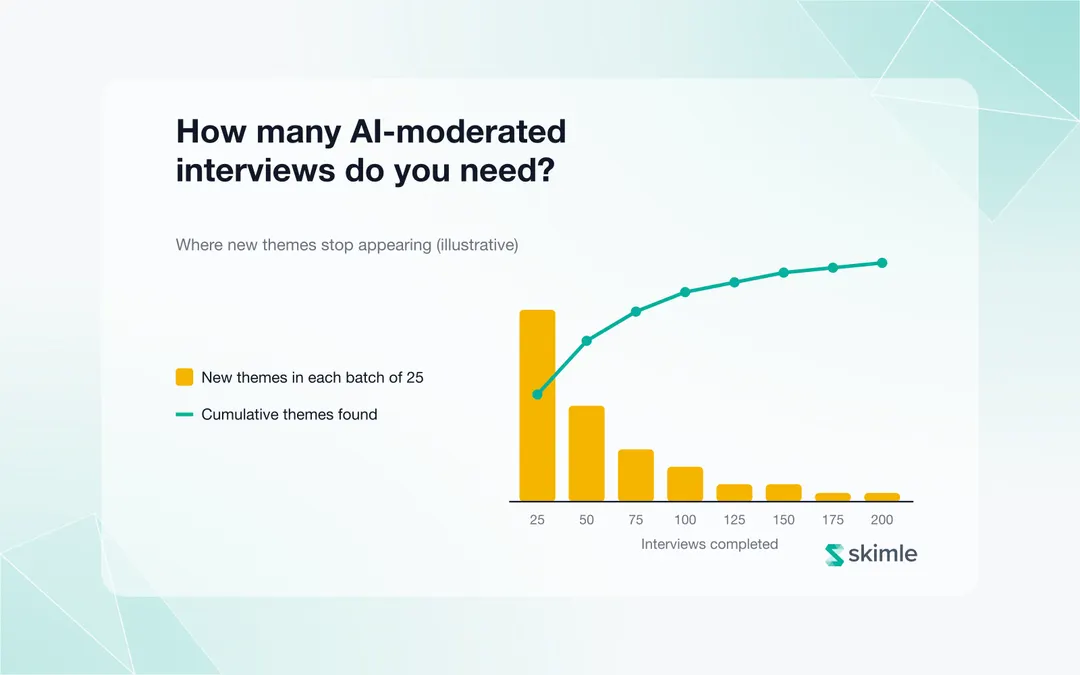
There is no universal number. The right sample depends on the diversity of the market, the strength of the signal, and the consequentiality of the decision. As a rule of thumb: for a market with relatively homogeneous customers and a clear pattern, 15-20 interviews often reaches saturation. For a fragmented market with multiple customer segments, each segment may need its own sample. Qualitative evidence supports strategic hypotheses; quantitative data at scale validates them.
How do you handle contradictory evidence?
Contradictory evidence is not a problem to be resolved by picking the more credible source; it is analytically valuable information. If expert A says the market is growing and expert B says it is contracting, the right response is to understand why they see it differently (different market definitions? different time horizons? different positions in the value chain?) and to report the disagreement transparently as part of the strategic picture.
Can AI fully automate strategy synthesis?
No. AI-assisted analysis can process large volumes of text, identify themes, and surface patterns that would be missed by manual review. What it cannot do is make the interpretive judgements that connect evidence to strategy: what does this pattern mean for this specific organisation in this specific competitive position? That interpretive layer requires human judgement applied to both the evidence and the strategic context.
How is evidence-based strategy different from market research?
Market research is a subset of what evidence-based strategy draws on. Market research typically focuses on understanding customers and competitors. Evidence-based strategy integrates customer evidence with expert intelligence, regulatory and industry analysis, competitive tracking, and internal data, synthesising across all of these into a unified strategic picture. The analytical approach is similar; the scope is broader.
Ready to bring structure and rigour to your qualitative evidence base? Try Skimle for free and see how AI-assisted analysis transforms unstructured interviews, documents and feedback data into a traceable, defensible evidence base for strategy.
Related reading: Qualitative research for consultants: tools and workflow | Commercial due diligence: qualitative analysis of targets and markets | Win/loss analysis: how to systematically learn from deals
About the authors
Henri Schildt is a Professor of Strategy at Aalto University School of Business and co-founder of Skimle. He has published over a dozen peer-reviewed articles using qualitative methods, including work in Academy of Management Journal, Organisation Science, and Strategic Management Journal. His research focuses on organisational strategy, innovation, and qualitative methodology. Google Scholar profile
Olli Salo is a former Partner at McKinsey & Company where he spent 18 years helping clients understand the markets and themselves, develop winning strategies and improve their operating models. He has done over 1000 client interviews and published over 10 articles on McKinsey.com and beyond. LinkedIn profile
Sources
- Evidence-Based Management: From Theory to Practice in Healthcare — Rousseau & Gunia (2016), Annual Review of Organizational Psychology and Organizational Behavior
- Qualitative Research and Evaluation Methods — Patton (2014), SAGE
- Strategic Analysis: Integrating Traditional and Alternative Methods — Fahey & Narayanan (1986), Strategic Planning Management
- The Art and Science of Customer Research — Dillon, Madden & Firtle (1994), Irwin