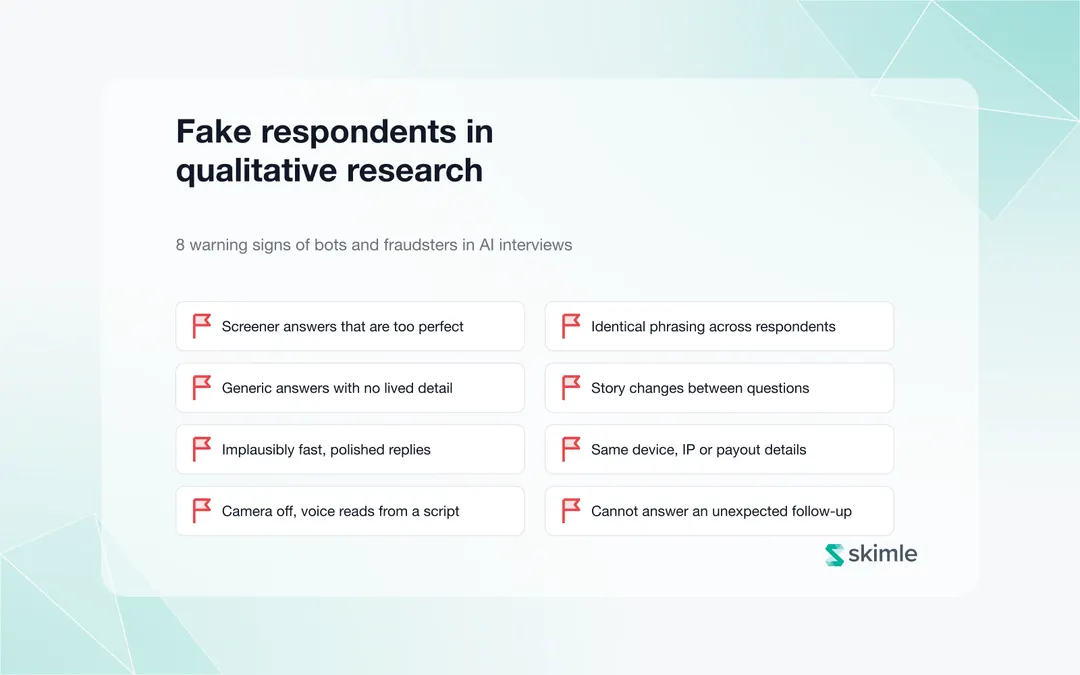
To spot fake respondents in qualitative research, look for screener answers that are too perfect, near-identical phrasing across participants, generic answers with no lived detail, stories that change between questions and implausibly fast, polished replies. Prevent them with tight screeners, identity checks and probing follow-ups, then review suspicious transcripts before analysis, never after.
Survey researchers have fought bots and professional cheaters for twenty years. Qualitative research felt safer: it is hard to fake a 45-minute video interview with a moderator watching. That protection is wearing thin. Online recruitment, text-based and asynchronous interviews, and large language models that can write a convincing answer to any question have brought survey-style fraud into qual.
How common are fake respondents in qualitative studies?
More common than most teams assume. A 2024 study in Health Behavior Research by Thompson and colleagues documented online recruitment for several qualitative projects. In the first, 46% of eligible respondents were suspected to be fraudulent. In a later project the figure was 54% in one sample and 88% in another. These were focus groups and interviews with incentives, recruited through social media, which is exactly the setup many commercial teams now use for fast-turnaround studies.
Those figures describe applicants who passed the screener, not completed interviews, and good screening stops many of them. They still show the scale of the pressure. When an incentive is attractive and the eligibility criteria are published in a recruitment ad, some people will pretend to be whoever the study wants.
Why are AI-moderated interviews more exposed?
AI interviewing removes the cost of a human moderator, which is what makes qual at scale affordable. It also removes the person who would have noticed something odd. Three features of AI and asynchronous interviews increase the exposure:
- Text answers can be generated. A respondent answering by text can paste each question into a chatbot and paste the reply back. The answer will be fluent, on topic and empty.
- Scale hides patterns. A moderator doing 15 interviews notices when two "different" people tell the same story. Across 300 interviews, nobody reads closely enough to see it unless the analysis surfaces it.
- Open links travel. A survey-style invitation link shared outside the intended audience can be picked up by incentive-hunting forums within hours.
None of this means AI interviews are unreliable. It means quality control has to be designed in, as it is for surveys. Our comparison of AI and human interviewing covers the wider trade-offs.
What are the 8 warning signs of a fake respondent?
No single sign proves fraud. Look for clusters: a respondent who shows three or four of these is worth excluding or re-contacting.
- Screener answers that are too perfect. They match every criterion exactly, including the unusual ones, and pick the "right" answer to every trap question you would expect a qualifying respondent to get wrong sometimes.
- Identical or near-identical phrasing across respondents. The same unusual sentence, metaphor or list order appearing in several transcripts is the clearest sign of copy-paste, shared scripts or a single person behind multiple identities.
- Generic answers with no lived detail. Real customers name the shop, the colleague, the month, the price they paid and the thing that annoyed them. Fabricated answers describe the category in the abstract: "I value quality and convenience in my purchasing decisions."
- Stories that change between questions. They have used the product for three years in one answer and "recently started" in another. They manage a team of ten, then describe doing everything alone.
- Implausibly fast, polished replies. Long, well-structured paragraphs returned within seconds, with headings or bullet points, in a context where real people type a few hurried lines.
- Shared technical or payment details. The same device, IP range, email pattern or incentive payout account behind several respondents. Your recruitment platform or panel provider should check these.
- On voice or video: reading, not talking. Long pauses before each answer followed by fluent, flat delivery, or a camera that is always off when the brief asked for it on.
- No answer to an unexpected follow-up. Ask for a specific example and a real respondent gives one, however clumsily. A fake one restates the general claim in different words.
If your team runs fast-turnaround consumer studies, see how this fits the market research and customer insights workflow.
How do you prevent fraud before the interview?
Prevention is cheaper than detection. The main levers sit in recruitment and in how the interview guide is written.
- Hide the eligibility criteria. Never publish who qualifies in the recruitment ad. Ask screener questions with plausible distractor options so the "right" answer is not obvious.
- Use trusted sample sources. Customer lists, CRM samples and verified B2B panels carry far less risk than open social media recruitment. If you must recruit openly, add identity checks such as LinkedIn verification for professionals.
- Use closed, single-use invitation links rather than one public link, and cap completions per source.
- Design the guide to require lived detail. Ask for specific moments: "Think about the last time you bought this. Where were you, and what made you pick it?" These questions are easy for real respondents and hard to fake convincingly.
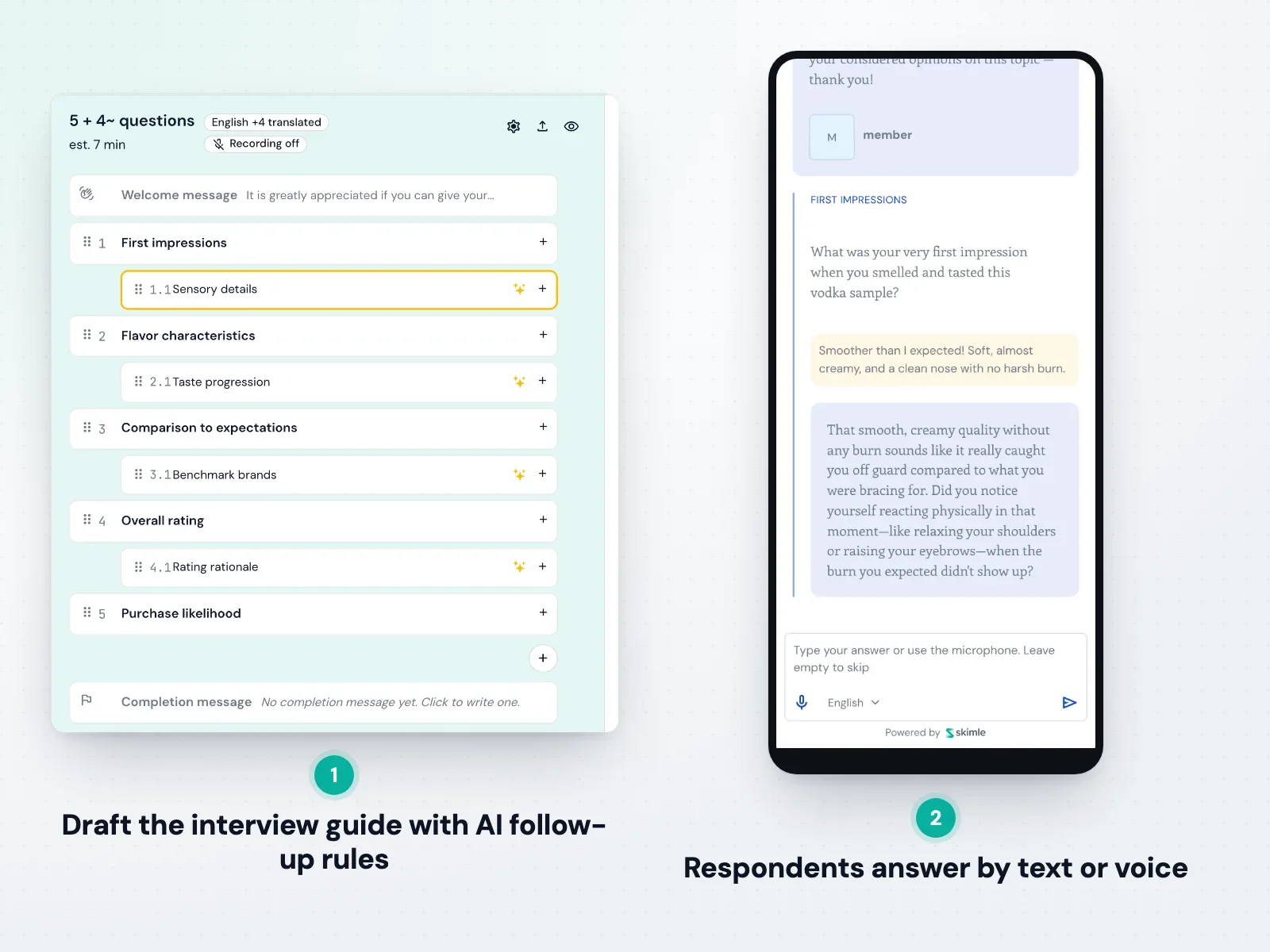
- Use follow-ups. An AI interviewer that asks "can you give me an example?" after a general answer does a lot of fraud screening for free. In Skimle Ask, you set follow-up rules in the interview guide so the interviewer probes vague answers automatically, as in the screenshot below.
- Set incentives sensibly. Very high incentives for very easy qualification attract professional respondents. Pay fairly for the time, and pay after a quality check where your terms allow it.
How do you detect fake respondents after fieldwork?
Even with good prevention, some will get through. Check before analysis, so excluded respondents never shape your themes.
Read for sameness. Analyse the transcripts systematically and look at categories where several respondents use near-identical wording. In Skimle every insight keeps its verbatim quote and links to its respondent, so a cluster of suspiciously similar quotes is easy to see side by side in the categories view.
Check internal consistency. Compare what each respondent said in the screener with what they said in the interview. Attach screener answers as metadata and the mismatches become visible, for example a "heavy user" whose interview reveals they have never opened the app.
Look at the outliers in both directions. Unusually short interviews, unusually long and polished ones, and answers that read like a product brochure all deserve a second look.
Ask the agent to look for you. In a large study, ask an AI assistant that can read the whole dataset to list respondents whose answers lack specific examples, or whose stories contradict themselves. In Skimle, the agentic chat answers with links to the exact quotes, so you can judge each case yourself rather than trusting a fraud score.
Decide and document. Keep a short exclusion log: who was removed and why. It protects the study if a client asks, and it helps your recruitment partner improve.
What about synthetic respondents?
Fraud and synthetic respondents are often confused, and they are different problems. Synthetic respondents are AI-generated personas that a research team uses openly to simulate answers. Fake respondents are people, or bots run by people, pretending to be someone they are not in a study designed for real participants. The first is a methodological choice with known limits, which we cover in our guide to synthetic respondents. The second is contamination that ruins the data without anyone choosing it.
The risk compounds when they meet. A fraudster who uses a chatbot to answer your interview turns your real study into an accidental synthetic one, without the controls a deliberate synthetic study would have.
What should go in a respondent quality checklist?
Use this as a starting point for every online qualitative study:
| Stage | Check |
|---|---|
| Recruitment | Eligibility criteria hidden; trusted sources; single-use links; identity checks for B2B |
| Screener | Distractor options; one open question that requires a specific answer |
| Interview guide | Questions about specific moments; follow-ups on vague answers |
| Fieldwork | Monitor completion speed and source quotas daily |
| Pre-analysis review | Duplicate phrasing; screener vs interview consistency; brochure-style answers |
| Reporting | Exclusion log; final base sizes stated per segment |
Frequently asked questions
Can AI detect AI-written interview answers?
Not reliably on its own. Detectors for AI-written text produce false positives and are easy to evade. The stronger signals are behavioural and contextual: identical phrasing across respondents, missing lived detail, inconsistency with the screener and failure to answer specific follow-ups. Use AI to surface candidates, and let a researcher decide.
Are voice interviews safer than text interviews?
Somewhat. Voice makes copy-paste harder and lets you hear hesitation and natural speech. It does not stop someone who lies about who they are, and voice cloning is improving. Combine voice with good screening rather than relying on it.
Should I pay incentives to suspected fake respondents?
Follow your terms and your panel provider's policy. Most commercial studies state that incentives depend on real participation meeting quality standards. Document the reasons for every exclusion either way.
How many respondents should I over-recruit to allow for exclusions?
For open online recruitment, plan for 10 to 20% exclusions. For customer lists and verified panels, 5% is usually enough. Track your actual rate per source and adjust the next study accordingly.
Running AI-moderated interviews? Try Skimle for free to run interviews with Skimle Ask and analyse every transcript with quotes you can trace back to each respondent.
Related reading:
- How many AI-moderated interviews do you need?
- Best AI interview tools in 2026
- Responsible AI in qualitative market research
About the author
Olli Salo is a former Partner at McKinsey & Company where he spent 18 years helping clients understand the markets and themselves, develop winning strategies and improve their operating models. He has done over 1000 client interviews and published over 10 articles on McKinsey.com and beyond. LinkedIn profile