Market research and customer insights teams choose between five distinct categories of software in 2026: UX research repositories (Dovetail, Condens), CX feedback analytics (Thematic, Chattermill, Enterpret), agency video platforms (Discuss.io, Remesh, Forsta), academic CAQDAS (NVivo, MAXQDA, ATLAS.ti), and AI interview tools. Most are built for one input format and one output, which is why teams commonly end up paying for three.
Why does "market research software" now mean 20 different things?
Ten years ago, a market research team's software stack was short: a survey tool, a CAQDAS package like NVivo for anyone doing qualitative coding, and Excel for everything else. That stack has fragmented badly.
Part of the reason is real specialisation. Video-first interviewing needs different infrastructure to structured feedback triage. Part of the reason is less flattering: once a vendor builds a workflow around one input format (session recordings, support tickets, survey verbatims), broadening it to handle arbitrary documents is a rebuild, not a feature request. So the tool stays vertical, and the researcher ends up stitching together three or four subscriptions to cover one project.
The global insights industry passed $153 billion (€141 billion) in 2024, according to ESOMAR's Global Market Research 2025 report, and continues to grow. That growth has pulled in venture-backed entrants at every layer of the stack, which is why the list below has gotten longer, not shorter, since 2023.
This review covers the full stack, from collection through to analysis. For a narrower breakdown of just the analysis layer, organised by category, see customer research analysis tools: the 2026 landscape by category.
Which market research tools should you know about in 2026?
| Tool | Category | Strongest at | Where it stops |
|---|---|---|---|
| Dovetail | UX research repository | Searchable, well-organised repository of past UX studies with polished sharing | Session/interview recordings; weak on arbitrary document corpora |
| Condens | UX research repository | Clean, affordable repository for smaller UX teams; transparent pricing | Same repository model as Dovetail, smaller feature surface |
| EnjoyHQ | UX research repository | Structured tagging taxonomies and cross-team insight search | Folded into UserTesting's broader video-testing suite |
| Marvin | UX research repository | AI-automated first-pass analysis of recorded sessions | Optimised for recorded sessions, not text-heavy document sets |
| Aurelius | UX research repository | Affinity-mapping synthesis workspace with strong search | Repository and tagging, not full coding methodology |
| Thematic | CX feedback analytics | Explainable themes: showing which phrases drove a result | Structured, continuous feedback (NPS, reviews); not interview-grade coding |
| Chattermill | CX feedback analytics | Breadth of integrations for enterprise-scale CX monitoring | Same structured-feedback focus; limited methodological control |
| Enterpret | CX feedback analytics | Linking feedback themes directly to roadmap decisions | Product feedback streams; not built for one-off qual studies |
| unwrap.ai | CX feedback analytics | Bug and feature-request synthesis for engineering teams | Ticket and review volume, not open-ended interview transcripts |
| Qualtrics XM Discover | Enterprise CX suite | Enterprise survey rigour with text analytics attached | Heavy implementation; survey-centric by design |
| Medallia | Enterprise CX suite | Omnichannel CX programmes at real enterprise scale | Counts and sentiment distributions rather than thematic depth |
| Discuss.io | Agency video platform | Recruitment, screening and live moderated video sessions | Session capture and recruitment, not document analysis |
| Remesh | Agency video platform | Real-time structured signal from up to ~1,000 participants at once | Directional reads, not close coding of individual narratives |
| Forsta | Agency full-suite platform | One vendor covering both quant surveys and qual research | Broad but heavy; absorbed into Qualtrics in 2026 (see below) |
| NVivo | Academic CAQDAS | Deep manual coding: node hierarchies, matrix coding, IRR checks | Academic workflows, steep licensing, weak collaboration |
| MAXQDA | Academic CAQDAS | Mixed-methods work and multi-speaker focus group handling | Same academic single-user model as NVivo |
| ATLAS.ti | Academic CAQDAS | Visual network and relationship mapping between codes | Academic and dissertation use, not client deliverables |
| Outset.ai | AI interview tool | AI-moderated interviews run at scale without schedulers | Data collection only; hands off to a separate analysis tool |
| User Interviews | AI interview / recruiting | Fast access to a recruited, screened participant pool | Recruiting and moderation, not deep coding |
| Synthetic Users | AI interview tool | Cheap, instant directional signal for early-stage concepts | Simulated data, not analysis of real qualitative data |
| Skimle | AI-native qualitative analysis | Versatile inputs (documents, transcripts, audio, surveys) with rigorous, two-way traceable coding | Not a live-session moderation tool or a UX-specific session repository |
What do these market research tools actually cost?
Pricing is the first thing most buyers want and the hardest thing to find, because roughly half this list sells only through sales-led enterprise contracts. Rough 2026 bands:
| Tool | Indicative 2026 cost | Transparency |
|---|---|---|
| Skimle | Free trial; paid starting at €20 ($22)/month including team access | Published |
| Condens | €500 ($545)/month for five business licenses | Published |
| Marvin | Free tier; $39 (€36) per user/month (for teams) | Published |
| Aurelius | From approximately $49 (€45)/month, scaling for teams | Published |
| ATLAS.ti | $670 (€615)/year business subscription | Published |
| NVivo | ~$790 (€730)/year academic; commercial licences higher | Published |
| MAXQDA | ~$990 (€900)/year per user | Published |
| Dovetail | Enterprise custom quote (mid-tier self-serve plans removed from public pricing in 2026) | Quote only |
| Qualtrics | Median contract ~$28,500 (€26,000)/year; range $6,500–$126,000 (€6,000–€116,000) | Quote only |
| Thematic | Enterprise quote; one source cites a foundation tier from ~$25,000 (€23,000)/year | Quote only |
| Remesh | Enterprise quote, reportedly from ~$10,000+ (€9,200+)/year | Quote only |
| Medallia | ~$20,000 (€18,500)/year entry to $500,000+ (€460,000) for mature programmes | Quote only |
| Discuss.io | Full studies commonly $15,000–$27,000 (€13,800–€24,900) per study | Quote only |
| Chattermill, Enterpret, unwrap.ai, EnjoyHQ, Forsta | Enterprise quote, scaled to feedback volume and team size | Quote only |
The CX analytics and agency platform categories are almost entirely sales-led, with entry points in the five-figure annual range, while the UX repository and CAQDAS categories are mostly transparent and sit one or two orders of magnitude lower. If you are a small insights team or a boutique agency, that gap alone eliminates about half this list before you compare a single feature.
Skimle sits in the transparent half of that table, starting at €20 ($22) per month with a free trial, so structured analysis can be tested on your own transcripts before booking a single sales call. See how it fits market research and customer insights teams.
UX research repositories: are they right for market research?
Dovetail, Condens, Aurelius, and Marvin all solve the same problem: a UX research team runs a lot of small studies and needs a searchable home for the clips, tags, and highlight reels that come out of them. EnjoyHQ used to compete directly in this space; it is now part of UserTesting's broader video-testing platform rather than a standalone product.
They differ more than the category label suggests:
- Dovetail is the most feature-complete and the most expensive, and has moved decisively upmarket: its 2026 public pricing lists only a free tier and a custom-quoted Enterprise plan, with recent product messaging focused on AI agents and enterprise governance.
- Condens is the transparent-pricing alternative, cheaper and lighter, and a sensible pick for a small UX team that wants a repository without a sales call.
- Marvin leans hardest into automation, running an AI first pass over recorded sessions rather than expecting a researcher to tag manually. It is the closest thing in this category to an analysis tool rather than a filing system.
- Aurelius is built around affinity-mapping synthesis, which is closer to how a UX team runs a workshop than to how a market researcher builds a codebook. That makes it a good fit for design synthesis and a poor one for systematic coding.
That repository model is useful for a product design team. It is a poor fit for a market research agency or an in-house consumer insights function running larger studies with client deliverables, metadata-driven segmentation, and a need to defend a finding back to its source. We cover that mismatch in detail in our Dovetail and Condens alternatives for market research teams post, and go three-way in Skimle vs Dovetail vs Condens.
CX feedback analytics: can they replace qualitative analysis?
Thematic, Chattermill, Enterpret, and unwrap.ai occupy a category that did not really exist five years ago: continuous, automated theme detection across large, structured feedback streams (NPS scores, app store reviews, support tickets, sales call notes). Qualtrics XM Discover and Medallia operate at enterprise scale in a related but heavier category, wrapping text analytics into a full experience management suite.
These platforms are excellent at what they are built for: watching a firehose of short, structured feedback and surfacing sentiment shifts over time. They are not designed for the workflow a market researcher runs when they need to code 40 in-depth interviews against a bespoke framework, trace every finding back to its source quote, and hand a client a defensible, auditable analysis. We compare that category directly in Thematic vs Chattermill vs Enterpret.
Agency platforms: what happens after the session ends?
Discuss.io and Remesh are video-first: they exist to recruit participants, run live moderated sessions or large-scale AI-moderated conversations (Remesh can run sessions with hundreds of participants simultaneously across dozens of languages), and record the result. Forsta, formed from the 2021 merger of Confirmit and FocusVision, is the broadest of the three, combining quantitative survey tooling with qualitative research features in one suite.
All three are strong at getting the conversation to happen. None of them is a specialist qualitative analysis engine once the recording exists, which is where a separate tool typically takes over. Forsta's position also just changed materially: Qualtrics completed a $6.75 billion (€6.2 billion) acquisition of Press Ganey Forsta in May 2026, folding it into a combined healthcare-and-experience-management platform. We go deeper on what that means for agencies evaluating these tools in Discuss.io vs Remesh vs Forsta. If your platforms of choice are specifically for focus group work, focus group analysis software: the analysis chain and how 8 tools compare in 2026 puts Remesh and Forsta alongside MAXQDA, ATLAS.ti, Looppanel, Civicom and Otter.ai across the full transcription-to-synthesis chain.
Academic CAQDAS: does NVivo still fit commercial research?
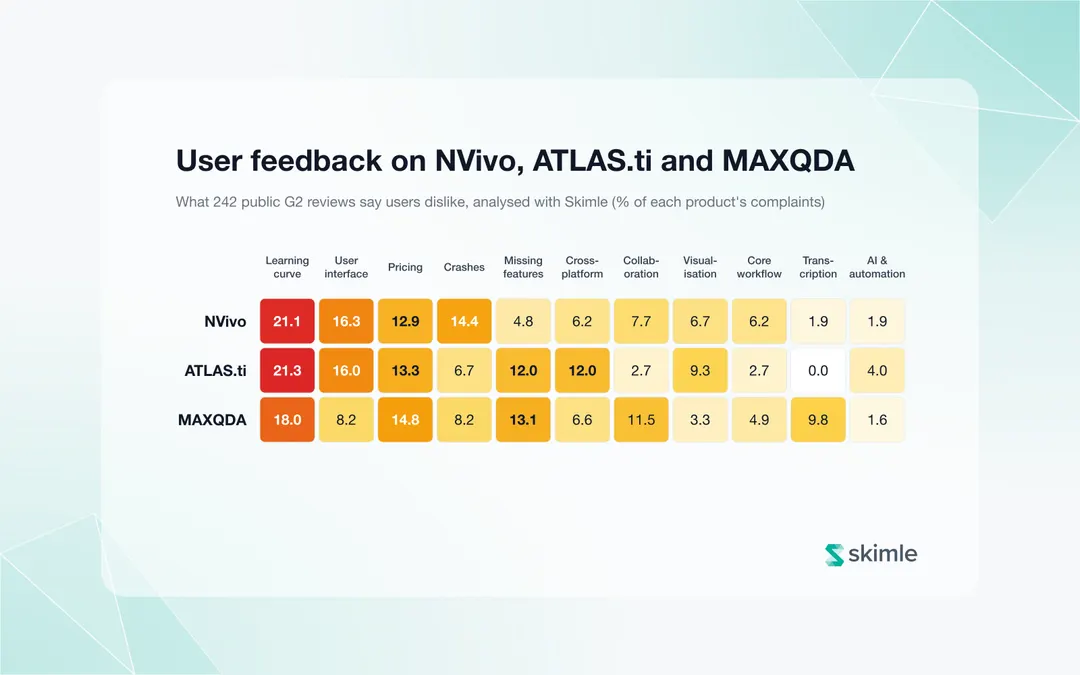
NVivo, MAXQDA, and ATLAS.ti remain the default answer when someone says "qualitative analysis software," largely because they are what PhD programmes teach. They are capable manual coding tools. They were designed for a single academic researcher working through one study, not for a commercial team running parallel projects with client reporting, metadata-driven cross-tabs, and a codebook that needs to survive staff turnover. See our full NVivo, MAXQDA, and ATLAS.ti comparison and NVivo alternatives for more on that gap.
AI interview tools: who analyses the data they collect?
Outset.ai, User Interviews, and Synthetic Users sit earlier in the pipeline than everything above: they help you collect qualitative data rather than analyse it. They are also three quite different propositions that often get lumped together:
- Outset.ai runs AI-moderated interviews, so a study that would need a moderator's calendar for three weeks can field in days. The trade-off is that an AI moderator probes less adaptively than a skilled human on an unexpected answer.
- User Interviews is fundamentally a recruitment marketplace with moderation tooling attached. If your bottleneck is finding qualified participants rather than talking to them, this is the category-correct tool.
- Synthetic Users generates simulated respondents rather than recruiting real ones. It is the most contested tool on this list, and worth reading our assessment of synthetic respondents before using it for anything a client will act on. Simulated data can be useful for pressure-testing a discussion guide; it is not evidence about a real market.
Each hands off to a separate tool once the conversations exist. That handoff is exactly where a rigorous analysis layer matters most, because the value of a well-collected interview evaporates if the coding underneath it is superficial. Skimle's own Skimle Ask sits in this collection layer too, with the difference that responses land directly in the analysis environment rather than needing an export.
Where does Skimle fit against 20 vertical tools?
We make one of the 20 tools, so treat this as a landscape review with a stated point of view rather than a neutral analyst report.
Where we think Skimle stands out from other market research tools is our versatility. Every category above optimised for one input format and one workflow: sessions for UX repositories, structured feedback for CX analytics, live video for agency platforms, single-researcher manual coding for CAQDAS, collection for AI interview tools. That specialisation is understandable, but it means a team doing real market research work often needs three subscriptions and a manual handoff between them. And considering the price tags aimed at large enterprises, using multiple tools often results to eye-watering invoices...
Skimle takes documents, interview transcripts, survey exports, PDFs, audio, and video transcripts as input, automatically or manually codes them against a rigorous, bottom-up thematic structure, and exports to REFI-QDA, Word, Excel, or a written research report. Every insight traces back to its source excerpt in both directions: from finding to quote, and from document to what was and was not coded, which is the check that catches what an automated pass missed. That two-way traceability is what a market researcher needs to defend a conclusion to a client, and it is largely absent from the fixed-vertical tools above.
| Dimension | Fixed vertical tools (typical) | Skimle |
|---|---|---|
| Input formats | One primary format (sessions, tickets, or live video) | Documents, transcripts, audio, video, survey exports, PDFs |
| Analysis depth | Automated tagging or single-researcher manual coding | Structured bottom-up coding, inductive or deductive, editable throughout |
| Traceability | Usually one-directional (finding to source) | Two-way: finding to source, and document to coded/uncoded |
| Output formats | Locked to the platform's own dashboard | REFI-QDA, Word, Excel, written reports |
| Team workflow | Built for one persona (UX researcher, CX analyst, or academic) | Shared, editable analytical structure across a research team |
If your team is only ever going to do one of these jobs, the specialist tool for that job may well be the right call, and we say so directly in each of the comparison posts linked above. If your team's actual job is producing defensible qualitative research across whatever format the data arrives in, that is the gap Skimle was built to close. See how it fits your workflow specifically if you work in market research or customer insights, or in product research.
Frequently asked questions
What is the difference between a CX feedback analytics platform and a qualitative analysis tool?
A CX feedback analytics platform (Thematic, Chattermill, Enterpret) is built to watch a continuous stream of short, structured feedback (NPS comments, reviews, tickets) and surface sentiment and theme trends automatically. A qualitative analysis tool is built for deeper, often interview-based data where a researcher needs to build and refine a coding framework, trace findings to source, and produce a defensible written analysis.
Is NVivo still relevant for commercial market research in 2026?
NVivo remains widely used in academic settings but is a weaker fit for commercial market research, where teams need multi-project client work, collaborative coding, and export formats suited to stakeholder reporting rather than a single researcher's dissertation workflow.
Can I use a UX research repository like Dovetail or Condens for market research?
You can, but the tools were designed around UX session repositories rather than market research deliverables. Metadata-driven segment analysis, multi-client project management, and structured export formats are typically thinner than in tools built specifically for market research and customer insights teams.
Why did Forsta get acquired by Qualtrics?
Qualtrics completed a $6.75 billion (€6.2 billion) acquisition of Press Ganey Forsta in May 2026 to combine Forsta's research and experience technology with Press Ganey's healthcare experience data, expanding Qualtrics' position in experience management. The deal shifts Forsta's near-term strategic focus toward healthcare, which is worth factoring in if you are a market research agency evaluating it as a long-term platform.
Do I need more than one tool from this list?
Often yes, but the answer might change with integrated tools like Skimle. A team might use Discuss.io or Remesh to run and record sessions, then need a separate tool to code and analyse the transcripts with real rigour. The handoff between collection and analysis tools is exactly where quality gets lost if the receiving tool is not built for it. With Skimle you can use Skimle Ask to collect responses or analyse data from any data source that can export audio, video, text or tabular data. You can anonymise, analyse, visualise and export ready reports in one platform with full collaboration options.
Which market research tools publish transparent pricing?
Condens, Marvin, Aurelius, Skimle, NVivo, MAXQDA, and ATLAS.ti publish pricing openly. Dovetail publishes only a free tier and a custom Enterprise quote as of 2026. The CX analytics platforms (Thematic, Chattermill, Enterpret, unwrap.ai) and agency platforms (Discuss.io, Remesh, Forsta) are all sales-led with no public pricing, typically starting in the five-figure annual range.
What is the cheapest credible option for a small insights team?
For a small team or boutique agency needing real analysis rather than just storage, the transparent-pricing tools sit in the €15–€100 ($16–$109) per month range: Condens for a repository, Skimle for structured analysis with client-ready export. The enterprise CX and agency platforms are generally out of reach below a five-figure annual budget.
Ready to see how a single tool handles the input formats these platforms split across three subscriptions? Try Skimle for free and run your own documents, transcripts, or survey exports through a rigorous, traceable analysis.
Want the detailed comparisons? Read Thematic vs Chattermill vs Enterpret, Discuss.io vs Remesh vs Forsta, and our complete qualitative data analysis tools comparison.
About the authors
Olli Salo is a former Partner at McKinsey & Company where he spent 18 years helping clients understand the markets and themselves, develop winning strategies and improve their operating models. He has done over 1000 client interviews and published over 10 articles on McKinsey.com and beyond. LinkedIn profile