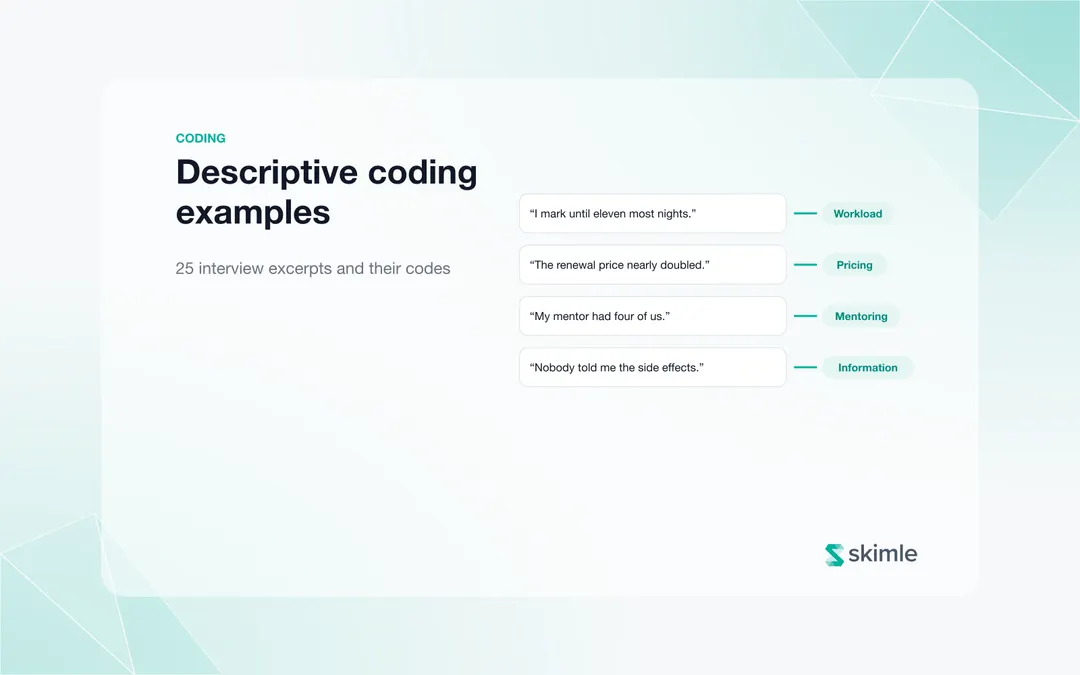
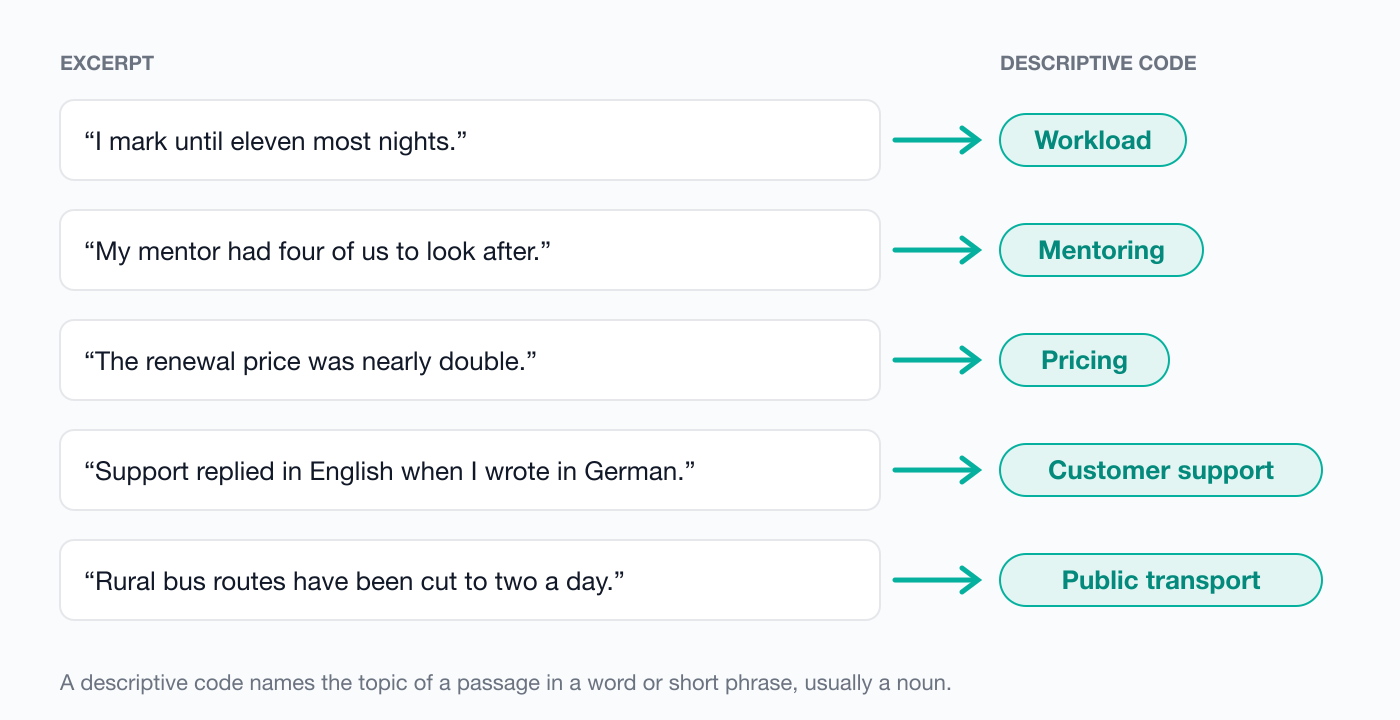
A descriptive code is a word or short phrase, usually a noun, that names the topic of a passage: what it is about, not what it means. "We had to queue outside for an hour" gets the descriptive code waiting; "My manager never asks how I am" gets manager relationship. This guide gives 25 worked examples from five fields, shows how descriptive codes differ from other code types, and explains how to do descriptive coding step by step.
Descriptive coding is usually the first pass through qualitative data. It gives you an index of what is in the transcripts before you start interpreting what it means. Johnny Saldaña's The Coding Manual for Qualitative Researchers describes it as summarising the basic topic of a passage, and recommends it for beginners, for data from many different sources and for studies that need an inventory before deeper analysis. For the full method, see our step-by-step guide to descriptive coding.
What do descriptive codes look like in practice?
Each table below takes five short excerpts from one field and gives the descriptive code a researcher would assign. Notice that every code is a topic label you could file the excerpt under, and none of them is a judgement about it.
Healthcare: patient interviews about chronic illness
| Excerpt | Descriptive code |
|---|---|
| "I take eleven tablets a day and I've stopped knowing what half of them are for." | Medication |
| "The appointment lasts seven minutes. By the time I've sat down it's over." | Consultation length |
| "My daughter drives me to every appointment now." | Family support |
| "I stopped going to the choir because I couldn't stand for long." | Social activities |
| "Nobody told me the side effects would include this tiredness." | Information from clinicians |
Education: interviews with newly qualified teachers
| Excerpt | Descriptive code |
|---|---|
| "My mentor was brilliant but she had four of us to look after." | Mentoring |
| "I mark until eleven most nights." | Workload |
| "Year 9 on a Friday afternoon is a different school." | Behaviour management |
| "I'd never been taught how to talk to an angry parent." | Parent communication |
| "I applied for a job abroad in my second term." | Leaving intentions |
HR: exit interviews
| Excerpt | Descriptive code |
|---|---|
| "The new role pays twenty per cent more for the same work." | Pay |
| "I asked three times about a promotion path and got nothing concrete." | Career progression |
| "After the reorganisation I reported to someone I'd never met." | Reorganisation |
| "Hybrid was fine until they started counting office days." | Office attendance policy |
| "I'll miss the team more than anything." | Colleagues |
Customer research: interviews with customers who cancelled
| Excerpt | Descriptive code |
|---|---|
| "The setup took us two weeks and we never really finished it." | Onboarding |
| "Support replied in English when I wrote in German." | Customer support |
| "The renewal price was nearly double the first year." | Pricing |
| "We moved to a tool our parent company already used." | Group-level decision |
| "The export to Excel broke every time we had more than a thousand rows." | Data export |
Policy: public consultation responses
| Excerpt | Descriptive code |
|---|---|
| "Rural bus routes have been cut to two a day." | Public transport |
| "Small firms cannot afford a compliance officer for this." | Compliance costs |
| "The consultation document is 140 pages long." | Consultation process |
| "Our members support the target but not the deadline." | Timeline |
| "Enforcement should sit with local authorities, not a new agency." | Enforcement responsibility |
How does a descriptive code differ from other kinds of code?
The same excerpt can be coded in several ways, depending on the method and how far into the analysis you are. Descriptive coding is the most literal; the others add interpretation or keep the participant's own words.
| Code type | What it captures | Code for "Nobody told me the side effects would include this tiredness." |
|---|---|---|
| Descriptive | The topic | Information from clinicians |
| In vivo | The participant's own words | "Nobody told me" |
| Process | An action, as a gerund | Discovering side effects |
| Emotion | A feeling | Frustration |
| Interpretive or analytic | What the passage means for the research question | Feeling left out of one's own treatment |
Descriptive codes are the safest starting point because two researchers are likely to agree on them, and they build an index you can search later. Interpretive codes do more analytical work but need a clear rationale. Our guide to qualitative coding covers open, axial, selective and in vivo coding in more depth, and inductive, deductive and abductive coding explains where your codes come from.
How do you do descriptive coding step by step?
- Read the data first. Read several transcripts in full before coding anything, so the codes reflect what is there rather than what you expected.
- Mark meaningful segments. A segment is a passage about one topic; it may be a sentence or a paragraph.
- Name the topic with a noun. Ask "what is this about?" and answer in one to three words: workload, pay, consultation length.
- Reuse codes consistently. Keep a running codebook with a one-line definition for each code, and apply the same code wherever the same topic comes up.
- Review and merge. After a few transcripts, merge codes that overlap (pay and salary), split codes that hold two topics, and note any change in your memo.
A typical interview study ends up with 20 to 60 descriptive codes. Fewer usually means the codes are too broad to be useful; many more usually means synonyms that need merging.
Doing this by hand across 30 transcripts takes days, and keeping codes consistent from the first transcript to the last is the hard part. Skimle runs a first descriptive pass across every document at once, from your own codebook or from scratch, and keeps every code linked to the passages behind it so you can review, rename and merge. See how it fits academic researchers and the predefined categories mode for coding with your own codebook.
What are the most common descriptive coding mistakes?
| Mistake | Example | Better |
|---|---|---|
| Interpreting instead of describing | Toxic culture | Team culture (keep the judgement for later) |
| Too vague | Experience | Onboarding experience |
| Too specific to reuse | Waited 20 minutes on 3 May | Waiting time |
| Using verbs or sentences | Customer complains about price | Pricing |
| Synonyms left unmerged | Pay, salary, compensation | Pay, defined once in the codebook |
How do descriptive codes become themes?
Descriptive codes are an index, not a finding. The next step is to group them into categories and then ask what the grouped material says about your research question. In the exit interview example, pay, career progression and reorganisation might group into a category about reasons for leaving, and reading across those passages might produce a theme such as "people left when the organisation stopped explaining their future". That theme is interpretive; the descriptive codes are what let you find and defend it.
For the full move from codes to themes, see how to code qualitative data, the complete guide to thematic analysis and, for a doctoral project, our guide for PhD students analysing interviews.
Frequently asked questions
What is an example of descriptive coding?
The excerpt "I mark until eleven most nights" from an interview with a teacher would be given the descriptive code workload. The code names the topic of the passage in one word, without judging it.
What is the difference between descriptive coding and in vivo coding?
A descriptive code is the researcher's own label for the topic, usually a noun. An in vivo code uses the participant's exact words as the code, in quotation marks. "Nobody told me" is an in vivo code; information from clinicians is the descriptive code for the same passage.
Is descriptive coding inductive or deductive?
It can be either. Codes can be created from the data as you read (inductive) or taken from a codebook based on your research questions or theory (deductive). Many projects start with a few deductive codes and add inductive ones as new topics appear. See deductive coding in qualitative research for the codebook-led approach.
How many descriptive codes should I have?
Usually 20 to 60 for an interview study of 15 to 30 participants. The right number is the one that lets you find every passage on a topic without codes overlapping.
Can AI do descriptive coding?
Yes, and it is one of the tasks AI does well, because descriptive codes describe rather than interpret. Use a tool that shows the passage behind every code and lets you edit the codebook, rather than one that returns a list of topics you cannot check.
Want to see descriptive coding on your own transcripts? Create a free Skimle account and run a first coding pass in minutes, with every code linked to its source passage.
Related reading:
- How to do descriptive coding: a step-by-step guide
- Deductive coding in qualitative research
- Qualitative coding: open, axial, selective and in vivo
- Qualitative data examples: 20 real examples across 8 types
About the authors
Henri Schildt is a Professor of Strategy at Aalto University School of Business and co-founder of Skimle. He has published over a dozen peer-reviewed articles using qualitative methods, including work in Academy of Management Journal, Organisation Science, and Strategic Management Journal. His research focuses on organisational strategy, innovation, and qualitative methodology. Google Scholar profile
Olli Salo is a former Partner at McKinsey & Company where he spent 18 years helping clients understand the markets and themselves, develop winning strategies and improve their operating models. He has done over 1000 client interviews and published over 10 articles on McKinsey.com and beyond. LinkedIn profile
Sources
- Saldaña, J. (2021). The coding manual for qualitative researchers (4th ed.). SAGE.
- Using thematic analysis in psychology - Braun and Clarke (2006), Qualitative Research in Psychology