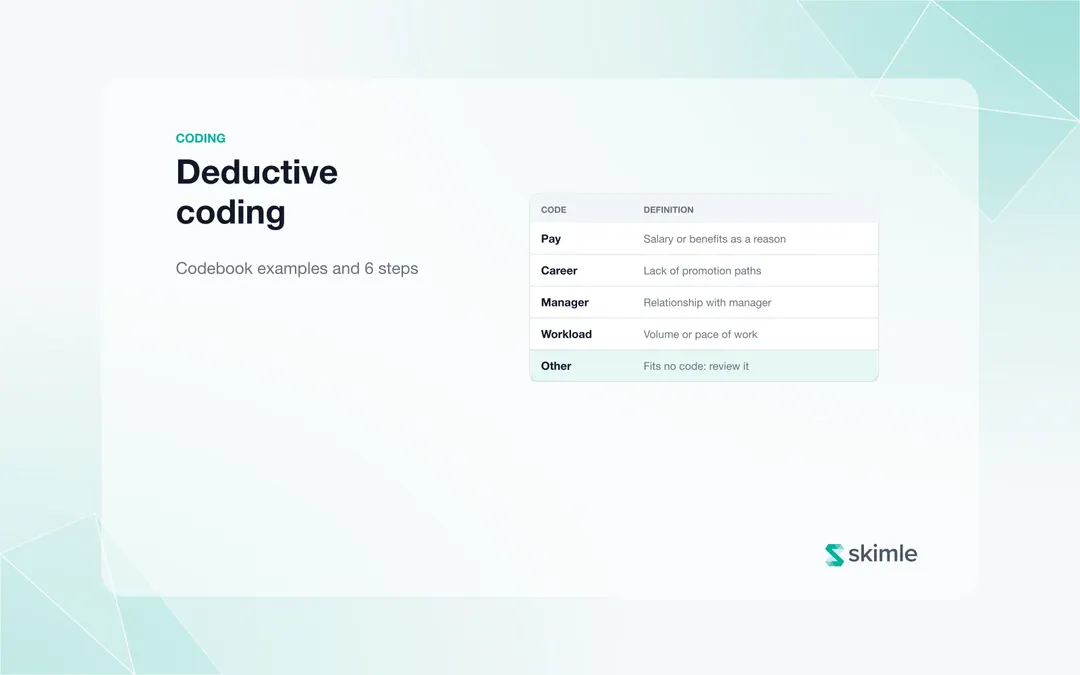
Deductive coding means coding qualitative data with a set of codes decided before you start, taken from a theory, a framework, earlier research or your research questions. You build a codebook with a definition for each code, apply it to every transcript, and record what fits each code. It is the opposite of inductive coding, where codes come out of the data. Most studies combine the two: a deductive starting codebook plus new codes for what the theory missed.
Deductive coding suits studies that test or extend an existing framework, evaluations with predefined questions, and team projects where several people must code the same way. This guide gives a worked codebook example, the six steps, a comparison with inductive coding, and the mistakes to avoid.
What is deductive coding?
In deductive coding the categories come first. You might take the five dimensions of a service quality model, the barriers listed in a policy framework, or the questions in your interview guide, and turn each into a code with a clear definition. You then read every transcript and assign passages to those codes.
The approach is sometimes called a priori coding, and it is the basis of several established methods: directed content analysis, which Hsieh and Shannon (2005) describe as starting from an existing theory to guide the initial codes; framework analysis, which charts data into a predefined matrix; and codebook thematic analysis. Reflexive thematic analysis can include deductive elements too, but is mainly inductive; see Braun and Clarke's reflexive thematic analysis.
What does a deductive codebook look like?
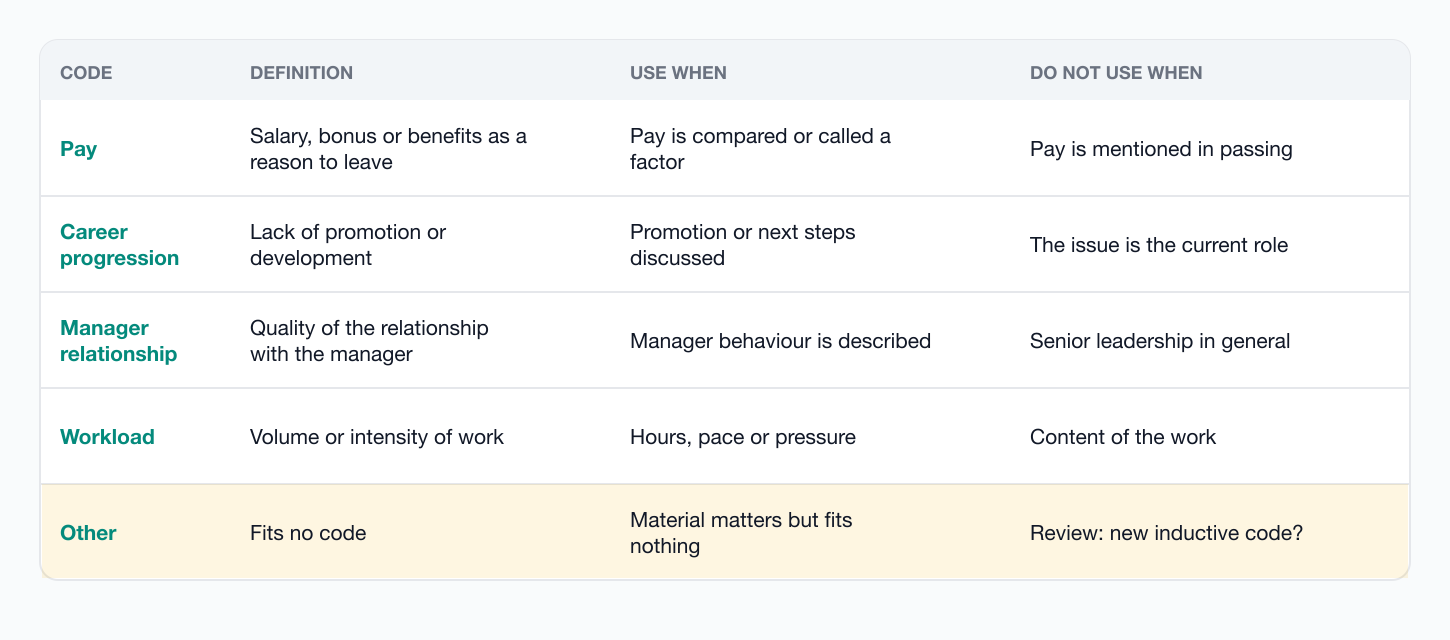
A good codebook gives every code a definition and rules for when to use it, so that two people would code the same passage the same way. Here is a short codebook for a study of why employees leave, built from the push and pull factors in the turnover literature.
| Code | Definition | Use when | Do not use when | Example excerpt |
|---|---|---|---|---|
| Pay | Salary, bonus or benefits as a reason to leave | The participant compares pay or calls it a factor | Pay is mentioned only in passing | "The new role pays twenty per cent more for the same work." |
| Career progression | Lack of promotion or development opportunities | Promotion, learning or next steps are discussed | The issue is the current role's content | "I asked three times about a promotion path and got nothing concrete." |
| Manager relationship | Quality of the relationship with the direct manager | The participant describes their manager's behaviour | Senior leadership in general (use Leadership) | "My manager never asked how I was doing." |
| Workload | Volume or intensity of work | Hours, pace or pressure are described | Content of the work (use Role fit) | "I was covering two jobs for most of last year." |
| External pull | An offer or opportunity elsewhere | A specific alternative is named | General dissatisfaction with no alternative | "A former colleague offered me a role at her start-up." |
Five to fifteen deductive codes is typical for a focused study; framework analysis projects may use more, organised into a hierarchy.
How do you do deductive coding in 6 steps?
- Choose the source of your codes. A theory, a framework, previous studies or your research questions. Name it in your methods section.
- Write the codebook. Give each code a name, a definition, inclusion and exclusion rules and an example. Vague definitions are the main source of inconsistent coding.
- Pilot it on two or three transcripts. Check whether every code is used, whether passages fit more than one code, and whether important material fits none.
- Refine and freeze a version. Tighten definitions, merge or split codes, and record the changes. If several people code, compare their coding on the pilot transcripts and discuss disagreements.
- Code the full dataset. Apply the codebook consistently. Keep a separate other or new code for material that matters but fits no code.
- Review what did not fit. Material in other is often the most interesting finding. Decide whether it becomes a new inductive code, which makes your approach hybrid.
What is the difference between deductive and inductive coding?
| Deductive coding | Inductive coding | |
|---|---|---|
| Where codes come from | Theory, framework or research questions | The data itself |
| When codes are fixed | Before coding starts | During coding |
| Best for | Testing or extending a framework, evaluations, team coding | Exploring new topics, building theory |
| Main strength | Consistency and comparability | Openness to the unexpected |
| Main risk | Forcing data into categories and missing what does not fit | Codes that drift or depend on one coder |
| Typical methods | Directed content analysis, framework analysis, codebook TA | Grounded theory, reflexive TA, IPA |
Most studies are hybrid. Fereday and Muir-Cochrane (2006) describe a widely cited approach that starts with a deductive codebook and adds inductive codes during analysis. Our guide to inductive, deductive and abductive coding compares all three and explains when to use each, and inductive vs deductive research covers the same distinction at the level of research design.
Applying a codebook consistently across 30 or 300 transcripts is where deductive coding gets slow, and where coders drift. Skimle applies your own codebook to every document as predefined categories, shows the passages behind each code so you can check them, and can propose new codes for material that fits none, which gives you a hybrid approach without a second pass. See how it fits academic researchers.
What are the most common deductive coding mistakes?
- Definitions too loose. "Culture" as a code with no definition will be applied differently by every coder and in every transcript.
- No place for the unexpected. Without an other code, material that does not fit is quietly dropped, and the study only confirms what it assumed.
- Treating the codebook as untouchable. A pilot that shows a code is never used, or always overlaps another, is evidence to revise it, with the change recorded.
- Counting instead of interpreting. Deductive coding makes counting easy, but how often a code appears is not the same as what the passages mean.
- Not naming the source. Reviewers expect to know which theory or framework the codebook came from and why.
How do you report deductive coding in a methods section?
State that coding was deductive or hybrid, name the theory or framework the codebook came from, give the number of codes and where the codebook can be found (usually an appendix), describe the pilot and any revisions, explain how new codes were handled, and, if several people coded, how disagreements were resolved. For write-up guidance, see how to write a thematic analysis results section and our guide for PhD students analysing interviews.
Frequently asked questions
What is an example of deductive coding?
A researcher studying employee turnover takes five factors from the literature (pay, career progression, manager relationship, workload and external offers), defines each as a code, and applies them to 25 exit interviews. The passage "My manager never asked how I was doing" is coded Manager relationship.
Is deductive coding qualitative or quantitative?
It is a qualitative method: you are reading and classifying text, not measuring it. Because codes are fixed, it is easy to count how often each appears, which is why deductive coding is common in mixed-methods studies. See how to quantify qualitative data.
Can deductive coding be used with thematic analysis?
Yes. Codebook thematic analysis and framework analysis are both largely deductive. Reflexive thematic analysis can start from theory but treats codes as evolving rather than fixed.
How many codes should a deductive codebook have?
Usually 5 to 15 top-level codes for a focused study, sometimes with subcodes. More than about 30 becomes hard to apply consistently.
What is the difference between deductive coding and descriptive coding?
They answer different questions. Deductive describes where codes come from (a predefined codebook). Descriptive describes what a code captures (the topic of a passage). A deductive codebook can be made of descriptive codes. See descriptive coding examples.
Want to apply your codebook across every transcript in minutes? Create a free Skimle account and run your codebook as predefined categories, with every coded passage traceable to its source.
Related reading:
- Inductive, deductive and abductive coding: when to use each
- Descriptive coding examples: 25 interview excerpts and their codes
- Framework analysis in qualitative research
- Qualitative content analysis
About the authors
Henri Schildt is a Professor of Strategy at Aalto University School of Business and co-founder of Skimle. He has published over a dozen peer-reviewed articles using qualitative methods, including work in Academy of Management Journal, Organisation Science, and Strategic Management Journal. His research focuses on organisational strategy, innovation, and qualitative methodology. Google Scholar profile
Olli Salo is a former Partner at McKinsey & Company where he spent 18 years helping clients understand the markets and themselves, develop winning strategies and improve their operating models. He has done over 1000 client interviews and published over 10 articles on McKinsey.com and beyond. LinkedIn profile
Sources
- Three approaches to qualitative content analysis - Hsieh and Shannon (2005), Qualitative Health Research
- Demonstrating rigor using thematic analysis: a hybrid approach of inductive and deductive coding and theme development - Fereday and Muir-Cochrane (2006), International Journal of Qualitative Methods
- Saldaña, J. (2021). The coding manual for qualitative researchers (4th ed.). SAGE.