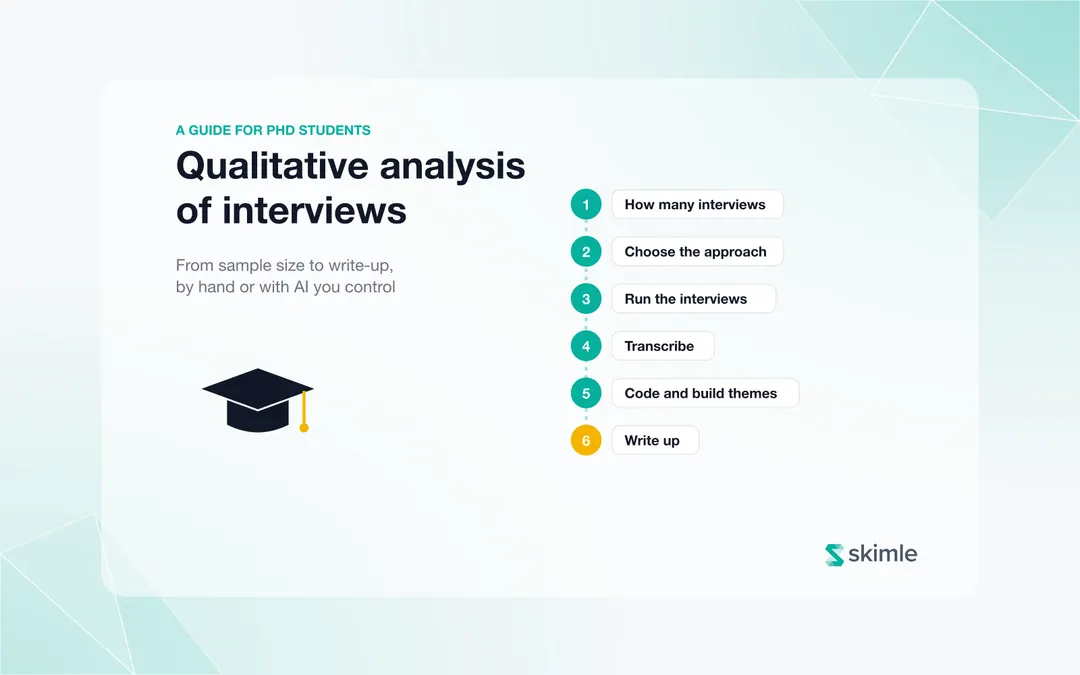
A qualitative interview study in a PhD follows seven steps: decide how many interviews the question needs, choose an analysis approach that fits your epistemology, run and record the interviews, transcribe them, code the data, build themes or categories, and write up. AI tools now speed up transcription and coding, but they belong in a transparent, researcher-controlled workflow, not a black box.
This guide is a map. Each section gives the short answer a PhD student needs and links to a fuller guide on the step. It is written by Henri Schildt, Professor of Strategy at Aalto University, who supervises doctoral students and publishes qualitative research, together with Olli Salo.
The video below walks through the seven steps in under three minutes.
Free webinar
Using Skimle to analyse interviews
How many interviews does a PhD study need?
There is no single number, and examiners will not expect one. They expect a justification. Two empirical studies give useful anchors. Guest, Bunce and Johnson (2006) found that most codes in their dataset had appeared within the first 12 interviews, and a systematic review by Hennink and Kaiser (2022) found that saturation was typically reached between 9 and 17 interviews in studies with a fairly homogeneous sample and focused aims.
Most PhD interview studies land between 15 and 40 interviews. Fewer suits an in-depth interpretative design such as IPA (often 6 to 10 participants); more suits a comparison across groups, where each group needs enough people to stand on its own. Justify the number by depth, the variety in your sample, and the method's own conventions rather than by saturation alone, which some approaches (reflexive thematic analysis among them) do not use as a stopping rule.
Read more: how many interviews you need for qualitative research, Guest, Bunce and Johnson (2006) explained and data saturation in qualitative research. For choosing who to interview, see purposive sampling.
What are the different approaches to qualitative analysis?
Choose the approach before you collect data, because it shapes your questions, your sample and what counts as a finding. The table summarises the approaches PhD students use most.
| Approach | What it produces | Typical use in a PhD | Read more |
|---|---|---|---|
| Reflexive thematic analysis | Themes as patterns of shared meaning, constructed by the researcher | The most common choice across social science, health and education | Braun and Clarke's reflexive TA |
| Grounded theory | A theory built inductively from the data, with theoretical sampling | When the aim is to explain a process nobody has theorised | Grounded theory guide |
| Interpretative phenomenological analysis (IPA) | A detailed account of how a few people make sense of an experience | Health and psychology studies of lived experience | IPA guide |
| Framework analysis | A matrix of cases by themes, from a partly predefined framework | Applied, policy and health research with defined questions | Framework analysis |
| Qualitative content analysis | Categories and their frequency across texts | Larger corpora and more descriptive questions | Qualitative content analysis |
| Discourse and narrative analysis | How language constructs meaning, identity or power | Linguistics, sociology, organisation studies | Discourse analysis |
Most approaches also need a decision on how inductive to be: whether codes come from the data, from theory, or from moving between the two. See inductive, deductive and abductive coding, and for the wider picture, the complete guide to thematic analysis.
How do you conduct the interviews in practice?
Write a semi-structured interview guide of 6 to 10 open questions, ordered from easy and concrete to reflective, with prompts for follow-up. Pilot it with two or three people and rewrite the questions that produce short answers. Ask for accounts ("tell me about the last time…") rather than opinions ("what do you think of…").
Record every interview with consent, and take brief notes on what the recording will not capture. Before the first interview, settle ethics approval, consent forms, data storage and how you will anonymise transcripts; examiners and journals will ask.
Read more: how to write an interview guide, good interview questions to ask, practical tips for running interviews and a practical recording and transcription setup. For a large sample with structured questions, AI-moderated interviews are now an option; see AI interviewing compared with human interviewing for where they fit and where they do not.
How should you transcribe the interviews?
Automatic transcription is now accurate enough for most research, and it saves weeks: transcribing an hour of audio by hand typically takes four to six hours. Use a tool that separates speakers, handles your languages and keeps the data where your ethics approval says it must be. Then read every transcript against the recording at least once; you will correct names and technical terms, and this first close reading is also the start of your familiarisation with the data.
Decide your transcription convention (verbatim with pauses and fillers, or cleaned) based on your method: discourse and conversation analysis need the detail, thematic analysis rarely does. Anonymise before analysis, replacing names, places and employers with consistent pseudonyms.
Read more: AI transcription tools for research, transcribing interviews in Skimle and how to anonymise qualitative data for ethics compliance.
Skimle transcribes audio and video in over 100 languages, separates speakers and keeps every quote linked to the moment in the recording, so checking a transcript against the audio takes one click.
How do you analyse existing data alongside interviews?
Many PhD projects combine interviews with data that already exists: documents and policies, open-ended survey answers, public online reviews or social media posts. Treat each source as its own dataset with its own provenance, and record which source every quote comes from.
For tabular data, such as posts exported from Reddit or answers from a survey, keep one row per item with columns for the source, date and any attributes. Imported into an analysis tool, the text becomes documents and the columns become metadata, so you can compare themes across sources, groups or time. Collect only public content, follow each platform's terms, and remove usernames before analysis.
Read more: qualitative data examples, how to analyse open-ended survey responses at scale, importing and exporting data and using metadata to find themes that differ between groups.
How do you analyse the data?
The core of the analysis is the same whatever tool you use: read closely, code segments of text, group codes into categories or themes, test them against the whole dataset, and keep a record of your decisions. What differs is how much of the mechanical work a tool does for you.
| Way of working | What it involves | Cost | Watch out for |
|---|---|---|---|
| By hand or in Excel | Printouts, highlighters or a spreadsheet of coded quotes | Free | Slow beyond 15 to 20 interviews; hard to keep an audit trail |
| Free coding software | Taguette or QualCoder: you code every segment yourself | Free | Limited analysis and collaboration features |
| Traditional CAQDAS | NVivo, MAXQDA or ATLAS.ti, often through a university licence | Licence | Steep learning curve; still fully manual coding |
| AI-assisted analysis | The tool proposes codes and themes across every transcript; you review, rename, merge and decide | Subscription | Must stay transparent and under your control (below) |
AI is gaining ground quickly in qualitative research, and for good reason: a first coding pass across 30 transcripts that took weeks now takes minutes. It needs care to apply. Uploading transcripts to a general chatbot and asking "what are the themes?" gives you an answer you cannot inspect or reproduce, and examiners will rightly reject it. A defensible AI-assisted workflow has four properties:
- Every theme is traceable to the quotes and transcripts it comes from, so you can read the evidence for any claim.
- You stay in control of the coding frame: you can start from your own categories, edit what the AI proposes, and record why.
- It is systematic, reading every transcript rather than a sample, so a theme's absence means something.
- You report it transparently in your methods chapter: which tool, what it did, and how you checked and changed its output.
A hybrid approach works well for PhD students. Use Skimle to transcribe and run a first, fully traceable coding pass, refine the categories yourself, then export the project in REFI-QDA format (codebook, coded segments and document variables) to NVivo, MAXQDA or ATLAS.ti if your supervisor or department works there. You keep the speed of AI and the familiarity of a traditional tool, and the coding stays inspectable at every step.
Read more: how to code qualitative data, descriptive coding examples, deductive coding with a codebook, free qualitative data analysis software, the best tools for PhD students, how to code interviews with AI, using AI in qualitative research: a guide for academics and combining AI analysis with manual coding and REFI-QDA export. See also how Skimle supports academic researchers.
How do you keep the analysis rigorous and reflexive?
Rigour in qualitative research comes from transparency and reflexivity, not from pretending the researcher is absent. Keep an analytic memo or reflexive journal from the first interview, noting decisions and surprises. Look actively for cases that contradict your emerging themes. If you work in a team or with a supervisor, discuss disagreements in coding rather than averaging them away, unless your method calls for agreement scores.
When AI is part of the workflow, the same principles apply with one addition: record what the tool proposed and what you changed. That record is your audit trail.
Read more: reflexivity in qualitative research, staying reflexive when working with AI and a 20-question checklist for AI-assisted analysis.
How do you write up the results?
The methods chapter names the approach and cites it, describes the sample and why it is that size, explains how data was collected, transcribed and anonymised, and states exactly how coding proceeded, including any software and AI use. The findings chapter usually gives each theme its own section: an analytical claim as the heading, interpretation, and two to four quotes that argue the point rather than decorate it.
Read more: how to write a thematic analysis results section, how to write up a thematic analysis and qualitative research examples, including what a qualitative paper looks like section by section.
Frequently asked questions
Can I use AI for my PhD qualitative analysis?
Usually yes, if your university's guidance allows it, your ethics approval covers the tool's data handling, and you report its use transparently. Use AI for the mechanical work (transcription, a first coding pass, finding quotes) and keep the interpretation yours. Check your institution's policy and tell your supervisor early.
Is NVivo required for a PhD?
No. Examiners care about whether your analysis is systematic and transparent, not which software you used. NVivo, MAXQDA and ATLAS.ti are common because universities licence them, but free tools, Excel or AI-assisted tools are equally acceptable when the method is sound and the process is documented.
How long does qualitative analysis take in a PhD?
For 20 to 30 interviews, expect two to four months of analysis by hand, including familiarisation, coding, theme development and early writing. AI-assisted coding can shorten the mechanical part to days, but the interpretation and writing still take weeks, and should.
Do I need to transcribe interviews myself?
Not necessarily. Transcribing yourself is a good way to know your data, but automatic transcription followed by a careful read against the recording achieves much of the same familiarity in far less time.
Planning your qualitative analysis? Create a free Skimle account and try a traceable first coding pass on a few of your own transcripts, or watch the interview analysis webinar first.
About the authors
Henri Schildt is a Professor of Strategy at Aalto University School of Business and co-founder of Skimle. He has published over a dozen peer-reviewed articles using qualitative methods, including work in Academy of Management Journal, Organisation Science, and Strategic Management Journal. His research focuses on organisational strategy, innovation, and qualitative methodology. Google Scholar profile
Olli Salo is a former Partner at McKinsey & Company where he spent 18 years helping clients understand the markets and themselves, develop winning strategies and improve their operating models. He has done over 1000 client interviews and published over 10 articles on McKinsey.com and beyond. LinkedIn profile
Sources
- How many interviews are enough? An experiment with data saturation and variability - Guest, Bunce and Johnson (2006), Field Methods
- Sample sizes for saturation in qualitative research: a systematic review of empirical tests - Hennink and Kaiser (2022), Social Science & Medicine
- Using thematic analysis in psychology - Braun and Clarke (2006), Qualitative Research in Psychology