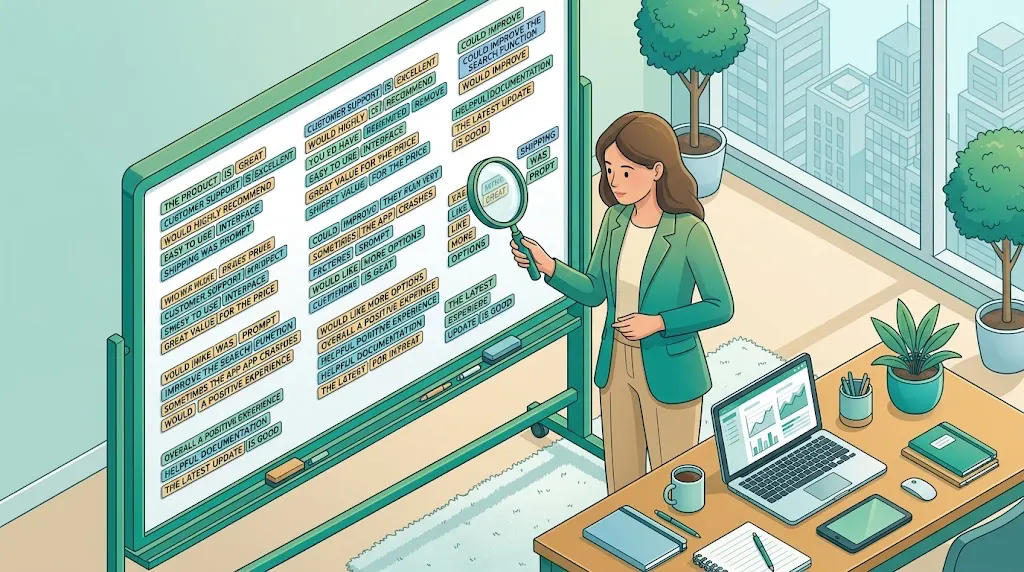
Quick answer: Earnings call transcript analysis with AI means coding management commentary and analyst Q&A for themes, then tracking how language shifts across quarters or peers. Search platforms like AlphaSense find every mention of a topic across thousands of filings. Skimle does something deeper: a structured thematic read of a single company's calls over time, or a small peer set in one quarter, with every theme traceable to its source quote.
An IR team spends a week preparing the CEO and CFO for the next earnings call, then spends almost no time afterwards working out whether the call actually landed the way they intended. An equity analyst tracking ten companies in a sector reads ten transcripts a quarter and tries to remember which management team said what about pricing three quarters ago. Both groups are sitting on a rich qualitative record, the actual words management used and the actual questions analysts kept asking, and most of it gets read once and filed away.
This post looks at what earnings call transcript analysis actually involves, where large-scale search platforms such as AlphaSense fit, and where a narrower, comparative thematic read (the kind Skimle is built for) does a different job.
Why the transcript is a different data source from the numbers
The earnings release tells you what happened to revenue, margin, and guidance. The transcript tells you how management explains what happened, what they emphasise unprompted, what they avoid, and what analysts keep pushing on. That is qualitative data: language, framing, and recurring questions, not figures.
Academic finance research backs this up with a consistent finding: the words matter independently of the numbers. Price, Doran, Peterson and Bliss, in research published in the Journal of Banking & Finance, found that the linguistic tone of earnings conference calls has incremental explanatory power for abnormal stock returns and trading volume beyond the earnings surprise itself, with the question-and-answer portion of the call carrying more of that signal than management's prepared remarks. In other words, what analysts ask and how management answers moves markets in ways the headline numbers do not fully capture.
That is the case for treating the transcript as its own analytical object, not just a record to file next to the press release.
What IR teams are actually trying to track
IR teams use earnings call transcript analysis for a narrower job than equity researchers, and it tends to fall into three buckets.
- Message consistency. Did the CFO describe the margin outlook the same way this quarter as last quarter, or did the language quietly shift from "confident" to "cautiously optimistic" without anyone deciding to change it?
- Analyst reaction patterns. Which topics come up in every Q&A regardless of what IR prepared for, and is that a sign the market doubts the guidance, or just ordinary curiosity about a new initiative?
- Spokesperson alignment. When the CEO and CFO answer the same type of question, do they use compatible language, or does one sound more hedged than the other in a way that could be read as friction?
None of these require searching across thousands of companies. They require a careful read of one company's own call history, which is a different kind of tool than a search engine across the whole market.
What equity analysts and the buy-side are trying to track
Sell-side analysts and buy-side investors use the same transcripts for a comparative job: how does one company's management commentary compare with its peers in the same quarter, and how has the sector's language shifted over several quarters.
A typical version of this: an analyst covering eight to twelve companies in a sector wants to know which management teams are using cautious language about a specific input cost, whether that caution is new this quarter or has been building for a year, and whether the analyst questions across calls are converging on the same concern. That is thematic analysis applied to a deliberately bounded set of documents, not a search for every mention of the topic across the market.
How does AI-based transcript analysis actually work?
Two distinct approaches answer two different questions, and confusing them leads to the wrong tool for the job.
Search and discovery answers "where has this topic come up, anywhere?" A platform like AlphaSense indexes a vast library of transcripts, filings, and broker research, and uses natural language search to surface every relevant mention across that library in seconds. This is the right tool when you don't know in advance which companies or calls matter and need to scan broadly before narrowing in.
Structured thematic analysis answers "what is this specific set of calls actually saying, and how does it change?" Instead of searching for a known topic, the analysis reads a bounded set of transcripts (one company's last eight quarters, or one quarter across ten peers) from the bottom up, surfaces the themes that are actually present including ones nobody thought to search for, and tracks how the language around each theme shifts across the set. Every theme links back to the exact passage it came from, so a claim like "management's tone on margin pressure softened over three quarters" can be checked against the original wording, not taken on trust.
The thematic analysis guide covers the methodology behind the second approach in more depth. It is the same logic that underpins how Skimle reads expert network and stakeholder calls, applied here to a different document type.
AlphaSense and Sentieo: what they do
AlphaSense is a market intelligence platform built around search across a large library of financial documents, including earnings transcripts, broker research, filings, and news. It acquired Sentieo, another financial research platform with its own transcript and document search tools, in May 2022. Sentieo's roughly 1,000 customers, including more than 800 institutional investment firms, were folded into AlphaSense, and Sentieo has continued to operate under AlphaSense ownership while the two product sets have been integrated over time.
AlphaSense's earnings-specific tooling includes AI-generated summaries of individual transcripts, sentiment scoring that flags positive or negative language within a call, and a feature that lets a user apply the same question across many transcripts at once to compare answers company by company. This is built for breadth: covering the widest possible set of companies and documents, and surfacing relevant passages fast when a user already knows roughly what they are looking for.
That is a different job from a focused comparative read of a small set of calls, and the distinction matters when choosing which tool a given task actually needs.
AlphaSense-type search vs Skimle-type thematic analysis
| Search and discovery (e.g. AlphaSense/Sentieo) | Structured thematic analysis (e.g. Skimle) | |
|---|---|---|
| Best for | Finding every mention of a known topic across a huge library | Understanding everything a bounded set of calls says, including themes you didn't search for |
| Typical scope | Thousands of companies, full market coverage | One company's call history, or a focused peer set |
| Starting point | A keyword or question you already have in mind | The data itself; themes are discovered, not pre-specified |
| Output | Ranked passages and summaries matching your query | A theme structure across the full set, with quotes and quarter-over-quarter or peer-by-peer comparison |
| Traceability | Links back to the source document | Every theme and every claim links back to the exact quote |
| Where it falls short | Doesn't build a structured comparative view of a small set over time | Doesn't scan the whole market; you choose the document set in advance |
The plain framing: a search platform and a thematic analysis tool solve adjacent but distinct problems, and most IR teams and focused analyst workflows need both at different points in the process. Search is how you find which calls matter. Thematic analysis is how you understand what a chosen set of calls actually says once you've found them.
How does Skimle approach earnings call transcripts?
Skimle is built for the second job: a focused, traceable read of a specific set of calls, not a search engine across the whole market. The workflow looks like this.
- Import the transcripts. Upload a company's last eight quarters of earnings call transcripts, or one quarter's transcripts across a peer group of competitors. Skimle accepts transcripts in standard formats and works whether they came from your own transcription service or a public source. The supported formats guide covers what Skimle accepts.
- Let Skimle build the theme structure. Rather than starting from a list of topics you expect to find, Skimle reads the full set and surfaces the themes management and analysts actually raised, recurring concerns, new topics that appeared this quarter, and language patterns that repeat across calls. The automatic thematic analysis docs explain how this discovery process works.
- Compare across time or across peers. For a single company's call history, you can see how the language around a specific theme (say, supply chain risk or pricing power) shifted quarter by quarter. For a peer set in a single quarter, you can see which companies used similar framing and which stood apart, with the underlying quotes for each.
- Check every claim against the source. Each theme links to the specific passage from the specific call that supports it. If someone on the IR team or the investment committee asks "where does this come from?", you can show the exact transcript excerpt rather than a generated summary that has drifted from the original wording. The transparency model behind this is the same one Skimle applies across all document types.
- Use metadata to slice the analysis. Tag each transcript with the quarter, the speaker (CEO vs CFO), or the peer company, then filter the theme view by those tags. This makes it possible to ask, for example, "show me everything the CFO said about margin across the last four quarters" without re-reading the transcripts. The metadata analysis guide covers this in detail.
This is closer to qualitative research practice than to financial search. It treats the transcript the way a researcher treats an interview: as a primary source to be coded and compared, not a document to be queried for keywords.
A worked example: tracking message consistency across two years
An IR team for a mid-cap industrial company wants to check whether the CFO's language about input cost pressure has been consistent across the last eight quarterly calls, after a board member raised a concern that the messaging has felt "less confident lately" without anyone being able to point to specifics.
The team imports the eight transcripts into Skimle, tagged by quarter. Skimle's theme analysis surfaces "input costs" as a recurring theme present in all eight calls, and shows the specific language used in each instance. Reading across the eight excerpts side by side (rather than relying on memory of eight separate calls) shows that the language did shift: from "we expect to fully offset cost pressure through pricing" in early quarters to "we are working to mitigate the impact" in the two most recent calls, a change in confidence that nobody had deliberately signed off on. The team can now address it directly in the next call's preparation, with the specific quotes as evidence for the recommendation rather than a vague impression.
A comparative version of the same exercise: an analyst covering ten companies in the same sector imports one quarter's transcripts from all ten, tagged by company. The theme analysis shows that eight of the ten management teams used notably more cautious language about a specific raw material cost than they did the previous quarter, while two used unchanged or more confident language. That divergence, visible because the calls are coded and compared systematically rather than read and remembered, is a more useful starting point for further research than any single transcript read in isolation.
When this approach does not fit
A focused thematic read is the wrong tool when the actual task is finding a needle in a market-wide haystack: "which of the 3,000 companies AlphaSense covers mentioned a specific regulatory risk this quarter?" That requires search across a library Skimle does not maintain. It is also the wrong tool for real-time monitoring during earnings season across the full market; a search and alerting platform is built for that kind of throughput.
Skimle's structured analysis works best as the second step, once you have decided which company, sector, or peer set actually warrants a careful read, and once the question has moved from "where does this show up" to "what is actually being said, and how is it changing".
Frequently asked questions
What is earnings call transcript analysis?
Earnings call transcript analysis is the practice of systematically reviewing the language used in quarterly earnings calls, both management's prepared remarks and the analyst Q&A, to identify themes, track sentiment, and compare commentary across time or across companies. It treats the transcript as qualitative data distinct from the financial results discussed on the call.
Is AlphaSense the same as Sentieo?
No, but they are related. Sentieo was an independent financial intelligence platform until AlphaSense acquired it in May 2022. Sentieo has continued to operate, bringing its roughly 1,000 customers (including more than 800 institutional investment firms) into the AlphaSense business, and the two platforms have been integrated over time. References to "Sentieo" today generally mean the Sentieo product within AlphaSense, not a separate company.
Can AI reliably analyse analyst Q&A sentiment?
AI sentiment scoring on earnings call language is a well-studied area in finance research, and tone has been shown to carry real information about future returns beyond what the financial results reveal on their own. That said, sentiment scores are a starting point, not a final answer. A theme-based read that shows the actual quotes behind a sentiment shift gives more confidence than a single aggregate score, because you can check whether the shift reflects something specific (a changed answer to a recurring question) or noise from a handful of unusual exchanges.
How many quarters of transcripts do I need for a reliable read on message consistency?
There is no fixed minimum, but four to eight quarters (one to two years) is usually enough to distinguish a real shift in language from quarter-to-quarter variation that does not mean anything. Fewer than four quarters makes it hard to tell a real trend from normal variation in how any one person happens to phrase an answer on a given day.
Does this replace an enterprise search platform like AlphaSense?
No. A platform built for search across thousands of companies and documents solves a different problem from a focused comparative analysis of a specific company's history or a chosen peer set. Most IR and research teams who need both will use a search platform to find and monitor broadly, and a structured thematic analysis tool for the deeper, comparative read once they have decided which calls deserve that attention.
Ready to read your own earnings calls more closely?
Try Skimle for free and see how a structured theme analysis, with every finding linked back to the exact quote, compares with reading transcripts quarter by quarter from memory. If you work in consulting or investing more broadly, see how Skimle fits due diligence and investment workflows.
Related reading: Getting more from expert network calls | Qualitative analysis in commercial due diligence | Competitive intelligence from qualitative research | Analysing Zoom and Teams call transcripts
About the author
Olli Salo is a former Partner at McKinsey & Company where he spent 18 years helping clients understand the markets and themselves, develop winning strategies and improve their operating models. He has done over 1000 client interviews and published over 10 articles on McKinsey.com and beyond. LinkedIn profile
Sources
- Earnings conference calls and stock returns: The incremental informativeness of textual tone - Journal of Banking & Finance (RePEc/IDEAS)
- AlphaSense Acquires Sentieo - Centana Growth Partners
- AlphaSense Merges with Sentieo - Integrity Research
- Is stock analyst coverage too "crowded"? - Mariuszoican (Substack)