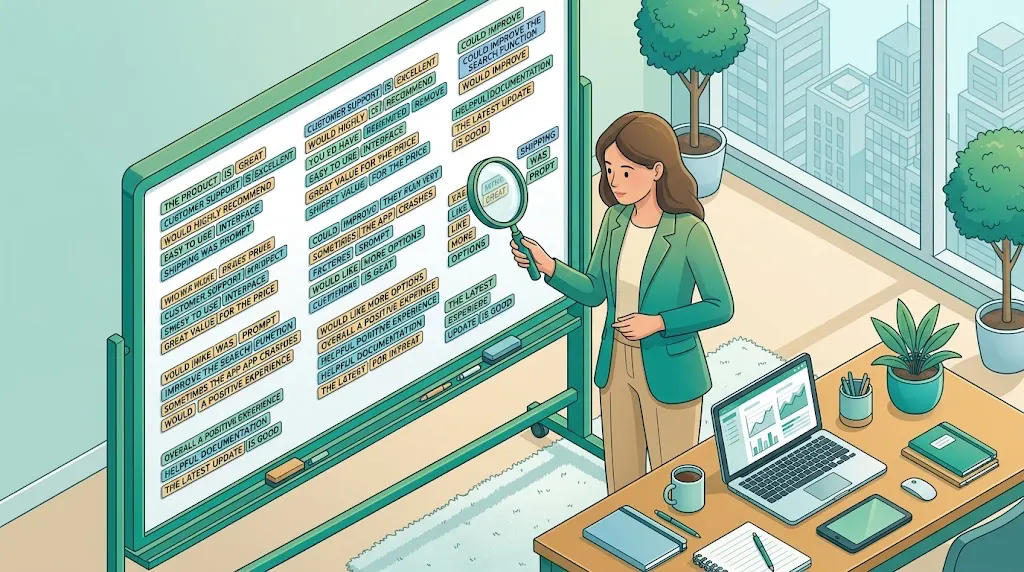
If you have ever tried to analyse 30 or 40 qualitative interviews properly (reading each transcript, coding passages, building a codebook, finding patterns, writing it up) you already know the problem. It takes weeks. For academic researchers with a six-month analysis window, this is manageable. For a consulting team with a three-week project timeline, or a market research function with quarterly deliverables, it is not. If you are also evaluating which tools support faster analysis workflows, NVivo and MAXQDA alternatives for 2026 covers eight options built for different speeds and research contexts.
The standard responses to this time pressure both have serious problems. This guide explains what those problems are, and why AI-assisted analysis offers a third path that neither shortcut can, one that keeps the visible, checkable steps manual coding always had; see Excel for text for that argument in full.
Why bottom-up manual coding does not scale for business
Systematic inductive coding (reading each transcript, generating codes from the data, building a codebook, iterating until themes emerge) is rigorous. It is also, in its pure form, extraordinarily slow.
A detailed thematic analysis of a single 60-minute interview transcript takes 2-4 hours when done carefully: reading through, generating initial codes, refining them, writing analytical memos. For 30 interviews, that is 60-120 hours of coding time before any synthesis has begun. For a team of two researchers with other responsibilities, this represents several weeks of work.
The time cost produces three predictable business outcomes:
- Fewer interviews than the question warrants. Researchers constrain their sample size to what they can analyse, rather than what the question requires. This is why "12 interviews" is the standard deliverable even when 30 would produce meaningfully different findings.
- Analysis compressed into the last days of a project. When coding takes weeks, it gets squeezed into whatever time remains after data collection. The result is a less thorough analysis presented with more confidence than it deserves.
- The back-office time crowds out the thinking time. The most valuable part of qualitative research (interpretation, synthesis, connecting findings to implications) gets the smallest time allocation. As Noren CEO Annakerttu Aranko puts it: "Before Skimle, over 50% of our time was spent on back-office work: managing transcripts, coding data, and doing rudimentary analyses. With Skimle, we are able to cut that time significantly, and spend much more time in interviews, doing thinking and problem solving, and with the clients."
The two shortcuts that seem to solve the problem but do not
When manual coding is impractical, most research teams adopt one of two shortcuts. Both have significant weaknesses.
Shortcut 1: Excel-based word frequency and manual theme counting

Recommended reading
How to do thematic analysis in Excel: a step-by-step guide (and when to upgrade)
The "Excel approach" typically involves: exporting transcripts, doing a word frequency count, grepping for common terms, perhaps doing a Find All to count how many transcripts mention "pricing" or "integration" or whatever the suspected themes are. Then building a summary table based on these counts.
This approach is quick. It is also fundamentally flawed.
Word frequency is not theme frequency. The word "problem" appearing 40 times across 30 transcripts does not tell you what the problem is, how serious participants considered it, or whether it is one theme or fifteen different complaints that happen to use the same word. Participants describing a frustrating experience and participants praising a feature they had initially had problems with might both contribute to that "problem" count.
What you are measuring is the presence of vocabulary, not the structure of meaning. Qualitative data is ambiguous, contextual, and irreducibly rich in ways that word counts cannot capture.
Shortcut 2: Top-down theme assignment
The faster alternative to inductive coding is to decide the themes before reading the data. The researcher hypothesises the main themes (perhaps from the research brief, from client discussions, or from previous experience in the sector), creates a structure, then reads through interviews looking for evidence to fill that structure.
The problem is systematic bias. You find what you were looking for. Evidence that fits the pre-specified themes is collected; evidence that contradicts them or falls outside them tends to be noted less carefully or lost entirely. The resulting "analysis" is better described as illustration: you have found quotes to support positions that were decided in advance.
This matters less if the hypotheses were based on solid prior research. It matters enormously when the point of the qualitative study was to discover what you did not already know, which is most of the time.
Neither approach gives you what systematic qualitative analysis is supposed to give you: a rigorous, evidence-grounded account of what is in the data, including the unexpected.
What rigour actually requires
Recommended reading
What AI sycophancy & hallucinations look like in practice... and why boring is better
Before explaining how AI changes this, it is worth being clear about what rigour means in qualitative analysis, because it is frequently confused with slowness. It is also frequently confused with an academic luxury commercial timelines cannot afford; see the bottom-up rigour problem in commercial research for why that assumption is what AI-assisted analysis actually removes.
Rigorous qualitative analysis requires four things:
Coverage. Every transcript is read and processed, not a sample. Patterns are identified across the full dataset, not from the documents that happen to be most memorable.
Traceability. Every theme can be connected back to specific excerpts in the data. "Customers find onboarding confusing" is a claim that should be backed by a set of specific quotes from specific transcripts, not by the analyst's general impression.
Inductive openness. The analysis is capable of surfacing patterns that were not anticipated at the outset. A methodology that only finds what it was set up to find is not analysis; it is verification.
Systematic consistency. The same analytical lens is applied to all the data. Passages are not coded differently based on which researcher processed them, or which day in a long project the coding happened.
Manual bottom-up coding can satisfy all four of these criteria, which is why it is the rigorous standard. The problem is not that it is rigorous; it is that it is too slow for most business contexts.
Top-down theme assignment fails on at least two: inductive openness (the themes are pre-specified) and often traceability (themes are asserted from general impression rather than traced to specific evidence).
The AI approach, done well, can satisfy all four at business speed. This is not an obvious claim, so it is worth explaining how.
How AI-assisted analysis achieves rigour at speed
The most important thing AI does in qualitative analysis is not summarise; it is read systematically. Every transcript, every passage, consistently: applying the same analytical lens without the fatigue, distraction, or selective attention that human readers inevitably bring to a large corpus.
Skimle's analytical pipeline works as follows:
Full corpus processing. Every uploaded document is read and processed, not sampled. A 40-transcript project gets the same analytical attention to transcript 40 as to transcript 1. This satisfies the coverage criterion that manual analysis often fails to meet in practice (the last few transcripts, coded at the end of a long project, are rarely coded with the same care as the first ones).
Inductive theme emergence. Rather than applying a pre-specified coding scheme, the analysis identifies patterns that appear across the data, grouping them into themes based on shared meaning. This is not a word frequency count; it is a semantic analysis of what passages mean in relation to each other. Unexpected patterns surface alongside expected ones.
Quote-level traceability. Every theme is presented with the specific excerpts from the data that support it. The analyst can navigate directly from a theme to the quotes, verify that the theme is a fair characterisation of the supporting evidence, and challenge the AI's categorisation where they disagree. This is the safeguard against the "the AI said so" problem: you are reviewing evidence, not accepting conclusions.
Researcher review and refinement. The AI's output is the starting point for the researcher's analysis, not the end point. The researcher reviews the themes, merges or splits them based on analytical judgement, discards themes that do not hold up to scrutiny, and writes the interpretive synthesis that connects findings to the research question. This is where expert judgement is irreplaceable, and it is the part of the analysis that takes most of the researcher's time: the right allocation.
What this means in practice: the time comparison
For a corpus of 30 semi-structured interview transcripts, the honest way to frame the time saved is as more interviews or more depth, not a smaller invoice; see why "3x faster" is the wrong pitch for AI in research for the fuller argument.
| Stage | Manual coding | AI-assisted (Skimle) |
|---|---|---|
| Initial coding | 60-120 hours | 1-2 hours (AI) |
| Theme development | 20-40 hours | 3-6 hours (researcher review) |
| Synthesis and write-up | 20-30 hours | 15-25 hours |
| Total | 100-190 hours | 20-35 hours |
The synthesis and write-up stages shrink less dramatically because that work cannot be replaced by AI. The interpretation, the connection of findings to the research question, the crafting of an evidence-based argument: these are human work. What AI eliminates is the mechanical processing that precedes them.
The practical implication is not just that the same analysis is faster. It is that a scope of analysis previously impractical becomes feasible: 60 interviews instead of 20, cross-tabulation by customer segment as a standard output rather than an afterthought, quarterly analysis cadences rather than annual ones.
For the methodology behind this type of analysis, see thematic analysis in qualitative research. For the practical workflow in Skimle, see how to find themes across a large set of interviews.
The right mental model: AI handles the processing, researchers handle the meaning
The frame that makes AI-assisted qualitative analysis work, and that prevents the "the AI said so" failure mode, is a clear division of labour.
AI does: reading all the data, identifying semantic patterns, grouping passages by shared meaning, generating a first-draft structure of themes with supporting evidence.
Researchers do: evaluating whether the AI's themes are analytically coherent and supported by the evidence, making interpretive judgements about what themes mean, connecting findings to the research question, writing the synthesis.
When this division is respected, the result is analysis that is faster than manual coding and more thorough than top-down theme assignment, with the rigour of the systematic approach and the speed of the computational one.
When it is not respected (when researchers accept AI output uncritically, or when the AI is asked to do the interpretive work rather than the processing work) quality suffers. The tools do not replace analytical thinking; they make more analytical thinking possible within the same time.
Frequently asked questions
Does AI-assisted analysis work for small datasets (under 10 interviews)?
For fewer than 10 interviews, manual analysis is often more appropriate. The time savings from AI processing are less significant at small scale, and the risk of AI errors or over-generalisation is higher when each document represents a larger proportion of the corpus. AI-assisted analysis is most valuable from 15-20 interviews upward, and becomes increasingly valuable as the dataset grows.
How do you verify that the AI has not missed important themes?
The primary safeguard is quote-level traceability: the ability to review every supporting quote for every theme, which reveals both what the AI found and how representative its characterisation is. A secondary safeguard is reviewing a random sample of full transcripts alongside the AI output, checking that the themes identified in the full-corpus analysis are reflected in the individual documents you know well.
Can AI-assisted analysis detect contradictions in the data?
Yes, when the tool is designed for it. Skimle's analysis surfaces divergent patterns alongside convergent ones, so contradictory perspectives across participants appear in the output rather than being averaged away. The researcher's job is then to interpret what the contradiction means, which often requires understanding the differences between participants (segment, tenure, context) that explain why they experienced things differently.
Is this approach accepted in academic research?
AI-assisted qualitative analysis is increasingly accepted in academic contexts with appropriate disclosure and methodological transparency. The researcher's responsibility is to document what tools were used, how the AI output was reviewed and refined, and what interpretive decisions were made by the researcher rather than the AI. For academic applications, see AI qualitative data analysis checklist.
Ready to stop spending weeks on coding and start spending that time on interpretation? Try Skimle for free and process your next interview corpus in hours rather than weeks, without sacrificing the traceability that makes findings credible.
About the authors
Henri Schildt is a Professor of Strategy at Aalto University School of Business and co-founder of Skimle. He has published over a dozen peer-reviewed articles using qualitative methods, including work in Academy of Management Journal, Organisation Science, and Strategic Management Journal. His research focuses on organisational strategy, innovation, and qualitative methodology. Google Scholar profile
Olli Salo is a former Partner at McKinsey & Company where he spent 18 years helping clients understand the markets and themselves, develop winning strategies and improve their operating models. He has done over 1000 client interviews and published over 10 articles on McKinsey.com and beyond. LinkedIn profile