The best NVivo and MAXQDA alternatives in 2026 depend on what is driving you away. For cost, free tools like Taguette and QualCoder cover basic text coding, while Quirkos and Dedoose offer cloud-based collaboration from around $13–$18 (€12–€16) per month. For AI-assisted analysis with full traceability, Skimle is the most complete option, running structured thematic analysis across your entire corpus in hours rather than weeks. This guide covers all eight alternatives with the trade-offs that matter.
Why are researchers switching away from NVivo and MAXQDA?
The short answer is that the price-to-value calculation has shifted. Both tools remain capable, but neither was designed for the AI era, and both carry costs that many researchers can no longer justify.
NVivo bommercial pricing starts above a thousand EUR per seat per year. On top of that, the 2022 acquisition of QSR International by private equity firm TA Associates, and the subsequent formation of Lumivero, has raised concerns about pricing trajectory and long-term product direction. Lumivero later acquired ATLAS.ti, two big legacy QDA tools in academic domains now share a single private equity backed parent.
MAXQDA is independently owned by VERBI GmbH, an important distinction in the current PE-backed landscape, but licences still come in steep even for academics. For consultants, HR teams, or researchers without institutional support, the annual fees run to thousands of EUR per seat, which is a meaningful outlay before you have done any analysis.
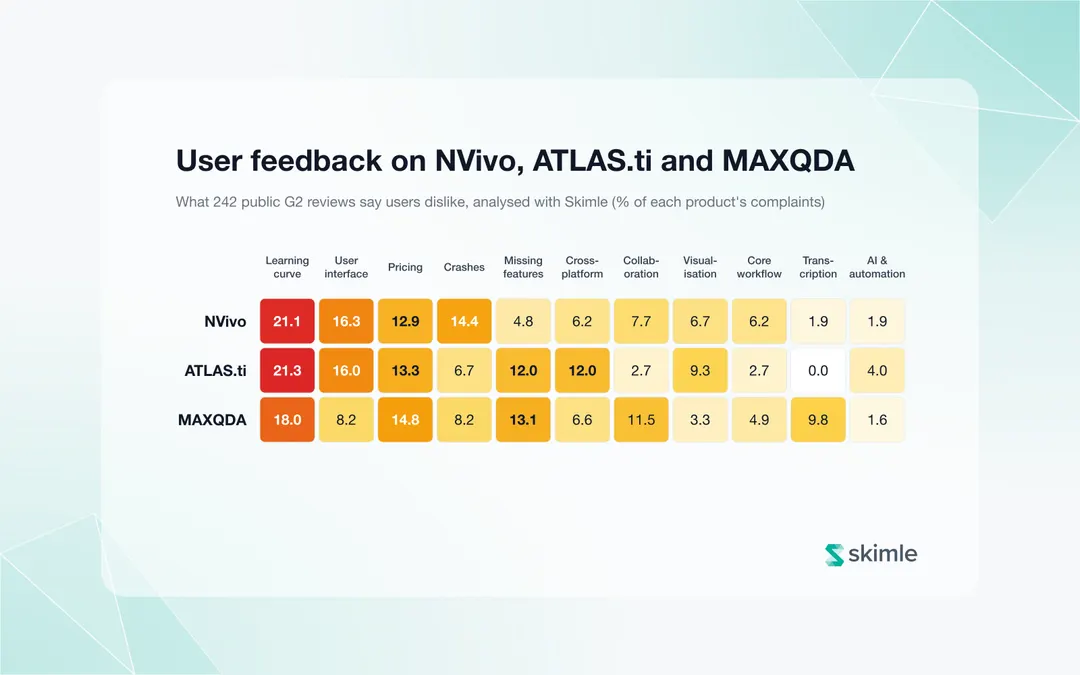
Beyond cost, the pattern of complaints is consistent. The learning curves are steep, particularly for NVivo. Both tools are desktop-first, which creates friction for distributed teams and Mac users. AI features have been added to both, but as layers on top of a fundamentally manual workflow: the researcher still does the initial coding pass, and the AI assists at the margins. Our analysis of user feedback on NVivo, ATLAS.ti and MAXQDA puts numbers on this: the learning curve is the top complaint for both, while crashes are a distinctly NVivo problem and collaboration and transcription stand out for MAXQDA.
For an overview, see NVivo alternatives for academic researchers. For a direct NVivo vs MAXQDA head-to-head, see NVivo vs MAXQDA 2026.
What to consider before switching
Before choosing a replacement, it helps to be clear about what is actually frustrating you. The right alternative depends on the problem:
- Cost is the main issue. Look at free tools (Taguette, QualCoder) or low-cost cloud options (Quirkos, Dedoose).
- Mac parity or browser access. MAXQDA is better than NVivo for Mac. Cloud tools (Dedoose, Skimle, Quirkos, Delve) work on any device.
- Collaboration is painful. NVivo's collaborative features cost extra. Tools built for cloud-first collaboration include Dedoose, Skimle, Quirkos, and Delve.
- AI analysis is a priority. Skimle is the only purpose-built AI-native option in this list. ATLAS.ti and MAXQDA have limited AI additions; the others have none or very little.
- You are locked out of your data. All tools here support standard export formats. Skimle, NVivo, MAXQDA, and ATLAS.ti all export to the REFI-QDA standard for project portability.
One more thing worth stating clearly: NVivo and MAXQDA remain good tools for specific situations. If your institution has a site licence, your methodology demands non-AI manual coding, and you have weeks to invest in learning the software, both tools have earned their reputations. The question is whether that situation describes you.
The 8 best NVivo and MAXQDA alternatives in 2026
1. Skimle (AI-native, cloud-based)
Skimle takes a fundamentally different approach from every other tool in this list. Rather than adding AI features to a manual coding environment, it was built around the idea that AI should handle the systematic first pass of analysis, so the researcher can focus on interpretation, refinement, and the judgements that require human expertise.
In practice: you upload your documents (transcripts, PDFs, survey responses, interview notes), and Skimle reads everything, builds a structured thematic representation, and surfaces that structure for you to inspect. Every theme links directly to the supporting quotes, and every quote traces back to its source document. The researcher's job is to review that structure, challenge what the AI got wrong, add what it missed, and reorganise where the conceptualisation needs adjusting.
The resulting workflow is faster at every stage. Manual coding of 20 interviews in NVivo or MAXQDA typically takes weeks. The equivalent in Skimle takes hours for the initial analysis, with researcher review adding further time depending on depth required.
Beyond analysis, Skimle includes built-in transcription (100+ languages), Skimle Anonymise for GDPR-compliant pseudonymisation with audit trail, metadata analysis for comparing themes across participant segments, and agentic AI chat across your full corpus. The platform is EU-hosted and GDPR-compliant by design, which matters for academic ethics applications and client data agreements.
Skimle supports full manual coding on top of AI output, and exports in REFI-QDA format if you need to hand off to a colleague working in NVivo, MAXQDA, or ATLAS.ti. The manual coding and REFI-QDA export guide covers how that interoperability works.
Pricing: Free trial available. Paid plans start at €20 month for the Starter tier. Academic pricing is available, see skimle.com/pricing.
Who it suits: Researchers, consultants, and insights teams analysing 20+ interviews who want AI to handle the systematic first pass and their time spent on interpretation. Academic researchers doing dissertation or other research. Consultants and investors running primary research programmes where coding speed is commercially significant.
Limitations: Skimle requires some trust in AI-generated output as a starting point, which some methodologies or IRB protocols may not accommodate. If your research design commits you to fully manual coding without AI involvement, Skimle's core value proposition does not apply.
2. MAXQDA (desktop + cloud, independent ownership)
If the Lumivero ownership situation is your primary concern with NVivo, MAXQDA is the strongest like-for-like replacement. VERBI GmbH has owned MAXQDA since the 1980s and remains independently held, with no known private equity involvement. That distinction is increasingly relevant for researchers thinking about long-term platform risk.
Feature-for-feature, MAXQDA is the closest equivalent to NVivo. It handles text, PDFs, audio, video, images, and survey data. It supports hierarchical code structures, memos, literature reviews, and mixed-methods integration through MAXQDA Analytics Pro. The visual tools are comparable in quality, and the interface has consistently received better usability scores than NVivo, particularly for new users.
The Mac situation is meaningfully better than NVivo. MAXQDA offers full feature parity across platforms, which matters for research teams in disciplines where Apple hardware is the norm.
AI Assist is available in the Analytics Pro tier, primarily for document summarisation and code suggestions. It is useful but supplementary: the core workflow is still manual coding with AI at the margins.
Pricing (2026 estimates, verify at maxqda.com): Academic individual licences start around €230/year for the base MAXQDA edition. Analytics Pro (mixed-methods integration, AI Assist) runs to around €430/year for academics. Commercial pricing reaches €780–€1,600/year depending on package.
Who it suits: Researchers who want NVivo-level depth without Lumivero's ownership concerns. Mac users frustrated with NVivo's feature parity gap. Mixed-methods researchers who need qualitative coding integrated with statistical analysis. Researchers whose institution has lost its NVivo site licence and needs an individual purchase.
Limitations: Not cheap at commercial tier. Still a fundamentally manual tool. AI features are useful but described by users as limited compared to purpose-built AI tools. For a detailed comparison of MAXQDA and ATLAS.ti against each other, see MAXQDA vs ATLAS.ti 2026.
3. Dedoose (cloud-based, mixed methods, collaborative)
Dedoose was developed at UCLA by social scientists who wanted a collaborative qualitative tool that ran in a browser without per-platform differences. Those design choices still define it: cloud-native, distributed-team-friendly, priced monthly rather than annually, and oriented towards mixed-methods research.
Its collaborative model is a real differentiator at this price point. Multiple researchers can code the same project simultaneously from any browser, with no installation and no version control headaches. Interrater reliability statistics (Cohen's kappa, percentage agreement) are built in, which matters for research that requires demonstrable coding consistency for publication or ethics review.
The mixed-methods integration allows you to define descriptor variables for each document or participant (age group, role, interview round, and so on), link these to qualitative codes, and cross-tabulate to see how coding patterns vary across participant characteristics. For health research, education studies, or social science with demographic analysis, this is practically useful.
The significant limitation in 2026 is the absence of AI features. Dedoose has no auto-coding, no AI summarisation, and no AI-assisted analysis. Every line of coding is manual. For large corpora, this is a real time cost.
Pricing: Approximately $18 (€16)/month for individual researchers. Student pricing around $13 (€12)/month. Group discounts available.
Who it suits: Distributed academic teams needing simultaneous collaborative coding. Projects running twelve months or less, where monthly pricing is more economical than annual licences. Researchers who need interrater reliability statistics. Mixed-methods projects combining qualitative codes with participant demographics.
Limitations: No AI features at all. Interface is functional but dated compared to more recently built tools. Monthly costs accumulate on longer projects. No REFI-QDA export. For a full Dedoose comparison, see the Dedoose review 2026.
4. Quirkos (affordable, visual, cloud + desktop)
Quirkos positions itself as qualitative analysis made simpler. The interface uses visual "bubbles" to represent codes, which some researchers find more intuitive than the tree-based structures in NVivo or MAXQDA. Both cloud and desktop versions are available, and both work on Windows and Mac without feature gaps.
It is not a deep analytical environment. There are no mixed-methods statistical features, no network visualisation, no multimedia analysis. Quirkos handles text documents and the associated coding work, and it handles that clearly.
The pricing is among the lowest in the paid QDA market. Academic users pay around $13 (€12)/month, which is competitive with Dedoose but with a significantly cleaner interface and a permanent offline licence option for $69 (€63) per device.
For researchers who find NVivo or MAXQDA overwhelming and want something they can be productive in within an hour, Quirkos is worth considering. For anyone who needs the full feature depth those tools offer, it will not substitute.
Pricing: $13 (€12)/month academic. $23 (€21)/month commercial. Permanent offline licence $69 (€63) for 1 computer. Student pricing from $5 (€5)/month. 14-day free trial.
Who it suits: Researchers who prioritise simplicity and ease of use over analytical depth. Solo researchers on budget. Educators looking for a tool students can learn quickly. Projects that are primarily interview text without multimedia.
Limitations: No AI features. Limited visualisation tools. Not suited for complex mixed-methods designs. If the easiest QDA software to learn is the primary criterion, Quirkos is a strong option.
5. Delve (cloud-based, beginner-friendly, AI-assisted)
Delve is a browser-based qualitative analysis tool built around simplicity and accessibility. The coding interface is clean and organised around a central codebook with drag-and-drop reorganisation. Collaboration is included, with team members able to code independently and compare outputs.
It has added AI assistance, primarily through an AI Chat feature that functions as a peer debriefer for exploring alternative interpretations, refining code structures, and discussing findings. This is more conversational support than systematic AI-driven analysis, but it is more than most tools at this price point offer.
Delve integrates with Otter.ai, Dovetail, and Zoom Workplace for importing transcripts directly, which reduces the manual import overhead for teams already in those ecosystems.
Pricing: Education plan approximately $18 (€16)/user/month. Standard plan approximately $50 (€46)/user/month. 14-day free trial.
Who it suits: Students and early-career researchers who are new to qualitative analysis tools and want a quick ramp-up. Small research teams in educational or non-profit settings. Researchers already using Otter or Zoom who want direct transcript import without manual steps.
Limitations: AI features are conversational rather than systematic. Not designed for large corpora or complex analytical designs. For a detailed standalone assessment, see the Delve review 2026.
6. Taguette (free, open-source, text-only)
Taguette is a free, open-source qualitative analysis tool developed independently and widely listed in university library research guides as a no-cost starting point. It handles text documents in most common formats (PDF, DOCX, EPUB, TXT, HTML, RTF, ODT), lets you highlight passages and apply tags, and exports everything including the codebook, tagged passages, and full document set.
It runs as a local application or on a server, and the server version supports real-time collaboration without per-user costs. The interface is minimal and the feature set is narrow, but for a researcher who needs basic text coding and wants to pay nothing, it works.
Pricing: Free. Open-source.
Who it suits: Students and budget-constrained researchers doing straightforward text coding. Researchers whose institutions cannot provide software access. Projects where a simple tag-and-highlight workflow covers all analytical requirements.
Limitations: No AI features. No multimedia support. No interrater reliability tools. No mixed-methods integration. The simplicity that makes it easy to start is also the ceiling of what it can do. For a broader look at tools in this category, see the free qualitative data analysis software guide.
7. QualCoder (free, open-source, desktop)
QualCoder is a free, open-source CAQDAS tool that provides more analytical depth than Taguette while remaining free. It supports text, images, and audio/video files, and includes basic interrater reliability functions, a journal for researcher memos, and reports that can be exported in multiple formats.
It runs locally (Windows, Mac, Linux) with no cloud or subscription component. This means there are no data privacy concerns around cloud storage, which some researchers or institutions find relevant, but it also means no collaboration features.
Pricing: Free. Open-source.
Who it suits: Researchers who want more feature depth than Taguette but will not pay for software. Researchers with data sensitivity requirements that preclude cloud tools. Technically comfortable users who do not mind the setup process of open-source desktop software.
Limitations: No cloud collaboration. No AI features. The interface is functional but not polished. Ongoing development depends on a volunteer contributor community, which is worth considering for long-term project stability.
8. ATLAS.ti (now Lumivero, waking up to basic AI features recently )
ATLAS.ti is included here because it is the tool many researchers consider when leaving NVivo, and the ownership situation changes the calculus. Lumivero acquired ATLAS.ti in late 2024. Switching from NVivo to ATLAS.ti is, in effect, staying within the same private equity-backed portfolio.
With that caveat stated, ATLAS.ti has invested more heavily in AI features than either NVivo or MAXQDA. Its AI Lab includes auto-coding, quote extraction, and sentiment tools. The implementation receives mixed reviews: it generates a large volume of first-order codes that require significant manual organisation before they are analytically useful. A web version is available for browser access, and European data residency options were added to address GDPR concerns.
Pricing: Full commercial pricing broadly in line with the Lumivero portfolio. Verify current rates at atlasti.com.
Who it suits: Researchers already invested in ATLAS.ti training or with existing projects in the format. Researchers who want more AI-assisted coding attempts than NVivo offers and are prepared to organise the output manually.
Limitations: Lumivero ownership. AI output volume requires significant manual curation. For a deeper comparison of ATLAS.ti alternatives more broadly, see ATLAS.ti alternatives 2026.
Comparison table: NVivo and MAXQDA alternatives at a glance
| Tool | Cloud | AI features | Collaboration | REFI-QDA | Best for |
|---|---|---|---|---|---|
| Skimle | Yes | Full AI-native analysis | Yes, included | Yes | AI-assisted analysis at scale |
| MAXQDA | Desktop + cloud | Limited (AI Assist) | Paid add-on | Yes | Like-for-like NVivo replacement, Mac users |
| Dedoose | Yes | None | Yes, included | No | Distributed teams, mixed-methods, short projects |
| Quirkos | Yes + desktop | None | Yes | No | Simplicity, budget |
| Delve | Yes | AI Chat | Yes, included | No | Beginners, Zoom/Otter users |
| Taguette | Yes (self-hosted) | None | Server version | No | Zero cost, basic text coding |
| QualCoder | No (desktop only) | None | No | No | Free, desktop, offline |
| ATLAS.ti | Yes + desktop | Limited (AI Lab) | Yes | Yes | Existing ATLAS.ti users |
When does it make sense to stay with NVivo or MAXQDA?
It would be incomplete not to address this. Both tools have real strengths, and switching carries real costs.
Stay with NVivo if:
- Your institution provides a site licence that removes the cost barrier
- You are working extensively with video, audio, or social media data in a structured multimedia coding workflow
- Your field has established NVivo as the expected methodology tool in peer review and you are unwilling to justify a deviation
- Your project is long-running and the perpetual licence pricing (where still available) is more economical over time
Stay with MAXQDA if:
- Mixed-methods integration combining qualitative coding with quantitative content analysis is central to your design
- You need publication-ready visualisations directly from the tool
- VERBI GmbH's independent ownership and long track record matter for your research programme's stability
- The AI Assist features, while limited, align with what your team needs
For a full pricing breakdown on NVivo specifically, see NVivo pricing 2026: is it worth it? For MAXQDA pricing in detail, see MAXQDA pricing 2026.
What about switching costs?
Switching QDA tools is not frictionless. If you have existing coded projects in NVivo or MAXQDA, what happens to that data?
The REFI-QDA standard was developed precisely to address this. It allows coded projects, including documents, codes, and applied code segments, to be transferred between tools that support the format. NVivo, MAXQDA, ATLAS.ti, and Skimle all export to REFI-QDA. Dedoose, Quirkos, Delve, Taguette, and QualCoder do not.
If you have significant existing coded work you need to move, your practical options are: MAXQDA, ATLAS.ti, or Skimle. For a new project starting from scratch, all options are open.
Skimle's REFI-QDA export is helpful: you can run initial analysis in Skimle and move the coded project to a colleague's NVivo or MAXQDA installation. This makes Skimle a plausible option even on collaborative projects where co-authors work in legacy tools. For a practical walkthrough of how this interoperability works, see the manual coding and REFI-QDA export guide.
What does AI-assisted analysis actually mean for your workflow?
Researchers newer to AI-native tools sometimes expect AI to replace analysis entirely. That is not how any of the tools in this list work, and it is not desirable for rigorous research.
What AI does in a tool like Skimle is handle the systematic first pass: reading every document, identifying relevant passages, assigning codes, and building an initial thematic structure. The researcher then reviews that structure, challenges what the AI got wrong, adds what it missed, and reorganises where the conceptualisation needs adjusting. The interpretive judgements that constitute qualitative research remain the researcher's responsibility.
Manual coding of a single one-hour interview transcript typically requires 4–6 hours of researcher time. A corpus of 30 interviews therefore represents 120–180 hours of work before interpretation begins. AI-assisted analysis redistributes that effort: systematic pattern-finding goes to the AI, and researcher time concentrates on interpretation and judgement.
For more on how AI fits into rigorous qualitative methodology, see the AI for qualitative data analysis guide and the AI document analysis guide. The guide to using AI in qualitative research for academic researchers covers the ethical and methodological dimensions in depth.
Frequently asked questions
What is the best free alternative to NVivo and MAXQDA?
Taguette is the most accessible free option for basic text coding. It supports most text formats, works in a browser, and supports collaborative coding on a shared server. QualCoder offers more depth (including basic multimedia support and interrater reliability tools) but requires desktop installation. Neither has AI features or REFI-QDA support. For the full picture of free tools, see the free qualitative data analysis software 2026 roundup.
Which NVivo and MAXQDA alternative is easiest to learn?
Quirkos and Delve consistently receive the best usability ratings among paid tools, with most users reaching productive coding within an hour. Taguette is faster still to learn because its feature set is minimal. Skimle has a short ramp-up compared to legacy tools because the AI handles the initial analytical pass, so the researcher does not need to build a codebook from scratch before the data starts making sense. NVivo and MAXQDA both require days to weeks before most researchers feel confident using them productively.
Is there a qualitative analysis tool that works well on Mac?
Mac support is uneven across the category. MAXQDA offers the best Mac parity among desktop tools. Cloud-based tools (Skimle, Dedoose, Quirkos Cloud, Delve) work identically on Mac and Windows because they run in a browser. NVivo's Mac version still lacks certain features available on Windows, which has been a persistent complaint for years. For more detail, see qualitative data analysis software for Mac 2026.
How much does a NVivo or MAXQDA alternative cost?
The range is wide. Free options (Taguette, QualCoder) cost nothing. Quirkos and Dedoose both start at $13–$18 (€12–€16)/month for academic users. Skimle's Starter plan is €25 (~$27)/month. Delve's education plan is around $18 (€16)/month. ATLAS.ti student licences start at roughly €90/year. MAXQDA academic licences start around €230/year. The price difference between free tools and paid tools generally reflects AI features, collaboration capabilities, and format support rather than basic coding functionality.
Ready to try an alternative? Start a free Skimle trial and run AI-assisted analysis on your first project in minutes. No installation, no credit card required for the trial period.
Want to read more before deciding?
- Complete qualitative data analysis tools comparison, all major tools side by side
- NVivo pricing 2026: is it worth it?, full pricing breakdown with value analysis
- How to analyse interview transcripts, the analysis workflow step by step
About the authors
Henri Schildt is a Professor of Strategy at Aalto University School of Business and co-founder of Skimle. He has published over a dozen peer-reviewed articles using qualitative methods, including work in Academy of Management Journal, Organisation Science, and Strategic Management Journal. His research focuses on organisational strategy, innovation, and qualitative methodology. Google Scholar profile
Olli Salo is a former Partner at McKinsey & Company where he spent 18 years helping clients understand the markets and themselves, develop winning strategies and improve their operating models. He has done over 1000 client interviews and published over 10 articles on McKinsey.com and beyond. LinkedIn profile
Sources
- MAXQDA pricing - VERBI GmbH
- NVivo pricing - Lumivero
- Quirkos licences and pricing - Quirkos
- Taguette - free and open-source qualitative analysis
- Delve - qualitative data analysis software
- Qualitative Data Analysis Software Market Size, Forecast 2026–2035 - Business Research Insights
- REFI-QDA standard - Rotterdam Exchange Format Initiative