Mini-research is a small, fast study built on data you already hold or can collect in days: existing customer feedback, recorded sales calls, an AI-moderated interview sent to 50 people. Each one takes hours rather than months, produces a defensible finding, and can be published internally or externally. Below are 8 formats with the data source, effort and output for each.
The big annual study has a problem. It costs a lot, takes a quarter, and by the time it lands the question that prompted it has moved. Meanwhile the insights function gets asked things weekly that nobody has time to answer properly, so the answers come from whoever has the strongest opinion.
Mini-research fills that gap. The format is deliberately small: one question, one data source, days rather than months, one page of output. It is not a replacement for a serious study. It is what you run in the eleven weeks of the quarter when a serious study is not running.
There is a second benefit, which most insights teams underuse. A well-executed mini-study is publishable. TopRank Marketing and Ascend2's Answer Engine report, published November 2025 from a survey of nearly 800 B2B marketers, found that 93% of those using original research-based content rate it effective at driving engagement and leads, with 48% calling it very effective. The bottleneck for most companies is not distribution. It is having anything original to say. An insights team sitting on customer data is the single best-positioned function in the company to fix that.
This guide is for customer insights people inside companies and market researchers who want a menu of small studies they can actually run. If you are building the wider programme, voice of customer research covers the structural side.
What counts as mini-research?
Four constraints, and they are what make it work:
- One question. Narrow enough to answer in a sentence. "What do mid-market evaluators think we cost too much for?" rather than "how do customers perceive our pricing?"
- One data source. Combining sources is powerful and slower. Mini-research is deliberately single-source.
- Days, not months. If it takes longer than a week of elapsed time, it is a study, not a mini-study.
- One page out. A finding, the evidence behind it, and a recommendation. If it needs a 40-slide deck it was not a mini-study.
The quality bar stays the same as any research: real respondents, disclosed method, traceable evidence. Small does not mean sloppy. It means scoped.
The 8 formats at a glance
| # | Format | Data source | Elapsed time | Best output |
|---|---|---|---|---|
| 1 | Ask your own people | 20–100 employees via AI interview | 3–5 days | Internal alignment note |
| 2 | Re-cut existing feedback | Feedback you already collected | 1 day | Answer to a new question |
| 3 | Sales call mining | 30–100 recorded calls | 2 days | Objection handling brief |
| 4 | Win-loss quick read | Last quarter's closed deals | 2–3 days | Commercial diagnostic |
| 5 | Narrow customer pulse | 50–200 customers via AI interview | 5 days | Publishable finding |
| 6 | Public review sweep | App stores, review sites, forums | 1 day | Competitive comparison |
| 7 | Industry document scan | Earnings calls, job ads, consultations | 1–2 days | Market trend piece |
| 8 | Repeat wave | Any of the above, rerun | 1 day after the first | Trend line |
The first four run on data you already have. The last four need collection but very little of it.
1. Ask your own people what they are seeing
Your sales, support and customer success teams have thousands of customer conversations a quarter and no structured way to report the pattern. The weekly pipeline meeting captures deals, not signal.
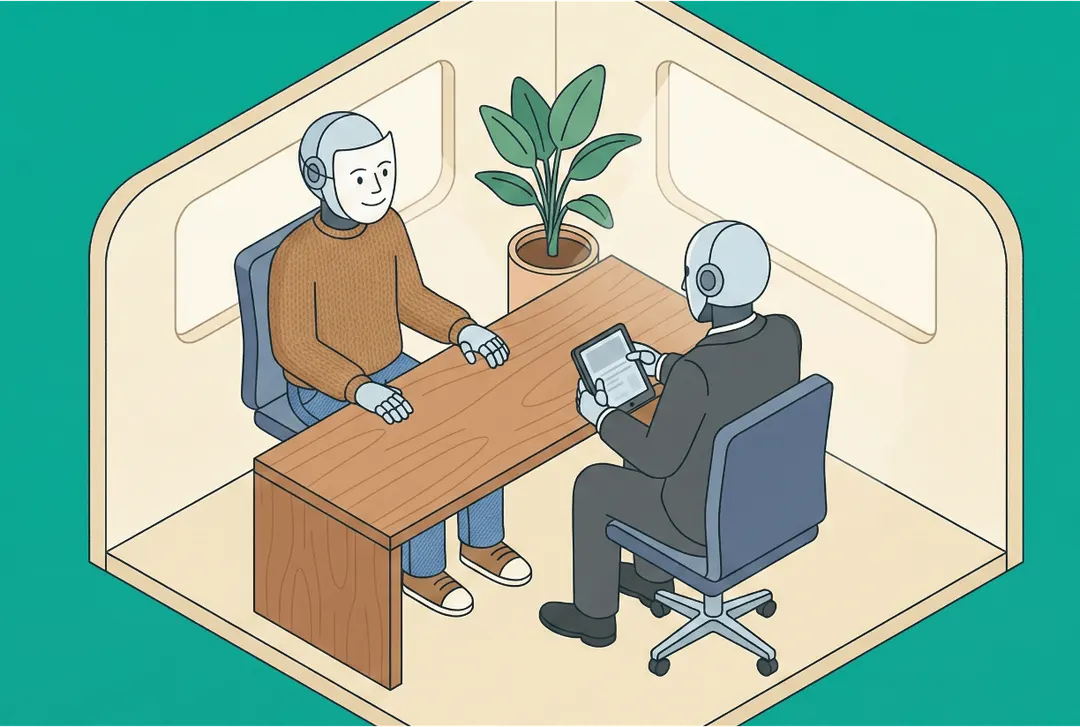
How to run it. Write 2 to 3 open questions and send them to 20 to 100 customer-facing employees as an AI-moderated interview rather than a survey, so the follow-up probing happens automatically. Questions that work: "What is the objection you have heard most often in the last month that you did not hear a year ago?", "Which competitor comes up more than it used to, and in what context?", "What do customers ask for that we cannot do?"
Why AI moderation rather than a form. A free-text box gets you a sentence. An Skimle Ask AI-assisted interview that asks "So customers are unhappy about features. That can be tough when trying to sell the product. Can you give me a specific recent example from a customer discussion?" gets you the story, which is the part with the diagnostic value. Skimle Ask handles this, and creating an Ask project takes about ten minutes tops.
What you get. A ranked view of what the front line is actually hearing, with quotes. This is the fastest early-warning system most companies could have and almost none run. By using Skimle it is easy to turn the qualitative data into quantified results (e.g, emerging themes and their frequency; differences between segments) that can be easier to communicate.
Publishing note. Usually internal. It can become external if the topic is industry-wide rather than company-specific, for example asking your own sales team what has changed about how buyers evaluate in your category.
2. Re-cut the feedback you already have against a new question
The highest-return mini-study in most companies, because the data collection cost is zero.
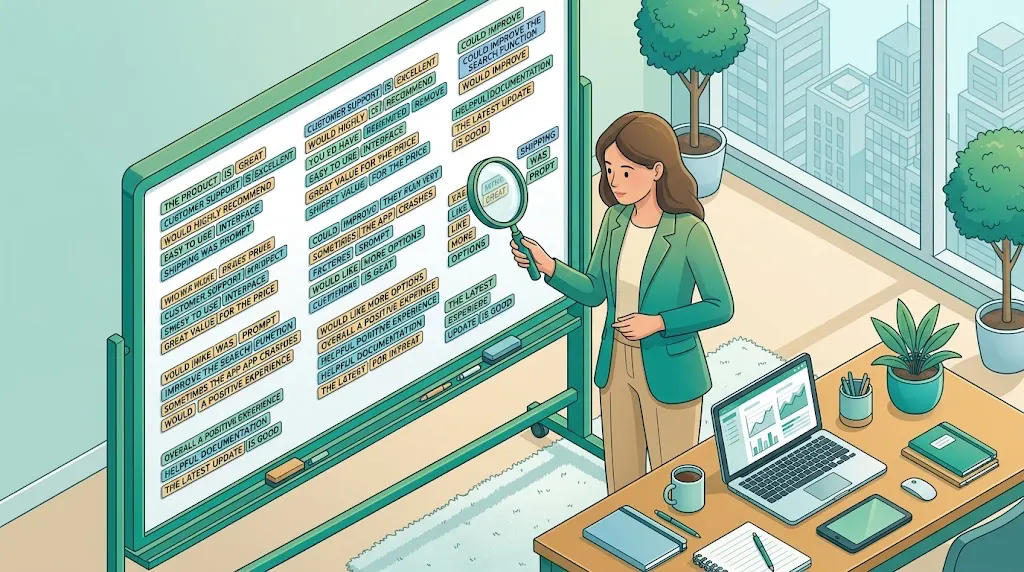
How to run it. Take a corpus you already collected for one purpose (last year's NPS verbatims, a churn interview set, two years of support tickets) and code it against a completely different category structure aimed at a new question. The original analysis asked "why are customers unhappy?" The re-cut asks "what do customers assume our product does that it does not?" Same data, different frame, new answer.
Where the value comes from. Qualitative data is chronically under-analysed relative to what it contains. Each analysis extracts what its framework was designed to see, and everything else stays in the text. A second pass against a sharper question routinely finds things the first pass had no category for.
What you get. An answer to a live question in a day, with no collection. Predefined category analysis in Skimle is the mechanic: you define the frame, the tool applies it across the corpus.
Publishing note. Strong external candidate when the question is one your market also has. "We went back through 1,200 customer comments to find out what people expect from X" is a legitimate research story. Don't waste your great sample and data collection efforts, recycle them as long as the data is still relevant!
3. Mine your recorded sales calls for the objection pattern
Every company with a revenue intelligence tool is sitting on hundreds of hours of customers explaining, in their own words, what stands between them and buying. Almost nobody analyses it as research, because it is filed as sales enablement.
How to run it. Export transcripts for 100 discovery or demo calls from one quarter. Tag each with segment, deal outcome and rep. Code against a structure covering objection type, competitive mention, requirement, and internal blocker. Then compare won versus lost.
What to look for. The gap between what reps think the objections are and what shows up in the transcripts is usually large and always interesting. The second finding worth chasing: objections raised by the customer unprompted versus ones the rep introduced. Our guide to analysing Zoom and Teams call transcripts covers the mechanics of getting these into an analysis.
What you get. An objection-handling brief grounded in evidence rather than anecdote, and a product input list ranked by how often it actually blocked a deal.
Publishing note. Internal, almost always, since call content is commercially sensitive. The aggregate pattern can sometimes be published if fully anonymised.
4. Run a win-loss quick read on last quarter's deals
A full win-loss programme with third-party interviews is a serious commitment. A quick read is not.
How to run it. Take every closed-won and closed-lost deal above a threshold from the last quarter. Pull the CRM notes, the final-stage call transcripts and any post-decision emails. Code them against a structure of decision drivers: price, capability, incumbent switching cost, internal champion strength, timing, trust. Compare the two groups.
The trap to avoid. Post-hoc rationalisation is severe in this data, especially in reps' own notes, where "lost on price" is the default explanation for everything. Weight customer language above internal summary, and treat "price" as a category that needs splitting into absolute cost, packaging, and inability to build a business case, which are three different problems.
What you get. A commercial diagnostic in two or three days. For the deeper version, see win-loss analysis: how to systematically learn from deals and the win-loss interview questions guide.
5. Run a narrow customer pulse on one question
This is the format most likely to produce genuinely publishable original research, because you control the question.
How to run it. Pick one narrow question your market argues about. Write 3 to 5 open questions around it. Send an AI-moderated Skimle Ask interview to 100 customers, prospects or industry contacts. Field for a week. Analyse.
Choosing the question well. The best mini-study questions are ones where the conventional wisdom is untested. "How do teams in your industry actually decide when to replace a tool they dislike?" "What happens in the six weeks between a demo and a purchase order?" "Who in your organisation actually reads the report you commission?" These have the property that everyone has an opinion and nobody has data. Using AI-assisted survey tools allows asking broad questions and trusting the AI to drill down to what matters instead of having to use a shotgun pattern of quantitative questions.
Why AI interviews rather than a survey. Depth at survey scale. A survey of 100 people gives you distributions that are borderline statistically relevant. An AI interview with 100 people gives you these distributions plus 100 explanations of why, which is what makes the finding quotable. Gathering rich data with AI interviews covers the approach, and AI interviewing versus human interviewing covers where each is appropriate.
What you get. A finding with a number and a set of quotes behind it, which is the raw material of a thought leadership piece. Also, interesting emerging themes might lead you to doing deeper, "real" qualitative interviews with people.
6. Sweep the public reviews, including your competitors'
Public review data is free, unfiltered, and often unexploited as research material.
How to run it. Pull reviews for your product and two or three competitors from app stores, G2, Capterra, Trustpilot or the relevant vertical site. Tag each by product, rating and date. Code against one shared structure so the products are comparable. Look at what people praise and complain about per product, and where the profiles differ.
The comparative angle is the point. Reading your own reviews tells you your problems. Reading four products' reviews against one framework tells you which problems are yours and which are the category's, which is a much more useful distinction and a much more interesting thing to publish. Analysing app store reviews at scale covers the workflow.
What you get. A category-level comparison in a day, and usually a clear view of the one thing your competitors are complimented on that you are not.
Publishing note. Handle with care externally. A neutral, method-disclosed comparison is credible. A selectively quoted one destroys trust.
7. Scan the industry's own documents
Companies publish an enormous amount about themselves in structured formats that nobody reads systematically.
How to run it. Pick a document type and a set of companies. Options that work well: earnings call transcripts for the ten largest players in a category, job advertisements over eighteen months (a superb leading indicator of where firms are actually investing), responses to a public consultation, annual reports, or published strategy documents. Code them against a structure of themes you care about, and track how the language shifts over time.
Why it works. These documents are written to be public and are therefore safe to quote, and because they are produced on a cadence, they give you a trend line for free. Earnings call transcript analysis covers one version, and consultant guide: analysing qualitative data covers document corpora more generally.
What you get. A market trend piece grounded in primary documents. This format publishes particularly well because it is fully verifiable by the reader.
8. Rerun it and publish the trend
The cheapest mini-study is the second run of a previous one. For agencies, this compounding advantage is worth pricing and pitching deliberately rather than folding into a generic AI-speed discount; see the commoditisation trap for the fuller argument.
How to run it. Take any of the formats above, keep the questions and the category structure identical, and rerun a quarter or a year later. The analysis cost is a fraction of the first pass because the framework already exists.
Why it is worth more than the first run. A single measurement is an observation. Two measurements are a direction, and direction is what people actually want. "37% of evaluators told us X" is interesting. "37% told us X, up from 22% a year ago" is a story people forward. Skimle's compare periods and timeline and trend views exist for exactly this.
The discipline required. Do not improve the questions between waves. The temptation is strong and it destroys comparability. Log the changes you wanted to make and apply them at a deliberate reset point, then say so in the method note.
How do you turn a mini-study into thought leadership?
Not every mini-study should be published. The ones that should share three properties: the question matters to your market and not only to you, the finding is at least mildly surprising, and the method survives scrutiny.
When those hold, the publishing case is strong. The 2025 Edelman-LinkedIn B2B Thought Leadership Impact Report, based on nearly 2,000 management-level professionals, found that 91% of the hidden buyers in a buying group want content that uncovers risks or opportunities they had not seen, 86% favour perspectives that challenge their assumptions, and 79% say they are more likely to champion a vendor during an RFP if that vendor consistently publishes quality thought leadership. Those are precisely the properties original research has and generic content does not.
Four rules for the write-up:
Lead with the finding, not the method. The headline is what you found. The method belongs in a short paragraph near the top, stated plainly.
Disclose the sample precisely. "We interviewed 84 operations managers at UK and Nordic manufacturers between May and June 2026, recruited from our customer base and our newsletter list." That sentence tells a reader exactly how much weight to put on the finding. Vague sampling claims are the fastest way to lose a technical audience.
Quote real people. The quotes are why anyone reads it. Anonymised and attributed to a role and segment ("Head of Operations, mid-market manufacturer") is the right level.
Do not overclaim. A mini-study of 84 people is a mini-study of 84 people. Say what it is, note what it cannot tell you, and let the finding stand on its own. Research readers trust a stated limitation far more than they trust confidence.
The same report found that over 40% of B2B deals stall on internal misalignment inside the buying group, which suggests a useful angle for insights teams specifically: the most valuable thing you can publish is often something that helps your customer's champion make the internal case, rather than something that argues for your product.
Where mini-research goes wrong
It becomes a survey with extra steps. If your questions are closed and your output is a bar chart, you have run a bad survey. Mini-research earns its keep on the explanations.
The sample is whoever answered. Convenience sampling is acceptable for a mini-study if you say so. It stops being acceptable the moment the finding is presented as representative of a market.
It is analysed by reading. Fifty AI interview responses is 15,000 words. Reading them produces an impression, not an analysis, and the impression will be dominated by whichever three responses were most vivid. Code them.
Nobody publishes it. The most common failure. The study runs, the finding lands in a Slack thread, and nothing happens. Decide the output format before you collect, and put a date on it.
For the standards question underneath all of this, see our post on responsible AI in qualitative market research and, if you are combining more than one source, combining customer insights across feedback channels.
Frequently asked questions
How many respondents does a mini-study need?
For an internal decision, 20 to 30 substantive responses will usually surface the main patterns, since qualitative themes stabilise faster than quantitative estimates. For something you intend to publish, 50 to 200 is a more comfortable range, mostly because readers weigh sample size heavily even when the analysis does not need it. What matters more than the number is that you state it clearly along with how people were recruited. See how many interviews are enough for the underlying methodology.
Can I use my own customers as respondents for published research?
Yes, if you disclose it. A study of your own customer base is legitimate research about that population and misleading if presented as a market-wide finding. Say "we asked 120 of our customers" and readers will calibrate correctly. Mixing your customers with non-customers and reporting the split is stronger still, because the comparison between the two groups is often the most interesting result.
How is mini-research different from just asking ChatGPT?
Mini-research collects or uses data from real people and analyses it systematically. Asking a language model what customers think produces a summary of what is common in its training data, which is by construction the consensus view rather than anything specific to your market. The whole value of a mini-study is that it can contradict the consensus, and only real respondents can do that.
How quickly can a mini-study actually be turned around?
Formats built on existing data (re-cutting feedback, sales calls, win-loss, public reviews) run in one to three days including the write-up. Formats requiring collection add roughly a week of fielding. The analysis itself is hours rather than days once the corpus is assembled, which is the part AI-assisted coding changes most. The realistic constraint is usually approval and scheduling, not the research.
What I've personally found is that type 7 mini studies sometimes almost write themselves when the right type of data emerges. For example, I've written engaging LinkedIn posts around the agenda selections of a conference (scraped the agenda and session abstracts to show which themes are hot now) and based on the speeches of members of parliament to show how the government and opposition are talking past each other as the themes they raise are vastly different. Before tools like Skimle these would have taken weeks to manually code, now the analysis is almost instant.
What should the output actually look like?
One page, or a short article. Headline finding, three sentences of method, three to five supporting points each with a quote, and a recommendation. If it is going external, add the sample description and a note on limitations. Anything longer will not be read by the people whose behaviour you are trying to change. Our guide on presenting qualitative findings to executives covers the framing in more detail.
My own favourite format is a onepager slide with graphs and explaining data. This works nicely as a LinkedIn image that stops scrolling.
Ready to run your first mini-study? Try Skimle for free. Collect responses with Skimle Ask or bring in feedback you already have, code it against your own structure, and get a defensible finding with quotes attached in an afternoon.
Related reading: See our guides on gathering rich data with AI interviews, analysing customer feedback with Skimle, and qualitative consumer insights research. If you work in consumer insights or at an agency, the customer and market researchers use-case page covers the full workflow.
About the author
Olli Salo is a former Partner at McKinsey & Company where he spent 18 years helping clients understand the markets and themselves, develop winning strategies and improve their operating models. He has done over 1000 client interviews and published over 10 articles on McKinsey.com and beyond. LinkedIn profile