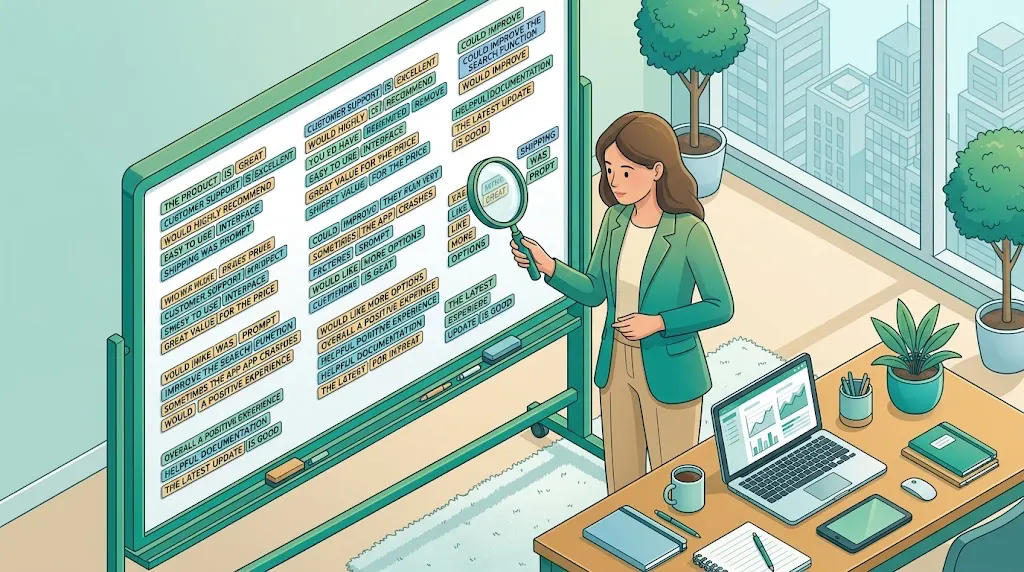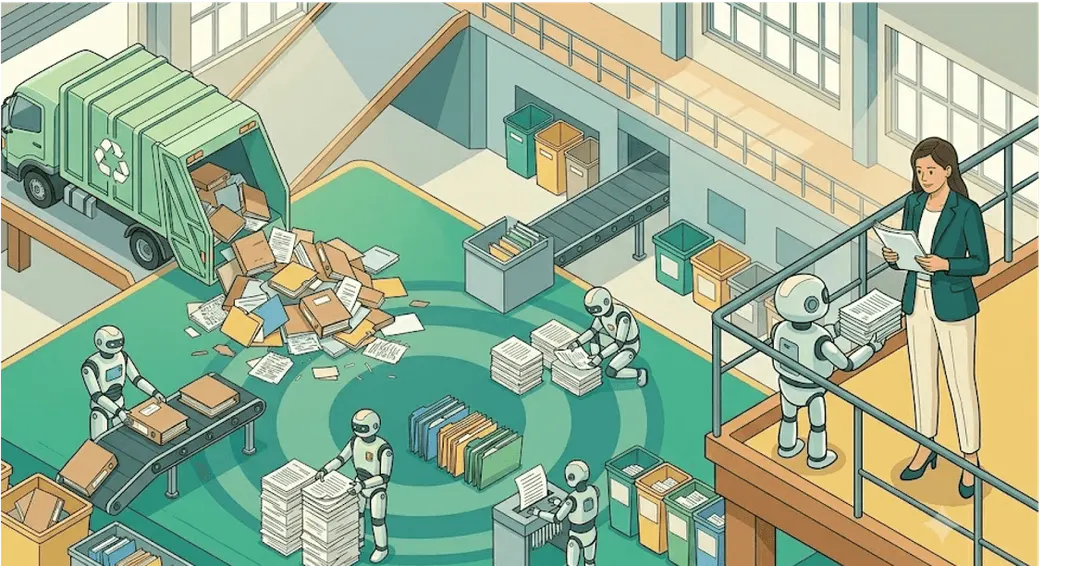
AI for public comment analysis works by ingesting submissions from a docket platform, regulations.gov in the US, the European Commission's "Have Your Say" portal in the EU, or any national consultation system, clustering near-duplicate and form-letter comments, coding the substantive ones against an issue framework, and linking every theme back to the exact comment that raised it. This lets agencies process volumes that would take analyst-months by hand, while preserving the traceability needed to defend the rule if it is challenged.
This is not a uniquely American problem. Any government that runs a notice-and-comment or public consultation process eventually hits the same arithmetic: a single high-profile US rulemaking can draw tens of thousands of submissions in weeks, and the European Commission's Digital Omnibus consultation drew over 500 detailed responses from organisations ranging from large technology firms to civil society groups before it closed in October 2025. The legal mechanisms differ by jurisdiction, but the underlying obligation is similar almost everywhere a consultation process exists: show that the input was actually read and accounted for, not just collected.
In the US, this is not a courtesy. Under the Administrative Procedure Act, agencies have a legal duty to respond to significant comments, and the Supreme Court reinforced exactly how seriously that duty applies in Ohio v. Environmental Protection Agency (603 U.S. 279, decided 27 June 2024), which held that an agency's failure to give a reasoned response to a substantive comment can render the resulting rule unlawful. In the EU, the European Commission's Better Regulation guidelines commit to analysing and summarising consultation feedback and explaining how it shaped the resulting proposal, a softer requirement than judicial review but one that still demands the same underlying capability: knowing what was actually said across hundreds or thousands of submissions, not just that submissions arrived.
This guide covers what "public comment analysis" means as a software category, how named tools like DocketScope and ICF's CommentWorks approach it (both built specifically for the US federal system), where general-purpose AI analysis platforms fit for agencies and consultancies working across jurisdictions, and how to think about the trade-off between a narrow comment-management tool and a flexible analysis tool that also happens to handle comments well.
What is public comment analysis software?
Public comment analysis software is a category of tools built specifically to help government agencies process the comments submitted during a notice-and-comment rulemaking or public consultation. The job has several distinct steps: pulling submissions from a docket (typically regulations.gov in the US, or a national consultation portal elsewhere), removing exact duplicates, clustering near-duplicate "mass comment" campaigns, identifying which comments raise new or substantive issues, coding those issues against a framework, and producing a response document that an agency's legal and policy staff can stand behind.
Two named products dominate discussion of this category, and both are built specifically for the US federal system:
| Tool | What it is | Built by | Primary audience | Jurisdiction |
|---|---|---|---|---|
| DocketScope | SaaS platform for duplicate detection, issue tagging, and team workflow on regulations.gov dockets | DocketScope Inc., a subsidiary of The Regulatory Group | Federal policy analysts and project managers running comment review teams | US federal only |
| CommentWorks | Cloud-based comment tracking, analysis, and response-drafting tool, now adding generative AI triage | ICF | Federal agencies (used on more than 20% of public comments posted across all federal dockets over the past decade, according to ICF) | US federal only |
| Skimle | General-purpose AI analysis platform that handles consultation responses as one of many qualitative data types | Skimle | Government agencies, regulatory affairs teams, consultancies, and NGOs who also analyse interviews, surveys, and other documents | Any jurisdiction; documents are uploaded rather than pulled via a specific docket API |
DocketScope's product page describes a workflow built around a multi-paned review interface: comments and attachments on one side, a hierarchical issue outline on the other, with automatic duplicate detection and form-letter clustering doing the initial sorting. It runs on AWS GovCloud and holds FedRAMP authorisation at the Moderate baseline, a US federal compliance standard, and the company states it has supported the regulatory process at more than twenty US federal agencies, including parts of the Department of Health and Human Services, the Department of Justice, and the Department of Homeland Security. The tool is explicitly built around one job, and one regulatory system: getting a US regulations.gov docket from raw submissions to a citable issue outline.
ICF's CommentWorks takes a similar starting position (comment tracking, sorting, and response drafting) and has recently added generative AI to triage comments faster and surface significant ones earlier for analyst review. ICF describes CommentWorks as part of its federal rulemaking support services, built around the US Federal Docket Management System specifically. ICF reports building a "fusion team" of regulatory experts, data scientists, and UX specialists to pressure-test the model's classifications against how a human reviewer would categorise the same comments, which is a sensible quality check given how much downstream weight those classifications carry.
Both tools solve a real problem well, for the system they were built for. Neither is built to ingest the EU's "Have Your Say" portal, a UK government consultation, or any non-US national system; an agency or consultancy working across jurisdictions, or an EU institution running its own Better Regulation consultations, would need a different tool regardless of how well DocketScope or CommentWorks handle a US docket. This is where a jurisdiction-agnostic approach matters: Skimle does not integrate with any specific docket platform, US or otherwise, which means the same analysis method works whether the consultation ran on regulations.gov, have-your-say.ec.europa.eu, or a paper-based national process that simply gets scanned and uploaded.
Why does comment volume keep increasing?
Comment volumes on contentious rules have grown for years, partly because online submission removed the friction of mailing a letter, and partly because advocacy organisations run mass-comment campaigns that can generate tens of thousands of near-identical submissions in days. The EPA's docket centre has stated that the agency receives as many as 7 million public comments annually across the rules, notices, and other actions it posts to regulations.gov, illustrating the scale even a single agency's portfolio can reach.
The EU's experience is smaller in raw volume but follows the same pattern. The European Commission ran over 100 public consultations a year between 2015 and 2018, and a single high-profile initiative can still produce more substantive feedback than a small policy team can read carefully: the Digital Omnibus consultation on simplifying EU digital rules drew over 500 detailed responses from organisations ranging from large technology companies to civil society groups, and as of December 2025 those responses were still only available to the public as 500 separate files on the consultation portal, with no structured synthesis. The volume problem scales with the size of the jurisdiction; the underlying bottleneck, having more substantive qualitative input than a team can read line by line, shows up everywhere a consultation process exists.
Mass campaigns create a specific analytical challenge: most of the volume is duplicate sentiment, but buried inside it can be a handful of comments raising a new technical objection that the agency is legally obliged to address. Treating every comment as equally novel wastes analyst time on the duplicates. Treating the docket as one undifferentiated pile risks missing the substantive minority. This is exactly the clustering-then-coding workflow that DocketScope, CommentWorks, and general-purpose analysis platforms like Skimle are all built to support, each with a different scope of what else the platform can do.
Bridget Dooling and Mark Febrizio's 2023 Brookings article "Robotic rulemaking" raised a related concern from the other direction: generative AI does not just help agencies process comments faster, it also makes it easier for commenters (or bots) to generate large volumes of fluent, plausible-sounding submissions. The result, they argue, is a "pooling equilibrium" risk, where agencies struggle to distinguish authentic public input from AI-assisted or fabricated mass campaigns. That risk does not change the agency's legal duty to respond to substantive comments; if anything it raises the stakes for having a defensible, documented method for telling which comments are substantive in the first place.
What does the law actually require with public comments and consultations?
The specific legal mechanism differs by jurisdiction, but the practical requirement, being able to show what was submitted and how it was accounted for, recurs almost everywhere.
What does US law require?
US administrative law requires agencies to consider and respond to "significant" comments before finalising a rule. This is not a courtesy. A 2013 GAO report on federal rulemaking found that of 77 major rules issued after agencies bypassed standard advance notice, agencies failed to publish responses to comments on 26 of them, and in one case an agency received 4,627 public comments on healthcare provisions and never published responses to any of them. The GAO recommended that the Office of Management and Budget issue clearer guidance on when a response is required.
Ohio v. EPA sharpened that obligation considerably. The Supreme Court found that the EPA had "sidestepped" rather than substantively addressed a comment raising a specific technical concern about its Good Neighbor Plan, and held that this kind of non-response can make the resulting rule unlawful under the Administrative Procedure Act. For any agency, regulatory affairs team, or consultancy doing this work in 2026, the practical upshot is the same: you need to be able to show, for any rule that gets challenged, exactly which comments were considered, what they argued, and how the agency responded. A summary memo that says "most commenters supported the proposal" does not meet that bar. A structured analysis that says "1,840 of 12,400 substantive comments raised concern X, including [named commenters], and the agency's response is Y" does.
What does the EU require?
The European Commission's Better Regulation guidelines work differently from US administrative law: there is no equivalent of judicial review striking down a regulation for failing to engage with a specific comment. The Commission instead commits, as a matter of policy, to analysing and publishing a summary of consultation feedback and explaining how it shaped the resulting proposal, so that respondents and the public can see how their input was used. It is a transparency commitment rather than a litigation risk, but it asks for the same underlying capability US agencies need: an accurate account of what hundreds or thousands of submissions actually said, not an impression based on whichever responses an analyst happened to read closely. A consultation summary that says "stakeholders broadly supported simplification" carries little weight if a regulated entity or member state later points out that a specific, well-argued objection was never mentioned.
This is the same defensibility requirement covered in more depth in how to analyse stakeholder consultation responses, which walks through coding frameworks, respondent metadata, and audit trail requirements for policy teams handling any consultation, in the US, the EU, or elsewhere.
How does AI-assisted comment analysis actually work?
Whether you use a purpose-built comment tool or a general-purpose analysis platform, the underlying steps are similar.
- Ingest. Pull the docket from regulations.gov (via API or bulk export) or upload submissions from a national consultation portal, covering PDFs, web form text, and attachments.
- Deduplicate and cluster. Identify exact duplicates and near-duplicate mass-comment campaigns so analysts are not reading the same argument thousands of times.
- Code against an issue framework. Tag each substantive comment against the categories the agency cares about (technical objections, cost concerns, legal arguments, alternative proposals), either built from scratch (inductive) or against a framework defined in advance (deductive).
- Identify novelty. Flag comments that raise an issue the agency had not previously considered. These are often the most legally significant inputs, because the duty to respond is strongest for new arguments the agency has not yet addressed.
- Produce a traceable output. Generate a report, spreadsheet, or response draft where every coded theme links back to the specific comment and commenter that raised it.
Where the tools diverge is in steps 3 and 5. DocketScope and CommentWorks are optimised for the rulemaking workflow specifically: their issue outlines, dashboards, and exports are shaped around what a federal docket review team needs. A general-purpose platform like Skimle runs the same automatic thematic analysis process it would apply to interview transcripts or survey responses, then lets you layer metadata by respondent type (trade association, individual citizen, regulated entity, advocacy group) to produce the kind of cross-tabulated reporting (such as "62% of industry respondents raised implementation timeline concerns, versus 14% of individual commenters") that a defensible response document needs.
When does a narrow comment tool make more sense than a general-purpose one?
If the only qualitative data problem your team has is regulations.gov dockets, day in and day out, a dedicated tool with a workflow purpose-built around that single task has a real advantage. DocketScope's issue-outline interface and CommentWorks' established federal track record reflect years of refinement around one specific job, and that specialisation shows up in details like FedRAMP authorisation, GovCloud hosting, and dashboards tuned to docket review metrics that a general-purpose tool would have to be configured to replicate.
The trade-off appears the moment your team's work extends beyond comment dockets. Regulatory affairs teams, policy consultancies, and NGOs rarely do only comment analysis. The same team that processes a consultation docket this quarter may also need to:
- Analyse stakeholder interview transcripts ahead of drafting the next proposal
- Code internal survey responses about implementation readiness
- Review expert submissions and technical reports alongside the public comment docket
- Cross-reference consultation findings against a previous round's analysis
A tool scoped only to comment dockets means running a second, different tool for everything else, with no shared traceability between the two. That is the structural limitation of vertical tools generally, covered in more depth in why some AI-native tools lock you into one workflow, which makes the same argument about UX research tools like Dovetail: a tool built around one specific motion is excellent when your work matches that motion exactly, and restrictive the moment it doesn't.
How does Skimle fit into public comment analysis?
Skimle is not a comment-management platform. It does not have a regulations.gov API integration or a docket-specific dashboard, and it does not need one for a national consultation system either. What it does is general-purpose AI analysis of qualitative documents, of which consultation responses and public comments are one common input type alongside interview transcripts, open-ended survey responses, and stakeholder submissions of any format. Because the input is a document upload rather than a platform-specific sync, the same analysis works whether the source is a US regulations.gov docket, an EU "Have Your Say" consultation, or a paper submission process that a smaller agency scans and uploads, without waiting for a vendor to build a new integration for that jurisdiction.
That generality is the point for teams whose work spans more than one document type. Upload a batch of consultation responses (PDF, Word, or plain text) and Skimle's automatic thematic analysis reads each one during upload, extracts the substantive points, and clusters them into a category hierarchy, the same process whether the input is 500 comments on a proposed rule or 80 stakeholder interviews. Every insight in that hierarchy links back to the exact source quote in the exact submission that produced it, in both directions: from theme to evidence, and from evidence to theme. That two-way traceability is what makes a "we considered 1,840 substantive comments raising concern X" claim checkable rather than asserted.
For teams that already know the issue framework they want to apply (because the consultation document specified the questions, or because a previous round established the categories), Skimle's predefined categories mode lets you code consistently against that framework across the entire corpus rather than letting themes emerge freely. Metadata tagging by respondent type, sector, or submission date then supports the cross-tabulated reporting that defensibility requires, and the metadata analysis view lets you compare how positions differ across those groups without re-running the analysis.
We covered a real example of this in Skimle in action: insights from 500+ EU Digital Omnibus consultation feedback documents, where we analysed over 500 responses to the European Commission's Digital Omnibus consultation, clustering more than 2,000 individual insights into around 20 main categories with full traceability back to the submitting organisation for each one. The full coding methodology for that kind of project, including how to structure a coding framework by position, issue, evidence type, and respondent type, is covered in how to analyse stakeholder consultation responses.
For agencies, consultancies, or NGOs running comment review alongside other qualitative work, the relevant question is not "which tool analyses comments best in isolation" but "which approach keeps comment analysis methodologically consistent with everything else we do." If you work across consultations, interviews, and internal documents, see how Skimle fits public sector and policy research for the broader workflow.
Public comment analysis tools compared
| Capability | DocketScope | CommentWorks (ICF) | Skimle |
|---|---|---|---|
| Jurisdiction | US federal only | US federal only | Any country; EU "Have Your Say", national consultations, regulations.gov, all handled the same way |
| Regulations.gov integration | Yes, built-in sync | Yes, built-in sync | No native integration; upload exported documents |
| Duplicate/mass-comment clustering | Yes, purpose-built | Yes, with GenAI triage | Yes, as part of general thematic clustering |
| Works on non-comment qualitative data (interviews, surveys, documents) | No | No | Yes, same engine across all document types |
| Predefined coding framework support | Yes | Yes | Yes, via predefined categories |
| Traceability from theme to source quote | Partial, via issue outline citations | Partial, via comment links | Full two-way traceability, theme to quote and quote to theme |
| FedRAMP authorisation | Yes (Moderate) | Not publicly stated | No; EU-based hosting with institutional options |
| REFI-QDA / academic interoperability | No | No | Yes |
| Best fit | Teams whose work is comment dockets exclusively | Federal agencies wanting an established vendor with GenAI triage | Teams analysing comments alongside other qualitative data |
Frequently asked questions
What is public comment analysis software?
Public comment analysis software helps government agencies process the comments submitted during a notice-and-comment rulemaking. It typically handles ingestion from a docket platform like regulations.gov, duplicate and mass-comment detection, issue coding, and generation of a traceable summary or response document that supports the agency's legal duty to address significant comments.
Do agencies have to respond to every public comment?
No. The legal duty is to respond to "significant" comments, meaning those that raise a substantive issue capable of affecting the rule. Agencies do not need to individually respond to comments that simply express support or opposition without new argument. The Supreme Court's 2024 decision in Ohio v. EPA clarified that agencies cannot sidestep a substantive comment with a generic response; the response must actually engage with the concern raised.
Can AI-generated public comments be detected and excluded?
Detection is improving but imperfect. Platforms like regulations.gov have spam and bot-detection checks, and tools like DocketScope and CommentWorks include duplicate and pattern-detection features that catch coordinated mass campaigns. Distinguishing an individually written AI-assisted comment from a human-written one is harder, which is one of the concerns raised in Brookings' "Robotic rulemaking" analysis of generative AI's effect on the rulemaking process.
Is it better to use a dedicated comment tool or a general-purpose AI analysis platform?
It depends on the scope of your team's work. If comment dockets are the only qualitative data your team handles, a dedicated tool like DocketScope or CommentWorks offers workflow features (docket sync, issue outlines tuned to rulemaking) built specifically for that job. If your team also analyses interviews, surveys, or other documents, or if you work outside the US federal system at all, a general-purpose platform like Skimle keeps the methodology and traceability consistent across all of it, rather than running separate tools with no shared structure.
Can I use these tools for EU consultations or other non-US public comment processes?
DocketScope and CommentWorks are both built specifically for the US federal system, FedRAMP-authorised infrastructure, GovCloud hosting, and direct integration with regulations.gov and the Federal Docket Management System, so they are not built to ingest the EU's "Have Your Say" portal or another country's consultation platform. Skimle does not integrate with any specific docket platform, which means it works the same way regardless of jurisdiction: upload the exported consultation responses, regardless of which portal they came from, and the analysis proceeds identically.
How long does it take to analyse a large comment docket with AI assistance?
For a docket of a few hundred to a few thousand substantive comments, AI-assisted analysis typically compresses what would be analyst-weeks of manual reading into hours to a few days, depending on document length and how much human review of the AI's coding is built into the process. ICF reports going from pilot inception to delivery of a working GenAI triage process in under three months; for a single docket, the per-rule processing time is much shorter once the framework is set up.
Sources
- DocketScope: public comment software and comment analysis tool
- ICF: using gen AI to process public comments faster
- ICF: CommentWorks
- Bridget Dooling and Mark Febrizio, "Robotic rulemaking" - Brookings
- Supreme Court clarifies requirement for agencies to respond to public comments - Nossaman
- EPA Docket Center - public comment volume
- European Commission - Have your say / Public Consultations and Feedback
- European Commission - Digital Omnibus consultation initiative page
- Better Regulation: guidelines and toolbox - European Commission
Ready to bring traceable AI analysis to your consultation or comment review? Try Skimle for free or book a demo to discuss government and institutional deployment options, including EU-based data processing and single-tenant hosting.
Want to go deeper on consultation analysis methodology? Read how to analyse stakeholder consultation responses, Skimle in action: the EU Digital Omnibus consultation, and AI for qualitative text and unstructured data analysis.
About the author
Olli Salo is a former Partner at McKinsey & Company where he spent 18 years helping clients understand the markets and themselves, develop winning strategies and improve their operating models. He has done over 1000 client interviews and published over 10 articles on McKinsey.com and beyond. LinkedIn profile