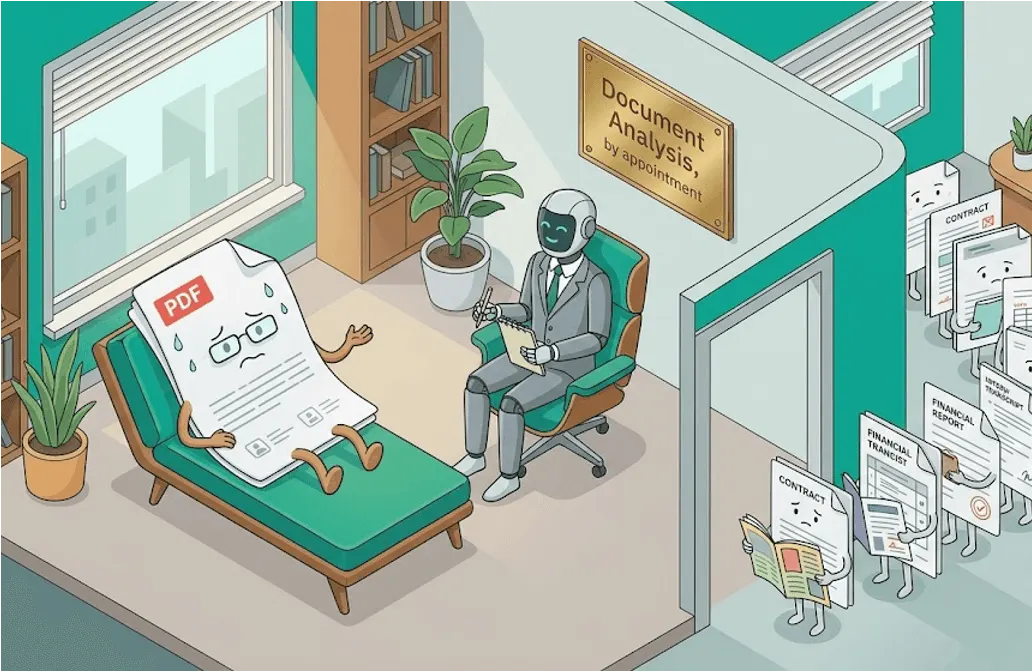
AI document analysis tools can read a PDF and answer questions about it in seconds. That works well for a single contract or a brief report. When you need to analyse a set of 50 interview transcripts, 200 consultation responses, or 300 pages of industry filings and reach defensible conclusions from the whole corpus, the chat-with-your-PDF approach breaks down quickly. This guide explains the three tiers of AI document analysis, when each is appropriate, and what systematic multi-document analysis actually requires.
What is AI document analysis?
AI document analysis is the use of machine learning and natural language processing to read, extract meaning from, and surface patterns in text-based documents. It covers a wide range of activities: optical character recognition (OCR) to convert scanned images into machine-readable text, question-answering over a single document, and systematic thematic analysis across hundreds of documents at once.
The term gets used loosely, which creates confusion. A PDF chatbot and a qualitative research platform both carry the label "AI document analysis" but they do fundamentally different things. Understanding the difference matters before you choose a tool.
What are the 3 tiers of AI document analysis?
A useful way to think about the landscape is a three-tier model, from simplest to most sophisticated.
| Tier | What it does | Best for | Breaks down when... |
|---|---|---|---|
| Tier 1: Extraction and OCR | Converts images and scans to text; extracts structured fields (dates, names, amounts) | Digitising archives, populating databases from forms | You need to interpret meaning, not just extract values |
| Tier 2: Single-document chat | Answers questions about one document at a time | Reviewing a contract, summarising a report, quick Q&A | You have more than ~10 documents, need cross-document patterns, or need an audit trail |
| Tier 3: Systematic multi-document analysis | Applies consistent coding to a corpus, surfaces patterns, links findings to source | 50+ interviews, consultation responses, due diligence corpora, policy analysis | Rarely. This is the right tool for serious analytical work. |
Most of the tools dominating search results today sit at Tier 2: ChatPDF, docAnalyzer, Foxit PDF Chat, and similar products. They are optimised for the experience of interrogating a single document. If that is your use case, they work well. If it is not, read on.
Why does chat-with-your-PDF break down at scale?
Tier 2 tools hit four specific walls when you try to apply them to a corpus of documents.
1. Context window limits
Every large language model has a maximum context window: the total amount of text it can process in a single request. Although context windows have grown (some models now advertise millions of tokens), research published in 2025 by Norman Paulsen found that models fell short of their advertised maximum context window by as much as 99% when tested on real-world tasks. The maximum effective context window varies by problem type and degrades significantly as document length increases.
In practice, a single hour-long interview transcript can run to 8,000–12,000 tokens. Fifty transcripts would be 400,000–600,000 tokens, well beyond what most tools can reliably process in one pass. The model either refuses, silently truncates, or produces unreliable output from material buried mid-window.
2. No cross-document structure
Asking "what did respondents say about pricing?" to a Tier 2 tool gives you an answer drawn from whichever document is loaded. To understand what all 50 respondents said about pricing, you would need to ask the same question 50 times and then synthesise the answers yourself. The tool has no mechanism for building a stable, cross-document structure. Systematic analysis requires a structured representation of the whole corpus, not repeated ad-hoc queries against individual files.
3. Hallucinated citations
Tier 2 tools generate fluent answers, but they cannot reliably cite the exact passage that supports a claim. A theme about "concerns with implementation timelines" might be presented with a supporting quote that was synthesised from fragments rather than drawn verbatim from the data. For research, due diligence, or policy work, this is a serious problem. You cannot defend a finding you cannot verify. The post can ChatGPT analyse qualitative data? documents how hallucinated quotes have caused real professional damage, including cases where consulting firms had to refund clients after fabricated citations were discovered.
4. No audit trail
Systematic analysis of a corpus requires a record of which documents were included, which categories were applied, and which passages support each finding. Tier 2 tools produce a conversational exchange, not a structured analytical record. If a stakeholder asks how you reached a conclusion, the answer "the AI chat told me" is not acceptable in any professional context.
How does systematic multi-document analysis work?
Tier 3 analysis follows a structured process that addresses each of the failure modes above. The steps are:
1. Corpus definition. Before analysis begins, define what is included: which document types, which time period, which sources. This definition is part of the methodology and determines what conclusions the analysis can support.
2. Coding scheme. Either inductive (the system identifies categories from the data) or deductive (a predefined category structure is applied). Good AI-native tools support both.
3. Systematic processing. Every document in the corpus is processed using the same coding scheme. This is where AI earns its place: applying consistent criteria to document 200 as carefully as to document 1, without fatigue or drift. According to IDC, 90% of organisational data is unstructured, and it is growing at roughly 55–65% annually. Manual systematic coverage of large corpora is simply not possible at these volumes.
4. Linked findings. Every insight is anchored to the specific passages that support it. You can trace from a theme back to the exact quotes, and from any document forward to all the themes it contributes to. This two-way traceability is what makes findings defensible.
5. Cross-document patterns. The analysis surfaces what appears across many documents, and flags what appears only in a few. Minority viewpoints and outlier signals matter as much as majority themes, and systematic analysis is the only reliable way to catch them.
For a deeper look at how this pipeline operates, see how analysis works.
What types of documents can AI analyse?
Almost any text-based document format can be processed by Tier 3 analysis tools. Common inputs include:
- Interview transcripts (Word, PDF, TXT)
- Survey open-ended responses (CSV, Excel, PDF)
- PDF reports, filings, and publications
- Consultation submissions and public comments
- Meeting notes and call recordings (via transcription)
- Scanned documents (via OCR as a pre-processing step)
The constraint is not format so much as language and structure. AI analysis works across multiple languages within the same corpus, which matters for European policy work or international research programmes. For a full list of formats, see supported formats.
Who actually needs Tier 3 analysis?
A decision table is more useful than a general answer here.
| Situation | Recommended tier |
|---|---|
| Reviewing a contract or single report quickly | Tier 2 (PDF chat) |
| Summarising one document for your own notes | Tier 2 (PDF chat) |
| Analysing 10–50 interview transcripts for a research project | Tier 3 (systematic) |
| Processing 100+ consultation responses for policy analysis | Tier 3 (systematic) |
| Running commercial due diligence with 50+ primary interviews and 100+ documents | Tier 3 (systematic) |
| FOIA or investigative journalism across a large document release | Tier 3 (systematic) |
| Employee survey open-ended responses at scale (500+ responses) | Tier 3 (systematic) |
| Ad-hoc question about a document you are reading right now | Tier 2 (PDF chat) |
The rule of thumb: if you need to reach a defensible conclusion about a pattern across a body of evidence, Tier 3 is the right tool. If you need a quick answer about a single document and can live without an audit trail, Tier 2 is fine.
What are the most common use cases for systematic AI document analysis?
Commercial due diligence
A large commercial due diligence engagement typically involves 40–60 primary interviews alongside 100–300 documents: earnings calls, analyst reports, regulatory filings, customer records. Processing this corpus manually requires 80–150 hours of analyst time for systematic coverage. AI-assisted analysis compresses that to hours, with the analyst reviewing the output rather than coding every document individually. The traceability requirement is acute in due diligence: if a finding influences an investment thesis, it must be verifiable back to the source. See commercial due diligence and qualitative analysis and the consultants and investors use case for more on this workflow.
Policy and public consultations
Government consultations often generate hundreds or thousands of written submissions. Manual analysis at this scale means either reading a sample (introducing selection bias) or deploying a team for weeks. AI systematic analysis processes the full corpus with consistent coding, surfaces the distribution of views across respondent types, and produces a defensible record of how each submission contributed to the findings. For the specific workflow, see public comment analysis for government consultations and the public sector and policy use case.
Research interview analysis
For qualitative researchers (academic or applied), the classic use case is a set of 20–80 interview transcripts that need to be coded and synthesised. A McKinsey Global Institute analysis found that knowledge workers spend on average 1.8 hours every day searching and gathering information; the coding and reading stage of qualitative research is a particular concentration of this burden. Systematic AI analysis handles first-pass coding across the full transcript set, leaving the researcher to review, challenge, and interpret, rather than spending weeks on the mechanical coding work.
FOIA and investigative journalism
A document release under freedom of information law can produce hundreds or thousands of pages with no index and no structure. Systematic AI analysis can process the full release, identify recurring topics, and surface the passages most likely to be analytically significant. See FOIA and leaked document analysis for investigative journalism for the detailed workflow.
Employee feedback and open-ended surveys
HR teams processing 360 feedback, exit interviews, or engagement survey open-text responses at scale face the same problem: the volume makes systematic manual analysis impractical, so most teams read a sample and report impressions. AI systematic analysis processes every response with the same coding scheme, surfaces the distribution of themes by department, seniority, or tenure, and links every finding back to the responses that support it.
What makes a good AI document analysis tool?
Given the range of tools on the market, here is what to evaluate.
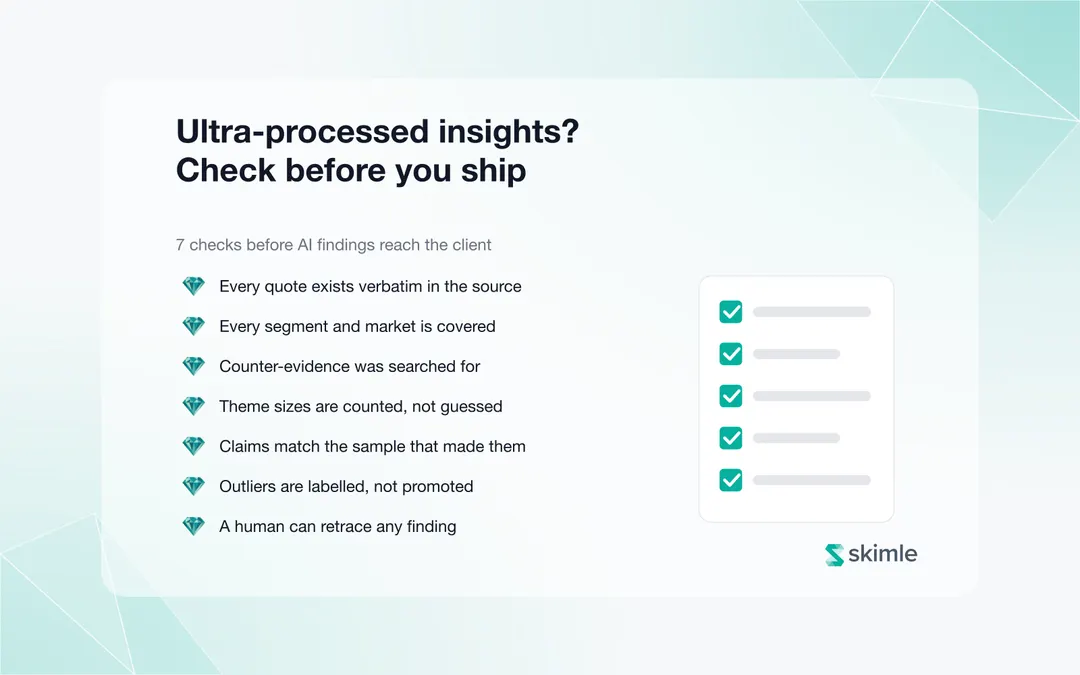
Traceability. Can you see the exact passage that supports each finding? A tool that shows themes without the underlying evidence is not suitable for serious analytical work. Hallucinations, context limits, and the black-box problem in AI qualitative analysis explains why this matters and how to test for it.
Full corpus coverage. Does the tool process every document in your set, or does it operate document-by-document? The cross-document pattern finding depends on processing the full corpus as a unit.
Consistent coding. Is the same framework applied to every document? Fatigue and interpretation drift in human coding are real problems; a good AI tool applies the same criteria throughout.
Flexibility on coding approach. Can you start inductively (let the system discover categories) or deductively (bring your own framework)? Skimle supports both in one mode: predefined categories lets you start from Skimle's own suggestions for open discovery, or bring an existing framework to apply.
Format support. Can it handle your actual documents? PDFs, Word files, plain text, transcripts from audio recordings? See the supported formats docs for what Skimle accepts.
Metadata analysis. Can you slice findings by document attributes: participant role, date, organisation type, interview wave? This is how you move from "this is the pattern in the data" to "this is the pattern among senior respondents, but not junior ones."
Why RAG and general AI tools fall short
A common approach to document analysis outside dedicated tools is retrieval-augmented generation (RAG): index documents into a vector database, then query that index with natural language. It looks like systematic analysis but shares many of the same failure modes as Tier 2 chat tools. The retrieval step surfaces what matches your query terms, not necessarily what is important in the corpus. Minority themes that use different vocabulary from your queries are systematically underrepresented.
The post why RAG doesn't work for qualitative research covers this in detail. The short version: RAG retrieves; it does not structure. Structuring the data systematically upfront (so the resulting analytical table is stable and queryable) is what makes analysis defensible rather than impressionistic.
How does Skimle approach AI document analysis?
Skimle sits at Tier 3. It processes a full corpus of documents (interviews, reports, consultations, feedback records, or any combination), applies consistent AI-assisted coding to every document, and produces a structured output where every insight traces to the specific passages that support it.
The underlying approach follows established qualitative research methodology, using hundreds of atomic AI calls to automate the mechanical coding work while keeping the researcher in control of the analytical framework. The result is what co-founder Henri Schildt describes as a structured table where both humans and AI can see, navigate, and challenge the evidence: closer to an Excel model of your data than to a chatbot response about it.
For deeper reading on the methodology, see how analysis works.
Frequently asked questions
What is AI document analysis?
AI document analysis is the use of artificial intelligence to read, interpret, and surface patterns in text-based documents. It ranges from basic extraction (pulling structured fields from forms) to systematic thematic analysis of large document corpora. The most common tools today answer questions about a single document; the most analytically capable tools apply consistent coding across hundreds of documents and link every finding back to the specific passages that support it.
Can AI analyse documents without a context window limit?
In practice, no AI tool can reliably analyse an unlimited volume of text in a single pass. Research has found that advertised context windows can overstate effective capacity by as much as 99% for real-world tasks. Systematic analysis tools work around this not by expanding context windows but by processing documents one at a time with a stable coding framework, then aggregating findings across the corpus. The analytical structure is built incrementally, not in one pass.
What is the difference between PDF chat and systematic document analysis?
PDF chat (Tier 2) answers questions about a single document at query time, with no persistent structure and no cross-document analysis. Systematic analysis (Tier 3) processes a full corpus using a consistent coding framework, builds a stable structured representation of the whole dataset, and links every finding to the source passages. PDF chat is appropriate for quick one-off questions. Systematic analysis is appropriate when you need defensible conclusions from a body of evidence.
How many documents can AI document analysis handle?
It depends on the tool. Tier 2 tools are typically designed for one document at a time. Tier 3 tools like Skimle handle corpora of hundreds of documents across multiple formats and languages. The practical limits are less about volume and more about whether the tool maintains full traceability as the corpus grows.
Is AI document analysis suitable for academic research?
Yes, with appropriate methodology and disclosure. The key requirements are traceability (every finding links to source passages), consistent application of a coding framework, and transparency about AI assistance in the methods section. Tools that cannot show you the evidence behind each finding are not suitable for research contexts.
What file formats does AI document analysis support?
Modern Tier 3 tools accept PDF, Word (DOCX), plain text (TXT), CSV, and Excel files. Some also support audio and video files via transcription. For the full format list that Skimle accepts, see supported formats.
Ready to analyse your document corpus systematically? Try Skimle for free and see how AI-assisted analysis handles a full corpus, from upload to structured thematic output with full traceability from every insight to source.
Related reading:
- Can ChatGPT analyse qualitative data?: why general AI tools fall short for serious analysis
- AI for data analysis: a guide to text-based qualitative data: companion guide on using AI across qualitative text
- Free qualitative data analysis software in 2026: if budget is the primary constraint
- NVivo and MAXQDA alternatives in 2026: if you are evaluating traditional QDA software
About the authors
Henri Schildt is a Professor of Strategy at Aalto University School of Business and co-founder of Skimle. He has published over a dozen peer-reviewed articles using qualitative methods, including work in Academy of Management Journal, Organisation Science, and Strategic Management Journal. His research focuses on organisational strategy, innovation, and qualitative methodology. Google Scholar profile
Olli Salo is a former Partner at McKinsey & Company where he spent 18 years helping clients understand the markets and themselves, develop winning strategies and improve their operating models. He has done over 1000 client interviews and published over 10 articles on McKinsey.com and beyond. LinkedIn profile
Sources
- Context Is What You Need: The Maximum Effective Context Window for Real World Limits of LLMs, Paulsen, arXiv (2025)
- IDC White Paper: Untapped Value: What Every Executive Needs to Know About Unstructured Data, IDC, sponsored by Box (August 2023)
- Various Survey Statistics: Workers Spend Too Much Time Searching for Information, Cottrill Research (citing McKinsey Global Institute)