A qualitative topline report is a short, early summary of what a study found, usually 3 to 8 pages delivered within a day or two of fieldwork ending. It answers the main research questions in plain language, gives 4 to 7 key findings with supporting quotes, notes differences between segments, flags open questions and explains briefly how the study was done.
The topline exists because clients cannot wait three weeks for the full report. A product team with a launch decision on Friday, a brand manager briefing an agency next week, a board meeting on Monday: they all need the headline now. The full report can follow, but for agencies and in-house insight teams the topline is often the document that actually shapes the decision.
What is the difference between a topline and a full report?
| Topline report | Full report or debrief | |
|---|---|---|
| Timing | 1 to 3 days after fieldwork | 1 to 3 weeks after fieldwork |
| Length | 3 to 8 pages or slides | 30 to 80 slides |
| Purpose | Early answer to the main questions | Complete evidence, nuance, recommendations |
| Depth | Key findings only | All themes, segments and appendices |
| Status | Provisional, may be refined | Final |
A good topline is a different document from the full report, with its own job: give the decision-maker the answer they need, clearly labelled as early.
What should a qualitative topline report include?
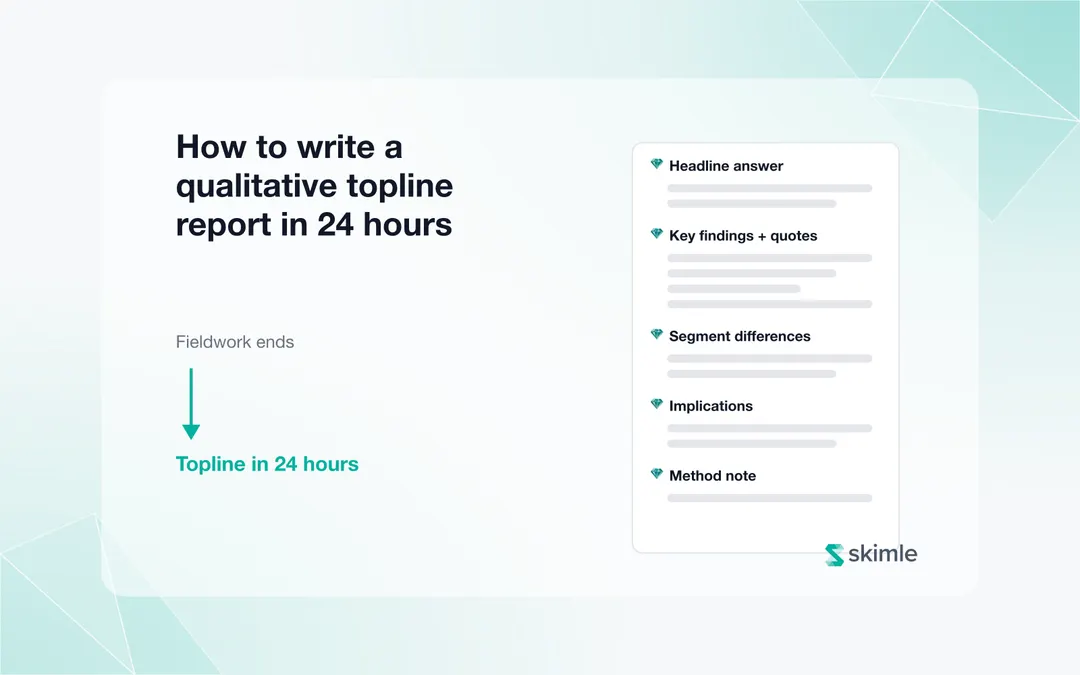
Use this structure. It works for 10 interviews and for 200, and it maps onto the outline shown on the cover of this post.
1. Headline answer (half a page)
One paragraph that answers the main research question directly. If the client asked "should we launch the premium tier?", the first sentence says what the research suggests, with the main reason. Everything else in the topline supports this paragraph.
2. Key findings with quotes (2 to 4 pages)
Four to seven findings, each written as a full sentence that states the finding rather than the topic. "Price" is a topic. "Most users accept the price but expect a free trial first" is a finding.
Under each finding:
- One or two sentences of explanation
- How widespread it is ("most respondents", "about a third", "a few but vocal")
- Two or three short verbatim quotes, attributed by segment, not name
3. Segment differences (half a page to a page)
Where groups differed in ways that matter: new versus long-term customers, markets, user types. Only include differences that change what the client should do.
4. Implications and open questions (half a page)
What the findings mean for the decision, and what the study did not answer. Be explicit about anything that needs the full analysis or another study.
5. Method note (a few lines)
Who was interviewed, how many, when, how (human or AI-moderated, video or text), and any limitations. Keep it short but never skip it.
How do you write a topline in 24 hours?
The timeline below assumes fieldwork ends at 5pm and the topline is due at 5pm the next day. It is tight but realistic if the analysis tool does the heavy coding.
| Time | Task |
|---|---|
| Evening, day 0 | Upload the final transcripts; run the analysis overnight or in the evening |
| 9:00 to 11:00 | Review the category structure: merge duplicates, split mixed categories, rename to finding-style labels |
| 11:00 to 12:30 | Check counts and segment differences; pick the 4 to 7 findings that answer the brief |
| 12:30 to 13:00 | Lunch, and a 15-minute talk with a colleague to test the headline |
| 13:00 to 15:00 | Write the headline answer and findings; select quotes |
| 15:00 to 16:00 | Quality check: verify every quote, check claims against the sample |
| 16:00 to 17:00 | Format, add the method note, send |
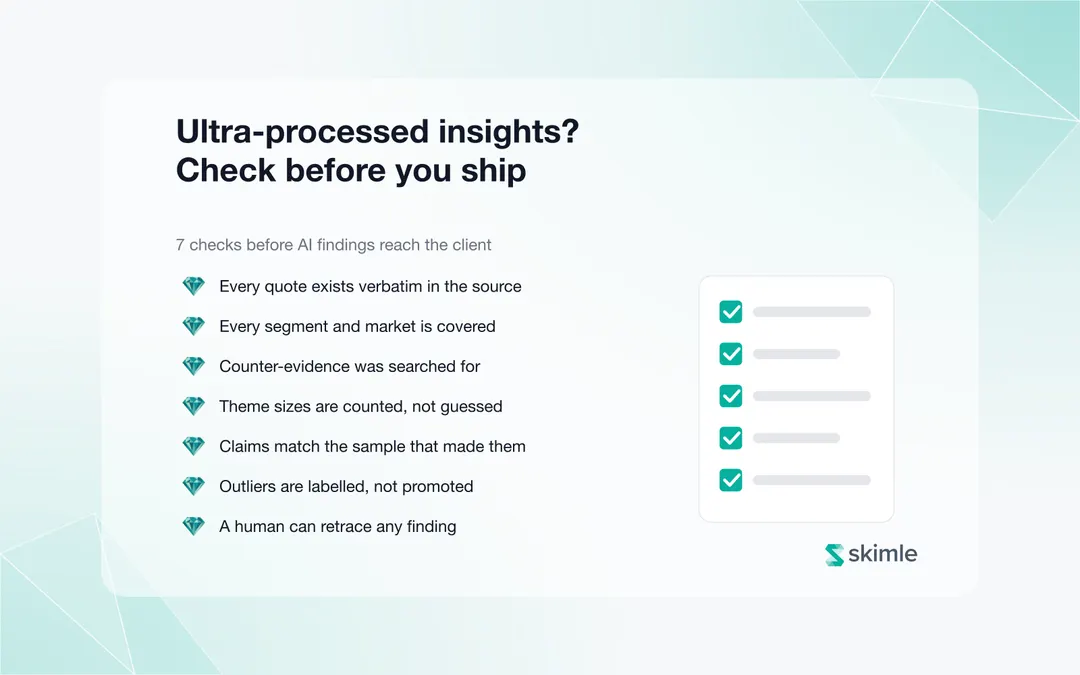
Two rules keep this on schedule. First, write the headline answer before the findings: if you cannot state it, you are not ready to write the rest. Second, verify quotes before formatting, because finding a misquoted sentence at 4:55pm is how toplines go out late. Our 7-point quality check for AI-generated insights covers what to check.
How does AI speed up topline reporting?
The slow part of a topline used to be coding: reading every transcript and sorting what people said. AI analysis does that systematically in minutes, provided the tool reads every document and keeps the verbatim quote behind each insight. The researcher's time goes into judgement, which is where it should go.
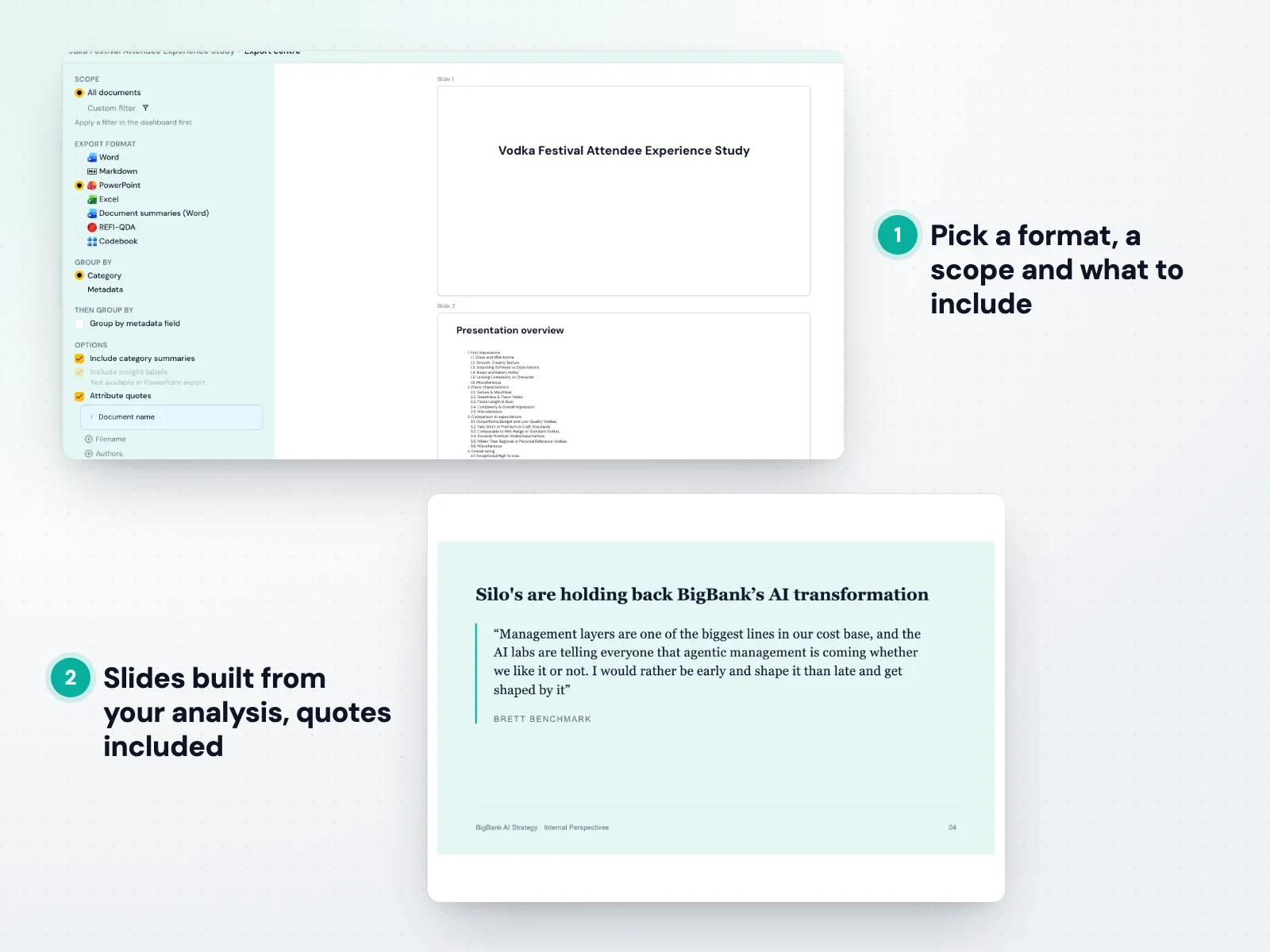
In Skimle the coded analysis feeds straight into reporting: you choose the categories to include and export to PowerPoint or Word with theme summaries, charts and supporting quotes already in place, as the screenshot below shows. The topline then needs editing and a headline, not assembly.
If you deliver toplines to clients or internal stakeholders, see how this fits the market research and customer insights workflow.
What makes a topline report useful rather than just fast?
- Findings, not topics. Every heading states what was learned.
- Clear strength labels. Say whether a finding is widespread, mixed or based on a few strong voices. "Early" does not mean "vague".
- Quotes that prove, not decorate. Choose quotes that show the finding clearly, in respondents' own words, and keep them short.
- One page the CEO can read. The headline answer and the list of findings should fit on one page. Everything else is supporting detail.
- Clear provisional status. State what may change in the full report. Clients accept a finding that is refined later, but a reversal they were not warned about damages trust.
Our guide to presenting qualitative findings to executives goes deeper on writing for senior readers.
Qualitative topline report template
Copy this outline into your template and fill it in:
TITLE: [Study name] - topline findings
Date | Fieldwork dates | Sample summary

1. HEADLINE ANSWER
[One paragraph answering the main research question.]

2. KEY FINDINGS
Finding 1: [Full-sentence finding]
  - Explanation (1-2 sentences)
  - How widespread: [most / about half / a minority / a few]
  - "Quote" - [segment]
  - "Quote" - [segment]
Finding 2: ...
(4-7 findings)

3. SEGMENT DIFFERENCES
[Only differences that change the recommendation.]

4. IMPLICATIONS AND OPEN QUESTIONS
- What this means for [decision]
- What the full report will add
- What this study cannot answer

5. METHOD NOTE
[n] interviews with [who], [how], [when]. Limitations: [...]
Frequently asked questions
How long should a qualitative topline report be?
Usually 3 to 8 pages or slides. If it is longer, it is turning into the full report. The headline answer and list of findings should fit on a single page.
Should a topline include recommendations?
It should include implications for the decision at hand. Detailed recommendations usually belong in the full report, once the analysis is complete. If the client needs a recommendation now, give it and label it as provisional.
Can a topline be written while fieldwork is still running?
Yes, as an interim topline after the first batch of interviews, which is common in AI-moderated studies. State the base size clearly and repeat the topline when fieldwork closes.
What is the difference between a topline and an executive summary?
An executive summary is the opening section of a full report and summarises the complete analysis. A topline is a standalone early document written before the full analysis is finished. In practice the final executive summary often grows out of the topline.
Need toplines faster? Try Skimle for free: upload your transcripts in the evening and start the next morning with a coded analysis, ready to export to PowerPoint.
Related reading:
- How to analyse concept test interviews
- How to analyse in-depth interviews
- What a qualitative study actually costs
About the author
Olli Salo is a former Partner at McKinsey & Company where he spent 18 years helping clients understand the markets and themselves, develop winning strategies and improve their operating models. He has done over 1000 client interviews and published over 10 articles on McKinsey.com and beyond. LinkedIn profile