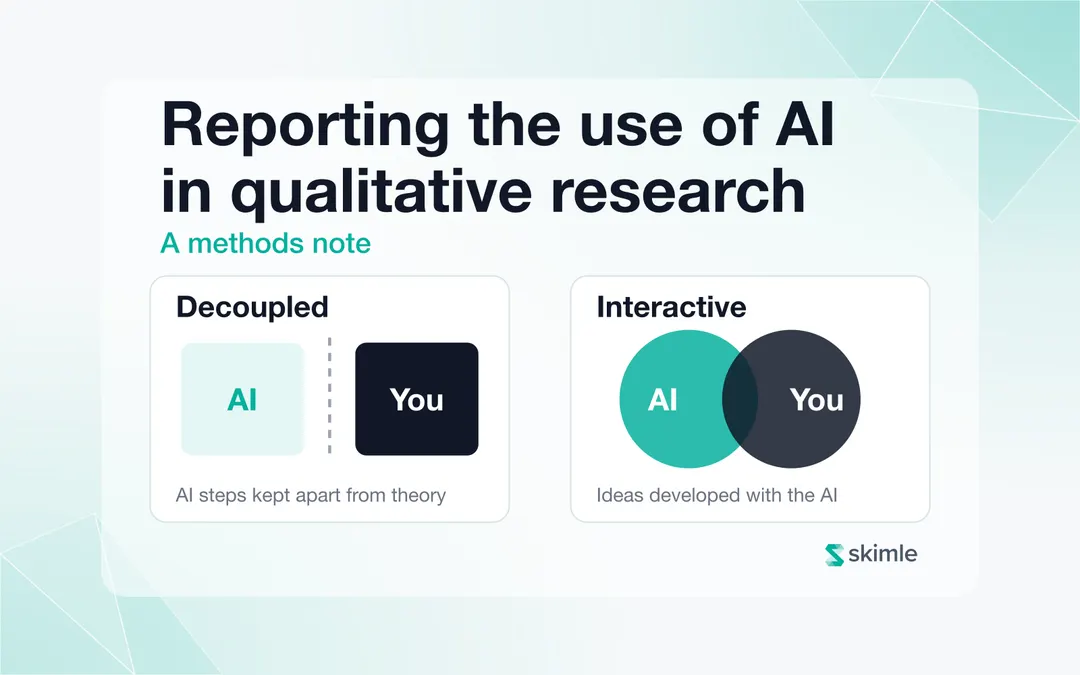
Academic researchers who use Skimle should be transparent about how they used it. This note helps you describe and justify that use in a methods section, thesis or response to reviewers. The core task is to explain in your Methods sections how you used Skimle to help analyse data and what you did by yourself. A key choice is whether you keep AI and your own work separate ("decoupled") or blend your own reasoning with AI suggestions (interactive).
Decoupled use: AI work is kept apart from your theorising
In decoupled use, Skimle performs a bounded step on its own and you do the creative theoretical work separately. This is the easiest use to justify, because the line between human thinking and AI work is clear. Four practices fit this pattern.
| Practice | What Skimle does | Why it is defensible |
|---|---|---|
| 1. Descriptive cataloguing | Creates topic categories that organise the dataset before any theoretical categories exist | Manages the data without stepping into theory development |
| 2. Systematic comparison | Imposes one uniform coding structure on all documents | Makes comparison across informants, demographic groups or time consistent |
| 3. Second opinion | Applies your theoretical coding scheme to the whole dataset as an additional pass | Verifies that you did not miss key quotes |
| 4. Alternative explanations | Runs an agentic analysis or a theoretically defined schema independently of you | Counters confirmation bias and assesses dynamics that are unrealistic to study manually |
In Skimle, descriptive cataloguing is an automatic thematic analysis, a second opinion uses predefined categories built from your own coding scheme, and alternative explanations come from an agentic analysis.
Interactive use: developing ideas with the AI
In interactive use, you test and develop ideas in dialogue with Skimle: through the AI chat, by restructuring categories, or by defining agentic analysis runs. This is a powerful way to control the AI and impose your own intent on the analysis. The challenge is that some audiences, especially thesis examiners, may find the blending of human reasoning and AI-generated inferences problematic, if the process is not clearly demonstrated. If you work this way, we suggest you summarise logs of your work, elaborating AI suggestions you adopted or rejected, and how you reflected those on your holistic understanding of the data and research context.
What to report
For each analysis step, state whether Skimle or you did it. There is no established vocabulary, but the distinction between "decoupled" and "interactive" helps you think how to report your work.
It is worth noting the tool you used, its guards against hallucinations, and the data-protection basis (EU hosting, processing agreement, ethics approval). Keep the exported codebook or project as the audit trail, for example as a REFI-QDA export or an Excel export of codes and documents.
Example wordings
Adapt the wordings below to your study. Text in square brackets is for you to fill in or choose from.
General introduction of Skimle:
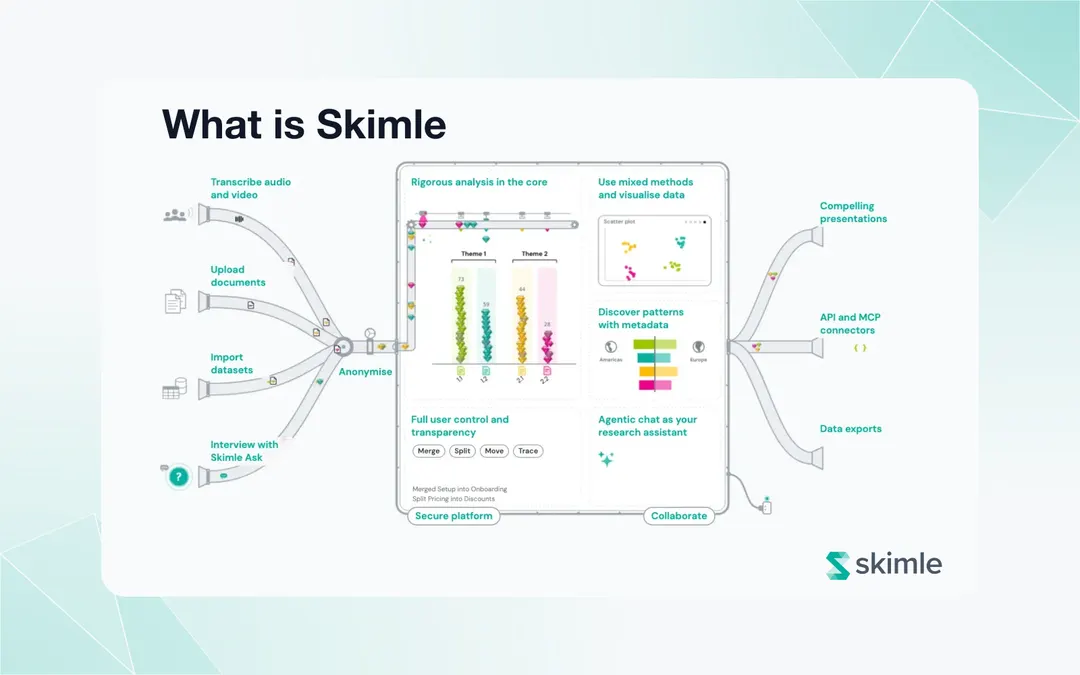
We used the AI analysis platform, Skimle.com, to support our analysis. The tool provides coding and categorisation functionality using a large language model. It is a fully GDPR compliant and secure platform with software-based verification of quote accuracy that prevents hallucinations in empirical data.
Decoupled use:
We analysed [N] [interview transcripts] using [method, citation]. We used the software in discrete steps [before / after] our data analysis, clearly separating the AI-assisted data processing from theory development.
To catalogue our empirical data, we used Skimle to create descriptive coding and categorisation of contents in each document paragraph by paragraph, linked to verbatim quotes. This initial outline of topics supported our theoretical coding by helping us examine all passages related to specific topics across informants. Subsequently, the theoretical coding and theory development were carried out by the authors without AI assistance.
To verify our findings [and/or assess alternative explanations], we concluded our analysis by instructing Skimle to identify all passages related to our theoretical categories across the material. This step enabled us to gain confidence that we had noticed all relevant passages that supported and/or contradicted our theoretical arguments. [During this step we revised our manuscript by adding newly surfaced quotes and/or by refining our understanding of construct x based on views of informants / archival documents we had initially overlooked.]
Interactive use:
We used Skimle's [AI chat / category restructuring / agentic analysis] to test and develop emerging interpretations. By prompting the AI to identify passages supporting and contradicting our interpretations, we were able to rapidly evolve our interpretations of the data, while attending to material across the whole corpus. We used the outputs created by AI as an input for our [rereading of the data / team conversations / own analysis]. All theoretical claims are the authors' own.
Justifying the approach and stating its limits
The case for rigour rests on three design criteria set out in Schildt (2026): a predictable process, two-way transparency between data and conclusions, and researcher control. These map onto familiar quality criteria: consistent and complete coding, an audit trail a reader can follow, and human interpretive judgment. We discuss the criteria in more depth in Designing AI that augments qualitative researchers.
- Verified quotes are not verified interpretations. A language model can attach a real quote to the wrong category or over-read it. Report how you checked the coding.
- Cognitive offloading. AI coding can replace engagement with the data. Say how you stayed close to it. See Is AI destroying the ability to think? and our note on reflexivity when using AI.
- Local rules. Check journal, university and ethics-committee requirements on AI use before you submit.
For a fuller treatment of where AI helps at each stage of a study, read AI-assisted qualitative analysis: a guide for academic researchers. If you are planning a study, see how Skimle supports academic researchers.
About the author
Henri Schildt is a Professor of Strategy at Aalto University School of Business and co-founder of Skimle. He has published over a dozen peer-reviewed articles using qualitative methods, including work in Academy of Management Journal, Organisation Science, and Strategic Management Journal. His research focuses on organisational strategy, innovation, and qualitative methodology. Google Scholar profile
Sources
- Skimle product description
- Schildt, H. (2026). Designing AI for Qualitative Research: Predictability, Transparency, and Control in AI tool Skimle.com. SSRN.
- Schildt, H. How to Use AI in Qualitative Research: A Guide for Academic Researchers. Skimle blog.