NVivo pricing in 2026 starts at approximately $125 (€115) per year for a student licence and rises to roughly $1,100–$1,200 (€1,000–€1,100) per year for a commercial subscription. Academic perpetual licences sit in the $550–$650 (€500–€600) range (check Lumivero's website for current figures, as prices have shifted since the Lumivero acquisition). Whether NVivo is worth it depends entirely on your situation: for a researcher at an institution with a site licence, doing complex mixed-methods or multimedia analysis, it is hard to fault. For an individual researcher paying out of pocket on a text-based project, the cost is harder to justify, and the alternatives are better than they have ever been. This post covers the full pricing structure, what you actually get for the money, the cases where NVivo is genuinely the right call, the cases where it is not, and what the realistic alternatives look like.
NVivo pricing tiers in detail
NVivo is now sold and developed by Lumivero, the private equity-backed company formed in 2022 when TA Associates merged QSR International (NVivo's original developer) with several other analytics software firms. Lumivero has since also acquired ATLAS.ti and Citavi, meaning three of the four most widely cited qualitative data analysis (QDA) tools in academic literature now share a single commercial parent.
The pricing structure as of 2026, based on publicly available information (verify at lumivero.com/product/nvivo):
Student licence Around $125 (€115) per year. This is the entry-level tier and is the most accessible price point Lumivero offers. It is time-limited and designed for individuals in full-time study. The student licence covers the core analysis features but does not include AI-assisted auto-coding or transcription. Those require the AI and Transcription add-on, which adds roughly $300 (€275) on top, making AI-enabled NVivo for students closer to $425 (€390) per year.
Academic subscription (non-student) Individual academic researchers not covered by an institutional site licence pay more. Estimates from public pricing and user-reported figures suggest the range is roughly $295–$595 (€270–€545) per year, depending on tier and region. The variation reflects different package levels and whether the AI add-on is included.
Academic perpetual licence Perpetual licences allow a researcher to pay once and use the software indefinitely, without ongoing subscription costs. This has historically been an attractive option for researchers running multi-year projects or returning to archived data. Prices have risen significantly since the Lumivero transition, with current perpetual academic licences estimated at $550–$650 (€500–€600). The option exists but is less prominently marketed than subscriptions.
Commercial subscription For researchers and analysts outside academia (consulting firms, market research agencies, HR teams, government bodies), commercial NVivo pricing starts at approximately $1,100–$1,200 (€1,000–€1,100) per year per user. Team and enterprise pricing adds further cost.
Team pricing NVivo Collaboration Cloud, which enables real-time multi-user project access, is a paid add-on rather than included in base licences. For a team of four researchers, total annual costs (individual licences plus collaboration) can run to $5,000–$9,000 (€4,600–€8,250) or more.
What you get for the price
NVivo has been in continuous development for roughly 35 years, and the feature set reflects that. For certain use cases, no other tool comes close.
Data type breadth. NVivo handles more data formats than any comparable QDA tool: interview transcripts, PDFs, Word documents, audio recordings, video files, images, social media exports (Twitter, Facebook, LinkedIn), bibliographic references, survey responses, and field notes. For a project that brings together fieldwork recordings, newspaper archives, and structured survey data in a single analytical environment, NVivo is still the most capable option available.
Analytical tools for every taste. Matrix coding queries, word frequency analysis, text search queries, cluster analysis, concept maps, treemaps, and word clouds are all available. These go beyond simple code-and-retrieve and allow systematic pattern-finding across large datasets. For a researcher who knows how to use them (which takes a lot of time to learn...), these features add genuine analytical value.
Mixed methods integration. NVivo supports classifying documents and participants by demographic or contextual variables, then running queries that examine how themes distribute across those variables. This is useful for researchers combining qualitative coding with structured comparisons, without having to export to a statistical package.
Methodological credibility. Citing NVivo in a methods section is accepted shorthand in many disciplines. Reviewers and journal editors in fields like organisational studies, nursing, education research, and public health know what NVivo analysis looks like and what it implies about rigour. For researchers at early stages of building a publication record, this is not a trivial consideration.
Rudimentary AI features added 2025... for an extra fee Recent NVivo versions include basic auto-coding and sentiment analysis. Users generally report these as useful for initial orientation rather than systematic analysis. The AI features are available as an add-on (the AI and Transcription package) rather than included in base subscriptions.
When NVivo is worth it
NVivo is worth the cost in these situations:
Your institution has a site licence. If your university or research centre covers the cost, the pricing question largely disappears. NVivo under a site licence is a good tool. The remaining question is whether the learning curve is worth it for your project, which depends on scale and complexity.
Your project involves multimedia data. If you are analysing interview recordings, documentary footage, photographs, or social media with images and video, NVivo's multimedia coding capabilities are unmatched among QDA tools. Other options in this space are meaningfully weaker.
Your dataset is large and multi-layered. A mixed methods project with 150 documents, demographic case variables, multiple coders, and complex query requirements is a legitimate use case for NVivo's full feature set. The tool was built for this.
Your field has strong NVivo norms. In some disciplines, reviewers will scrutinise software choice. If your target journals or your supervisor's preferred methodology have established NVivo as the expected tool, that convention has a real cost to override.
When NVivo is not worth it
The case against paying for NVivo is strong in a growing number of situations.
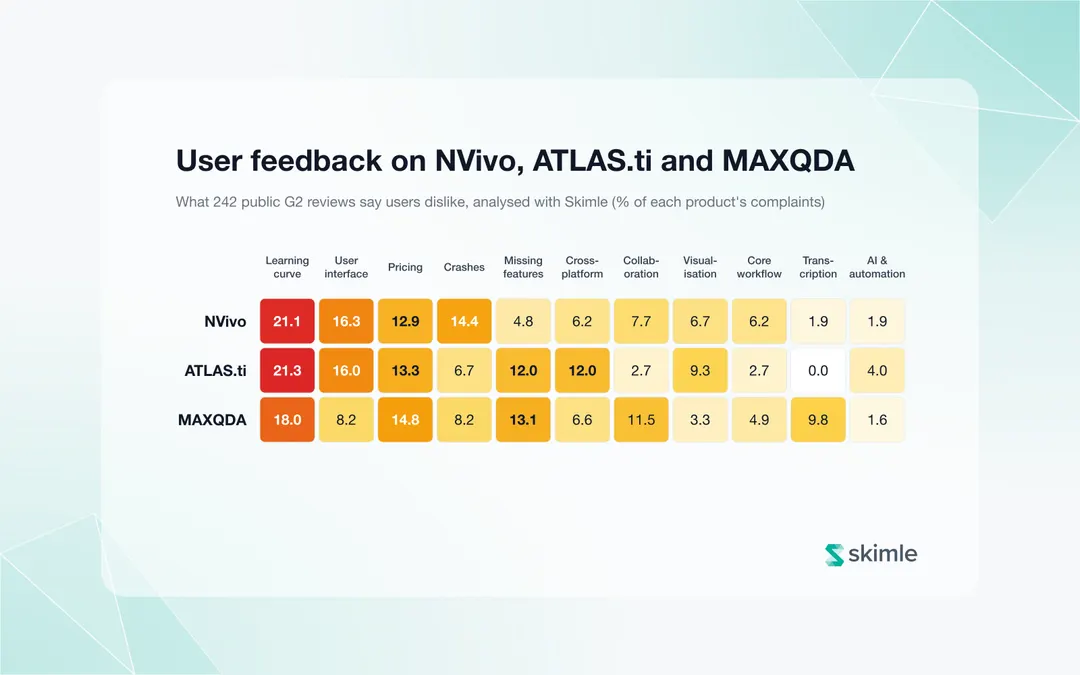
The learning curve is a real cost. NVivo training workshops at most universities run two to three full days. Researchers who have not been through formal training frequently describe spending their first week in the tool learning the interface rather than doing analysis. That time has a real value, particularly on time-limited projects. In our analysis of 242 G2 reviews of NVivo, ATLAS.ti and MAXQDA, the learning curve was NVivo's most common complaint, at 21% of everything reviewers disliked.
For a project that will last six months, spending a week becoming functional in NVivo before the analysis starts is a significant proportion of the total time available. For a three-year funded project, it is a more reasonable investment.
Overkill for text-focused projects. The majority of qualitative research in social science, education, and health uses text data: interview transcripts, focus group records, open-text survey responses, and documents. For researchers working entirely within this scope, roughly 80% of NVivo's feature set is not relevant to their analysis. They are paying for capabilities they will never use. Because of this, if you go outside academia to other fields doing qualitative analysis, for example market research or consulting, you rarely if ever come across Nvivo.
Performance on underpowered machines. NVivo is a resource-heavy desktop application. On machines that are not highly specified, it becomes slow; on older hardware, it becomes frustrating. Corrupted project files and data loss on large projects are a persistent community complaint. If you are working on a standard university-issued laptop rather than a well-specified research workstation, this is worth taking seriously.
Mac version limitations. Despite improvements in recent releases, the NVivo Mac version still lacks certain features available only on Windows. Researchers who use Macs as their primary machine should check the current feature comparison carefully before purchasing. See our qualitative data analysis software for Mac guide for a full breakdown of which tools handle Mac best.
The perpetual subscription problem. Annual subscriptions mean that access to your own analytical environment depends on continued payment. For a researcher who stops their subscription two years after completing a project and then needs to return to the data, that is a practical problem. The perpetual licence option addresses this but is more expensive upfront.
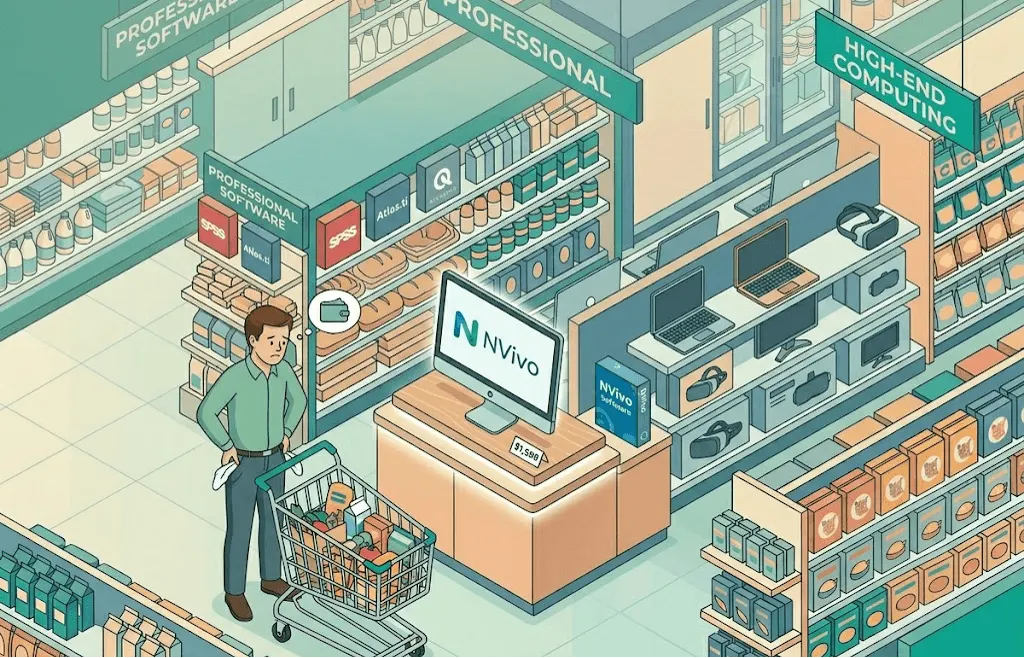
Individual researchers paying out of pocket. At $1,100+ (€1,000+) per year at commercial rates, NVivo is genuinely expensive for a solo practitioner or a small team without institutional backing. At that price point, the alternatives deserve serious consideration.
Alternatives to NVivo
MAXQDA
MAXQDA is developed by VERBI GmbH, a Berlin-based company that has been building qualitative analysis software since the 1980s and remains independently owned, with no known private equity involvement. This matters for researchers thinking about long-term tool dependency.
For features, MAXQDA is the closest like-for-like alternative to NVivo. It handles text, PDFs, audio, video, images, and survey data. The MAXQDA Analytics Pro tier adds integrated statistical analysis, which makes it the strongest option for researchers combining qualitative and quantitative methods in a single environment. The Mac version has full feature parity with Windows, which NVivo cannot claim.
MAXQDA pricing (2026 estimates, verify at maxqda.com):
- Academic individual: approximately $230–$280 (€210–€260) per year for the base edition
- Academic Analytics Pro (mixed methods tier): approximately $390–$430 (€360–€400) per year
- Commercial: approximately $850–$1,600 (€780–€1,470) depending on package
The learning curve is real but somewhat gentler than NVivo. Users consistently reach productive coding faster. TeamCloud (collaboration) is a paid add-on, not included in the base licence.
For a detailed head-to-head between these two tools, see the NVivo vs MAXQDA comparison.
ATLAS.ti
ATLAS.ti was previously the main independent alternative to NVivo. In 2024, Lumivero acquired ATLAS.ti, meaning both tools now share a single PE-backed parent. For researchers concerned about Lumivero's ownership of NVivo, switching to ATLAS.ti does not address that concern.
ATLAS.ti has invested heavily in AI features, particularly through its AI Lab functionality. User reviews describe the AI coding output as producing a large number of first-order codes that require significant manual organisation before they are analytically useful. Atlas.ti pricing is broadly comparable to NVivo.
AI-native tools: Skimle
NVivo, MAXQDA, and ATLAS.ti are all, at their core, manual coding environments. Some have added AI features as a layer on existing architecture; those additions are generally described by users as useful for orientation but not for systematic analysis.
Skimle is built differently. Rather than providing a coding interface and sprinkling AI on top, it approaches qualitative analysis from the AI outward: it reads all documents systematically, builds a structured thematic representation of the material, and surfaces that structure for the researcher to inspect, challenge, edit and extend. The researcher's role shifts from doing the initial coding pass to reviewing and refining what the AI has found. More time doing the initial exploration and more time doing deeper exploration, less in the manual middle.
This distinction matters for the time investment. Skimle can process a set of 30 interview transcripts and produce an initial thematic structure in the time it would take to manually code three or four of them in NVivo. What remains is the interpretive work: are these the right categories? Does this theme actually hold up across the data? What is being missed?
For the question of methodological rigour, two-way transparency is the key design principle. Every theme in Skimle links directly to the source paragraphs that generated it. Researchers can verify every claim against the underlying data. This is different from asking an LLM to summarise your interviews and accepting what it produces. If you want more on how AI fits into qualitative research methodology without undermining rigour, there is a detailed guide covering that territory.
For researchers who conduct thematic analysis and want to understand how AI-assisted approaches fit within established methodological frameworks, the demystifying thematic analysis guide is a useful foundation.
Manual coding is fully supported. AI-generated categories are a starting point, not a final answer. Researchers can add, rename, delete, and regroup categories, move individual insights between themes, and manually code passages the AI missed. The manual coding and REFI-QDA export workflow explains how this integrates with NVivo and ATLAS.ti workflows when interoperability is needed.
How Skimle pricing compares
Skimle has a free tier that includes meaningful analytical capability for individual researchers, covering projects up to 600 pages of analysis. Paid plans cover larger datasets. See current pricing for details.
Compared to NVivo's cost structure:
| NVivo (academic) | NVivo (commercial) | Skimle | |
|---|---|---|---|
| Entry price | ~$125 (€115)/year (student) | ~$1,100 (€1,000)/year | Free tier available |
| AI features included | Add-on only (+~$300/€275) | Add-on only | Included |
| REFI-QDA export | Yes | Yes | Yes |
| Learning time to productive analysis | Days to a week | Days to a week | Hours |
| Mac/Windows parity | Limited on Mac | Limited on Mac | Web-based |
| Transcriptions | Separate (30 EUR/hour) | Separate (10 EUR/hour) | Included in all tiers, extra about 5 EUR / hour |
The most significant difference in practice is not the upfront cost but the time investment. For researchers whose primary constraint is time rather than budget, the ability to generate an initial thematic structure in hours rather than spending days coding before any analytical picture emerges is a substantive change in workflow.
For researchers doing interview analysis, Skimle's approach to structuring transcript data is covered in detail in the interview analysis guide.
Skimle is not a replacement for every NVivo use case. Researchers working with multimedia data, running complex matrix queries across demographic variables, or working in fields where NVivo citation is a publication requirement will find those features matter. The complete comparison of qualitative data analysis tools places all the options side by side across a wider set of criteria for those wanting a more complete picture. The NVivo, MAXQDA, and ATLAS.ti vs Skimle comparison covers the direct comparison in more depth.
Which tool for which researcher
The right tool depends on what you are actually trying to do. A few practical scenarios:
Institutional researcher with site licence, large multimedia project: NVivo. The cost barrier is removed, and the feature set is genuinely needed.
PhD student, text-based qualitative project, institution has NVivo licence: Check whether the site licence is still active. If yes, NVivo as basis and Skimle for advanced initial AI coding. The qualitative research on a PhD budget guide covers this scenario in full.
PhD student paying individually, text-based project: Skimle free tier or MAXQDA academic. NVivo's price is hard to justify at individual academic rates.
Commercial researcher (consulting, market research, HR): At $1,100+ (€1,000+) per year per user for NVivo commercial, the comparison with Skimle is stark. Unless multimedia coding or complex matrix queries are required, Skimle covers the core use case at a fraction of the cost.
Research team needing collaboration: NVivo's collaboration features are powerful but add cost. Skimle supports shared projects. MAXQDA's TeamCloud is a paid add-on.
Researcher in a field where NVivo citation is expected: This is a real consideration. Check whether your target journals and your supervisor have strong views before switching. For most fields, what matters is the methodological approach (reflexive thematic analysis, framework analysis, grounded theory), not the specific software. The academic researchers use case page gives more context on how Skimle fits within established academic workflows.
Is NVivo worth it in 2026?
Depends on who is paying.
For an institution covering the licence cost for a research team running complex, multi-method, multimedia projects, NVivo is worth it. The feature set is genuinely deep, the methodological credibility is established, and the integration with institutional research workflows is real.
For an individual researcher paying $1,100+ (€1,000+) per year from their own budget to do text-based qualitative analysis, the value proposition is much harder to defend. The alternatives have improved substantially. MAXQDA offers comparable manual coding features with better Mac support and independent ownership. Skimle offers AI-accelerated structured analysis with full traceability and REFI-QDA interoperability at a much lower price point.
The shift since 2022, when Lumivero was formed, has been real. Prices have risen and researchers who previously had no reason to think about alternatives are now evaluating them seriously. The tools available have also genuinely improved. For many researchers, the conclusion is that paying full commercial or academic individual rates for NVivo is no longer the obvious default it once was.
Evaluating qualitative analysis tools? Try Skimle for free — no credit card required. See how AI-native structured analysis compares to manual coding workflows.
Want to compare the full landscape? Read our complete comparison of qualitative data analysis tools and our detailed NVivo, MAXQDA, and ATLAS.ti vs Skimle comparison. For a dedicated look at what has replaced NVivo for many researchers, see NVivo alternatives for qualitative researchers and Dedoose review 2026: features, pricing and alternatives. For a full cost breakdown of the main traditional competitor, see our MAXQDA pricing 2026 guide.
About the authors
Henri Schildt is a Professor of Strategy at Aalto University School of Business and co-founder of Skimle. He has published over a dozen peer-reviewed articles using qualitative methods, including work in Academy of Management Journal, Organisation Science, and Strategic Management Journal. His research focuses on organisational strategy, innovation, and qualitative methodology. Google Scholar profile
Olli Salo is a former Partner at McKinsey & Company where he spent 18 years helping clients understand the markets and themselves, develop winning strategies and improve their operating models. He has done over 1000 client interviews and published over 10 articles on McKinsey.com and beyond. LinkedIn profile
Sources
- NVivo pricing — Lumivero
- Lumivero — Notice of Legal Entity Change
- Lumivero acquires ATLAS.ti — Lumivero newsroom
- TA Associates portfolio — Lumivero
- MAXQDA pricing — VERBI GmbH
- REFI-QDA standard — Rotterdam Exchange Format Initiative
- ResearchGate discussion: NVivo vs ATLAS.ti vs MAXQDA (2023)
- University of Oregon Libraries — Free qualitative data analysis software