The best qualitative analysis tool depends on your workflow. NVivo, MAXQDA, and Atlas.ti are mature, feature-rich platforms built for manual coding workflows. Skimle is an AI-native platform that automates the initial coding, cuts back-office time dramatically, and builds in transcription, metadata analysis, and anonymisation as standard features. For teams doing interview-based research at scale, Skimle typically gets researchers to insights in hours rather than weeks. For academic researchers with institutional licences and time for deep, iterative manual analysis, the traditional tools remain capable and well-established. This article explains the trade-offs in detail so you can decide what fits your situation.
What the legacy tools do well
NVivo, MAXQDA, and Atlas.ti are serious tools. They have been refined over decades, are supported by extensive academic literature, and are used by researchers who produce excellent, methodologically rigorous work. Dismissing them because newer alternatives exist would be a mistake.
Their core strengths are:
- Manual coding depth. If your methodology requires a researcher to read every line, apply codes thoughtfully, and build a codebook iteratively through immersion in the data, these tools are designed for exactly that process. Grounded theory, interpretive phenomenological analysis, and discourse analysis all benefit from the kind of careful, close engagement these tools support.
- Mixed-methods integration. MAXQDA in particular handles combinations of qualitative coding and quantitative content analysis elegantly. If your research design mixes surveys with interviews, or requires frequency analysis alongside interpretive coding, MAXQDA's mixed-methods module is a genuine differentiator.
- Complex visualisation and network analysis. Atlas.ti's network editor allows researchers to map relationships between codes, quotations, and memos visually. This is valuable for grounded theory work where conceptual relationships matter as much as the concepts themselves. MAXQDA's visual tools produce polished publication-ready charts and matrices.
- Institutional credibility. These tools carry methodological credibility in peer review. Citing your use of NVivo, MAXQDA, or Atlas.ti in a methods section signals a recognised practice with an established literature behind it.
- REFI-QDA interoperability. All three tools export to the REFI-QDA open standard, which means your coding work is not locked into any single platform and can be shared with collaborators using different tools.
For academic researchers who have an institutional licence, weeks available for analysis, and a methodology that benefits from deep manual immersion in the data, these tools earn their place. Many of the most respected qualitative researchers in the world use them and will continue to do so.
The problem with this generation for most use cases
These tools were designed before AI existed as a practical analytical capability. The core workflow across all three is: a human reads the data, applies codes, revises the codebook, reads more, applies more codes, and gradually builds a thematic structure through iterative engagement. This is a sound methodology. It is also slow, and the slowness is structural.
All three tools have added AI features in recent years. MAXQDA has "AI Assist" for document summarisation and code suggestions. Atlas.ti has an "AI Lab" with auto-coding and quote extraction. These additions are useful in the way that spell check is useful: they remove some mechanical friction without changing what you are fundamentally doing. The paradigm remains "AI assists human coding." The researcher still does the initial coding pass. The AI helps with some of it.
This is different from a tool designed around "AI does the systematic first pass, researcher interprets and refines." The distinction matters enormously for research at scale.
Beyond the AI question, several practical issues accumulate:
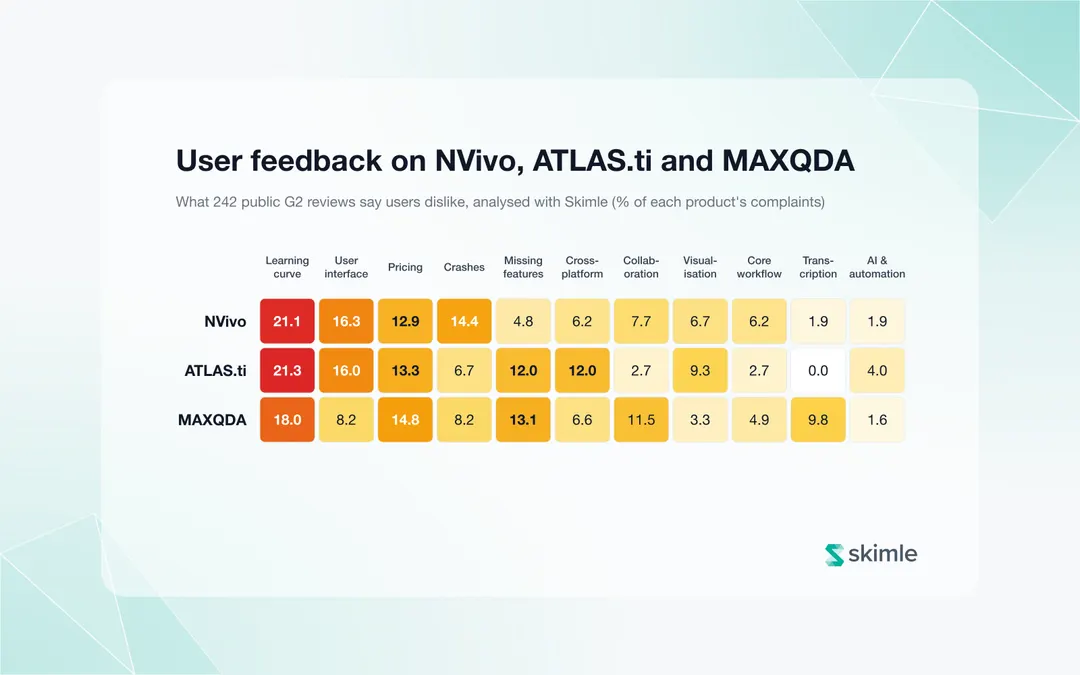
Learning curves. NVivo in particular is known for requiring weeks of investment before a researcher can use it productively. MAXQDA and Atlas.ti are somewhat gentler, but none of them is quick to pick up. For teams where research is one function among many (consultants, HR professionals, policy teams), this investment cost is significant. Our guide to the easiest qualitative data analysis software ranks the tools on this dimension specifically.
Pricing. Individual licences for these tools are not trivial. NVivo academic pricing runs approximately $295–$595 (€270–€545) per year for academic use; commercial pricing starts above $1,000 (€920). MAXQDA individual licences run approximately $460–$850 (€425–€780) per year depending on tier. Atlas.ti individual licences run approximately $480–$700 (€440–€640) per year. For teams, institutional pricing is negotiated separately and can be substantial. There are no free tiers for meaningful project sizes.
Transcription not included. Researchers using NVivo, MAXQDA, or Atlas.ti need to obtain transcripts separately, typically through a third-party service, before doing any analysis. That means separate billing, separate data handling, manual import, and format management. For teams doing regular primary research, this adds meaningful overhead. The transcription services sold separately by the platforms cost up to 30 EUR per hour.
No built-in anonymisation. Handling de-identification of sensitive interview data falls to the researcher. This is not a minor issue for anyone working with human participants. Manual anonymisation is slow, inconsistent, and easy to get wrong across a corpus of 30 or more transcripts.
Back-office overhead. File management, transcript preparation, data organisation, and version control across a multi-document project all consume time that could be spent on analysis and interpretation.
What Skimle does differently
Skimle was built from the ground up around a different assumption: that AI should do the systematic first analytical pass, and the researcher's job is to interpret, challenge, refine, and draw conclusions from what the AI surfaces. The underlying methodology is rigorous, inspired by Henri's experience as a qualitative researcher. The difference is where in the process the human and the AI each do their work.
Speed. Initial coding of 20 to 30 interviews takes minutes in Skimle, not weeks. The time saving is not marginal. For a consulting team running a 30-interview market study, the difference between three weeks of manual coding and an afternoon of AI-generated and reviewed structure changes what is commercially viable. For an academic researcher facing a deadline, it allows to spend more time on insights and theory building, less time on manual work. The researcher can take control of the full dataset themselves instead of hiring assistants.
Built-in transcription. Upload audio or video files directly. Skimle handles transcription across more than 100 languages, within the same secure environment as the analysis itself. There is no separate transcription service to manage, no manual import, and no split billing relationship. If you are setting up an end-to-end interview workflow, the practical transcription setup guide walks through how this works in practice.
Built-in anonymisation. Skimle Anonymise handles pseudonymisation of transcripts before sharing, with AI-powered detection of direct and indirect identifiers, a consistent pseudonym map across the full document set, and an audit trail that satisfies ethics board and GDPR requirements. Manual find-and-replace and researcher-by-eye methods cannot match the consistency or documentation that proper de-identification requires. See the full introduction to Skimle Anonymise for detail on how it works.
Metadata analysis. Skimle automatically assigns metadata to documents and lets researchers define custom metadata fields (role, organisation type, interview date, geography, and anything else relevant to the study). The platform then surfaces which metadata variables best explain differences in the data. If enterprise customers and SMB customers are saying materially different things, Skimle will show you that, rather than leaving you to discover it through manual cross-tabulation. The discovering themes using metadata variables guide explains how this works.
AI chat across the full dataset. Ask cross-category questions across your entire corpus and get answers grounded in your specific data. This is not a general-purpose AI answering from training data: it is querying across the structured representation of your interviews, with every answer traceable to source material.
Two-way transparency. Every theme in Skimle traces directly to verified verbatim quotes in the source transcripts. Every source paragraph is traceable to the categories it contributed to. There are no floating insights that cannot be substantiated. For researchers who need to demonstrate rigour (for peer review, for client reporting, or for their own peace of mind), this traceability is not incidental. It is structural. The post on two-way transparency explains the design logic behind this.
Manual coding and editorial control. AI-generated categories are a starting point, not a final answer. Skimle allows researchers to add, rename, delete, and regroup categories, move individual coded insights between themes, and manually code passages that the AI handled differently than the researcher would. The interpretive control that makes qualitative analysis qualitative is preserved. See manual coding and REFI-QDA export for detail on this workflow.
REFI-QDA export. If you need to take your coded data into NVivo, MAXQDA, or Atlas.ti (because a co-author works there, or because your institution requires a specific archiving format), Skimle exports in the open REFI-QDA standard. This is the same interchange format that all three legacy tools support. Running initial analysis in Skimle and handing off to a colleague's preferred tool does not require re-coding from scratch.
EU-hosted, GDPR-compliant from day one. Skimle is designed and hosted in the EU. For researchers and teams handling sensitive participant data, this is a compliance baseline, not an optional add-on. The distinction from US-hosted tools matters for IRB applications, GDPR compliance reviews, and client data agreements. For context on why this matters more than it used to, see the AI in qualitative research guide for academic researchers.
When to choose each
This is not a question that has one answer for all researchers. The tools serve different needs, and the right choice depends on your situation.
Choose NVivo, MAXQDA, or Atlas.ti if:
- Your institution provides a licence and you have the time investment available to learn the tool properly
- You need advanced visual modelling (Atlas.ti's network editor, MAXQDA's visual tools) as part of your analytical process
- Your research design requires mixed-methods integration combining qualitative coding with quantitative statistical analysis, where MAXQDA Analytics Pro is well-suited
- Your IRB or ethics board specifies a particular tool, or your methods section requires citation of established QDA software
- You are working on a project where you want to do the coding yourself, all of it, and you have the time to do so
Within the legacy tools: MAXQDA suits mixed-methods work, cleaner interfaces, and Mac users best. Atlas.ti suits interpretivist and grounded theory work, network-focused analysis, and experienced QDA users who want flexibility. For a head-to-head of those two, the MAXQDA vs Atlas.ti comparison covers the differences in detail. For a fuller survey of all QDA software categories including free options, the complete QDA tools comparison is the right starting point.
Choose Skimle if:
- You need to move from data to insights quickly, whether because of commercial deadlines, research timelines, or the scale of your corpus
- You are doing interview-based research at any meaningful scale (10 or more interviews is where the speed advantage becomes significant, and it grows from there)
- You want transcription, analysis, anonymisation, and metadata-driven segmentation in a single platform with one billing relationship
- Collaboration matters: Skimle is built as a shared platform where team members can work on the same project without the file-management complexity of desktop QDA tools
- You care about GDPR-compliant EU infrastructure and need to be able to demonstrate that to clients, participants, or ethics reviewers
- Your audience is not other QDA software users: Skimle's output formats are designed to be shared with stakeholders who are not researchers, not just exported into a format only NVivo can read
For consulting and research firms, the consultants and investors use case explains how Skimle fits into applied research workflows. For academic researchers who want rigorous methodology without the manual coding bottleneck, the academic researchers use case is the right starting point. The thematic analysis complete guide is useful background on the methodology that underlies both traditional QDA workflows and Skimle's AI-native approach, and how to analyse interview transcripts gives a practical five-step framework that applies regardless of which tool you use.
A note on methodology and rigour
One concern that comes up when researchers consider AI-native tools is whether the analytical rigour is preserved when AI does the initial coding. It is a fair question.
The answer is that rigour depends on the methodology and the traceability of the process, not on whether a human or an AI performed the initial segmentation of the data. A thematic analysis in which every theme is substantiated by a linked verbatim quote, and every quote is traceable to its source document, is more auditable than a manual coding process in which the researcher's decisions are invisible inside a software project file. The two-way transparency post makes this case in detail. The broader academic framework for what AI tools designed to augment researchers should provide — predictability, two-way transparency, substantive control, and methodological flexibility — is laid out in Designing AI for qualitative research.
For academic researchers specifically, the question of how to document AI-assisted methods for peer review is now a practical one, not a theoretical one. The AI in qualitative research guide addresses this directly, including guidance on what to report in a methods section when AI tools are involved.
The AI qualitative data analysis checklist is a useful pre-publication review tool regardless of which AI-assisted approach you are using.
Ready to see how AI-native qualitative analysis compares for your specific dataset? Try Skimle for free and see how structured AI-assisted analysis changes the time from data to insight.
Related reading:
Manual coding and REFI-QDA export: combining Skimle with manual workflows
How to analyse interview transcripts: 5 steps from raw data to synthesis
About the authors
Henri Schildt is a Professor of Strategy at Aalto University School of Business and co-founder of Skimle. He has published over a dozen peer-reviewed articles using qualitative methods, including work in Academy of Management Journal, Organisation Science, and Strategic Management Journal. His research focuses on organisational strategy, innovation, and qualitative methodology. Google Scholar profile
Olli Salo is a former Partner at McKinsey & Company where he spent 18 years helping clients understand the markets and themselves, develop winning strategies and improve their operating models. He has done over 1000 client interviews and published over 10 articles on McKinsey.com and beyond. LinkedIn profile